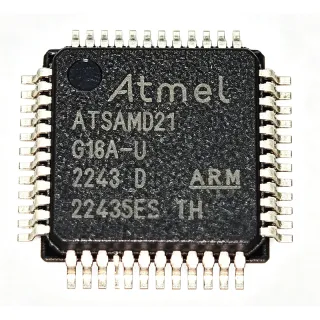
DSPIC33EP512MC204-I/MV - 70 MIPS DSC, 512KB Flash | Microchip
MPN: DSPIC33EP512MC204-I/MV ✓ Active| Qty | Unit Price | Extended |
|---|---|---|
| 1 | $4.71 | $4.71 |
| 10 | $4.35 | $43.50 |
| 100 | $4.05 | $405.00 |
| 500 | $3.85 | $1,925.00 |
| 1,000 | $3.55 | $3,550.00 |
DSPIC33EP512MC204-I/MV Overview
A digital signal controller combines the compute architecture of a 16-bit microcontroller with the DSP engine of a digital signal processor. In the system hierarchy, a DSC sits between a general-purpose MCU and a dedicated DSP: it executes real-time control loops and math-intensive algorithms (PI controllers, transforms, filters) while retaining MCU-style peripherals, flash memory, and ease of use. DSCs are the backbone of precision motor control, digital power conversion, and sensing systems.
Key features of this device include the 70 MIPS dsPIC33E core with integrated DSP multiply-accumulate and modulo/ bit-reversed addressing, Quadrature Encoder Interface (QEI) blocks for rotary feedback, the Peripheral Trigger Generator (PTG), dedicated motor-control PWM, on-chip comparators and op amps, plus DMA for peripheral data movement. These peripherals offload the CPU, enabling high-frequency control loops with low software overhead.
Architecturally, the dsPIC33E family uses an enhanced Harvard architecture with a 24-bit instruction word and pipelined execution, achieving deterministic single-cycle MAC operations. The working register array and dual operand fetch support C-compiler-friendly code while retaining tight assembly-level timing control. Operating supply range is 3.0V to 3.6V, supporting standard 3.3V rails. Per the family datasheet, in-circuit serial programming (ICSP) via two pins allows field firmware updates without removing the device.
Typical applications include brushless DC, PMSM, and stepper motor drives, switch-mode power supplies and digital power stages, sensor signal conditioning, and industrial automation nodes where encoder feedback and fast PWM converge.
Design consideration: the 6x6 UQFN package exposes a thermal pad; connect it to a ground pour and place a 0.1uF decoupling capacitor within 2 mm of each VDD pin. Budget crystal selection against the PLL multiplier to hit 70 MIPS exactly.
This page synthesizes verified distributor pricing, pin-compatible drop-in alternatives within the same MV package, and practical design notes not found in the manufacturer datasheet.
Drop-in alternatives for DSPIC33EP512MC204-I/MV — same package, pin-to-pin compatible. Different-package parts requiring PCB rework are excluded.
Variants in this series
Same-series models that are drop-in compatible with DSPIC33EP512MC204-I/MV (same form factor and footprint) — differing in Package, Core, Operating Temperature, RAM, Timers.
Quick Comparison Tool — Select alternative parts for side-by-side comparison:
DSPIC33EP512MC204-H/MV
✅ Drop-In📋 Reference alternative (not in catalog)
DSPIC33EP512MC204-E/MV
✅ Drop-In📋 Reference alternative (not in catalog)
DSPIC33EP256MC204T-I/MV
✅ Drop-In✓ In Stock
$3.34 / Unit
View Datasheet →DSPIC33EP128MC204-I/MV
✅ Drop-In ⚠️ Specs Unverified📋 Reference alternative (not in catalog)
DSPIC33EP32MC504-E/MV
✅ Drop-In✓ In Stock
$3.35 / Unit
View Datasheet →DSPIC33EP512MC204-I/MV Maximum Ratings & Electrical Characteristics
| Core | dsPIC33E (16-bit DSC) |
| Maximum Performance | 70 MIPS |
| Program Memory (Flash) | 512KB (170K x 24) |
| RAM | 48KB |
| Supply Voltage Range | 3.0 V to 3.6 V |
| Operating Temperature | -40C to +85C (I grade) |
| Package | 48-UQFN (6x6 mm), MV suffix |
| Mounting Type | Surface Mount |
| Instruction Word Width | 24-bit |
| DSP Engine | Single-cycle MAC with DSP addressing modes |
| Quadrature Encoder Interface (QEI) | Yes |
| Peripheral Trigger Generator (PTG) | Yes |
| Motor Control PWM (MCPWM) | Yes |
| DMA Channels | 4 |
| Timers | 5 |
| On-chip Op Amps and Comparators | Yes |
| Programming Interface | ICSP (In-Circuit Serial Programming) |
| RoHS Status | Compliant |
| Product Family | dsPIC33EP512MC204 (dsPIC33E family) |
DSPIC33EP512MC204-I/MV 48-uqfn (6x6 mm), mv suffix Pin Configuration Guide
Pin configuration for DSPIC33EP512MC204-I/MV (48-uqfn (6x6 mm), mv suffix package). This digital IC includes GPIO, communication interfaces (UART, SPI, I2C), and power pins. Refer to the manufacturer datasheet for alternate pin functions and configuration options. Essential for embedded system design and PCB layout.

No detailed pinout data available for DSPIC33EP512MC204-I/MV.
Refer to the datasheet for full pin configuration.
Typical Applications
DSPIC33EP512MC204-I/MV is suitable for 6 applications: Brushless DC and PMSM Motor Drives, Digital Power Conversion (SMPS / PFC), Industrial Automation and Field Nodes, Stepper Motor Controllers and Robotics, Sensor Signal Conditioning and Data Acquisition, Medical and Lab Instrumentation Control.
Brushless DC and PMSM Motor Drives
The DSPIC33EP512MC204-I/MV fits sensorless and encoder-based FOC motor drives because its 70 MIPS DSP core executes single-cycle multiply-accumulate operations for Clarke/Park transforms and current-loop PI controllers at 10-20 kHz rates. The hardware QEI module decodes quadrature encoder signals without CPU load, while dedicated motor-control PWM produces complementary outputs with programmable dead time for three-phase bridges. Firmware runs from 512KB Flash, leaving ample room for compensation tables, protection state machines, and communication stacks. Place the device between gate-driver ICs and current-sense amplifiers, using the on-chip op amps and comparators to close the current loop internally; the 4-channel DMA keeps ADC sampling deterministic during control interrupts.
Recommended
Digital Power Conversion (SMPS / PFC)
In digitally controlled power supplies, PFC stages, and LLC converters, this DSC replaces analog control ICs with firmware flexibility: the 70 MIPS core sustains voltage and current control loops at switching frequencies up to several hundred kHz using the MCPWM peripheral's high-resolution outputs. On-chip comparators provide hardware overcurrent trip without software latency, and 512KB Flash supports adaptive compensation algorithms plus a communication interface for telemetry. The PTG (Peripheral Trigger Generator) sequences ADC sampling to PWM events autonomously, minimizing loop jitter - a key benefit over MCU-only solutions. Keep the analog ground plane clean and route PWM outputs away from feedback traces; the 6x6 UQFN's short internal bond wires reduce parasitic ringing on gate-drive outputs.
Recommended
Industrial Automation and Field Nodes
For factory automation nodes, the DSPIC33EP512MC204-I/MV serves as the local control processor coordinating sensors, actuators, and a CAN/UART fieldbus. The 48KB RAM buffers communication frames and sensor histories, while the 70 MIPS core runs protocol stacks concurrently with real-time I/O. Its industrial -40C to +85C rating suits unconditioned cabinets, and the 3.0-3.6V supply tolerates regulated 3.3V rails with standard margins. The QEI and PTG peripherals handle position tracking and event sequencing in hardware, freeing the CPU for the protocol stack - a layout that reduces interrupt latency compared with software-only approaches. The 512KB Flash allows firmware field updates via ICSP with a legacy image retained, supporting long-lifetime industrial deployments.
Recommended
Stepper Motor Controllers and Robotics
Stepper-driven robotics and lab automation demand coordinated multi-axis motion: this DSC generates microstepping PWM waveforms via the motor-control PWM module while computing trapezoidal/S-curve velocity profiles in its 70 MIPS DSP core. The QEI modules accept closed-loop encoder feedback for lost-step detection, and on-chip comparators implement hardware stall and overcurrent protection. With 512KB Flash, full kinematics tables and multi-axis trajectory planners fit on-chip without external memory, and 48KB RAM holds motion buffers for smooth queueing. Use the DMA channels to stream profile data to the PWM module so step timing stays jitter-free even during communication interrupts, which is the decisive factor in achieving quiet microstepping at high step rates.
Recommended
Sensor Signal Conditioning and Data Acquisition
The integrated op amps, comparators, and DMA on this DSC let designers build compact acquisition front ends: sensor signals are amplified on-chip, converted by the ADC, and moved to RAM by DMA without CPU intervention, while the 70 MIPS core applies digital filtering (IIR/FIR) in real time. The 512KB Flash stores calibration curves and logging buffers, and 48KB RAM sustains high-rate capture. This architecture suits industrial vibration monitoring, weigh-scale front ends, and general instrumentation where a discrete amplifier-plus-MCU chain would add BOM cost. Configure the on-chip op amp in unity-gain buffer mode ahead of the ADC input to reduce source impedance, and exploit the PTG to trigger precisely spaced samples for FFT-based analysis.
Recommended
Medical and Lab Instrumentation Control
Benchtop medical and laboratory devices - pumps, valves, stages, and sample handlers - use this DSC as the motion and control core. The deterministic 70 MIPS core closes pump-motor loops using MCPWM and encoder feedback, while 512KB Flash retains calibration data, audit logs, and multiple firmware images for validated environments. The 3.3V interface connects directly to isolated communication transceivers, and the industrial temperature rating covers typical lab ambient conditions. On-chip comparators provide hardware safety interlocks that do not depend on software state, an important consideration for IEC 60601-class system architectures. Using DMA-driven ADC sampling keeps analog monitoring continuous even during host communication bursts over UART or SPI.
Recommended
Recommended Products Summary
Engineering reference data for DSPIC33EP512MC204-I/MV — comparison, design guidance, and compliance information.
Selection Guide
Comparison with Alternatives
| Parameter | This Product | DSPIC33EP512MC204-H/MV | DSPIC33EP512MC204-E/MV | DSPIC33EP256MC204T-I/MV | DSPIC33EP128MC204-I/MV | DSPIC33EP32MC504-E/MV |
|---|---|---|---|---|---|---|
| Package | 48-UQFN (6x6 mm, MV) | 48-UQFN (6x6 mm, MV) - same | 48-UQFN (6x6 mm, MV) - same | 48-UQFN (6x6 mm, MV) - same | 48-UQFN (6x6 mm, MV) - same | 48-UQFN (6x6 mm, MV) - same |
| Brand | Microchip Technology | Microchip Technology | Microchip Technology | Microchip Technology | Microchip Technology | Microchip Technology |
| Performance | 70 MIPS | 60 MHz class (lower speed grade) | 70 MIPS | 70 MIPS | 70 MIPS | 70 MIPS |
| Program Memory (Flash) | 512KB (170K x 24) | 512KB | 512KB | 256KB | 128KB | 32KB |
| QEI / Motor Control PWM | Yes / Yes | Yes / Yes | Yes / Yes | Yes / Yes | Yes / Yes | Yes / Yes |
Key Differentiators
- Largest Flash in the pin-compatible MC204 family (vs DSPIC33EP256MC204T-I/MV)
- Extended-temperature sibling available without redesign (vs DSPIC33EP512MC204-E/MV)
- Full 70 MIPS speed grade (vs DSPIC33EP512MC204-H/MV)
- Lowest-cost entry point when code is small (vs DSPIC33EP32MC504-E/MV)
Design Notes
Supply the device from a clean 3.3V rail within the 3.0V to 3.6V range. Place one 0.1uF ceramic capacitor within 2 mm of each VDD/VSS pin pair plus a 4.7-10uF bulk capacitor near the package. At 70 MIPS, core current is a few tens of mA, so rail integrity is dominated by transient switching noise - keep the analog supply filtered through an LC or ferrite bead if ADC accuracy is critical. Do not exceed 3.6V, as the dsPIC33EP MC family lacks a wide-voltage 5V-tolerant variant in this package group.
The 48-UQFN 6x6 mm (MV) package has a central exposed pad; connect it to a solid ground plane with an array of thermal vias to reduce junction-to-ambient resistance and improve EMI performance. Verify pad geometry against the Microchip datasheet land-pattern recommendation before layout release - UQFN pads are recessed, and non-conforming footprints are a common reflow defect. Keep crystal traces short and guarded by ground for stable PLL operation at the 70 MIPS configuration.
Configure configuration-word settings (oscillator source, PLL divider, watchdog, code protection) at programming time - incorrect PLL multipliers are the most frequent cause of 'device runs slow' issues on dsPIC33E designs. Confirm that the peripheral pin-select (PPS) mapping assigns QEI, UART, and PWM functions before first power-up, since unmapped pins default to general I/O. For migration from dsPIC33F, note changed register maps and RAM addressing; recompile rather than relinking legacy objects.
Motor-control PWM outputs driving gate circuits should route with series resistors (typically 10-33 ohm) to damp ringing from package and trace inductance. Keep encoder QEA/QEB inputs differential or shielded if cable length exceeds ~30 cm, and use the digital filter settings in the QEI module to reject contact bounce. Separate the noisy PWM/ground-return region of the board from the ADC input traces to preserve analog accuracy.
Compliance Information
RoHS compliance indicated by distributor listings (PCB Electronics, DigiKey). REACH, halogen-free, and conflict-minerals status not stated in the provided data.