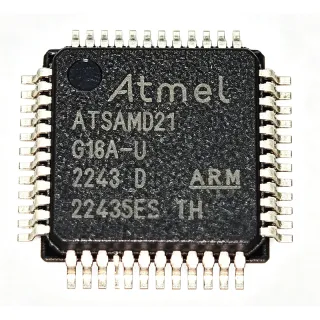
DSPIC33EV256GM104-I/PT - 16-bit 70 MIPS 5V DSC | Microchip
MPN: DSPIC33EV256GM104-I/PT ✓ Active| Qty | Unit Price | Extended |
|---|---|---|
| 1 | $6.13 | $6.13 |
| 10 | $5.85 | $58.50 |
| 100 | $5.4 | $540.00 |
| 500 | $5.1 | $2,550.00 |
| 1,000 | $4.85 | $4,850.00 |
DSPIC33EV256GM104-I/PT Overview
A digital signal controller combines the computational power of a digital signal processor with the peripheral integration and control architecture of a microcontroller. Within the power-management hierarchy of embedded systems, the DSC sits above general-purpose MCUs for math-intensive real-time control: it executes multiply-accumulate and barrel-shift operations in hardware while integrating PWM generators, communication interfaces, and analog blocks on one die. The dsPIC33EV family extends this concept with 5V tolerance, making it well suited to electrically noisy environments.
Key features include the 5V dsPIC DSC core rated at 70 MIPS, on-chip ECC Flash for functional-safety-oriented designs, up to six PWM outputs from three generators for motor control, SENT and CAN communication interfaces, and integrated op amps with advanced analog features. Peripheral Pin Select (PPS) allows flexible remapping of digital peripherals onto 35 available I/O pins.
Architecturally, the device pairs a 16-bit CPU with a DSP engine (17-bit x 17-bit multiplier, barrel shifter, dual operand fetch) clocked from a 40 MHz external clock and internally multiplied via PLL to 70 MIPS instruction throughput. Four DMA channels offload peripheral data movement, and nine timers support complex time-base requirements. Low-power modes and a wide 3.0V to 5.5V operating range (per Kynix listing, 5.5V max) support battery-tolerant and industrial designs.
Typical applications include brushless DC and PMSM motor control in appliances, automotive sensor and body-control units operating in harsh vibration and noise, and industrial power conversion where SENT and CAN buses and 5V noise immunity are decisive advantages.
When designing with this DSC, budget the ECC Flash for safety-relevant code and remap peripherals through PPS early in schematic capture to avoid pin conflicts; verify RAM allocation carefully because third-party listings vary between 16 KB and 32 KB.
This page synthesizes distributor pricing, same-family drop-in alternatives, and practical design notes not found in the manufacturer datasheet, giving engineers a single verifiable reference.
Drop-in alternatives for DSPIC33EV256GM104-I/PT — same package, pin-to-pin compatible. Different-package parts requiring PCB rework are excluded.
Variants in this series
Same-series models that are drop-in compatible with DSPIC33EV256GM104-I/PT (same form factor and footprint) — differing in Package, Core Architecture, Flash Program Memory, Operating Temperature Range, Programming Interface.
Quick Comparison Tool — Select alternative parts for side-by-side comparison:
DSPIC33EV256GM104-E/PT
✅ Drop-In✓ In Stock
$3.4 / Unit
View Datasheet →DSPIC33EV256GM104-H/PT
✅ Drop-In📋 Reference alternative (not in catalog)
DSPIC33EV128GM104T-I/PT
✅ Drop-In✓ In Stock
$3.38 / Unit
View Datasheet →DSPIC33EV256GM104-I/ML
✅ Drop-In📋 Reference alternative (not in catalog)
DSPIC33EV256GM104-I/PT Maximum Ratings & Electrical Characteristics
| Core Architecture | 16-bit dsPIC DSC with DSP engine |
| Maximum Instruction Throughput | 70 MIPS |
| Maximum Clock Frequency | 40 MHz |
| Supply Voltage (Typical) | 5 V |
| Program Memory (Flash) | 256 KB with ECC |
| Data RAM | 32 KB |
| Package | 44-TQFP (10x10 mm), PT suffix |
| Operating Temperature Range | -40C to +85C (I grade) |
| I/O Pins | 35 |
| PWM Outputs | Up to 6 (three generators) |
| Communication Interfaces | CAN, I2C, SPI, UART, SENT |
| DMA Channels | 4 |
| Timers | 9 |
| Technology | CMOS |
| Special Features | Barrel shifter, on-chip op amps, Peripheral Pin Select (PPS), low-power modes |
| Mounting Type | Surface Mount |
| RoHS Status | Compliant |
DSPIC33EV256GM104-I/PT 44-tqfp (10x10 mm), pt suffix Pin Configuration Guide
Pin configuration for DSPIC33EV256GM104-I/PT (44-tqfp (10x10 mm), pt suffix package). This digital IC includes GPIO, communication interfaces (UART, SPI, I2C), and power pins. Refer to the manufacturer datasheet for alternate pin functions and configuration options. Essential for embedded system design and PCB layout.

No detailed pinout data available for DSPIC33EV256GM104-I/PT.
Refer to the datasheet for full pin configuration.
Typical Applications
DSPIC33EV256GM104-I/PT is suitable for 6 applications: Brushless Motor Control, Automotive Sensor Units, Home Appliance Control, Industrial Power Conversion, Automotive Touch and Control Panels, Industrial Sensing and Instrumentation.
Brushless Motor Control
The DSPIC33EV256GM104-I/PT is a strong fit for BLDC and PMSM motor control because its three PWM generators deliver up to six complementary outputs with hardware dead-time, while the 70 MIPS DSP core executes field-oriented control loops with multiply-accumulate instructions in a single cycle. The 5V I/O directly drives common gate-driver logic levels without level shifting, reducing BOM cost and improving noise margin in inverter environments. Placed at the heart of the control board, the DSC samples phase currents through its ADC and op amps, computes the FOC algorithm at kilohertz loop rates, and updates PWM duty cycles synchronously - yielding smooth torque with quantifiable efficiency gains over 8-bit solutions.
Recommended
Automotive Sensor Units
Microchip positions the dsPIC33EV family explicitly for automotive sensors and touch/control units operating in harsh, noisy, vibrating conditions, and the GM104 embodies that mission. Its SENT (SAE J2716) interface transmits sensor values point-to-point with high noise immunity, while the on-chip CAN controller connects to vehicle networks. The 256 KB ECC Flash protects program integrity against automotive electrical transients, and 5V-tolerant I/O interfaces directly with legacy 5V sensor rails. In a typical pressure or position sensor module, the GM104 conditions the analog front end with its integrated op amps, compensates the reading in firmware, and streams calibrated data over SENT - replacing discrete amplifier and compensation circuitry.
Recommended
Home Appliance Control
Appliance electronics face mains-borne noise, wide temperature swings, and cost pressure - conditions where the DSPIC33EV256GM104-I/PT's 5V robustness and ECC Flash provide measurable reliability advantages. In a washing machine or dishwasher controller, the DSC drives the BLDC wash motor with six PWM outputs, reads user-interface touch inputs, and manages heater and valve loads through its 35 remappable I/O pins. The 70 MIPS core leaves ample headroom for sensor fusion and safety diagnostics such as unbalanced-load detection. Because the whole system runs at 5V, the design avoids 3.3V regulator complexity and benefits from wider noise margins near switching loads and relay coils.
Recommended
Industrial Power Conversion
Digital power supplies, solar micro-inverters, and battery chargers demand deterministic control loops with precise PWM timing - exactly what the DSPIC33EV256GM104-I/PT provides. Its three PWM generators support complementary outputs with dead-time insertion, and the 16-bit DSP core executes PI and predictive control algorithms at 70 MIPS without cycle stealing from communication tasks, thanks to four DMA channels. The 5V domain simplifies interfacing with gate-driver ICs and isolation feedback channels common in industrial power stages. ECC Flash ensures that firmware corruption from electrical noise cannot lead to uncontrolled switching, a safety-relevant property for grid-connected converters and industrial DC-DC systems operating continuously.
Recommended
Automotive Touch and Control Panels
Microchip's dsPIC33EV GM family page highlights touch and control units for harsh environments, and the GM104 supports this with 35 I/O pins remappable via Peripheral Pin Select, on-chip analog features for capacitive-touch sensing front ends, and CAN for networked body-control nodes. In a climate-control or door-module panel, the DSC scans touch electrodes, debunks vibration-induced false triggers in firmware using its DSP capability, and reports commands over CAN to the vehicle bus. The -40C to +85C I-grade covers cabin electronics; specify the -E or -H variant when the unit sits near the engine bay where +125C ambient excursions occur, without changing the PCB footprint.
Recommended
Industrial Sensing and Instrumentation
The DSPIC33EV256GM104-I/PT suits industrial sensing nodes where analog signal conditioning, DSP-based filtering, and robust fieldbus communication converge. Its integrated op amps buffer sensor signals on-chip, the 16-bit ADC digitizes them, and firmware-implemented IIR/FIR filters exploit the single-cycle MAC for real-time noise rejection at 70 MIPS. Nine timers and four DMA channels coordinate periodic sampling without CPU intervention, while UART, SPI, and I2C connect to local peripherals and CAN links the node to factory networks. The 5V supply directly powers many industrial sensors, and the -40C to +85C rating plus ECC Flash sustains reliable unattended operation in dusty, electrically noisy plant-floor enclosures.
Recommended
Recommended Products Summary
Engineering reference data for DSPIC33EV256GM104-I/PT — comparison, design guidance, and compliance information.
Selection Guide
Comparison with Alternatives
| Parameter | This Product | DSPIC33EV256GM104-E/PT | DSPIC33EV256GM104-H/PT | DSPIC33EV128GM104T-I/PT | DSPIC33EV256GM104-I/ML |
|---|---|---|---|---|---|
| Package | 44-TQFP (10x10 mm) | 44-TQFP (10x10 mm) - same | 44-TQFP (10x10 mm) - same | 44-TQFP (10x10 mm) - same | 44-TQFP (10x10 mm) - same footprint family (verify outline) |
| Brand | Microchip Technology | Microchip Technology | Microchip Technology | Microchip Technology | Microchip Technology |
| Flash Memory | 256 KB (ECC) | 256 KB (ECC) | 256 KB (ECC) | 128 KB | 256 KB (ECC) |
| Data RAM | 32 KB | 32 KB | 32 KB | 32 KB | 32 KB |
| Performance | 70 MIPS / 40 MHz clock | 70 MIPS / 40 MHz | 70 MIPS / 40 MHz | 70 MIPS / 40 MHz | 70 MIPS / 40 MHz |
| Temperature Range | -40C to +85C (I grade) | -40C to +125C (E grade) | Automotive grade | -40C to +85C (I grade) | -40C to +85C (I grade) |
| Communication Interfaces | CAN, I2C, SPI, UART, SENT | CAN, I2C, SPI, UART, SENT | CAN, I2C, SPI, UART, SENT | CAN, I2C, SPI, UART, SENT | CAN, I2C, SPI, UART, SENT |
| PWM Outputs | Up to 6 (three generators) | Up to 6 | Up to 6 | Up to 6 | Up to 6 |
Key Differentiators
- Largest Flash in the same 44-TQFP drop-in footprint (vs DSPIC33EV128GM104T-I/PT)
- Extended temperature option without redesign (vs DSPIC33EV256GM104-E/PT)
- 5V noise immunity with integrated analog (vs DSPIC33EP64MC504-E/MV)
Design Notes
Use the Peripheral Pin Select (PPS) feature early in schematic capture. Per Section 11.5 of the dsPIC33EV family datasheet (DS70005144H), RPn/RPIn pins can host any remappable peripheral with some documented limitations; mapping UART, SPI, PWM, and CAN onto optimal physical pins minimizes trace crossings and EMI. Lock the PPS configuration in firmware after validation, and document the mapping in your schematic because a PPS error produces a fully functional-looking but non-communicating board.
Decouple VDD with a 0.1 uF ceramic capacitor placed within 5 mm of each VDD/VSS pair, plus bulk capacitance near the regulator. Because this is a 5V design often sharing a rail with motor drivers and relay coils in appliance/automotive environments, add a series ferrite bead and local bulk capacitance (10 uF) between the noisy system rail and the DSC supply. Verify that transient dips stay within the family's specified operating range (max 5.5V per distributor listings) under motor stall or load-dump conditions.
Confirm RAM sizing before allocating buffers: vendor listings conflict between 32 KB (Microchip USA, official) and 16 KB (one Mouser headline) for this MPN. Validate against the family datasheet DS70005144H memory tables. Also note that the -I/PT grade tops out at +85C; designs near heat-generating motor drivers or under-hood locations should select the -E/PT (+125C) variant, which is pin-to-pin identical, rather than derating thermal margin on the I-grade part.
For SENT and CAN links, route the differential CAN pair as 120-ohm matched impedance and keep SENT signal traces short with solid ground reference. The GM104's 5V I/O swing is beneficial for noise immunity, but fast PWM edges (70 MIPS core clocking) can couple into adjacent analog inputs of the on-chip op amps; separate analog and digital ground returns and place an RC anti-alias filter ahead of ADC inputs per the datasheet's analog module guidance.
Compliance Information
RoHS compliant per standard Microchip industrial-grade (I-suffix) offering; the -I/PT grade itself is not AEC-Q100 qualified - use the -H/PT automotive variant where AEC qualification is required. REACH/halogen status not stated in provided data.