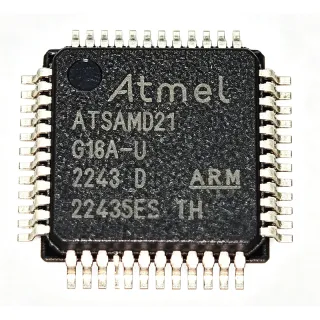
DSPIC33EV32GM102-I/SP - 16-bit 5V DSC, 32KB Flash | Microchip
MPN: DSPIC33EV32GM102-I/SP ✓ Active| Qty | Unit Price | Extended |
|---|---|---|
| 1 | $4.62 | $4.62 |
| 10 | $4.16 | $41.60 |
| 100 | $3.7 | $370.00 |
| 500 | $3.33 | $1,665.00 |
| 1,000 | $2.98 | $2,980.00 |
DSPIC33EV32GM102-I/SP Overview
A digital signal controller combines the computational throughput of a digital signal processor with the peripheral integration and control-oriented architecture of a microcontroller. Within the power-management hierarchy, a DSC sits above a standard MCU in signal-processing capability while remaining a single-chip embedded controller, making the dsPIC33EV family well suited to closed-loop control loops that execute math-heavy algorithms such as field-oriented motor control or digital power conversion.
Key features of this part include the 5V-tolerant dsPIC DSC core rated at 70 MIPS, on-chip CAN 2.0B and SENT peripherals for automotive and industrial networking, integrated analog (op amps, comparators and advanced analog features), PWM engines for motor control, seven timers and four DMA channels. The 5V operation directly interfaces with legacy industrial signal levels without level shifters, a hallmark differentiator versus 3.3V-only competitors.
Architecturally, the device is a CMOS 16-bit core with a 40MHz internal clock source, PLL-based frequency multiplication to reach 70 MIPS instruction throughput, Peripheral Pin Select (PPS) for flexible pin mapping of digital peripherals, and multiple internal bus architectures for parallel data movement via DMA.
Typical applications include appliance motor control (washing machines, compressors), automotive body and powertrain auxiliary systems using CAN or SENT interfaces, industrial power supplies, and digital lighting (HID/LED ballasts), where harsh electrical environments demand 5V noise immunity.
Design consideration: the SPDIP package makes this variant ideal for prototyping and low-volume through-hole boards; for high-volume SMT production, the same die is available in SOIC, SSOP and QFN packages, allowing layout reuse across the dsPIC33EV32GM102 series.
This page synthesizes distributor pricing, drop-in same-family alternatives, application guidance, and practical design notes not found in the manufacturer datasheet alone.
Drop-in alternatives for DSPIC33EV32GM102-I/SP — same package, pin-to-pin compatible. Different-package parts requiring PCB rework are excluded.
Variants in this series
Same-series models that are drop-in compatible with DSPIC33EV32GM102-I/SP (same form factor and footprint) — differing in Package, Operating Temperature, Program Memory (Flash), RAM, Core Architecture.
Quick Comparison Tool — Select alternative parts for side-by-side comparison:
DSPIC33EV32GM002-I/SP
✅ Drop-In ⚠️ Specs Unverified✓ In Stock
$2.35 / Unit
View Datasheet →DSPIC33EV128GM102-I/SP
✅ Drop-In ⚠️ Specs Unverified✓ In Stock
$0.13 / Unit
View Datasheet →DSPIC33EV256GM102-I/SP
✅ Drop-In ⚠️ Specs Unverified✓ In Stock
$3.1 / Unit
View Datasheet →DSPIC33EP32MC202-I/SP
✅ Drop-In ⚠️ Specs Unverified✓ In Stock
$3.57 / Unit
View Datasheet →DSPIC33EP64MC202-I/SP
✅ Drop-In ⚠️ Specs Unverified✓ In Stock
$3.1 / Unit
View Datasheet →DSPIC33EV32GM102-I/SP Maximum Ratings & Electrical Characteristics
| Core Architecture | 16-bit dsPIC DSC |
| Max MIPS | 70 MIPS |
| Operating Voltage Class | 5V |
| Flash Program Memory | 32 KB |
| RAM | 4 KB |
| Clock Frequency | 40 MHz (internal FRC) |
| Timers | 7 |
| DMA Channels | 4 |
| CAN | Yes (CAN 2.0B) |
| SENT Interface | Yes |
| Analog Features | Op amps, comparators, advanced analog |
| PWM | Yes (motor control PWM) |
| Operating Temperature | -40C to +85C (industrial) |
| Package | 28-lead SPDIP (PDIP) |
| Mounting Type | Through Hole |
| Technology | CMOS |
| Peripherals - Remappable | Peripheral Pin Select (PPS) |
DSPIC33EV32GM102-I/SP 28-lead spdip (pdip) Pin Configuration Guide
Pin configuration for DSPIC33EV32GM102-I/SP (28-lead spdip (pdip) package). This digital IC includes GPIO, communication interfaces (UART, SPI, I2C), and power pins. Refer to the manufacturer datasheet for alternate pin functions and configuration options. Essential for embedded system design and PCB layout.

No detailed pinout data available for DSPIC33EV32GM102-I/SP.
Refer to the datasheet for full pin configuration.
Typical Applications
DSPIC33EV32GM102-I/SP is suitable for 6 applications: Appliance Motor Control, Automotive CAN Nodes, Industrial Power Supplies and Digital Power, Digital Lighting and Ballasts, Prototype and Through-Hole Embedded Systems, Sensor Acquisition and SENT-enabled Industrial Sensing.
Appliance Motor Control
The DSPIC33EV32GM102-I/SP fits appliance motor control (washing machines, compressors, fans) because its 70 MIPS 16-bit DSP core executes sensorless BLDC and single-shunt FOC algorithms at PWM switching rates, while integrated op amps and comparators condition current-shunt feedback on-chip, removing external amplifier ICs. The motor-control PWM peripheral generates complementary or independent PWM outputs with dead-time control, and the seven timers plus four DMA channels keep loop timing deterministic without CPU intervention. In use, the DSC sits directly on the 5V control rail of the inverter board, where its 5V noise immunity outperforms 3.3V MCUs in the electrically noisy environment near the switching stage. The trade-off versus a dedicated motor-control ASIC is firmware effort, repaid by flexibility across motor types and firmware upgradability in the field.
Recommended
Automotive CAN Nodes
The DSPIC33EV32GM102-I/SP is well suited to auxiliary automotive nodes (body control sub-functions, sensor gateways, actuator drivers) because it integrates a CAN 2.0B controller and a SENT (SAE J2716) peripheral on the same die as a 5V-tolerant 70 MIPS core. The CAN module handles arbitration, error frames and filtering in hardware, while the SENT receiver decodes nibble streams from SENT-compatible sensors commonly found on throttle, pressure and position applications. The 5V I/O directly drives legacy automotive signal levels, reducing level-shifter count, and the -40C to +85C industrial grade covers most cabin and engine-bay-adjacent positions. Design consideration: pair with an external CAN transceiver and verify AEC-Q100 requirements; use the extended-temperature family variants for under-hood installations.
Recommended
Industrial Power Supplies and Digital Power
For digitally controlled AC/DC and DC/DC converters, the DSPIC33EV32GM102-I/SP provides the fast PWM engines, 70 MIPS DSP-MAC throughput and on-chip comparators needed for peak-current-mode and voltage-mode loops executed at switching frequencies up to hundreds of kHz. The 4 DMA channels offload ADC result transfers so the control ISR stays short and jitter-free, and the 5V core tolerates the voltage transients typical of industrial power stages. A typical implementation uses the DSC as a secondary controller managing PWM generation, housekeeping telemetry and fault protection while a primary controller handles supervision. Unlike analog-only control, firmware-based control allows adaptive compensation, soft-start profiles and in-field tuning, at the cost of requiring code development and verification effort upfront.
Recommended
Digital Lighting and Ballasts
The DSPIC33EV32GM102-I/SP suits digital lighting applications such as LED drivers, HID ballasts and dimming controllers, where the family datasheet explicitly lists this use case. The motor-control PWM peripherals generate the high-frequency switching and low-frequency dimming waveforms, the comparators implement cycle-by-cycle current limiting in hardware for fault protection, and the 70 MIPS core executes power-factor-correction and color-mixing algorithms. Operating directly at 5V simplifies interfacing with legacy lighting ballast circuitry and opto-isolated feedback. In a typical streetlight or industrial luminaire, the DSC controls the power stage, communicates over DALI/DMX via software UART mapped through Peripheral Pin Select, and monitors temperature and current. The benefit versus a fixed-function driver IC is one platform spanning multiple wattages and protocols with firmware-only variants.
Recommended
Prototype and Through-Hole Embedded Systems
The 28-pin SPDIP package of the DSPIC33EV32GM102-I/SP makes it the preferred variant for prototyping, education and maintainable through-hole products. The wide 0.1-inch lead pitch fits breadboards, wire-wrap and socketed production boards, so firmware can be iterated by swapping chips, and field-service equipment can be updated without hot-air rework. Despite the legacy package, the device delivers full family performance: 70 MIPS, 32KB Flash, CAN, SENT, op amps and PPS pin remapping. A common pattern is to prototype on the SPDIP variant and transition to the pin-function-identical SOIC/SSOP/QFN variants for volume SMT assembly, keeping the same firmware and largely the same schematic. This shortens development cycles substantially compared to debugging directly on dense SMT boards.
Recommended
Sensor Acquisition and SENT-enabled Industrial Sensing
The DSPIC33EV32GM102-I/SP works well as a smart-sensor front end because its SENT peripheral natively decodes SAE J2716 data from SENT-output sensors (pressure, position, level), while the on-chip op amps and advanced analog block condition ratiometric analog signals without external amplifiers. Four DMA channels stream ADC results to the 4KB RAM with minimal CPU load, and the 70 MIPS core applies filtering, linearization and diagnostics in real time. In a typical industrial sensor node, the DSC reads the SENT stream or its own ADC, performs compensation, and forwards data over CAN or UART to a PLC. The 5V supply matches industrial sensor wiring conventions, and -40C to +85C operation covers unconditioned cabinets. Compared to a discrete amplifier-plus-MCU chain, this single-chip approach reduces BOM count and calibration drift sources.
Recommended
Recommended Products Summary
Engineering reference data for DSPIC33EV32GM102-I/SP — comparison, design guidance, and compliance information.
Selection Guide
Comparison with Alternatives
| Parameter | This Product | DSPIC33EV32GM002-I/SP | DSPIC33EV128GM102-I/SP | DSPIC33EV256GM102-I/SP | DSPIC33EP32MC202-I/SP | DSPIC33EP64MC202-I/SP |
|---|---|---|---|---|---|---|
| Package | 28-pin SPDIP (through-hole) | 28-pin SPDIP - same | 28-pin SPDIP - same | 28-pin SPDIP - same | 28-pin SPDIP - same | 28-pin SPDIP - same |
| Brand | Microchip Technology | Microchip Technology | Microchip Technology | Microchip Technology | Microchip Technology | Microchip Technology |
| Core / MIPS | 16-bit dsPIC33EV, 70 MIPS, 5V | 16-bit dsPIC33EV, 70 MIPS, 5V | 16-bit dsPIC33EV, 70 MIPS, 5V | 16-bit dsPIC33EV, 70 MIPS, 5V | 16-bit dsPIC33EP, 60 MIPS, 3.3V | 16-bit dsPIC33EP, 60 MIPS, 3.3V |
| Flash Memory | 32 KB | 32 KB | 128 KB | 256 KB | 32 KB | 64 KB |
| CAN 2.0B | Yes | No | Yes | Yes | No | No |
| SENT Peripheral | Yes | Yes | Yes | Yes | No | No |
| Operating Temperature | -40C to +85C | -40C to +85C | -40C to +85C | -40C to +85C | -40C to +85C | -40C to +85C |
Key Differentiators
- CAN 2.0B on board (vs DSPIC33EV32GM002-I/SP)
- 5V noise immunity with 70 MIPS DSP performance (vs DSPIC33EP32MC202-I/SP)
- Integrated analog (op amps + comparators) (vs DSPIC33EP64MC202-I/SP)
- Honest trade-off: 32KB Flash is the family minimum (vs DSPIC33EV256GM102-I/SP)
Design Notes
Decouple each VDD pin with a 100 nF ceramic capacitor placed as close to the pin as possible, and follow the family datasheet (DS70005144H) recommendations for VDDCORE decoupling - do not omit this capacitor or the device may fail PLL lock at 70 MIPS. Because the -I/SP variant is through-hole SPDIP, lead inductance is higher than SMT packages; keep the ground return path short and use a solid ground plane on the PCB even in through-hole layouts.
The 40MHz internal FRC oscillator is convenient, but the CAN 2.0B peripheral requires a clock source with sufficient tolerance for bus bit timing; for CAN applications use an external crystal or verify the FRC-PLL accuracy against the CAN frame error budget in the family datasheet. Also remember that MCLR is a programming-critical pin: add a 10k pull-up and reserve the ICSP header (MCLR/PGD/PGC/VDD/VSS) on every board, since in-circuit debugging via MPLAB ICD/REAL ICE requires it.
Peripheral Pin Select (PPS) allows remapping digital peripherals to RPn pins, which is powerful but creates layout traps: re-check the PPS mapping after any firmware change because a mis-mapped UART or PWM output can silently move to a different physical pin. Keep the on-chip op-amp input pins away from PWM switching nodes and motor phase traces on the PCB; the op amps feed ADC channels whose accuracy degrades with coupled switching noise. Route the CAN differential pair with matched length if the transceiver sits more than a few cm from the DSC.
Estimated: the 28-pin SPDIP package in a still-air through-hole board presents a relatively high theta_JA (typical PDIP values are on the order of 70-100 C/W; consult DS70005144H for the exact figure). At the 5V core with tens of mA supply current, self-heating is minor, but if the DSC also sources significant I/O current (e.g., driving LEDs or transistor gates), budget the junction temperature against the +85C ambient rating using P_total = VDD x IDD + sum of I/O dissipation.
Compliance Information
Compliance data was not included in the Verified Web Data. RoHS/REACH/lead-free status should be confirmed on the Microchip product page or the distributor environmental listing before design-in. AEC-Q100 qualification is not indicated for this standard-grade part; use -E extended-temperature variants or verify qualification status for automotive designs.