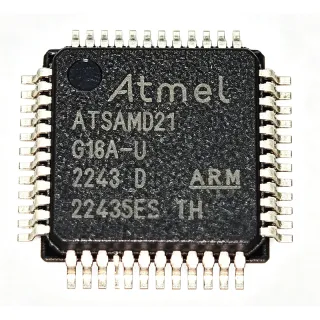
DSPIC33FJ256MC710-I/PF - 40MIPS 16-bit DSC 256KB Flash | Microchip
MPN: DSPIC33FJ256MC710-I/PF ✗ End of Life| Qty | Unit Price | Extended |
|---|---|---|
| 1 | $22.25 | $22.25 |
| 10 | $21.5 | $215.00 |
| 100 | $20.4 | $2,040.00 |
| 500 | $19.6 | $9,800.00 |
| 1,000 | $18.8 | $18,800.00 |
DSPIC33FJ256MC710-I/PF Overview
A Digital Signal Controller combines the compute structure of a microcontroller with the mathematical acceleration of a digital signal processor. In the power-management IC hierarchy, the dsPIC33F sits between general-purpose MCUs (such as the PIC24H family, with which it is pin compatible) and dedicated DSPs, offering a hardware multiply-accumulate (MAC) unit, barrel shifter, and fixed-point DSP engine within an MCU-class peripheral set. This makes it a natural fit for embedded control loops that also need real-time signal math.
Key features of the DSPIC33FJ256MC710-I/PF include its 40 MIPS performance at 3.3V operation, 256KB of self-programmable Flash, and a motor-control-oriented peripheral suite with complementary PWM outputs and quadrature encoder interface support, tailored for digital power conversion and motion control. According to Microchip product documentation, the family offers seamless migration options to and from PIC24 MCUs and dsPIC30F DSCs in similar packages.
Technically, the dsPIC33F core executes C compiler-friendly 16-bit instructions while the DSP engine performs single-cycle MAC operations; boundary-scan support and in-circuit serial programming (ICSP) via PGECx/PGEDx pin pairs simplify debug and production programming. Microchip notes that all VDD and VSS pins must be connected and PGECx/PGEDx must be used as matched pairs for reliable programming.
Typical applications include brushless DC motor drives, single- and three-phase induction motor control, switched reluctance motors, digital power supplies, and sensorless servo positioning systems where deterministic 40 MIPS execution and fast interrupt response matter.
A key design consideration: the DS (not recommended for new design) status of the base dsPIC33FJ256MC710 means new designs should target the pin-compatible dsPIC33FJ256MC710A variant, which shares the same TQFP-100 footprint.
This page synthesizes distributor pricing, drop-in alternatives, and practical design notes not found in the manufacturer datasheet alone.
Drop-in alternatives for DSPIC33FJ256MC710-I/PF — same package, pin-to-pin compatible. Different-package parts requiring PCB rework are excluded.
Variants in this series
Same-series models that are drop-in compatible with DSPIC33FJ256MC710-I/PF (same form factor and footprint) — differing in Operating Temperature, Package, Mounting Type, Connectivity, Core.
Quick Comparison Tool — Select alternative parts for side-by-side comparison:
DSPIC33FJ256MC710A-I/PF
✅ Drop-In📋 Reference alternative (not in catalog)
DSPIC33FJ256MC510T-I/PF
✅ Drop-In ⚠️ Specs Unverified✓ In Stock
$6.65 / Unit
View Datasheet →DSPIC33FJ256GP510-I/PF
✅ Drop-In ⚠️ Specs Unverified✓ In Stock
$4.98 / Unit
View Datasheet →DSPIC33FJ128MC710-I/PF
✅ Drop-In ⚠️ Specs Unverified✓ In Stock
$7.15 / Unit
View Datasheet →DSPIC33FJ256MC710-I/PF Maximum Ratings & Electrical Characteristics
| Core Architecture | 16-bit dsPIC33F DSC with DSP engine |
| Maximum Clock / Performance | 40 MIPS |
| Program Memory (Flash) | 256 KB |
| RAM | 8192 words (30 KB) |
| Supply Voltage | 3.3 V |
| Operating Temperature | -40C to +85C (Industrial) |
| Package | 100-pin TQFP (14x14 mm), PF |
| Mounting Type | Surface Mount |
| Pin Count | 100 |
| Programming Interface | ICSP via PGECx/PGEDx pairs (2-wire) |
| Boundary Scan | Yes |
| Fixed-Point Support | Yes (DSP MAC, barrel shifter) |
| Family Migration | Pin compatible with PIC24H; high compatibility with dsPIC30F |
| Recommended For New Design | No - migrate to dsPIC33FJ256MC710A |
| Lead Free | Yes (per Future Electronics listing) |
DSPIC33FJ256MC710-I/PF 100-pin tqfp (14x14 mm), pf Pin Configuration Guide
Pin configuration for DSPIC33FJ256MC710-I/PF (100-pin tqfp (14x14 mm), pf package). This digital IC includes GPIO, communication interfaces (UART, SPI, I2C), and power pins. Refer to the manufacturer datasheet for alternate pin functions and configuration options. Essential for embedded system design and PCB layout.

No detailed pinout data available for DSPIC33FJ256MC710-I/PF.
Refer to the datasheet for full pin configuration.
Typical Applications
DSPIC33FJ256MC710-I/PF is suitable for 6 applications: Brushless DC (BLDC) Motor Drives, Servo Drives and Precision Positioning, Digital Power Supplies and Converters, Induction and Switched Reluctance Motor Control, Industrial Automation and Sensing Nodes, Uninterruptible and Backup Power Systems.
Brushless DC (BLDC) Motor Drives
The DSPIC33FJ256MC710-I/PF fits BLDC drives because its 40 MIPS dsPIC33F core executes field-oriented or trapezoidal commutation loops deterministically, while the hardware MAC accelerates the fixed-point math of current and speed observers. In a typical drive, the DSC generates complementary PWM gate signals, reads the quadrature or hall feedback, and closes the current loop in tens of microseconds. According to Microchip, the dsPIC33F Motor Control family explicitly targets brushless DC, induction, and switched reluctance machines. Because the 100-pin TQFP exposes ample PWM and ADC-capable pins, dual-axis designs can share one controller. Using the A-revision (710A) avoids known silicon errata in production drives.
Recommended
Servo Drives and Precision Positioning
Dual-axis servo drives, robotic joint control, and precision positioning systems benefit from this DSC's combination of 40 MIPS throughput, 256KB Flash for trajectory and field-oriented control firmware, and 30KB RAM for state buffers. The quadrature encoder interface peripheral decodes encoder feedback in hardware, freeing CPU cycles for the position/velocity/current cascade loop. The DSP engine's single-cycle multiply-accumulate supports adaptive notch filters and observer-based control. With a 100-pin TQFP providing parallel peripheral access, one DSPIC33FJ256MC710-I/PF can control two servo axes concurrently, reducing BOM count versus one MCU per axis in compact industrial drives.
Recommended
Digital Power Supplies and Converters
Digitally controlled AC-DC and DC-DC converters use the DSPIC33FJ256MC710-I/PF for its fast interrupt response and deterministic PWM update, running voltage-mode or average-current-mode control at switching frequencies of hundreds of kHz. The 3.3V core, hardware MAC, and motor-control PWM peripherals with dead-time insertion suit phase-shifted full-bridge and LLC topologies. Microchip positions the dsPIC33F Motor Control family for unified motor control and digital power applications, and the 256KB Flash accommodates compensation libraries, PMBus-style communication, and diagnostic logging. Sampling the feedback ADC synchronously with the PWM eliminates control-loop jitter, a key benefit over analog controllers.
Recommended
Induction and Switched Reluctance Motor Control
Single- and three-phase induction motors and switched reluctance machines require computationally intensive control such as V/Hz, sensorless flux observers, or direct torque control - workloads matched to the 40 MIPS dsPIC33F core with its DSP MAC and barrel shifter. Microchip's product documentation lists these motor types as primary targets of the dsPIC33FJ256MC710A family, which shares the silicon and footprint of the 710. The 100-pin TQFP offers enough PWM channels and ADC inputs to drive three-phase bridges with current sensing on multiple phases, while 256KB Flash stores parameter tables, protection routines, and communication stacks (MODBUS/UART) in a single controller.
Recommended
Industrial Automation and Sensing Nodes
In factory automation, the DSPIC33FJ256MC710-I/PF serves as an intelligent sensing and actuation node: its fixed-point DSP engine filters and demodulates sensor signals (e.g., resolvers, ultrasonic, vibration), while UART/SPI/I2C ports feed supervisory PLC networks. The industrial -40C to +85C rating covers unconditioned cabinets, and ICSP with matched PGECx/PGEDx pairs enables field firmware updates on the installed base. Migration compatibility with PIC24H MCUs lets system architects scale I/O-heavy nodes to general-purpose MCUs on the same PCB layout, per Microchip's stated seamless-migration strategy. Boundary-scan support simplifies in-circuit test during panel-level production of automation modules.
Recommended
Uninterruptible and Backup Power Systems
UPS and inverter products benefit from the DSPIC33FJ256MC710-I/PF's ability to run multiple nested control loops - battery charge management, DC-bus regulation, and sine-wave PWM generation - within one 40 MIPS controller. The hardware MAC handles RMS computation, harmonic compensation, and phase-locked-loop grid synchronization efficiently at 3.3V. With 256KB Flash, firmware can include soft-start, transfer logic, and event logging without external memory. The industrial temperature grade and boundary-scan testability suit rack-mounted power hardware, and the same TQFP-100 footprint is shared across Flash sizes, letting OEMs scale feature tiers (128KB/192KB/256KB) on a single PCB platform.
Recommended
Recommended Products Summary
Engineering reference data for DSPIC33FJ256MC710-I/PF — comparison, design guidance, and compliance information.
Selection Guide
Comparison with Alternatives
| Parameter | This Product | DSPIC33FJ256MC710A-I/PF | DSPIC33FJ256MC510T-I/PF | DSPIC33FJ256GP510-I/PF | DSPIC33FJ128MC710-I/PF |
|---|---|---|---|---|---|
| Package | 100-TQFP (14x14 mm, PF) | 100-TQFP (14x14 mm) - same | 100-TQFP (14x14 mm) - same | 100-TQFP (14x14 mm) - same | 100-TQFP (14x14 mm) - same |
| Brand | Microchip Technology | Microchip Technology | Microchip Technology | Microchip Technology | Microchip Technology |
| Performance | 40 MIPS | 40 MIPS | 40 MIPS | 40 MIPS | 40 MIPS |
| Flash Program Memory | 256 KB | 256 KB | 192 KB | 256 KB | 128 KB |
| RAM | 8192 words (30 KB) | 30 KB | 30 KB | 30 KB | 16 KB |
| Peripheral Family | Motor Control (MC) | Motor Control (MC) | Motor Control (MC) | General Purpose (GP) | Motor Control (MC) |
| Operating Temperature | -40C to +85C (I grade) | -40C to +85C | -40C to +85C | -40C to +85C | -40C to +85C |
Key Differentiators
- Full 256KB Flash in the motor-control family (vs DSPIC33FJ128MC710-I/PF)
- Motor-control peripherals vs general-purpose set (vs DSPIC33FJ256GP510-I/PF)
- Established industrial silicon vs active revision (vs DSPIC33FJ256MC710A-I/PF)
Design Notes
Connect every VDD and VSS pin of the 100-pin TQFP to the 3.3V rail and ground plane respectively. Per Microchip guidance for this device, leaving even one power pin unconnected can cause programming and runtime failures that are difficult to diagnose. Decouple each VDD pin pair with 100 nF ceramics placed within 2 mm of the pin, plus bulk 10 uF capacitance near the corner supply entries.
The dsPIC33FJ256MC710 provides multiple PGECx/PGEDx programming pairs; ICSP works only when clock and data come from the SAME matched pair (e.g., PGEC2 with PGED2). Route your programming header to one chosen pair and keep traces short. Also note the base 710 is NRND with a published 10-page silicon errata: review the errata document before freezing a design, and prefer the 710A for new PCBs.
Estimated: a dsPIC33F-class DSC drawing roughly 50-80 mA at 3.3V dissipates only about 0.17-0.26 W, so the 14x14 mm TQFP needs no heatsink; a solid ground plane is sufficient thermal management. Budget the supply for peak active + Flash-write current during self-programming, and hold the 3.3V rail within the dsPIC33FJ datasheet tolerance to preserve the 40 MIPS operating point across the -40C to +85C range.
Keep motor-control PWM outputs away from the analog ADC inputs and the PGECx/PGEDx programming traces. Switching nodes in drives can couple hundreds of millivolts of noise into ADC sampling, degrading current-loop accuracy. Use series termination (22-33 ohm) on fast PWM edges near cable connectors and guard the analog reference with local filtering to preserve the DSC's fixed-point control-loop precision.
Compliance Information
Future Electronics lists the DSPIC33FJ256MC710-I/PF as lead free and industrial temperature grade. AEC-Q100 not_applicable/qualified status applies to separate -H grade variants (e.g., DSPIC33FJ256MC710A-H/PF per Microchip USA). RoHS/REACH certificates should be requested from Microchip directly.