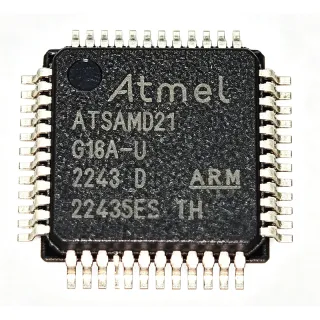
DSPIC33FJ32MC104T-I/TL - 16-bit DSC 16 MIPS 32KB Flash | Microchip
MPN: DSPIC33FJ32MC104T-I/TL ✓ Active| Qty | Unit Price | Extended |
|---|---|---|
| 1 | $5.2 | $5.20 |
| 10 | $4.75 | $47.50 |
| 100 | $4.2 | $420.00 |
| 500 | $3.85 | $1,925.00 |
| 1,000 | $3.45 | $3,450.00 |
DSPIC33FJ32MC104T-I/TL Overview
A digital signal controller combines the compute throughput of a DSP with the peripheral integration and ease of use of a microcontroller. Within the power-management hierarchy, a DSC sits between a general-purpose MCU and a dedicated DSP: it executes real-time control loops (current, speed, position) while simultaneously handling communication and housekeeping tasks. The dsPIC33FJ32MC104 belongs to the dsPIC33F motor-control family from Microchip Technology, a vendor with broad 16-bit embedded control heritage.
Key features include a 16-bit dsPIC33F core, motor-control PWM peripherals (MCPWMs), a Charge Time Measurement Unit (CTMU) for capacitive touch and precise timing, and Peripheral Pin Select (PPS) for flexible digital peripheral mapping. Connectivity covers I2C, SPI, UART/USART, IrDA, and LINbus, enabling integration into CAN-adjacent industrial networks and automotive subnodes.
Architecturally, the device uses a modified Harvard 16-bit pipeline with DSP-class multiply-accumulate instructions, letting a single part execute field-oriented motor control mathematics while bit-banging communications. Flash at 11K x 24 instructions is sufficient for sensorless FOC or brushed-DC control with headroom for protocol stacks.
Typical applications include BLDC and PMSM motor drives, power supplies and digital power conversion, and industrial automation nodes requiring deterministic control at low cost.
Design consideration: the 3.3V supply and 44-VTLA exposed-pad package demand a solid ground pour for thermal and signal-integrity performance; verify the MCLR/ICSP programming footprint early.
This page synthesizes distributor data, drop-in family alternatives, and practical design notes not found in the manufacturer datasheet.
Drop-in alternatives for DSPIC33FJ32MC104T-I/TL — same package, pin-to-pin compatible. Different-package parts requiring PCB rework are excluded.
Variants in this series
Same-series models that are drop-in compatible with DSPIC33FJ32MC104T-I/TL (same form factor and footprint) — differing in Package, Supply Voltage, Motor Control PWM, Mounting Type, Operating Temperature.
Quick Comparison Tool — Select alternative parts for side-by-side comparison:
DSPIC33FJ32MC104T-E/TL
✅ Drop-In✓ In Stock
$3.95 / Unit
View Datasheet →DSPIC33FJ32MC102T-I/TL
✅ Drop-In✓ In Stock
$3.2 / Unit
View Datasheet →DSPIC33FJ32MC102T-I/SO
✅ Drop-In ⚠️ Specs Unverified✓ In Stock
$3.3 / Unit
View Datasheet →DSPIC33FJ32MC101-I/P
✅ Drop-In ⚠️ Specs Unverified✓ In Stock
$2.18 / Unit
View Datasheet →DSPIC33FJ32MC104T-I/TL Maximum Ratings & Electrical Characteristics
| Core | 16-bit dsPIC33F |
| Program Memory Size | 32 KB (11K x 24) Flash |
| RAM Size | 2 KB |
| Maximum Operating Frequency | 32 MHz (16 MIPS) |
| Supply Voltage | 3.3 V |
| Package | 44-VTLA (6x6 mm) QFN with exposed pad |
| Mounting Type | Surface Mount |
| Operating Temperature | -40C to +85C (I grade) |
| Connectivity | I2C, SPI, UART/USART, IrDA, LINbus |
| Motor Control PWM | MCPWMs |
| Charge Time Measurement Unit | CTMU |
| Peripheral Pin Select | PPS |
| Product Family | dsPIC33FJ32MC motor control DSC family |
| Packaging | Tape & Reel (T suffix) |
| Number of Pins | 44 |
DSPIC33FJ32MC104T-I/TL 44-vtla (6x6 mm) qfn with exposed pad Pin Configuration Guide
Pin configuration for DSPIC33FJ32MC104T-I/TL (44-vtla (6x6 mm) qfn with exposed pad package). This digital IC includes GPIO, communication interfaces (UART, SPI, I2C), and power pins. Refer to the manufacturer datasheet for alternate pin functions and configuration options. Essential for embedded system design and PCB layout.

No detailed pinout data available for DSPIC33FJ32MC104T-I/TL.
Refer to the datasheet for full pin configuration.
Typical Applications
DSPIC33FJ32MC104T-I/TL is suitable for 6 applications: BLDC Motor Drives, Digital Power Conversion, Industrial Automation Nodes, Capacitive Touch Interfaces, Appliance and HVAC Control, Embedded Control Prototyping.
BLDC Motor Drives
The DSPIC33FJ32MC104T-I/TL fits BLDC motor control because its motor-control PWM (MCPWMs) generate complementary outputs with hardware dead-time insertion for three-phase inverter bridges, and its 16-bit DSP core runs field-oriented control arithmetic at 16 MIPS. In a typical drive, the DSC reads current sense signals through its ADC, executes PI/FOC current loops at multi-kHz rates, and outputs six PWM channels to the gate drivers while UART or LINbus reports status to the host. With 32KB of Flash, the MC104 holds sensorless algorithms and startup state machines that the smaller 16KB MC102 cannot. The main trade-off versus dedicated motor ASSPs is flexibility: firmware updates and multi-motor support come free, but the engineer owns the control tuning and safety interlocks.
Recommended
Digital Power Conversion
In switch-mode power supplies, PFC stages, and DC-DC converters, the DSPIC33FJ32MC104T-I/TL provides the deterministic 16-bit core and high-resolution MCPWM outputs needed for voltage-mode and current-mode control loops at switching frequencies of tens to hundreds of kilohertz. The 16 MIPS throughput supports multi-loop control with ADC-triggered interrupt latency in the low microseconds, while Peripheral Pin Select (PPS) lets engineers map PWM faults and feedback inputs optimally. The 32KB Flash accommodates soft-start sequencing, protection state machines, and PMBus-style housekeeping. Compared with analog controllers, the DSC adds programmability and telemetry; the design cost is careful attention to ADC sampling synchronization with the PWM carrier to avoid beat-frequency noise in the control loop.
Recommended
Industrial Automation Nodes
Factory automation nodes - conveyors, pumps, fans, and actuators - use the DSPIC33FJ32MC104T-I/TL where a single part must close a control loop and talk to a network. Its UART/USART with IrDA and LINbus support, plus I2C and SPI, allow direct integration with sensors, displays, and field buses without external bridge ICs. The -40C to +85C industrial temperature grade suits control cabinets and machinery enclosures, and the CTMU enables capacitive touch panels on operator interfaces without dedicated touch controllers. At 16 MIPS the core handles both the PWM loop and protocol handling concurrently. For nodes that later need richer connectivity, the same footprint family allows migration between Flash sizes (MC101/MC102/MC104) with zero PCB change, protecting the hardware investment.
Recommended
Capacitive Touch Interfaces
The Charge Time Measurement Unit (CTMU) on the DSPIC33FJ32MC104T-I/TL provides a precise constant-current source and timing reference for capacitive touch sensing, allowing the same DSC that runs a motor or power loop to implement buttons and sliders on the product enclosure. Because the CTMU measures charge time with sub-nanosecond resolution, the design achieves stable touch thresholds across supply and temperature variation without external touch ICs. Peripheral Pin Select maps CTMU channels flexibly to the 35 general-purpose I/O, so electrode placement follows the industrial design rather than the pinout. The 32KB Flash leaves room for drift-compensation and multi-key decoding firmware. The main design consideration is PCB hygiene: guard electrodes and proper ground pours are required to prevent false triggers in noisy motor-drive environments.
Recommended
Appliance and HVAC Control
White goods, fans, compressors, and HVAC blowers benefit from the DSPIC33FJ32MC104T-I/TL combination of motor-control PWM, 3.3V low-power operation, and LINbus/IrDA-capable serial links used in appliance communication buses. A single DSC can drive a variable-speed BLDC blower with sensorless FOC at 16 MIPS while simultaneously reading NTC or digital temperature sensors over I2C and reporting diagnostics over UART. The 2KB RAM holds the control-loop state and a small command buffer; the 32KB Flash supports multi-speed profiles and fault logging. Extended-memory headroom lets OEMs add self-test routines demanded by appliance safety standards. Compared with fixed-function motor ICs, firmware-defined behavior lets one hardware platform serve multiple product tiers - a significant BOM and logistics advantage for appliance manufacturers.
Recommended
Embedded Control Prototyping
For prototyping and low-volume products, the DSPIC33FJ32MC104T-I/TL is attractive because the entire dsPIC33F family is supported by Microchip MPLAB X IDE, the XC16 compiler (free tier available), and low-cost in-circuit programmers/debuggers (PICkit and ICD). The 44-pin QFN with exposed pad can be evaluated on adapter boards, and Peripheral Pin Select means pin conflicts common in fixed-pinout MCUs are largely eliminated during board respins. The 32KB Flash with 11K x 24 instructions is large enough for real applications, not just demos, and the 2KB RAM supports buffered UART and SPI transactions. When the design migrates to production, the same code drops unchanged onto the MC102 or MC101 to reduce cost, preserving the development investment across the volume spectrum.
Recommended
Recommended Products Summary
Engineering reference data for DSPIC33FJ32MC104T-I/TL — comparison, design guidance, and compliance information.
Selection Guide
Comparison with Alternatives
| Parameter | This Product | DSPIC33FJ32MC104T-E/TL | DSPIC33FJ32MC102T-I/TL | DSPIC33FJ32MC101-I/P |
|---|---|---|---|---|
| Package | 44-VTLA (6x6 mm) QFN, exposed pad | 44-VTLA (6x6 mm) QFN - same | 44-VTLA (6x6 mm) QFN - same | Same family - verify package code for 44-pin variant |
| Brand | Microchip Technology | Microchip Technology | Microchip Technology | Microchip Technology |
| Core / Performance | 16-bit dsPIC33F, 16 MIPS | 16-bit dsPIC33F, 16 MIPS | 16-bit dsPIC33F, 16 MIPS | 16-bit dsPIC33F, 16 MIPS |
| Operating Temperature | -40C to +85C (I grade) | -40C to +125C (E grade) | -40C to +85C (I grade) | -40C to +85C (I grade) |
Key Differentiators
- Double the program memory within the identical footprint (vs DSPIC33FJ32MC102T-I/TL)
- Extended-temperature sibling available on the same die (vs DSPIC33FJ32MC104T-E/TL)
- Integrated CTMU capacitive touch measurement (vs DSPIC33FJ32MC102T-I/TL)
Design Notes
The device operates from a 3.3V external supply and uses an internal core regulator requiring a dedicated low-ESR VCAP capacitor on the VCAP/VDDCORE pin per the Microchip datasheet and Family Reference Manual. Omitting or misplacing this capacitor is a leading cause of erratic startup and brown-out resets. Decouple each VDD/VSS pin pair with 100nF ceramics placed within 2mm of the pins, plus a bulk 10uF at the board level. Estimated: total I/O load current should be budgeted so combined source/sink stays within datasheet per-pin and total-device limits.
The 44-VTLA QFN has an exposed thermal pad that must be soldered to a grounded copper pour with an array of thermal vias - this is not optional for reliability even though the part is not high-power. The pad provides both heat dissipation and the primary ground return for the ADC, so a poor solder joint degrades analog accuracy and EMC. Follow the Microchip QFN land-pattern application note for stencil design (typically ~50-70% paste coverage on the pad to avoid voiding and tombstoning of the perimeter lands).
Motor-control designs fail most often at the boundary between the DSC and the power stage, not in firmware. Route PWM outputs short and symmetric to gate drivers, keep ADC sense lines away from PWM and gate-switching nodes, and synchronize ADC sampling to the PWM carrier using the MCPWM trigger (not free-running sampling) so current is measured at the carrier midpoint where ripple is minimal. Also confirm MCLR/ICSP programming access is preserved in production layouts, and use Peripheral Pin Select configuration checks in firmware to catch remap conflicts at startup.
Estimated: the I-grade part is specified to +85C ambient; when driving motor gates at 16 MIPS the die dissipation is modest (tens of milliwatts class), so the dominant heat source in the system is usually the power stage, not the DSC. Keep the controller away from heatsinks and inductor hot spots on the PCB, verify that local board temperature near the QFN stays below the 85C ambient rating with margin, and choose the E-grade DSPIC33FJ32MC104T-E/TL (+125C) for thermally aggressive enclosures.
Compliance Information
Sold as lead-free/RoHS-compliant on distributor channels (Mouser, DigiKey, Hotenda). For binding compliance documentation, obtain the material declaration for this exact MPN from the Microchip product page. AEC-Q100 qualification not stated in provided data for this orderable part number.