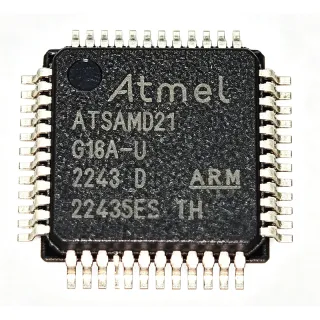
DSPIC33FJ32MC204-I/ML - 16-bit DSC 32KB Flash 40MIPS QFN-44
MPN: DSPIC33FJ32MC204-I/ML ✓ Active| Qty | Unit Price | Extended |
|---|---|---|
| 1 | $6.72 | $6.72 |
| 10 | $6.05 | $60.50 |
| 100 | $5.38 | $538.00 |
| 500 | $4.84 | $2,420.00 |
| 1,000 | $4.37 | $4,370.00 |
DSPIC33FJ32MC204-I/ML Overview
A Digital Signal Controller combines the computational architecture of a digital signal processor (DSP) with the peripheral set and ease of use of a microcontroller (MCU). Within the power-management hierarchy of embedded systems, a DSC sits between a general-purpose MCU and a dedicated DSP, offering multiply-accumulate (MAC) DSP instructions alongside familiar control peripherals, making the dsPIC33F family a midpoint between PIC24 microcontrollers and dedicated motor-control silicon.
Key differentiating features include two high-speed PWM generators with independent timebases for motor-control topologies, Peripheral Pin Select (PPS) which allows many digital peripherals to be remapped to nearly any pin on the device, and up to four high-speed analog comparators with direct PWM fault integration for fast current limiting.
Architecturally, the device executes an optimized C compiler-friendly 16-bit instruction set with DSP engine support (dual 40-bit accumulators, MAC and multiply instructions), operating from a 3.0V to 3.6V supply. Flash program memory is self-programmable, supporting field firmware updates.
Typical applications include Brushless DC (BLDC) and Permanent Magnet Synchronous Motor (PMSM) drives, sensorless FOC motor control, digital power supplies, and industrial automation nodes where deterministic PWM timing matters.
Design consideration: as a 3.3V-only device, level shifting is required for 5V peripherals; also plan the ECAN/UART pin mapping early since PPS assignments are locked per pin direction.
This page synthesizes distributor pricing context, drop-in alternatives, and practical design notes not found in the manufacturer datasheet.
Drop-in alternatives for DSPIC33FJ32MC204-I/ML — same package, pin-to-pin compatible. Different-package parts requiring PCB rework are excluded.
Variants in this series
Same-series models that are drop-in compatible with DSPIC33FJ32MC204-I/ML (same form factor and footprint) — differing in Operating Temperature, Flash Program Memory, Package, SRAM, Supply Voltage Range.
Quick Comparison Tool — Select alternative parts for side-by-side comparison:
DSPIC33FJ64MC204-I/ML
✅ Drop-In📋 Reference alternative (not in catalog)
DSPIC33FJ32MC204-E/ML
✅ Drop-In ⚠️ Specs Unverified📋 Reference alternative (not in catalog)
DSPIC33FJ32GP304-I/ML
✅ Drop-In✓ In Stock
$3.49 / Unit
View Datasheet →DSPIC33FJ32GP204-I/ML
✅ Drop-In ⚠️ Specs Unverified📋 Reference alternative (not in catalog)
DSPIC33FJ32MC204-I/ML Maximum Ratings & Electrical Characteristics
| Core Architecture | 16-bit dsPIC33F DSC |
| Maximum Clock Speed | 40 MHz |
| Flash Program Memory | 32 KB |
| SRAM | 2 KB |
| Supply Voltage Range | 3 V to 3.6 V |
| I/O Ports | 35 |
| PWM Generators | 2 (independent timebases) |
| Analog Comparators | Up to 4 high-speed |
| Peripheral Pin Select (PPS) | Yes |
| Package Type | 44-pin QFN (ML), surface mount |
| Operating Temperature | -40C to +85C (Industrial) |
| Mounting Type | Surface Mount |
| Life Cycle Stage | Active |
| Lead Finish | Lead free |
| Migration Path | Seamless to/from PIC24F, PIC24H, dsPIC30F |
| ROM Type | Flash (self-programmable) |
DSPIC33FJ32MC204-I/ML 44-pin qfn (ml), surface mount Pin Configuration Guide
Pin configuration for DSPIC33FJ32MC204-I/ML (44-pin qfn (ml), surface mount package). This digital IC includes GPIO, communication interfaces (UART, SPI, I2C), and power pins. Refer to the manufacturer datasheet for alternate pin functions and configuration options. Essential for embedded system design and PCB layout.

No detailed pinout data available for DSPIC33FJ32MC204-I/ML.
Refer to the datasheet for full pin configuration.
Typical Applications
DSPIC33FJ32MC204-I/ML is suitable for 6 applications: BLDC Motor Control, Sensorless FOC / PMSM Drives, Digital Power Supplies, Industrial Automation Nodes, Automotive-adjacent Motor Subsystems, Embedded Control with Flexible I/O.
BLDC Motor Control
The DSPIC33FJ32MC204-I/ML is purpose-built for Brushless DC (BLDC) motor drives: its two high-speed PWM generators with independent timebases generate complementary or independent six-step commutation waveforms, while up to four high-speed analog comparators connect directly to PWM fault inputs for cycle-by-cycle overcurrent shutdown without CPU intervention. In a typical sensorless trapezoidal drive, the 40 MIPS 16-bit core runs the commutation state machine and back-EMF zero-crossing detection in the 32 KB Flash budget with room for a serial diagnostics link. The Peripheral Pin Select feature lets the designer route PWM outputs, UART, and encoder inputs to optimal QFN pins, simplifying gate-driver placement. Compared to a general-purpose MCU, the deterministic PWM fault path materially reduces MOSFET stress during stall or short-circuit events.
Recommended
Sensorless FOC / PMSM Drives
Field-Oriented Control (FOC) of Permanent Magnet Synchronous Motors demands fast multiply-accumulate throughput for the Clarke/Park transforms and PI current loops. The DSPIC33FJ32MC204-I/ML provides a 16-bit DSP engine with 40-bit accumulators executing MAC instructions at 40 MIPS, and Microchip's Motor Control family is specifically validated for FOC firmware libraries. The 32 KB Flash typically accommodates sensorless observer code (SMO or sliding-mode) plus current-loop ISR at 10-20 kHz PWM frequency. Two independent PWM timebases support master/slave inverter phases, and the high-speed comparators provide hardware current limiting. Designers should budget SRAM carefully (2 KB) - use fixed-point Q15 math and avoid floating-point libraries to keep the control loop deterministic within the interrupt latency budget.
Recommended
Digital Power Supplies
Digitally controlled AC-DC and DC-DC converters benefit from the DSPIC33FJ32MC204-I/ML's high-resolution PWM and fast analog comparators. The 40 MIPS core closes voltage-mode or average-current-mode loops at switching frequencies typical of telecom and server power stages, while the comparators implement peak-current limiting directly in hardware - critical for transformer protection during transients. The 3.0V-3.6V supply and 35 I/O allow direct interfacing with optocoupler feedback and housekeeping circuitry. PPS routing keeps the control loop traces short on the 44-pin QFN, reducing PWM signal ringing. Firmware-based control also enables adaptive features (burst mode, dead-time optimization) that analog controllers cannot offer, provided the ISR is tuned to complete well within one switching period.
Recommended
Industrial Automation Nodes
In factory automation, the DSPIC33FJ32MC204-I/ML serves as an intelligent actuator or sensor node combining motor or solenoid drive with fieldbus connectivity. Its on-chip peripherals (UART, SPI, I2C, comparators, PWM) plus PPS flexibility let one controller manage actuation, analog sensing, and serial communication without external glue logic. The industrial -40C to +85C rating covers unconditioned cabinet environments. The 16-bit core with DSP instructions also performs on-node signal conditioning, such as FFT-based vibration signatures or FIR filtering of sensor data, within the 32 KB Flash. For CAN-based networks, pair with a CAN transceiver and use the ECAN module. Extended-temperature (-E/ML) drop-in variants exist for hot enclosures near drives.
Recommended
Automotive-adjacent Motor Subsystems
The dsPIC33FJ32MC204 family integrates into non-safety automotive-adjacent subsystems such as HVAC blower drives, pump controllers, and throttle actuators in industrial-vehicle equipment. The two independent PWM timebases drive multi-channel actuators, and the direct comparator-to-PWM fault path protects power stages against locked-rotor conditions. Note the -I/ML grade is rated -40C to +85C; for underhood zones exceeding this range, the pin-compatible -E/ML (-40C to +125C) is the correct drop-in choice without layout changes. The 3.3V-only supply simplifies interfacing with modern transceiver ICs, though 5V sensor inputs require level shifting. Verify any formal automotive qualification requirement against the -Q1 counterpart family before design freeze.
Recommended
Embedded Control with Flexible I/O
General embedded control designs benefit from the DSPIC33FJ32MC204-I/ML's Peripheral Pin Select, which removes fixed-pin constraints that complicate board routing on the 44-pin QFN. Designers can assign UART, SPI, and output-compare functions to whichever RP pins best suit the layout, then change assignments in firmware across board revisions - a significant advantage for product families sharing one PCB. The 35 I/O lines, on-chip comparators, and PWM outputs cover mixed signal-actuation tasks such as valve sequencing, heater control, and alarm thresholds without external analog ICs. The self-programmable 32 KB Flash supports field firmware updates over UART or CAN. Seamless migration to PIC24 and dsPIC30F siblings protects long-term sourcing flexibility.
Recommended
Recommended Products Summary
Engineering reference data for DSPIC33FJ32MC204-I/ML — comparison, design guidance, and compliance information.
Selection Guide
Comparison with Alternatives
| Parameter | This Product | DSPIC33FJ64MC204-I/ML | DSPIC33FJ32MC204-E/ML | DSPIC33FJ32GP304-I/ML | DSPIC33FJ32GP204-I/ML |
|---|---|---|---|---|---|
| Package | 44-QFN (ML) | 44-QFN (ML) - same | 44-QFN (ML) - same | 44-QFN (ML) - same | 44-QFN (ML) - same |
| Brand | Microchip Technology | Microchip Technology | Microchip Technology | Microchip Technology | Microchip Technology |
| Flash Memory | 32 KB | 64 KB | 32 KB | 32 KB | 32 KB |
| SRAM | 2 KB | 2 KB | 2 KB | 2 KB | 2 KB |
| Core Speed | 40 MHz | 40 MHz | 40 MHz | 40 MHz | 40 MHz |
| Supply Voltage | 3 V to 3.6 V | 3 V to 3.6 V | 3 V to 3.6 V | 3 V to 3.6 V | 3 V to 3.6 V |
| Operating Temperature | -40C to +85C (Industrial) | -40C to +85C (Industrial) | -40C to +125C (Extended) | -40C to +85C (Industrial) | -40C to +85C (Industrial) |
| Peripheral Family / PWM | Motor Control: 2 high-speed PWM generators, up to 4 comparators | Motor Control: same PWM/comparators | Motor Control: same PWM/comparators | General Purpose: output compare, ECAN emphasis | General Purpose: output compare, ECAN emphasis |
Key Differentiators
- Optimized for motor control with hardware fault protection (vs DSPIC33FJ32GP304-I/ML)
- Extended temperature drop-in for hot environments (vs DSPIC33FJ32MC204-E/ML)
- Flash headroom option on identical footprint (vs DSPIC33FJ64MC204-I/ML)
Design Notes
The dsPIC33FJ32MC204 operates from a 3.0V-3.6V supply only - it is not 5V tolerant in the way older dsPIC30F parts are. If interfacing with 5V sensors or legacy logic, add level shifters or run the peripheral through a resistor-divider. Additionally, configure the oscillator and configuration words (e.g., watch-dog, PWM pin mode) correctly at first programming; incorrect configuration bits on the Motor Control family can leave PWM outputs in a safe but non-functional state and cause confusing bring-up failures.
Place 0.1uF ceramic decoupling capacitors at each VDD/VSS pin pair of the 44-pin QFN, as close to the pins as possible, plus one bulk 4.7uF-10uF capacitor near the device. The exposed thermal pad on the ML package should be soldered to a grounded copper pour per Microchip layout guidelines - it is primarily a ground/heat path. Route high-current motor phase traces away from the analog comparator inputs to prevent false overcurrent trips on the PWM fault path.
Estimated: at 40 MIPS with a 3.3V rail, core current consumption is in the tens of milliamps typical for this family; budget the local regulator accordingly and verify exact figures in the family datasheet electrical characteristics tables. When powering from a switching supply, add an RC filter or ferrite bead to VDD if the ADC and comparators are used for current sensing - ripple on the analog supplies degrades comparator trip accuracy used for PWM current limiting.
Peripheral Pin Select (PPS) assignments should be locked down early in the design: input and output mappings are configured via separate registers and must be initialized before enabling the corresponding peripheral. Keep PWM output traces to gate drivers short and matched within each phase leg to minimize dead-time asymmetry; on the QFN-44, group the PWM pin cluster on one side of the footprint to the extent the PPS table allows.
Compliance Information
Distributor data describes the package as lead-free plastic and lifecycle stage active. REACH, halogen-free and conflict-minerals declarations not found in provided data - obtain current declarations from Microchip product compliance pages.