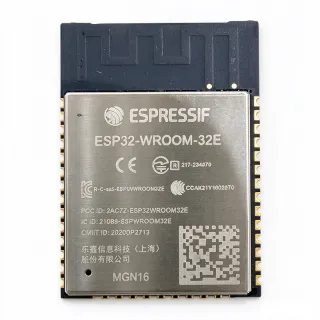
ESP32-S3-WROOM-1-N16R8 - WiFi+BLE 5, 16MB Flash | Espressif
MPN: ESP32-S3-WROOM-1-N16R8 ✓ Active| Qty | Unit Price | Extended |
|---|---|---|
| 1 | $3.95 | $3.95 |
| 10 | $3.55 | $35.50 |
| 100 | $3.16 | $316.00 |
| 500 | $2.85 | $1,425.00 |
| 1,000 | $2.6 | $2,600.00 |
ESP32-S3-WROOM-1-N16R8 Overview
A Wi-Fi plus Bluetooth LE module is a wireless system-in-package that integrates an RF transceiver, antenna, microcontroller, memory, and power management onto a single certified PCB assembly. Within the hierarchy of wireless connectivity solutions, such modules sit above bare SoCs (which require RF design expertise) and below complete single-board computers, making them the standard choice for IoT product integration.
Key differentiating features include 8 MB of octal SPI PSRAM for AI workloads, vector instructions for neural network computing acceleration, 36 GPIOs, and the ESP32-S3's rich peripheral set including SPI, I2S, I2C, UART, RMT, and a 14-bit LCD camera interface. The dual-core LX7 architecture allows one core to run the wireless protocol stack while the other executes user applications.
Technically, the module integrates the ESP32-S3R8 chip with the PSRAM die stacked inside, a 40 MHz crystal, flash memory, and a PCB antenna with matching network. The AI acceleration makes it suitable for wake word detection, speech command recognition, and camera-based face detection at the edge.
Typical applications include AIoT devices, smart speakers, home automation hubs, industrial sensor gateways, and battery-powered voice assistants.
Design considerations: respect strapping pin configurations (IO0, IO45, IO46) at boot, and note peak Wi-Fi TX currents near 350 mA require a low-ESR 3.3 V supply with adequate decoupling.
This page synthesizes distributor availability, same-family drop-in variants, and practical design notes not found in the manufacturer datasheet.
Drop-in alternatives for ESP32-S3-WROOM-1-N16R8 — same package, pin-to-pin compatible. Different-package parts requiring PCB rework are excluded.
Quick Comparison Tool — Select alternative parts for side-by-side comparison:
ESP32-S3-WROOM-1-N8R8
✅ Drop-In📋 Reference alternative (not in catalog)
ESP32-S3-WROOM-1-N16
✅ Drop-In📋 Reference alternative (not in catalog)
ESP32-S3-WROOM-1-N8R2
✅ Drop-In📋 Reference alternative (not in catalog)
ESP32-S3-WROOM-1U-N16R8
✅ Drop-In📋 Reference alternative (not in catalog)
ESP32-S3-WROOM-1-N16R8 Specifications (manufacturer-published)
| SoC | ESP32-S3R8 |
| CPU | Dual-core Xtensa 32-bit LX7, up to 240 MHz |
| Flash Memory | 16 MB Quad SPI |
| PSRAM | 8 MB Octal SPI |
| Wi-Fi Standard | 802.11 b/g/n, 2.4 GHz |
| Bluetooth | Bluetooth 5 (LE) |
| Antenna | PCB trace antenna |
| GPIO Count | 36 GPIOs |
| Supply Voltage | 3.3 V |
| Operating Temperature | -40C to +85C |
| Interface Peripherals | SPI, I2S, I2C, UART, RMT, LED PWM, LCD/Camera interface |
| AI Acceleration | Vector instructions for neural network and signal processing |
| Mounting Type | Surface Mount (castellated edges) |
| Frequency | 2.4 GHz |
| RoHS Status | Compliant |
| Module Dimensions | 18 mm x 25.5 mm x 3.1 mm |
| Protocols | Wi-Fi, Bluetooth LE, ESP-IDF / Arduino support |
ESP32-S3-WROOM-1-N16R8 Pin Configuration
| Pin 1 | GND — Ground |
| Pin 2 | 3V3 — Power supply input, 3.3 V |
| Pin 3 | EN — Chip enable (active high), strapping-related reset |
| Pin 4 | IO4 — GPIO4 / ADC1_CH3 |
| Pin 5 | IO5 — GPIO5 / ADC1_CH4 |
| Pin 6 | IO6 — GPIO6 / ADC1_CH5 |
| Pin 7 | IO7 — GPIO7 / ADC1_CH6 |
| Pin 8 | IO15 — GPIO15 / ADC2_CH4 / XTAL_32K_P |
| Pin 9 | IO16 — GPIO16 / ADC2_CH5 / XTAL_32K_N |
| Pin 10 | IO17 — GPIO17 / ADC2_CH6 |
| Pin 11 | IO18 — GPIO18 / ADC2_CH7 / USB_D- (via PHY on some boards) |
| Pin 12 | IO8 — GPIO8 / ADC1_CH7 / SUBSPICS1 |
| Pin 13 | IO19 — GPIO19 / USB_D- |
| Pin 14 | IO20 — GPIO20 / USB_D+ |
| Pin 15 | IO3 — GPIO3 / ADC1_CH2 |
| Pin 16 | IO46 — GPIO46 / strapping pin (boot mode) |
| Pin 17 | IO9 — GPIO9 / ADC1_CH8 / DQ1 (do not use when octal PSRAM active) |
| Pin 18 | IO10 — GPIO10 / ADC1_CH9 / DQ2 (reserved with octal PSRAM) |
| Pin 19 | IO11 — GPIO11 / DQ3 (reserved with octal PSRAM) |
| Pin 20 | IO12 — GPIO12 / SPIHD (reserved with octal PSRAM) |
| Pin 21 | IO13 — GPIO13 / SPIWP (reserved with octal PSRAM) |
| Pin 22 | IO14 — GPIO14 / SPICS1 (reserved with octal PSRAM) |
| Pin 23 | IO21 — GPIO21 |
| Pin 24 | IO47 — GPIO47 / SPIDQS (reserved with octal PSRAM) |
| Pin 25 | IO48 — GPIO48 (reserved with octal PSRAM) |
| Pin 26 | IO45 — GPIO45 / strapping pin (VDD_SPI voltage) |
| Pin 27 | IO0 — GPIO0 / strapping pin (boot mode, boot button) |
| Pin 28 | IO35 — GPIO35 (reserved with octal PSRAM) |
| Pin 29 | IO36 — GPIO36 (reserved with octal PSRAM) |
| Pin 30 | IO37 — GPIO37 (reserved with octal PSRAM) |
| Pin 31 | IO38 — GPIO38 (reserved with octal PSRAM) |
| Pin 32 | IO39 — GPIO39 / JTAG (MTCK) |
| Pin 33 | IO40 — GPIO40 / JTAG (MTDO) |
| Pin 34 | IO41 — GPIO41 / JTAG (MTDI) |
| Pin 35 | IO42 — GPIO42 / JTAG (MTMS) |
| Pin 36 | RXD0 (IO44) — UART0 receive |
| Pin 37 | TXD0 (IO43) — UART0 transmit |
| Pin 38 | IO2 — GPIO2 / ADC1_CH1 |
| Pin 39 | IO1 — GPIO1 / ADC1_CH0 |
| Pin 40 | GND — Ground |
| Pin 41 | GND — Ground / center exposed pad |
Power & Thermal Characteristics
| Power Input | 3.3 V |
| Operating Temperature | -40C to +85C |
Power input and thermal parameters for ESP32-S3-WROOM-1-N16R8 as published by the manufacturer.
Typical Applications
ESP32-S3-WROOM-1-N16R8 is suitable for 6 applications: AIoT Voice Assistants, Smart Home Automation Hubs, Camera and Face Detection Devices, Industrial IoT Sensor Gateways, Battery-Powered Wearables and Trackers, Smart Displays and HMI Panels.
AIoT Voice Assistants
The ESP32-S3-WROOM-1-N16R8 fits voice-controlled devices because its ESP32-S3 SoC provides vector instructions that accelerate neural network inference for wake word detection and speech command recognition, while 8 MB of octal PSRAM buffers continuous audio frames from an I2S microphone. In a typical smart speaker design, the module captures audio via I2S, runs Espressif's ESP-SR algorithms locally, and streams recognized commands or raw audio over Wi-Fi to the cloud. The 16 MB flash stores acoustic models and OTA firmware banks. Because inference runs at the edge, the device responds without network latency and keeps voice data private, a key differentiator versus cloud-only designs.
Recommended
Smart Home Automation Hubs
For smart home hubs and gateways, the module's simultaneous Wi-Fi (802.11 b/g/n) and Bluetooth 5 LE connectivity lets a single ESP32-S3-WROOM-1-N16R8 bridge BLE sensors and Wi-Fi backhaul without a second radio. The 36 GPIOs drive relays, read door sensors, and connect displays, while 16 MB flash holds multiple protocol stacks, web server assets, and OTA update images. The 3.3 V supply integrates directly into mainstream hub power architectures, and deep sleep modes support battery-powered sub-nodes. Developers benefit from mature ESP-IDF and Arduino ESP32 core support, including ESP RainMaker for cloud provisioning, shortening time to market for Matter-adjacent products.
Recommended
Camera and Face Detection Devices
The ESP32-S3-WROOM-1-N16R8 is well suited to compact vision devices because the ESP32-S3 SoC integrates an LCD/Camera peripheral supporting DVP cameras, and the 8 MB octal PSRAM provides the frame buffering that image pipelines demand. On-device face detection runs using Espressif's ESP-WHO framework accelerated by vector instructions, enabling doorbell and access-control products that make decisions locally. The 16 MB flash stores model weights and web configuration assets. A typical design pairs the module with an OV2640-class DVP camera, processes QVGA frames in PSRAM, and transmits events over Wi-Fi. Designers should budget supply current for concurrent camera capture and Wi-Fi TX bursts.
Recommended
Industrial IoT Sensor Gateways
In industrial settings, the module's -40C to +85C operating range, castellated surface-mount footprint for reliable soldering, and rich UART/SPI/I2C peripheral set make the ESP32-S3-WROOM-1-N16R8 a cost-effective sensor gateway controller. It aggregates Modbus or custom RS-485 data via UART transceivers, timestamps it, and uploads to MQTT brokers over Wi-Fi, while BLE handles local commissioning from a phone. The 8 MB PSRAM supports local data logging when the network is down, using the large flash for circular buffers. PCB designers should provide solid 3.3 V rail decoupling since Wi-Fi TX bursts approach 350 mA, and should keep the PCB antenna region clear of ground planes per Espressif hardware design guidelines.
Recommended
Battery-Powered Wearables and Trackers
For wearables and asset trackers, the ESP32-S3-WROOM-1-N16R8 combines Bluetooth 5 LE low-energy modes with Wi-Fi for occasional high-bandwidth sync, all in an 18 mm x 25.5 mm module with an integrated PCB antenna that removes RF tuning work from compact enclosures. Deep sleep and light sleep modes cut average current dramatically between BLE advertisements or sensor reads, and the RTC peripherals allow GPIO wake sources. The 16 MB flash supports OTA updates in the field, critical for deployed battery products. The 8 MB PSRAM even enables small on-device ML models for gesture or activity classification. Power budgeting should measure real sleep currents on the final PCB rather than relying on module-only estimates.
Recommended
Smart Displays and HMI Panels
The ESP32-S3's LCD/Camera interface and 8 MB of octal PSRAM make the N16R8 module a strong fit for cost-sensitive smart displays and HMI panels driving SPI or RGB touchscreens. Frame buffers reside in PSRAM, freeing the LX7 cores for application logic, networking, and voice input simultaneously; Espressif's esp-brookesia and LVGL ports provide mature UI stacks. The 16 MB flash accommodates UI assets, fonts, and multiple OTA images. Typical products include thermostat panels, appliance controls, and room controllers that combine a touchscreen, Wi-Fi provisioning, and BLE commissioning in one chip. Layout attention to the RGB interface routing length and 3.3 V current headroom for the display backlight is recommended.
Recommended
Recommended Products Summary
Engineering reference data for ESP32-S3-WROOM-1-N16R8 — comparison, design guidance, and compliance information.
Selection Guide
Comparison with Alternatives
| Parameter | This Product | ESP32-S3-WROOM-1-N8R8 | ESP32-S3-WROOM-1-N16 | ESP32-S3-WROOM-1-N8R2 | ESP32-S3-WROOM-1U-N16R8 |
|---|---|---|---|---|---|
| Package | SMD castellated module 18x25.5 mm, PCB antenna | Same footprint, PCB antenna | Same footprint, PCB antenna | Same footprint, PCB antenna | Same footprint, external antenna connector |
| Brand | Espressif Systems | Espressif Systems | Espressif Systems | Espressif Systems | Espressif Systems |
| CPU | Dual-core Xtensa LX7 up to 240 MHz | Dual-core Xtensa LX7 up to 240 MHz | Dual-core Xtensa LX7 up to 240 MHz | Dual-core Xtensa LX7 up to 240 MHz | Dual-core Xtensa LX7 up to 240 MHz |
| Flash | 16 MB Quad SPI | 8 MB Quad SPI | 16 MB Quad SPI | 8 MB Quad SPI | 16 MB Quad SPI |
| PSRAM | 8 MB Octal SPI | 8 MB Octal SPI | None | 2 MB Quad SPI | 8 MB Octal SPI |
| Antenna | PCB trace | PCB trace | PCB trace | PCB trace | External antenna connector |
| Wireless | Wi-Fi 802.11 b/g/n + Bluetooth 5 (LE) | Wi-Fi 802.11 b/g/n + Bluetooth 5 (LE) | Wi-Fi 802.11 b/g/n + Bluetooth 5 (LE) | Wi-Fi 802.11 b/g/n + Bluetooth 5 (LE) | Wi-Fi 802.11 b/g/n + Bluetooth 5 (LE) |
| Best Use Case | AIoT with large models and OTA dual-bank | AIoT where 8 MB flash suffices, lower cost | General IoT, no PSRAM needed | Cost-sensitive basic IoT | Metal enclosures / external antenna designs |
Key Differentiators
- Doubled flash storage for OTA and ML models (vs ESP32-S3-WROOM-1-N8R8)
- 8 MB octal PSRAM for AI and vision workloads (vs ESP32-S3-WROOM-1-N16)
- Integrated PCB antenna eliminates RF design work (vs ESP32-S3-WROOM-1U-N16R8)
Design Notes
Provide a 3.3 V supply rated for at least 500 mA headroom. Wi-Fi 802.11n TX bursts draw peak currents near 350 mA, and the 8 MB octal PSRAM adds dynamic current. Use a low-ESR 22 uF bulk capacitor plus 0.1 uF/1 uF ceramics close to the 3V3 and GND pins, and a solid ground connection to the center pad. Brownout during RF bursts is the most common cause of random module resets on first-rev boards.
Keep the PCB antenna region completely free of copper, ground planes, and components. Espressif's hardware design guidelines recommend a keep-out matching the module antenna area and placing the module at the board edge with the antenna extending outward. If the product uses a metal enclosure, choose the ESP32-S3-WROOM-1U-N16R8 with an external antenna instead of burying the trace antenna, since metal shielding can reduce range by an order of magnitude.
Respect the strapping pins at reset: IO0 (boot mode), IO45, and IO46 are sampled by the ROM bootloader, so attached peripherals must not pull them to invalid levels during power-up. Additionally, with the octal PSRAM of the R8 configuration, GPIO35, GPIO36, GPIO37, and several SPI pins are reserved for the PSRAM interface and must not be used in your design. Verify with the pin definitions table in the Espressif datasheet before finalizing the netlist.
Route USB D+/D- (IO19/IO20) as a 90-ohm differential pair if using native USB, and keep the EN pin RC reset circuit per Espressif reference designs to guarantee clean power-on reset. For flashing, bring out TXD0/RXD0 (IO43/IO44) and the boot button on IO0 on test points, since USB serial flashing may be unavailable in custom boot configurations.
Compliance Information
RoHS compliant per DigiKey listing and Espressif documentation. REACH, halogen-free, and conflict minerals declarations should be obtained directly from Espressif.