Espressif Systems

ESP32-S3-WROOM-1U - WiFi/BLE 5 Module, ESP32-S3 | Espressif

MPN: ESP32-S3-WROOM-1U ✓ Active
In Stock Ships in 1-3 business days
Up to 16 MB (variant dependent) Memory
From $2.25 USD / Unit
MOQ: 1 |
Price updated: 2026-10-15
Volume Pricing
Qty Unit Price Extended
1 $3.45 $3.45
10 $3.1 $31.00
100 $2.78 $278.00
500 $2.5 $1,250.00
1,000 $2.25 $2,250.00
ℹ️ All prices are in USD

ESP32-S3-WROOM-1U Overview

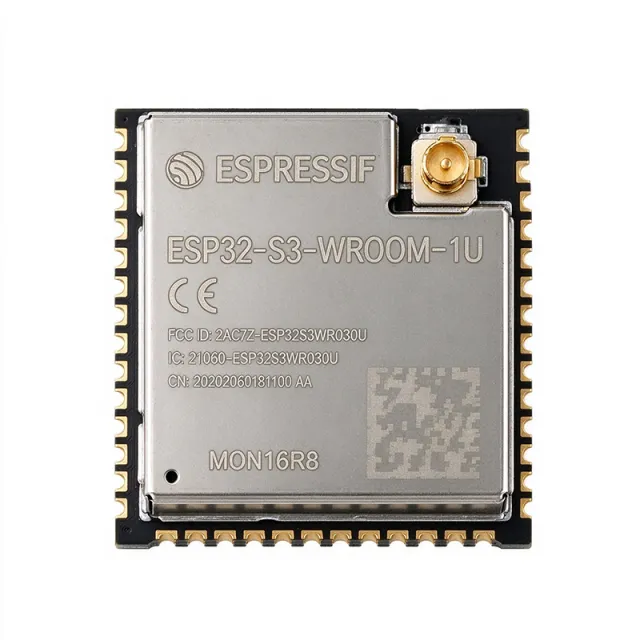
The Espressif Systems ESP32-S3-WROOM-1U is a generic 2.4 GHz Wi-Fi (802.11 b/g/n) and Bluetooth 5 (LE) MCU module built around the ESP32-S3 series SoC, featuring an Xtensa dual-core 32-bit LX7 processor, support for up to 16 MB flash and up to 8 MB PSRAM, and a U.FL connector for external antennas instead of an on-board PCB antenna.

A Wi-Fi + Bluetooth LE MCU module is a surface-mount system-in-package that integrates a wireless SoC, flash memory, crystal oscillator, RF matching network, and power management onto a single castellated-edge PCB. Modules occupy the top of the embedded wireless hierarchy - above bare SoCs, which require RF layout expertise, and below finished development boards - and are the standard building block for IoT products that need certified radio performance without in-house RF engineering.

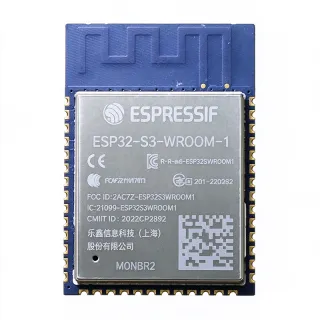
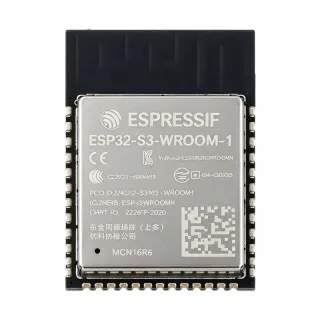
Key features of the ESP32-S3-WROOM-1U include up to 36 GPIOs with a rich peripheral set, hardware acceleration for neural network computing and signal processing workloads, native USB OTG on the ESP32-S3 SoC, and Bluetooth 5 LE long-range support. The U.FL (IPEX) antenna connector allows designers to place the antenna remotely or use higher-gain external antennas, which distinguishes it from the PCB-antenna ESP32-S3-WROOM-1 sibling in the same series.

Technically, the module is built around the ESP32-S3 SoC with dual-core LX7 CPUs clocked for general-purpose embedded workloads, integrating AI vector instructions that offload edge-inference tasks. The RF front end is pre-matched and pre-certified, dramatically reducing design risk compared to a discrete ESP32-S3 chip implementation where antenna matching and regulatory testing fall on the designer.

Typical applications include AIoT edge devices, voice assistant endpoints, smart-home controllers, industrial sensor gateways, and any product requiring an external or remote-mounted antenna such as metal-enclosure designs that route the U.FL cable to an external bulkhead antenna.

A key design consideration is strapping-pin handling: GPIO0, GPIO45, and GPIO46 configure boot mode and flash voltage at reset, so external circuits on these pins must respect datasheet pull-up/pull-down requirements to avoid boot failures.

This page synthesizes the Espressif datasheet, distributor availability, drop-in family alternatives, and practical design notes not found on the manufacturer product page alone.

Drop-in alternatives for ESP32-S3-WROOM-1U — same package, pin-to-pin compatible. Different-package parts requiring PCB rework are excluded.

Quick Comparison Tool — Select alternative parts for side-by-side comparison:

ESP32-S3-WROOM-1-N8

Espressif Systems
ESP32-S3-WROOM-1 · ESP32-S3 (dual-core Xtensa LX7) · 8 MB SPI flash · None (N8 variant) · 802.11 a/b/g/n, 2.4 GHz · Bluetooth v5.0 LE · PCB trace antenna

✓ In Stock

$2.8711 / Unit

View Datasheet →

ESP32-S3-WROOM-1-N16R8

Espressif Systems
ESP32-S3R8 · Dual-core Xtensa 32-bit LX7, up to 240 MHz · 16 MB Quad SPI · 8 MB Octal SPI · 802.11 b/g/n, 2.4 GHz · Bluetooth 5 (LE) · PCB trace antenna · 36 GPIOs

✓ In Stock

$2.8711 / Unit

View Datasheet →

ESP32-S3-WROOM-1U-N8

8 MB flash vs up to 16 MB on higher variants (-44% flash), same footprint and pinout

📋 Reference alternative (not in catalog)

ESP32-S3-WROOM-1U-N16R2

Espressif Systems
Dual-core Xtensa LX7 (ESP32-S3R2 SoC) · 240 MHz · 16 MB quad SPI · 2 MB quad SPI (die integrated in module) · 802.11 b/g/n, 2.4 GHz · Bluetooth 5.0 LE · External via U.FL (IPEX) connector, antenna not included · 3.0 V to 3.6 V (3.3 V typical)

✓ In Stock

$2.7891 / Unit

View Datasheet →

ESP32-S3-WROOM-1U-N16R8

adds 8 MB PSRAM for AI/framebuffer workloads; identical footprint and pinout

📋 Reference alternative (not in catalog)

ESP32-S3-WROOM-1U Specifications (manufacturer-published)

Core Processor Xtensa dual-core 32-bit LX7 (ESP32-S3 SoC)
Wi-Fi Standard 802.11 b/g/n, 2.4 GHz
Bluetooth Bluetooth 5 (LE)
Flash Memory Up to 16 MB (variant dependent)
PSRAM Up to 16 MB (variant dependent)
GPIO Count Up to 36 GPIOs
Antenna Type External antenna via U.FL connector (antenna not included)
AI Acceleration Neural network computing and signal processing acceleration
USB Native USB OTG (ESP32-S3 SoC)
Mounting Type Surface Mount (castellated edges)

ESP32-S3-WROOM-1U Interfaces & Connectors

ESP32-S3-WROOM-1U exposes the following interfaces and connectors as published by the manufacturer: Wireless, Bluetooth, GPIO, USB. Expansion header pinout, connector pin numbering, and electrical limits are defined in the manufacturer documentation.

Wireless 802.11 b/g/n, 2.4 GHz
Bluetooth Bluetooth 5 (LE)
GPIO Up to 36 GPIOs
USB Native USB OTG (ESP32-S3 SoC)

Refer to the manufacturer documentation for the full expansion header pinout and connector pin numbering.

Typical Applications

ESP32-S3-WROOM-1U is suitable for 6 applications: AIoT Edge Inference Devices, Smart Home Controllers and Hubs, Industrial Sensor Gateways, Voice Assistant Endpoints, Battery-Powered IoT Sensor Nodes, Connected Displays and HMI Panels.

🧩

AIoT Edge Inference Devices

The ESP32-S3-WROOM-1U is purpose-built for AIoT because the ESP32-S3 SoC provides hardware acceleration for neural network computing and signal processing workloads, per the Espressif datasheet. Voice keyword spotting, small vision models, and sensor-fusion inference run directly on the dual-core LX7 cores with vector instructions, avoiding a separate AI coprocessor. For workloads needing large tensor buffers, select an R-suffix variant with up to 8-16 MB PSRAM. The U.FL antenna connector lets the radio be routed to an optimal location when the inference hardware sits inside a metal or dense enclosure, preserving Wi-Fi cloud connectivity for model updates and telemetry.

🏠

Smart Home Controllers and Hubs

Smart-home hubs need concurrent Wi-Fi station/access-point operation and Bluetooth LE provisioning, which the ESP32-S3-WROOM-1U delivers with 802.11 b/g/n and Bluetooth 5 LE on one certified module. Up to 36 GPIOs interface relays, buttons, and sensors, while the rich peripheral set covers I2C, SPI, and UART buses for Zigbee/Thread bridge front ends. The U.FL connector allows a bulkhead antenna on a metal DIN-rail or wall-box enclosure, solving the RF shielding problem that defeats PCB-antenna modules. Strapping pins GPIO0/45/46 must follow datasheet pull requirements since hubs power-cycle frequently.

🏭

Industrial Sensor Gateways

In factory environments, the ESP32-S3-WROOM-1U aggregates Modbus, CAN (via external transceiver), and analog sensor data over Wi-Fi to MQTT brokers. The dual-core LX7 separates protocol stacks from application logic for deterministic sampling, and the signal-processing acceleration supports on-node filtering and FFT analysis before transmission. Industrial cabinets are typically metal, so the U.FL connector routing to an external omnidirectional antenna is frequently the deciding factor over the PCB-antenna ESP32-S3-WROOM-1. Wide operating conditions and castellated SMD mounting support reflow assembly on standard industrial PCB processes.

🎧

Voice Assistant Endpoints

Espressif targets voice applications explicitly: the ESP32-S3 series adds vector instructions for neural network computing, enabling always-on wake-word detection with Espressif's ESP-SR library running on-module. The U variant's external antenna improves receive sensitivity placement away from speaker-induced EMI and metal speaker housings. Audio front ends use I2S microphones (e.g., INMP441) with the module's I2S peripheral, and PSRAM-equipped variants (N8R8/N16R8) hold acoustic models and audio buffers that exceed internal SRAM. Typical designs pair the module with an I2S power amplifier for full voice-interaction products.

📱

Battery-Powered IoT Sensor Nodes

The ESP32-S3 supports deep-sleep modes in the low-microamp class (confirm exact figures in the module datasheet electrical characteristics), enabling multi-year battery life for periodic-reporting sensors. The dual-core LX7 completes burst sensing plus Wi-Fi transmission quickly, maximizing sleep duty cycle. ESP32-S3-WROOM-1U's U.FL antenna is advantageous when the node is mounted inside a weatherproof metal or foil-lined enclosure, where a PCB antenna would be detuned. Designers should route GPIO0 and GPIO46 free of leakage paths in sleep, since strapping-pin states are re-sampled at every wake from deep sleep.

📺

Connected Displays and HMI Panels

The ESP32-S3 integrates an LCD peripheral with RGB and I80 interfaces plus SPI display support, letting the ESP32-S3-WROOM-1U drive GUI panels directly - a role the older ESP32 generation could not fill well. PSRAM variants (up to 16 MB per the datasheet) hold full framebuffers for LVGL-based touch interfaces, and Wi-Fi plus BLE delivers OTA updates and mobile provisioning. Products with metal bezels benefit from the U.FL external antenna to avoid detuning. Use the ESP32-S3 hardware design guidelines for trace impedance on RGB buses to keep signal integrity at high pixel clocks.

Recommended Products Summary

ESP32-S3-WROOM-1U-N16R8 PSRAM-equipped variant for larger AI models Used in: AIoT Edge Inference Devices, Voice Assistant Endpoints, Connected Displays and HMI Panels ESP32-S3-DEVKITC-1 Development board for ESP32-S3 prototyping Used in: AIoT Edge Inference Devices ESP32-S3-WROOM-1-N16R8 Espressif Systems Used in: Smart Home Controllers and Hubs ESP32-C6-WROOM-1 Wi-Fi 6/Thread alternative for Matter hubs Used in: Smart Home Controllers and Hubs ESP32-S3-WROOM-1U-N8 Cost-optimized variant for simple telemetry nodes Used in: Industrial Sensor Gateways, Battery-Powered IoT Sensor Nodes TJA1051 CAN transceiver for industrial fieldbus Used in: Industrial Sensor Gateways ESP32-S3-BOX Reference design for voice assistant development Used in: Voice Assistant Endpoints BME280 Low-power environmental sensor companion Used in: Battery-Powered IoT Sensor Nodes FT6236 Capacitive touch controller over I2C Used in: Connected Displays and HMI Panels
What is the ESP32-S3-WROOM-1U module?
The ESP32-S3-WROOM-1U is a generic 2.4 GHz Wi-Fi (802.11 b/g/n) and Bluetooth 5 (LE) MCU module from Espressif Systems, built around the ESP32-S3 SoC with an Xtensa dual-core 32-bit LX7 processor. It supports up to 16 MB flash and up to 16 MB PSRAM, exposes up to 36 GPIOs, and uses a U.FL connector for an external antenna rather than an on-board PCB antenna. According to the Espressif datasheet, it also provides hardware acceleration for neural network computing and signal processing workloads.
What is the difference between ESP32-S3-WROOM-1U and ESP32-S3-WROOM-1?
The only fundamental difference is the antenna: the ESP32-S3-WROOM-1U has a U.FL connector for an external antenna (antenna not included), while the ESP32-S3-WROOM-1 has an on-board PCB antenna. Both share the same ESP32-S3 SoC, memory options, castellated footprint, and peripheral set, and per the Espressif datasheet both target the same AI and IoT application scenarios. Choose the 1U variant for metal enclosures or remote/higher-gain antennas.
What are the key specifications of ESP32-S3-WROOM-1U that engineers should know?
Key specifications: 2.4 GHz Wi-Fi 802.11 b/g/n plus Bluetooth 5 LE; ESP32-S3 SoC with Xtensa dual-core 32-bit LX7 CPU; up to 16 MB flash and up to 16 MB PSRAM depending on the orderable variant; up to 36 GPIOs; hardware acceleration for AI/NN and signal processing; U.FL external antenna connector, surface-mount castellated package. These figures come directly from the Espressif ESP32-S3-WROOM-1/1U datasheet.
Where to download the ESP32-S3-WROOM-1U datasheet PDF?
The official ESP32-S3-WROOM-1 and ESP32-S3-WROOM-1U combined datasheet PDF is available from Espressif documentation at documentation.espressif.com (esp32-s3-wroom-1_wroom-1u_datasheet_en.pdf). The document covers the overview, pin definitions, functional description, and electrical characteristics for both modules. Always use the Espressif documentation portal rather than third-party mirrors so you get the latest revision, since memory-configuration variants and strapping-pin guidance are updated periodically.
Where can I buy ESP32-S3-WROOM-1U and what does it cost?
The ESP32-S3-WROOM-1U is stocked by major distributors such as DigiKey (for example the ESP32-S3-WROOM-1U-N16 variant, DigiKey part listing 16162649) and Mouser. Pricing depends on the flash/PSRAM suffix; typical unit pricing for the family is roughly USD 2.25-3.45 at quantity-one levels as of 2026-10-11, with volume breaks at 10/100/500/1000 pieces. Check the live distributor listing for current stock and pricing, since Espressif module availability varies by memory variant.
What is the lead time and stock situation for ESP32-S3-WROOM-1U?
Lead time varies by memory variant and distributor. Common variants such as the -N8 and -N16 are typically in stock at DigiKey and Mouser with same-day shipment, while higher-memory variants (N16R8) can experience longer lead times during industry-wide memory shortages. The DigiKey listing for ESP32-S3-WROOM-1U-N16 states ships today as of the verification date 2026-10-11. For production volumes above 1000 pieces, confirm factory lead time with Espressif or an authorized Espressif distributor.
Can ESP32-WROOM-32UE replace ESP32-S3-WROOM-1U?
No, not as a verified drop-in replacement. Although ESP32-WROOM-32UE and ESP32-S3-WROOM-1U are similar castellated modules with a U.FL antenna option, they are built around different SoC generations (ESP32 vs ESP32-S3) and the cross-reference data provides no proven pin-to-pin compatibility. Third-party comparison sites discuss them side by side, but pinout verification against both datasheets is required before attempting a substitution. Stay within the ESP32-S3-WROOM-1/1U family for safe replacements.
What is the best replacement for ESP32-S3-WROOM-1U?
The safest replacement is another module in the ESP32-S3-WROOM-1/1U family with the same footprint: ESP32-S3-WROOM-1U-N8, ESP32-S3-WROOM-1U-N16, or the R-series variants with integrated PSRAM (N8R8, N16R8). These share the same castellated land pattern and pinout per the Espressif datasheet, differing only in flash/PSRAM density. If a PCB antenna is acceptable, ESP32-S3-WROOM-1 variants also fit the same footprint but change the antenna characteristic - re-verify RF range testing afterward.
Is ESP32-S3-WROOM-1U the same as ESP32-S3-WROOM-1U-N16?
Not exactly - N16 is a memory suffix within the 1U family. ESP32-S3-WROOM-1U is the base series name; the full orderable MPN carries a suffix indicating flash and PSRAM: N16 means 16 MB flash and no PSRAM, N16R8 means 16 MB flash plus 8 MB PSRAM (quad or octal per the variant table in the datasheet). When ordering or designing, always specify the complete suffix because firmware partition tables and PSRAM initialization differ between variants.
What is the best Espressif-family alternative with a PCB antenna for ESP32-S3-WROOM-1U?
The best same-family PCB-antenna equivalent is the ESP32-S3-WROOM-1 (for example the -N8R2 or -N16R8 variants). It uses the identical module footprint and pinout but replaces the U.FL connector with an on-board PCB antenna, eliminating the external antenna BOM item and its assembly cost. Per the Espressif datasheet both modules share the same ESP32-S3 SoC and memory options, but radiated performance and regulatory test reports differ, so antenna choice should be re-evaluated in your enclosure.
Is ESP32-S3-WROOM-1U suitable for AI and voice applications?
Yes. According to the Espressif datasheet, the ESP32-S3 SoC inside the module provides dedicated acceleration for neural network computing and signal processing workloads, making the module an ideal choice for AI-related application scenarios such as voice assistants and edge inference. Memory-heavy AI workloads should select an R-suffix variant with PSRAM (e.g., N8R8 or N16R8 with up to 8-16 MB PSRAM), since neural network buffers typically exceed internal SRAM capacity.
Does ESP32-S3-WROOM-1U include an antenna?
No. The ESP32-S3-WROOM-1U is the external-antenna variant of the series: it provides a U.FL (IPEX) RF connector and ships without an antenna, as confirmed by the DigiKey product description 'Antenna Not Included, U.FL Surface Mount.' Designers must add a U.FL-terminated 2.4 GHz antenna or a bulkhead antenna assembly. If an integrated antenna is preferred, choose the ESP32-S3-WROOM-1 (without the U) which has an on-board PCB antenna.
Which strapping pins must be considered when designing with ESP32-S3-WROOM-1U?
Critical strapping pins are GPIO0 (boot mode), GPIO45 (VDD_SPI/flash voltage), and GPIO46, which the ESP32-S3 samples at reset. External circuitry on these pins must respect the required pull-up/pull-down states described in the Espressif datasheet and the ESP32-S3 hardware design guidelines, otherwise the module may enter the wrong boot mode or set an incorrect flash voltage. Community references also flag these pins in ESP32-S3-WROOM pinout guides. Avoid capacitive loads and drivers that fight the internal strapping resistors on these nets.
ESP32-S3-WROOM-1U vs ESP32-S3-WROOM-1U-N16R8 - which should I choose?
Choose the N16R8 variant when your firmware needs large frame buffers, TensorFlow Lite Micro models, or display framebuffers: it adds 8 MB PSRAM to the 16 MB flash of the plain N16. Choose the base -N16 (or smaller -N8) when the application is simple telemetry or control where PSRAM is unnecessary, saving cost. Both share the same footprint and pinout, so the decision is purely firmware/memory - board layout does not change, and upgrading later is a solder-level swap on the same land pattern.
Is ESP32-S3-WROOM-1U supported by ESP-IDF, Arduino, and MicroPython toolchains?
Yes. The ESP32-S3 series is a first-class target in Espressif's ESP-IDF framework, and the WROOM-1U modules work with the Arduino core for ESP32 (select an ESP32-S3 board definition) and with MicroPython ESP32-S3 builds. Because the modules share the ESP32-S3 SoC, the same toolchain, flasher, and drivers apply across all WROOM-1/1U memory variants. Native USB OTG on the ESP32-S3 also allows flashing and serial monitoring over USB without an external UART bridge, simplifying development setups.

Engineering reference data for ESP32-S3-WROOM-1U — comparison, design guidance, and compliance information.

Selection Guide

Choose the ESP32-S3-WROOM-1U when your product needs a certified Wi-Fi + Bluetooth 5 LE module with AI acceleration AND an external antenna - metal enclosures, remote antenna placement, or higher-gain antenna requirements are the decisive scenarios. Select the memory suffix by firmware need: -N8 for simple connected devices, -N16 for larger OTA images without PSRAM needs, and -N16R8/-N8R8 for voice, display, or TensorFlow Lite workloads requiring PSRAM. Choose the PCB-antenna ESP32-S3-WROOM-1 variants (same footprint) when the antenna can sit inside a plastic enclosure, saving the U.FL cable, connector, and antenna BOM cost - but budget for RF range re-testing. Do not substitute ESP32-WROOM-32UE or other SoC-generation modules without full pinout verification, since cross-reference data confirms no proven drop-in compatibility outside the WROOM-1/1U family.

Comparison with Alternatives

Parameter This Product ESP32-S3-WROOM-1U-N8 ESP32-S3-WROOM-1U-N16 ESP32-S3-WROOM-1U-N16R8 ESP32-S3-WROOM-1-N8 ESP32-S3-WROOM-1-N16R8
Package Castellated SMD module with U.FL connector Same - U.FL module footprint Same - U.FL module footprint Same - U.FL module footprint Same footprint, PCB antenna instead of U.FL Same footprint, PCB antenna instead of U.FL
Brand Espressif Systems Espressif Systems Espressif Systems Espressif Systems Espressif Systems Espressif Systems
Core Xtensa dual-core 32-bit LX7 (ESP32-S3) Xtensa dual-core 32-bit LX7 (ESP32-S3) Xtensa dual-core 32-bit LX7 (ESP32-S3) Xtensa dual-core 32-bit LX7 (ESP32-S3) Xtensa dual-core 32-bit LX7 (ESP32-S3) Xtensa dual-core 32-bit LX7 (ESP32-S3)
Wireless Wi-Fi 802.11 b/g/n + Bluetooth 5 LE, 2.4 GHz Wi-Fi 802.11 b/g/n + Bluetooth 5 LE Wi-Fi 802.11 b/g/n + Bluetooth 5 LE Wi-Fi 802.11 b/g/n + Bluetooth 5 LE Wi-Fi 802.11 b/g/n + Bluetooth 5 LE Wi-Fi 802.11 b/g/n + Bluetooth 5 LE
Antenna External via U.FL (not included) External via U.FL (not included) External via U.FL (not included) External via U.FL (not included) On-board PCB antenna On-board PCB antenna
Flash Up to 16 MB (variant dependent) 8 MB 16 MB 16 MB 8 MB 16 MB
PSRAM Up to 16 MB (variant dependent) None None 8 MB None 8 MB
GPIOs Up to 36 Up to 36 Up to 36 Up to 36 Up to 36 Up to 36
AI Acceleration Yes (NN + signal processing) Yes (NN + signal processing) Yes (NN + signal processing) Yes (NN + signal processing) Yes (NN + signal processing) Yes (NN + signal processing)

Key Differentiators

  • External antenna flexibility via U.FL connector (vs ESP32-S3-WROOM-1-N16R8)
  • PSRAM options for AI workloads (vs ESP32-S3-WROOM-1U-N16)
  • AI/NN hardware acceleration on-module (vs ESP32-WROOM-32UE-N4)

Design Notes

Strapping pins GPIO0, GPIO45, and GPIO46 are sampled at reset and determine boot mode and flash voltage. Route these nets with minimal capacitance and ensure external pull-up/pull-down resistors match the states required in the Espressif datasheet. A push-button on GPIO0 is the standard BOOT entry method; avoid buffers or large filter capacitors that delay the pin reaching its required level before sampling. Violating strapping requirements is the most common cause of 'module does not boot' field failures.

Power the module from a clean 3.3V rail sized for Wi-Fi TX bursts - the ESP32-S3 RF power amplifier draws high peak current during 802.11 transmissions (consult the datasheet electrical characteristics table for exact figures). Place a low-ESR bulk capacitor plus 100 nF and 1 uF ceramic decoupling capacitors close to the module's 3V3 and GND pins. An under-designed supply manifests as Wi-Fi disconnects or brown-out resets during transmission, not at idle, so test with the radio actively streaming.

Follow the Espressif ESP32-S3 hardware design guidelines for the module keep-out: no signal routing or ground plane under the module body near the RF section, and keep the U.FL connector's microstrip/coax route to the antenna connector as short as possible with controlled 50-ohm impedance. For metal enclosures, place a bulkhead antenna and use a short U.FL-to-SMA pigtail; never fold the pigtail tightly against the shield can. Verify the ground connection of the U.FL connector shell to the module GND pads per the datasheet footprint.

Compliance Information

RoHS
Unknown
REACH
Unknown
AEC-Q100
Lead Free
Unknown
Halogen Free
Unknown
Conflict Minerals
Unknown

Compliance details were not present in the provided web data; consult the Espressif product page and regulatory documentation for RoHS/REACH certification status.

Data verified on: 2026-10-11 — data verified and curated by XAIPART's component engineering team

Related Searches

ESP32-S3-WROOM-1U datasheet ESP32-S3-WROOM-1U buy price Espressif ESP32-S3-WROOM-1U module ESP32-S3-WROOM-1U vs ESP32-S3-WROOM-1 ESP32-S3-WROOM-1U drop-in replacement ESP32-S3 module U.FL external antenna ESP32-S3-WROOM-1U-N16R8 PSRAM AI ESP32-S3-WROOM-1U pinout strapping pins ESP32-S3 WiFi Bluetooth LE module for smart home what can replace ESP32-S3-WROOM-1U ESP32-S3-WROOM-1U lead time stock ESP32-S3 voice assistant wake word module

Related Components & Terms

Espressif Systems ESP32-S3-WROOM-1U ESP32-S3-WROOM-1 ESP32-S3-WROOM-1U-N16R8 ESP32-S3 ESP32-WROOM-32UE Xtensa LX7 Wi-Fi 802.11 b/g/n Bluetooth 5 LE U.FL connector PCB antenna MCU module system-in-package PSRAM flash memory neural network acceleration strapping pins IoT AIoT voice assistant surface mount RoHS
Quick Quote RFQ
Fill in complete details — our sales team will respond within 24 hours
Part Number Manufacturer Package QTY Target Price Extended
Total: $0.00 USD
✓
Quote submitted!

We will respond to your email within 24 hours

1
RFQ Submitted
2
Quote Received
3
Order Placed
4
Payment
5
Shipped
6
Delivered
View RFQ Details