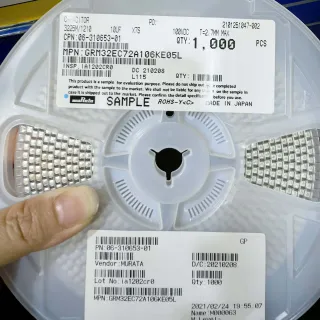
GCM155R71H104KE02D - 0.1µF 50V X7R 0402 MLCC | Murata
MPN: GCM155R71H104KE02D ✓ Active| Qty | Unit Price | Extended |
|---|---|---|
| 1 | $0.1 | $0.10 |
| 10 | $0.08 | $0.80 |
| 100 | $0.05 | $5.00 |
| 1,000 | $0.03 | $30.00 |
| 10,000 | $0.02 | $200.00 |
GCM155R71H104KE02D Overview
An X7R MLCC is a Class II multilayer ceramic capacitor whose dielectric (barium titanate based) provides moderate-to-high volumetric efficiency and stable capacitance over a wide temperature range. Capacitors like the GCM155R71H104KE02D belong to the broader taxonomy: capacitor -> ceramic capacitor -> MLCC -> Class II MLCC -> X7R MLCC -> automotive-grade X7R MLCC. They occupy the gap between low-K NP0/C0G parts (zero TC, low density) and Class III/Y5V/Z5U parts (high density but poor stability).
Key features include a 0402 EIA case (1.0 × 0.5 mm) for high-density PCB layouts, 50 VDC rated voltage with X7R ±15% TC, ±10% capacitance tolerance, and compliance with AEC-Q200 stress-test requirements for automotive electronics. The X7R dielectric delivers high ripple-current capability and low ESR at switching frequencies, supporting bulk decoupling on 12 V automotive rails and IC supply pins.
The GCM series uses nickel-barrier terminations with 100% matte-tin plating for excellent solderability and resistance to leaching during reflow. The internal electrode is nickel (Ni), the standard for cost-effective X7R parts. The construction is qualified for lead-free reflow at peak 260 °C, matching standard JEDEC J-STD-020 profile.
Typical applications include decoupling of automotive ECU microcontrollers, bypassing sensors and transceivers, noise suppression on CAN/LIN/FlexRay transceivers, ADAS camera and radar power conditioning, and general-purpose filtering on 5 V, 12 V, and 24 V rails. It is also used in industrial control, factory automation, and consumer power-conversion modules.
When designing with this part, choose 0402 to maximize PCB density but respect the 0.5 mm pad-to-pad creepage - use 0.2-0.3 mm solder land extensions. For DC bias derating on 50 V X7R parts, expect -15% to -50% capacitance drop at 12-25 V applied DC; for noise-sensitive analog stages consider NP0/C0G alternatives.
This page synthesizes distributor pricing, AEC-Q200 qualification context, drop-in alternatives, and practical PCB layout notes that go beyond the manufacturer datasheet summary.
Drop-in alternatives for GCM155R71H104KE02D — same package, pin-to-pin compatible. Different-package parts requiring PCB rework are excluded.
Quick Comparison Tool — Select alternative parts for side-by-side comparison:
GRM155R71H104KE14D
✅ Drop-In📋 Reference alternative (not in catalog)
GCM155R71H104KE02J
✅ Drop-In📋 Reference alternative (not in catalog)
CGA2B3X7R1H104K050BB
✅ Drop-In📋 Reference alternative (not in catalog)
CL05B104KB5NNNC
✅ Drop-In📋 Reference alternative (not in catalog)
CC0402KRX7R9BB104
✅ Drop-In📋 Reference alternative (not in catalog)
GCM155R71H104KE02D Maximum Ratings & Electrical Characteristics
| Capacitance | 0.1 µF (100 nF) |
| Capacitance Tolerance | ±10% |
| Rated Voltage (VDC) | 50 V |
| Dielectric / Temperature Characteristic | X7R (±15% TC, -55 °C to +125 °C) |
| Package / Case | 0402 (1005 Metric), 1.0 × 0.5 mm |
| Mounting Type | Surface Mount (SMD) |
| Automotive Qualification | AEC-Q200 |
| Termination Style | Nickel-barrier with matte-tin plating |
| Internal Electrode | Nickel (Ni) |
| Operating Temperature Range | -55 °C to +125 °C |
| MSL Level | 1 (per JEDEC J-STD-020, unlimited floor life) |
| Reflow Peak Temperature | 260 °C (lead-free reflow compatible) |
| RoHS Status | Compliant |
| REACH Status | Compliant |
| Lead-Free | Yes |
| Halogen-Free | Yes |
| Series | GCM (Automotive Grade MLCC) |
GCM155R71H104KE02D Pin Configuration
| Pin 1 | Terminal 1 — Solder terminal (non-polarized) |
| Pin 2 | Terminal 2 — Solder terminal (non-polarized) |
Typical Applications
GCM155R71H104KE02D is suitable for 6 applications: Automotive ECU Decoupling, CAN/LIN/FlexRay Transceiver Bypass, ADAS Camera & Radar Power Filtering, Industrial PLC & Factory Automation, Switch-Mode Power Supply (SMPS) Snubber & Filter, IoT & Sensor Node Decoupling.
Automotive ECU Decoupling
The GCM155R71H104KE02D is purpose-built for decoupling automotive ECU microcontroller and ASIC supply pins, where the AEC-Q200 qualification and 50 V rating provide reliability headroom over 5 V/12 V rail transients. The 0.1 µF X7R capacitance delivers low-impedance broadband decoupling from approximately 1 MHz to 100 MHz when paired with a smaller 1 nF-10 nF X7R in parallel. Its 0402 case fits the high-density layouts of modern engine-control, transmission, and body modules. Compared to a 50 V NP0 alternative, the X7R dielectric provides 5-10× higher volumetric efficiency at this capacitance, which is critical when 30-50 decoupling capacitors must surround a single microcontroller. Use one GCM155R71H104KE02D per IC supply pin with a 0.1 Ω ferrite bead to filter both high- and low-frequency noise.
Recommended
CAN/LIN/FlexRay Transceiver Bypass
In CAN, LIN, and FlexRay automotive transceivers, the GCM155R71H104KE02D serves as the VCC bypass capacitor placed within 1-2 mm of the transceiver supply pin to suppress EMI from the bus edges. Its AEC-Q200 qualification is mandatory for OEM-qualified automotive networking designs, and the 50 V rating easily covers 12 V and 24 V battery transients including load-dump spikes up to 35 V. The X7R dielectric keeps capacitance stable from -40 °C cold-start to +125 °C under-hood operation, ensuring the bus signal integrity is preserved across the full automotive temperature range. Typical designs use one 0.1 µF + one 1 nF + one 100 pF triple-bypass network at each transceiver supply pin.
Recommended
ADAS Camera & Radar Power Filtering
The GCM155R71H104KE02D is widely specified for ADAS camera and short-range radar power conditioning, where AEC-Q200 qualification and miniaturized 0402 footprint are essential. The 0.1 µF X7R provides effective filtering of high-frequency switching noise from upstream POL converters that would otherwise couple into the sensitive analog front-end of the image sensor or MMIC. In a 77 GHz radar PCB, a GCM155R71H104KE02D placed on each LDO output (1.8 V, 3.3 V) reduces ripple by 20-40 dB at the sensor's operating frequency band. The 50 V rating gives large derating margin on the 12 V camera/radar input rail, supporting 24 V automotive systems with no part change.
Recommended
Industrial PLC & Factory Automation
Factory automation PLCs, motor drives, and servo controllers rely on the GCM155R71H104KE02D for decoupling 24 V rail logic and I/O isolator supplies where automotive-grade reliability translates directly to long-term industrial reliability. The X7R ±15% TC and -55 °C to +125 °C operating range cover factory-floor temperature swings, while the AEC-Q200 qualification provides documented mechanical-shock and vibration resilience required for machinery-mounted cabinets. Its 50 V rating comfortably handles 24 V industrial bus transients. Use the GCM155R71H104KE02D on each digital isolator VCC pin and on each RS-485 transceiver supply pin.
Recommended
Switch-Mode Power Supply (SMPS) Snubber & Filter
In SMPS secondary-side filtering and snubber networks, the GCM155R71H104KE02D's 50 V rating and AEC-Q200 reliability make it a robust choice for output filter caps on 5 V, 12 V, and 15 V rails. The 0.1 µF X7R, placed in parallel with an electrolytic bulk cap, attenuates switching-frequency ripple (typically 100 kHz to 1 MHz) by 15-25 dB in LLC and flyback topologies. The 0402 case enables tight placement near the synchronous rectifier MOSFET gate drive. AEC-Q200 qualification ensures long-term reliability under thermal cycling between cold idle and full-load operation.
Recommended
IoT & Sensor Node Decoupling
Battery-powered IoT sensor nodes, BLE beacons, and wearable devices use the GCM155R71H104KE02D as a primary MCU and wireless-IC decoupling capacitor where 0402 size and 50 V headroom give design margin for both 3.3 V Li-ion and energy-harvesting supply rails. The X7R dielectric's stable capacitance from -40 °C to +85 °C keeps the LDO control loop stable across cold outdoor and warm body-worn operating conditions. Although AEC-Q200 is over-spec for consumer IoT, the GCM series often costs only marginally more than GRM, making it a popular upgrade for designs that may later pivot to automotive variants.
Recommended
Recommended Products Summary
Engineering reference data for GCM155R71H104KE02D — comparison, design guidance, and compliance information.
Selection Guide
Comparison with Alternatives
| Parameter | This Product | GRM155R71H104KE14D | GCM155R71H104KE02J | CGA2B3X7R1H104K050BB | CL05B104KB5NNNC | CC0402KRX7R9BB104 |
|---|---|---|---|---|---|---|
| Package | 0402 (1005 Metric) | 0402 (1005 Metric) - same | 0402 (1005 Metric) - same | 0402 (1005 Metric) - same | 0402 (1005 Metric) - same | 0402 (1005 Metric) - same |
| Brand | Murata Manufacturing | Murata Manufacturing | Murata Manufacturing | TDK | Samsung Electro-Mechanics | Yageo |
| Capacitance | 0.1 µF | 0.1 µF | 0.1 µF | 0.1 µF | 0.1 µF | 0.1 µF |
| Rated Voltage | 50 VDC | 50 VDC | 50 VDC | 50 VDC | 50 VDC | 50 VDC |
| Dielectric | X7R | X7R | X7R | X7R | X7R | X7R |
| Tolerance | ±10% | ±10% | ±10% | ±10% | ±10% | ±10% |
| AEC-Q200 Qualification | Yes | No | Yes | Yes | No | No |
| Operating Temperature | -55 °C to +125 °C | -55 °C to +125 °C | -55 °C to +125 °C | -55 °C to +125 °C | -55 °C to +125 °C | -55 °C to +125 °C |
| RoHS / Lead-Free | Yes / Yes | Yes / Yes | Yes / Yes | Yes / Yes | Yes / Yes | Yes / Yes |
Key Differentiators
- AEC-Q200 qualified as standard (vs GRM155R71H104KE14D)
- Wide automotive-grade second-source ecosystem (vs CL05B104KB5NNNC)
- 50 V rating provides 4× derating headroom on 12 V rails (vs GRM155R71H104KE14D)
Design Notes
Place the GCM155R71H104KE02D within 1-2 mm of the IC supply pin, with vias connecting the pad to the inner power/ground planes. Recommended land dimensions per IPC-7351 nominal are 0.40 mm × 0.50 mm pads with 0.50 mm center-to-center spacing; deviating outside 0.35-0.55 mm pad width causes tombstoning or weak solder joints. Use 0.2-0.3 mm solder-mask dams between the two pads to prevent solder bridging during reflow.
For multi-decoupling capacitor networks around high-pin-count microcontrollers (e.g. 100+ pins), parallel the GCM155R71H104KE02D with smaller-value 1 nF-10 nF X7R caps to broaden the low-impedance band. The 0.1 µF dominates above ~10 MHz; smaller caps handle 100 MHz-1 GHz. Place smaller caps closer to the IC than the 0.1 µF. Keep the ground-via within 1 pad-pitch of the cap's ground terminal to minimize parasitic inductance, which would otherwise nullify high-frequency decoupling effectiveness above ~50 MHz.
Estimated: At 25 VDC applied bias (50% of 50 V rating), an X7R 0.1 µF 0402 typically loses 15-25% of nominal capacitance due to the dielectric's DC-bias coefficient; at 50 VDC the loss is 30-50%. For noise-sensitive analog filters or sample-and-hold stages, this derating shifts the cutoff frequency and must be accounted for in design calculations. If bias-stable capacitance is required (e.g. in ADC anti-alias filters), substitute an NP0/C0G dielectric of the same value at higher cost and larger case.
Compliance Information
AEC-Q200 qualified per Murata GCM automotive MLCC datasheet. RoHS and REACH compliant per EU directives. Halogen-free per Murata product declaration. AEC-Q200 (automotive passive components) is the applicable qualification standard; AEC-Q100 is for active ICs and not applicable here.