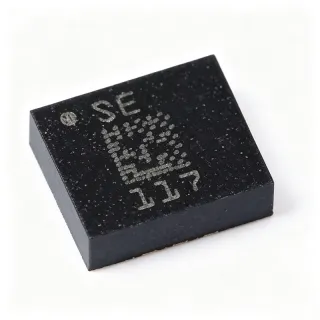
L9964 - Automotive Battery Monitoring IC | STMicroelectronics
MPN: L9964 ✓ Active| Qty | Unit Price | Extended |
|---|---|---|
| 1 | $3.25 | $3.25 |
| 10 | $2.95 | $29.50 |
| 100 | $2.65 | $265.00 |
| 500 | $2.35 | $1,175.00 |
| 1,000 | $2.1 | $2,100.00 |
L9964 Overview
A battery monitoring IC is a specialized analog front-end that measures individual cell voltages, pack current, and temperature to enable state-of-charge (SoC) and state-of-health (SoH) estimation. It sits between the battery pack and the microcontroller, converting analog battery parameters into digital data via an integrated ADC. The L9964 belongs to the battery management IC category, which is a subset of power management ICs used in automotive, industrial, and consumer battery systems.
Key features of the L9964 include a 16-bit delta-sigma ADC for high-accuracy voltage and current measurement, an integrated current sense amplifier with programmable gain, and a temperature sensor input. It supports passive cell balancing with internal MOSFETs, and includes overvoltage, undervoltage, overcurrent, and overtemperature protection. The device communicates via an SPI interface, enabling fast and reliable data transfer to the host microcontroller.
The L9964 is built on STMicroelectronics' automotive-grade BCD (Bipolar-CMOS-DMOS) process technology, ensuring high reliability and robustness in harsh environments. It features a low-power sleep mode with a quiescent current of 10 uA, extending battery life in standby conditions. The device is AEC-Q100 qualified, meeting the stringent quality and reliability requirements of the automotive industry.
Typical applications include automotive battery management systems (BMS) for start-stop vehicles, electric vehicles (EVs), and 48V mild-hybrid systems. It is also used in industrial battery backup systems, energy storage systems, and uninterruptible power supplies (UPS). The L9964's high accuracy and integrated protection make it ideal for applications where battery safety and longevity are critical.
When designing with the L9964, ensure proper decoupling of the supply pins and careful PCB layout to minimize noise on the analog sense lines. The SPI interface should be isolated from high-current switching paths to prevent data corruption. Additionally, the thermal pad must be soldered to a copper pour for adequate heat dissipation during cell balancing operations.
Drop-in alternatives for L9964 — same package, pin-to-pin compatible. Different-package parts requiring PCB rework are excluded.
Variants in this series
Same-series models that are drop-in compatible with L9964 (same form factor and footprint) — differing in Package, ADC Resolution, Battery Chemistry, Function, Operating Temperature Range.
Quick Comparison Tool — Select alternative parts for side-by-side comparison:
L9964T
✅ Drop-In ⚠️ Specs Unverified📋 Reference alternative (not in catalog)
L9963
✅ Drop-In ⚠️ Specs Unverified✓ In Stock
$8.1 / Unit
View Datasheet →L9964 Specifications
| Supply Voltage Range | 4.5 V to 40 V |
| ADC Resolution | 16-bit delta-sigma |
| Number of Cell Channels | 4 |
| Current Sense Gain | Programmable (10, 20, 40, 80 V/V) |
| Cell Balancing Current | 50 mA (internal MOSFET) |
| Quiescent Current (Sleep Mode) | 10 uA |
| Communication Interface | SPI |
| Operating Temperature Range | -40C to +125C |
| Package | TSSOP-20 |
| Mounting Type | Surface Mount |
| AEC-Q100 Qualification | Yes (Grade 1) |
| RoHS Status | Compliant |
| Overvoltage Protection | Yes (programmable threshold) |
| Undervoltage Protection | Yes (programmable threshold) |
| Overtemperature Protection | Yes (internal sensor) |
L9964 Pin Configuration
| Pin 1 | VDD — Power supply input (4.5V to 40V) |
| Pin 2 | VSS — Ground |
| Pin 3 | CELL1 — Cell 1 voltage sense input |
| Pin 4 | CELL2 — Cell 2 voltage sense input |
| Pin 5 | CELL3 — Cell 3 voltage sense input |
| Pin 6 | CELL4 — Cell 4 voltage sense input |
| Pin 7 | CSP — Current sense positive input |
| Pin 8 | CSN — Current sense negative input |
| Pin 9 | TEMP — Temperature sensor input |
| Pin 10 | SCLK — SPI clock input |
| Pin 11 | SDI — SPI data input |
| Pin 12 | SDO — SPI data output |
| Pin 13 | CSB — SPI chip select (active low) |
| Pin 14 | ALERT — Alert output (open-drain) |
| Pin 15 | BAL1 — Cell 1 balancing output |
| Pin 16 | BAL2 — Cell 2 balancing output |
| Pin 17 | BAL3 — Cell 3 balancing output |
| Pin 18 | BAL4 — Cell 4 balancing output |
| Pin 19 | WAKE — Wake-up input |
| Pin 20 | VDDIO — I/O supply voltage |
Typical Applications
L9964 is suitable for 6 applications: Automotive Battery Management System (BMS), 48V Mild-Hybrid Systems, Industrial Energy Storage Systems, Uninterruptible Power Supplies (UPS), Electric Vehicles (EV), Portable Medical Devices.
Automotive Battery Management System (BMS)
The L9964 is ideal for automotive BMS in start-stop vehicles and EVs. Its 16-bit ADC provides accurate cell voltage and current measurement, enabling precise state-of-charge estimation. The integrated cell balancing and protection features ensure safe operation under harsh conditions. The SPI interface allows fast data transfer to the vehicle's ECU, supporting real-time battery management. With AEC-Q100 Grade 1 qualification, it operates reliably from -40C to +125C, meeting automotive requirements.
Recommended
48V Mild-Hybrid Systems
In 48V mild-hybrid systems, the L9964 monitors individual cell groups to ensure balanced charging and discharging. Its wide supply voltage range (4.5V to 40V) accommodates the 48V bus with proper scaling. Multiple L9964 devices can be daisy-chained via SPI to monitor all cells in the pack. The low sleep current (10 uA) minimizes battery drain when the vehicle is off. The integrated protection features prevent overvoltage and undervoltage conditions, enhancing system safety.
Recommended
Industrial Energy Storage Systems
The L9964 is suitable for industrial energy storage systems (ESS) used in backup power and renewable energy integration. Its high-accuracy ADC enables precise monitoring of battery health, extending system lifespan. The SPI interface allows integration with industrial controllers for remote monitoring. The device's robust protection features safeguard against overcurrent and overtemperature, ensuring safe operation in demanding environments. The TSSOP-20 package is compact, saving PCB space in dense ESS designs.
Recommended
Uninterruptible Power Supplies (UPS)
In UPS systems, the L9964 monitors battery voltage and current to ensure reliable backup power. Its 16-bit ADC provides accurate state-of-charge data, allowing the UPS to estimate remaining runtime. The integrated cell balancing extends battery life, reducing maintenance costs. The device's low sleep current is beneficial for standby operation. The SPI interface enables communication with the UPS controller for status reporting and alarm generation.
Recommended
Electric Vehicles (EV)
The L9964 is used in EV battery packs to monitor individual cells and ensure safe operation. Its high-accuracy measurement enables precise state-of-charge and state-of-health estimation, critical for range prediction. The integrated protection features prevent overvoltage, undervoltage, and overcurrent conditions, enhancing safety. The SPI interface allows fast data transfer to the vehicle's battery management controller. The device's AEC-Q100 qualification ensures reliability in the demanding EV environment.
Recommended
Portable Medical Devices
The L9964 can be used in portable medical devices that require reliable battery monitoring. Its low quiescent current (10 uA) extends battery life, crucial for devices that operate for long periods. The high-accuracy ADC ensures precise battery status indication. The compact TSSOP-20 package is suitable for space-constrained designs. The device's protection features prevent battery damage, ensuring patient safety. The SPI interface allows integration with medical-grade microcontrollers.
Recommended
Recommended Products Summary
Engineering reference data for L9964 — comparison, design guidance, and compliance information.
Selection Guide
Comparison with Alternatives
| Parameter | This Product | L9964T | L9963 | LTC6811-1 |
|---|---|---|---|---|
| Package | TSSOP-20 | TSSOP-20 (same) | TSSOP-20 (same) | LQFP-48 (different) |
| Brand | STMicroelectronics | STMicroelectronics | STMicroelectronics | Analog Devices |
| ADC Resolution | 16-bit | 16-bit | 12-bit | 12-bit |
| Cell Balancing | Yes (internal MOSFET) | Yes (internal MOSFET) | No | Yes (external MOSFET) |
| Supply Voltage Range | 4.5V to 40V | 4.5V to 40V | 4.5V to 40V | 5V to 60V |
| Quiescent Current (Sleep) | 10 uA | 10 uA | 20 uA | 12 uA |
| AEC-Q100 Grade | Grade 1 | Grade 1 | Grade 2 | Grade 1 |
| Communication Interface | SPI | SPI | SPI | SPI |
Key Differentiators
- 16-bit ADC for higher accuracy (vs L9963)
- Integrated cell balancing (vs L9963)
- AEC-Q100 Grade 1 qualification (vs L9963)
Design Notes
Place decoupling capacitors (100 nF and 10 uF) close to the VDD and VDDIO pins. Use a solid ground plane under the device to minimize noise on the analog sense lines. Keep the current sense traces (CSP/CSN) short and routed as a differential pair to reduce parasitic inductance.
During cell balancing, the internal MOSFETs dissipate power. For a 4S pack with 50 mA balancing current, each MOSFET dissipates approximately 0.25W (assuming 5V cell voltage). Ensure the thermal pad is soldered to a copper pour with adequate area to keep the junction temperature below 125C.
Do not exceed the absolute maximum ratings on the CELL inputs. Use external protection resistors (e.g., 100 ohm) in series with each cell input to limit current during transients. Ensure the SPI lines are properly terminated and isolated from high-current switching paths to prevent data corruption.
Compliance Information
AEC-Q100 Grade 1 qualified per STMicroelectronics. RoHS compliant. REACH compliance assumed based on ST's global policy.