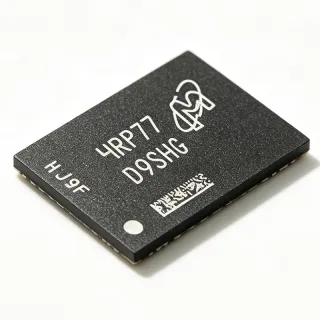
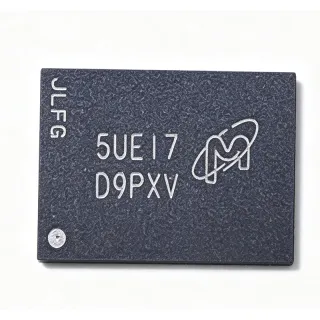
MT47H32M16NF-25E:H - 512Mb DDR2 SDRAM 400MHz FBGA-84 | Micron
MPN: MT47H32M16NF-25E:H ✓ Active| Qty | Unit Price | Extended |
|---|---|---|
| 1 | $12.89 | $12.89 |
| 10 | $11.6 | $116.00 |
| 100 | $10.31 | $1,031.00 |
| 500 | $9.02 | $4,510.00 |
| 1,000 | $7.73 | $7,730.00 |
MT47H32M16NF-25E:H Overview
DDR2 SDRAM (Double Data Rate Type Two Synchronous Dynamic Random Access Memory) is a class of DRAM that transfers data on both the rising and falling edges of the clock, doubling effective bandwidth relative to SDR SDRAM at the same clock rate. In the memory hierarchy, DDR2 SDRAM sits between DDR1 and DDR3, forming part of the broader DRAM -> volatile memory -> semiconductor memory family used as main memory in embedded and computing systems.
Key features of the MT47H32M16NF-25E family include a 1.8V core supply, 400 MHz operation (DDR2-800 data-rate class given the -25E speed grade), on-die termination (ODT), auto-precharge functionality, and a data mask (DM) function for write masking. The x16 organization with 16-bit data bus simplifies board-level routing in cost-sensitive embedded designs that do not need the full 64-bit wide memory bus of PC-class DIMMs.
The architecture uses a 4-bank organization with burst lengths of 4 and 8, programmable CAS latency, and Posted CAS with additive latency to improve command bus efficiency. Differential strobes (DQS/DQS#) provide precise data capture timing at the controller, and the 400 ps output jitter figure supports reliable source-synchronous timing closure at full speed. Temperature variants include commercial (0C to +85C), industrial IT (-40C to +95C), automotive AAT/AIT grades, with the :H suffix denoting lead-free/RoHS-friendly ball metallurgy.
Typical applications include legacy industrial controllers, networking equipment line cards, set-top boxes, medical instrumentation, and embedded processor memory subsystems built around controllers that support DDR2-800 x16 devices.
Design consideration: FBGA ball packages require X-ray or acoustic inspection for solder-joint quality and exact footprint adherence to JEDEC ball maps; verify controller ODT settings against the datasheet termination table.
This page synthesizes distributor pricing, drop-in alternatives, and practical design notes not found in the manufacturer datasheet.
Drop-in alternatives for MT47H32M16NF-25E:H — same package, pin-to-pin compatible. Different-package parts requiring PCB rework are excluded.
Variants in this series
Same-series models that are drop-in compatible with MT47H32M16NF-25E:H (same form factor and footprint) — differing in Mounting Type, Organization, Package.
Quick Comparison Tool — Select alternative parts for side-by-side comparison:
MT47H32M16NF-25E IT:H
✅ Drop-In📋 Reference alternative (not in catalog)
MT47H32M16NF-25E AIT:H
✅ Drop-In📋 Reference alternative (not in catalog)
MT47H32M16NF-25E AAT:H
✅ Drop-In📋 Reference alternative (not in catalog)
AS4C32M16D2A-25BAN
✅ Drop-In📋 Reference alternative (not in catalog)
MT47H32M16NF-25E:H Maximum Ratings & Electrical Characteristics
| Memory Type | DDR2 SDRAM |
| Density | 512 Mbit |
| Organization | 32M x 16 |
| Clock Frequency | 400 MHz |
| Output Jitter | 400 ps |
| Supply Voltage | 1.8 V |
| Interface | Parallel |
| Package | 84-FBGA (8 x 12.5 mm) |
| Speed Grade | -25E |
| Operating Temperature (IT variant) | -40C to +95C |
| On-Die Termination (ODT) | Yes |
| Auto Precharge | Yes |
| Data Mask Function | Yes |
| Mounting Type | Surface Mount |
| RoHS Status | Compliant (:H lead-free suffix) |
| FBGA Code | D9SBV |
MT47H32M16NF-25E:H 84-fbga (8 x 12.5 mm) Pin Configuration Guide
Pin configuration for MT47H32M16NF-25E:H (84-fbga (8 x 12.5 mm) package). This digital IC includes GPIO, communication interfaces (UART, SPI, I2C), and power pins. Refer to the manufacturer datasheet for alternate pin functions and configuration options. Essential for embedded system design and PCB layout.

No detailed pinout data available for MT47H32M16NF-25E:H.
Refer to the datasheet for full pin configuration.
Typical Applications
MT47H32M16NF-25E:H is suitable for 6 applications: Legacy Industrial Controllers, Networking Equipment Line Cards, Set-Top Boxes and Consumer Multimedia, Medical Instrumentation Main Memory, Automotive Infotainment and Telematics (Legacy), Test and Measurement Equipment.
Legacy Industrial Controllers
The MT47H32M16NF-25E:H is a mainstay for sustaining legacy industrial controller platforms designed around DDR2 memory controllers. Its 512 Mbit capacity in a 32M x16 organization matches the x16-only memory controllers common in industrial MPUs, and the 1.8V supply integrates cleanly with existing power trees. The IT:H industrial temperature option (-40C to +95C) supports unheated factory-floor enclosures, while the FBGA package withstands vibration better than TSOP alternatives. Designers place the device on a short, matched-length fly-by or tree topology with on-die termination absorbing reflections, reducing the external termination component count. Because the part remains lifecycle-active, it avoids the last-time-buy risk of many DDR2 competitors, making it the low-risk choice for long-lifecycle industrial BOMs.
Recommended
Networking Equipment Line Cards
Networking switch and router line cards from the DDR2 era frequently use x16 DDR2 components for packet buffering and route-table storage. The MT47H32M16NF-25E:H's 400 MHz clock (800 MT/s) with 400 ps output jitter provides the bandwidth and timing margin needed for 64-bit-wide buffer subsystems built from four devices in parallel. On-die termination (ODT) simplifies multi-drop routing on dense line cards by terminating stubs at the die instead of discrete resistors, and the data mask function allows partial writes of packet headers without read-modify-write cycles. The 84-ball FBGA (8 x 12.5 mm) footprint keeps height low for front-access card cages, and the :H lead-free construction meets RoHS requirements for telecom equipment sold in regulated markets.
Recommended
Set-Top Boxes and Consumer Multimedia
DDR2-based set-top box SoCs commonly require a single x16 DDR2 device as main memory, and the MT47H32M16NF-25E:H's 512 Mbit capacity and 32M x16 organization fit this single-chip memory architecture directly. The 400 MHz operating point gives roughly 1.6 GB/s of peak bandwidth from one device - adequate for HD video decode buffering in legacy designs. Auto-precharge reduces command overhead in the sequential streaming access patterns typical of video buffers, and the burst length 4/8 modes match the cache-line bursts of media processors. The low 1.8V core keeps total memory subsystem power compatible with passive-cooled consumer enclosures, and the compact FBGA package fits the tight PCB area above or below the SoC typical of STB board layouts.
Recommended
Medical Instrumentation Main Memory
Medical diagnostic instruments with long service lives - patient monitors, laboratory analyzers, ultrasound front ends - often retain DDR2 memory controllers and require a dependable, still-in-production DDR2 SDRAM for firmware and data buffering. The MT47H32M16NF-25E:H in the IT:H industrial grade (-40C to +95C) tolerates the wide ambient swings of hospital equipment rooms and mobile carts. Its 1.8V low-power operation reduces heat contribution inside sealed instrument enclosures with only convection cooling, and the deterministic DDR2 interface simplifies EMC design relative to faster DDR3 subsystems. The 84-FBGA package's field reliability supports the multi-year service commitments typical of medical device regulatory filings, and the active lifecycle status avoids requalification of a redesigned memory subsystem.
Recommended
Automotive Infotainment and Telematics (Legacy)
Legacy automotive infotainment head units and telematics control units designed on DDR2 controllers use the AAT:H or AIT:H grades of the MT47H32M16NF-25E for code and data memory. Micron's automotive temperature grades are validated for the extended thermal envelopes of in-dash environments, and the identical 84-ball FBGA footprint allows the same PCB to be populated with commercial, industrial, or automotive suffixes depending on the platform tier - a common practice for mixed consumer/professional vehicle lines. The device's 400 ps jitter and ODT give stable signaling across the automotive voltage-transient environment, and the data mask function supports partial updates of navigation map data. Sustaining engineers value the single-die cross-grade strategy to avoid respins across trim levels.
Recommended
Test and Measurement Equipment
Bench instruments such as oscilloscopes, logic analyzers, and signal generators from the DDR2 generation use x16 DDR2 SDRAM for waveform capture memory and instrument state storage. The MT47H32M16NF-25E:H's 512 Mbit capacity provides deep capture buffers, and its 400 MHz / 800 MT/s bandwidth supports sustained streaming of acquisition data into memory during long captures. Multiple devices can share a common address/command bus with per-device CS and ODT control, and the on-die termination reduces the reflection management burden on long backplane-length traces inside instruments. The FBGA ball package resists thermal cycling fatigue in fan-cooled instruments, and the active lifecycle status means instrument OEMs can keep servicing deployed fleets without redesigning acquisition memory.
Recommended
Recommended Products Summary
Engineering reference data for MT47H32M16NF-25E:H — comparison, design guidance, and compliance information.
Selection Guide
Comparison with Alternatives
| Parameter | This Product | MT47H32M16NF-25E IT:H | MT47H32M16NF-25E AIT:H | MT47H32M16NF-25E AAT:H | AS4C32M16D2A-25BAN |
|---|---|---|---|---|---|
| Package | 84-FBGA (8 x 12.5 mm) | 84-FBGA (8 x 12.5 mm) - same | 84-FBGA (8 x 12.5 mm) - same | 84-FBGA (8 x 12.5 mm) - same | 84-FBGA (8 x 12.5 mm) - same |
| Brand | Micron Technology | Micron Technology | Micron Technology | Micron Technology | Alliance Memory, Inc. |
| Density | 512 Mbit | 512 Mbit | 512 Mbit | 512 Mbit | 512 Mbit |
| Organization | 32M x 16 | 32M x 16 | 32M x 16 | 32M x 16 | 32M x 16 |
| Clock Frequency | 400 MHz | 400 MHz | 400 MHz | 400 MHz | 400 MHz |
| Supply Voltage | 1.8 V | 1.8 V | 1.8 V | 1.8 V | 1.8 V |
| Stock Status (as of 2026-09-03) | In stock, ships today (DigiKey) | Out of stock; backorders unavailable | In stock, ships today (DigiKey) | In stock, ships today (DigiKey) | Listed as available substitute (DigiKey) |
Key Differentiators
- Active lifecycle status with in-stock commercial supply (vs AS4C32M16D2A-25BAN)
- Single die spanning commercial to automotive grades (vs MT47H32M16NF-25E IT:H)
- Cost-optimized x16 organization for embedded controllers (vs MT47H64M8SH-25E)
Design Notes
At 400 MHz (800 MT/s), DDR2 x16 routing demands source-synchronous timing discipline. Keep length mismatch between DQS/DQS# and its associated DQ byte-lane group within the controller's specified window (typically a few tens of mils; check your CPU/FPGA datasheet, not the memory datasheet, for the exact skew budget). Enable on-die termination (ODT) with the RTT value from the Micron datasheet termination table rather than adding external bus termination resistors - ODT absorbs stub reflections at the die and saves board area. The 400 ps output jitter spec is the number to use in your timing-closure analysis for tQH/tAC checks.
The 84-FBGA (8 x 12.5 mm, 0.8 mm ball pitch) footprint must follow the exact ball map in the Micron datasheet ball-assignment table - do not infer the map from the x8 variant. Use via-in-pad or dogbone fanout with 0.5 mm/8-mil rules typical for 0.8-pitch BGA. Plan at least one solid reference plane adjacent to the signal layers, and place the ten VDD/VDDQ decoupling capacitors (mix of 0.1 uF and 0.01 uF ceramics) within 3 mm of the ball field. For manufacturability, specify X-ray inspection of BGA solder joints in your production test plan, since shorts beneath the package are invisible optically.
Separate VDD (core, 1.8V) and VDDQ (I/O, 1.8V) rails per the datasheet ball assignments; they share a nominal voltage but decouple them individually to prevent I/O switching noise from modulating the core. Estimated: a 512 Mb DDR2 at 800 MT/s typically draws on the order of 200-500 mA of average VDDQ current under mixed read/write traffic depending on activity factors - budget regulator headroom accordingly and verify with Micron's power calculator rather than assuming. Ensure the controller drives CKE low during idle to enter power-down and cut standby current substantially.
Do not interchange suffixes blindly: the :H commercial grade does not cover -40C environments - select IT:H, AIT:H, or AAT:H for extended temperature. Verify FBGA die code (D9SBV for this family) when sourcing from broker channels, since remarked DDR2 parts are a documented counterfeiting target for legacy densities. Also confirm your DDR2 controller's supported CAS latency and drive-strength settings match the -25E speed-bin register values in the Micron datasheet before layout freeze.
Compliance Information
The :H suffix in Micron part numbering denotes lead-free/RoHS-compliant ball metallurgy per distributor listings. AEC-Q100 qualification is not stated in the provided data for this part; automotive grades are indicated by AIT/AAT suffixes. REACH, halogen-free, and conflict-minerals status not found in provided data.