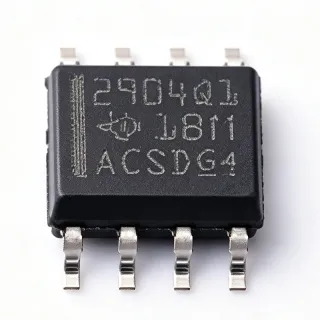
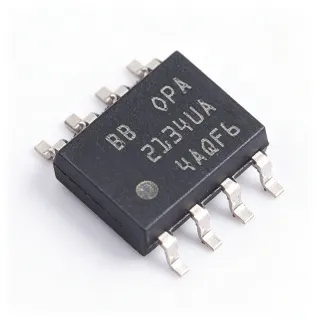
OPA227U - High Precision Low Noise Op Amp | Texas Instruments
MPN: OPA227U ✓ Active| Qty | Unit Price | Extended |
|---|---|---|
| 1 | $3.42 | $3.42 |
| 10 | $3.05 | $30.50 |
| 100 | $2.68 | $268.00 |
| 500 | $2.35 | $1,175.00 |
| 1,000 | $2.05 | $2,050.00 |
OPA227U Overview
An operational amplifier (op amp) is a high-gain DC-coupled electronic voltage amplifier with differential inputs and a single-ended output. Within the broader analog semiconductor taxonomy, an op amp belongs to the linear IC family, and the precision op amp sub-category is further characterized by ultra-low offset voltage, low drift, low bias current, and high common-mode rejection ratio (CMRR). The OPA227U occupies a position above general-purpose op amps (such as the LM358) and below chopper-stabilized amplifiers, targeting applications that require both AC fidelity and DC accuracy in a single device.
The OPA227U is built on a complementary bipolar process that delivers 5 us settling time to 16-bit accuracy, a substantial improvement over legacy OP-27 and OP-177 designs. Its 10 nA maximum input bias current, 138 dB minimum CMRR, and 160 dB minimum open-loop gain enable the device to maintain precision across wide common-mode and temperature ranges. Single, dual, and quad channel versions (OPA227, OPA2227, OPA4227) share the same internal compensation and pinout, allowing portable designs to scale channels without redesign.
Typical applications include precision instrumentation, active filters, data acquisition systems, professional audio equipment, and test & measurement front-ends. The combination of low noise and high DC accuracy makes the OPA227U particularly well-suited for 16-bit and 18-bit ADC driver circuits, weigh scales, thermocouple amplifiers, and medical instrumentation. Operating from +/-2.5 V to +/-18 V dual supplies or 5 V to 36 V single supply, the device adapts to industrial and battery-powered designs.
When designing with the OPA227U, observe standard precision op-amp practices: keep input traces short and guarded to preserve CMRR, place a 1 nF to 10 nF ceramic bypass capacitor close to the supply pins, and use low-thermal-EMF PCB materials for high-gain stages. A 100 ohm series output resistor isolates the amplifier from capacitive loads greater than 1 nF to prevent ringing. The OPA227U is a direct upgrade path for legacy OP-27 designs, providing a quieter, wider-bandwidth, lower-distortion alternative in the same SOIC-8 footprint.
This page synthesizes distributor pricing, drop-in alternative cross-references, and practical design notes for the OPA227U. The information below is curated for engineers evaluating the part for new designs, second-source qualification, or legacy OP-27/OP-177 upgrades.
Drop-in alternatives for OPA227U — same package, pin-to-pin compatible. Different-package parts requiring PCB rework are excluded.
Variants in this series
Same-series models that are drop-in compatible with OPA227U (same form factor and footprint) — differing in Package, Slew Rate.
Quick Comparison Tool — Select alternative parts for side-by-side comparison:
OPA2227UA/2K5G4
✅ Drop-In📋 Reference alternative (not in catalog)
OPA227UA
✅ Drop-In📋 Reference alternative (not in catalog)
OPA228U
✅ Drop-In✓ In Stock
$3.25 / Unit
View Datasheet →OPA277UA
✅ Drop-In📋 Reference alternative (not in catalog)
OP27GSZ
✅ Drop-In📋 Reference alternative (not in catalog)
AD8671ARZ
✅ Drop-In📋 Reference alternative (not in catalog)
OPA227U Maximum Ratings & Electrical Characteristics
| Number of Channels | 1 |
| Amplifier Type | Precision, Low Noise |
| Gain Bandwidth Product | 8 MHz |
| Slew Rate | 2.3 V/us |
| Input Voltage Noise Density | 3 nV/sqrt(Hz) |
| Input Offset Voltage (max) | 75 uV |
| Input Bias Current (max) | 10 nA |
| CMRR (min) | 138 dB |
| Open-Loop Gain (min) | 160 dB |
| Settling Time (0.1%) | 5 us |
| Operating Supply Voltage (Dual) | +/-2.5 V to +/-18 V |
| Operating Supply Voltage (Single) | 5 V to 36 V |
| Operating Temperature Range | -40C to +85C |
| Package | SOIC-8 (D) |
| Mounting Type | Surface Mount |
| Pin Count | 8 |
| Unity-Gain Stable | Yes |
| RoHS Status | Compliant |
OPA227U Pin Configuration
| Pin 1 | Offset Null — Offset trimming pin |
| Pin 2 | IN- — Inverting input |
| Pin 3 | IN+ — Non-inverting input |
| Pin 4 | V- — Negative supply (or GND for single supply) |
| Pin 5 | Offset Null — Offset trimming pin |
| Pin 6 | OUT — Output |
| Pin 7 | V+ — Positive supply |
| Pin 8 | NC — Not connected |
Typical Applications
OPA227U is suitable for 7 applications: Precision Instrumentation Amplifiers, Professional Audio Signal Conditioning, 16-bit and 18-bit ADC Input Drivers, Active Filters and Integrators, Test and Measurement Equipment, Thermocouple and RTD Signal Conditioning, Medical Instrumentation Front-Ends.
Precision Instrumentation Amplifiers
The OPA227U's 75 uV maximum offset voltage, 10 nA maximum input bias current, and 138 dB minimum CMRR make it ideal for precision instrumentation front-ends such as weigh scales, strain gauge amplifiers, and bridge sensor conditioners. The 3 nV/sqrt(Hz) voltage noise floor preserves signal integrity at microvolt-level sensor outputs, while the 8 MHz GBW supports closed-loop gains of 1000 with adequate bandwidth. The OPA227U is commonly configured in 3-amplifier instrumentation topologies with matched resistors such as the LT5400 for best CMRR.
Recommended
Professional Audio Signal Conditioning
With 3 nV/sqrt(Hz) input noise density, 2.3 V/us slew rate, and 0.00008% total harmonic distortion, the OPA227U delivers clean audio performance in microphone pre-amplifiers, line drivers, and summing amplifiers. The wide 8 MHz GBW preserves high-frequency harmonics beyond the 20 kHz audio band, while the 160 dB open-loop gain minimizes DC offset at the output. The SOIC-8 package fits compact audio mixer designs, and the dual OPA2227 enables stereo channels with matched performance.
Recommended
16-bit and 18-bit ADC Input Drivers
The OPA227U's 5 us settling time to 0.1% and 8 MHz GBW make it well suited as a buffer or active filter for 16-bit ADC inputs such as the ADS1148, ADS1248, and AD7768. Its low 3 nV/sqrt(Hz) voltage noise preserves the ADC's effective number of bits, and the 75 uV maximum offset is well below the ADC's 1 LSB at typical input ranges. A 100 ohm series output resistor between the OPA227U output and the ADC input damps switched-capacitor kickback for clean conversions.
Recommended
Active Filters and Integrators
The OPA227U's 2.3 V/us slew rate and unity-gain stability enable it to drive active low-pass, high-pass, and band-pass filters at frequencies up to 100 kHz. Its 10 nA maximum input bias current minimizes integration drift in analog integrators and Sallen-Key filter topologies. The 160 dB open-loop gain ensures filter Q accuracy at high closed-loop gains, while the low 3 nV/sqrt(Hz) noise floor preserves filter output signal-to-noise ratio.
Recommended
Test and Measurement Equipment
Precision bench multimeters, oscilloscope front-ends, and laboratory data acquisition systems benefit from the OPA227U's combination of low noise, high CMRR, and low offset. The 138 dB CMRR rejects line-frequency common-mode noise in 50/60 Hz industrial environments, while the 8 MHz GBW preserves fast transient response. The SOIC-8 package integrates easily into multi-channel measurement boards alongside 16-bit or 18-bit ADCs.
Recommended
Thermocouple and RTD Signal Conditioning
The OPA227U's 10 nA maximum input bias current minimizes errors from source impedance in thermocouple and RTD measurement circuits. The 75 uV maximum offset voltage is comparable to the thermal EMF of type K thermocouples over typical temperature ranges, and the low input bias current drift over temperature preserves measurement accuracy. Combined with a precision reference such as the REF5025, the OPA227U enables accurate temperature measurements to within 0.1C in industrial process control.
Recommended
Medical Instrumentation Front-Ends
ECG, EEG, and patient monitoring equipment leverage the OPA227U's low 3 nV/sqrt(Hz) voltage noise, 138 dB CMRR for 50/60 Hz line rejection, and 160 dB open-loop gain for high-gain bio-signal amplification. The SOIC-8 package supports compact patient-worn designs, while the device's +/-2.5 V to +/-18 V dual supply operation provides headroom for high-gain ECG stages. The OPA227U's low input bias current preserves signal integrity from high-impedance electrode sources.
Recommended
Recommended Products Summary
Engineering reference data for OPA227U — comparison, design guidance, and compliance information.
Selection Guide
Comparison with Alternatives
| Parameter | This Product | OPA2227UA/2K5G4 | OPA277UA | OP27GSZ | AD8671ARZ |
|---|---|---|---|---|---|
| Brand | Texas Instruments | Texas Instruments | Texas Instruments | Analog Devices | Analog Devices |
| Package | SOIC-8 (D) | SOIC-8 (D) - same | SOIC-8 (D) - same | SOIC-8 (D) - same | SOIC-8 (D) - same |
| Number of Channels | 1 | 2 | 1 | 1 | 1 |
| Input Noise Density | 3 nV/sqrt(Hz) | 3 nV/sqrt(Hz) | 8 nV/sqrt(Hz) | 4.5 nV/sqrt(Hz) | 2.5 nV/sqrt(Hz) |
| Slew Rate | 2.3 V/us | 2.3 V/us | 0.8 V/us | 2.8 V/us | 4 V/us |
| Input Offset Voltage (max) | 75 uV | 75 uV | 20 uV | 100 uV | 30 uV |
| CMRR (min) | 138 dB | 138 dB | 130 dB | 126 dB | 130 dB |
| Unity-Gain Stable | Yes | Yes | Yes | Yes | Yes |
| Approx. Price (1k qty) | $2.05 | $3.20 | $2.85 | $2.50 | $2.80 |
Key Differentiators
- Lower noise than legacy OP-27/OP-177 (vs OP27GSZ)
- Higher CMRR than AD8671 (vs AD8671ARZ)
- Dual-channel option in same SOIC-8 (vs OPA2227UA/2K5G4)
Design Notes
The OPA227U operates from +/-2.5 V to +/-18 V dual supplies or 5 V to 36 V single supply. Place 100 nF ceramic bypass capacitors as close as possible to the V+ and V- supply pins, with an additional 10 uF tantalum or ceramic bulk capacitor at the supply entry point. For dual-supply operation, ensure that the negative supply comes up simultaneously with the positive supply to avoid latch-up. Source: TI OPA227 datasheet (SBOS062).
The OPA227U's input bias current of 10 nA maximum is low but not negligible. When designing high-impedance sensor interfaces (above 1 Mohm), the bias current creates offset voltage across the source resistance. Use bias-current compensation techniques: match the DC impedance at both inputs, or use the OPA277U for ultra-low bias current requirements. Do not exceed the absolute maximum differential input voltage of +/-0.7 V to prevent input stage damage.
For high-precision applications, use a guard ring driven by the output or a low-impedance voltage follower around the input traces to minimize leakage currents. Keep input traces short and symmetric to preserve CMRR. Use a 100 ohm series output resistor for capacitive loads greater than 1 nF to prevent ringing. Surface-mount SOIC-8 footprint allows standard PCB assembly; ensure adequate thermal relief on the copper pour to maintain solder joint reliability.
Compliance Information
RoHS compliant per TI product page. The OPA227UA/2K5 is the lead-free production ordering part. Not AEC-Q100 qualified - choose automotive-grade precision op amps for vehicle applications.