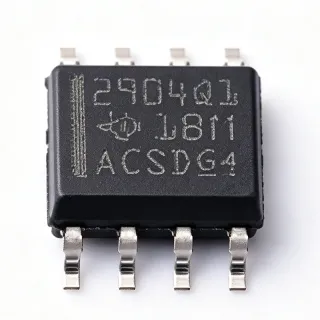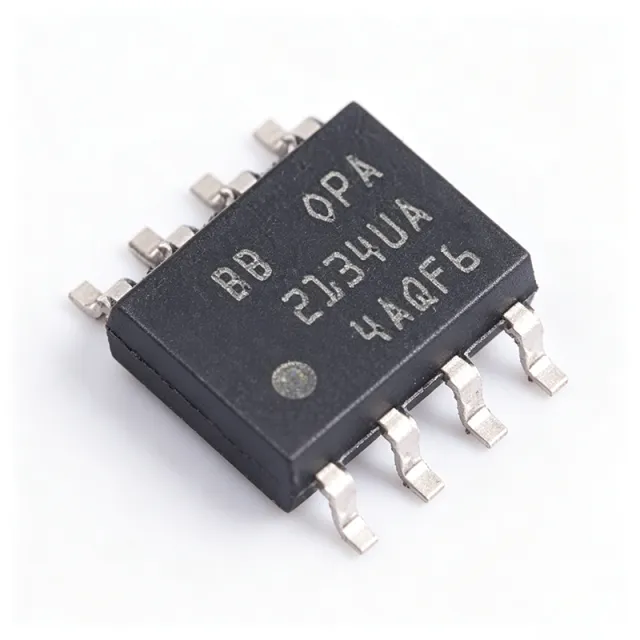
OPA2134UA/2K5 - Dual Audio Op-Amp 0.00008% THD | TI
MPN: OPA2134UA/2K5 ✓ Active| Qty | Unit Price | Extended |
|---|---|---|
| 1 | $1.55 | $1.55 |
| 10 | $1.4 | $14.00 |
| 100 | $1.25 | $125.00 |
| 500 | $1.1 | $550.00 |
| 1,000 | $0.99 | $990.00 |
| 2,500 | $0.92 | $2,300.00 |
OPA2134UA/2K5 Overview
An audio operational amplifier is a precision linear amplifier optimized to pass audio-band signals with minimal added harmonic distortion, noise, and phase error. It sits in the analog signal chain between transducers, DACs, and loudspeakers, and is a specialized subclass of the general op amp: an audio op amp is a linear amplifier within the analog signal processing chain of consumer, professional, and automotive audio electronics.
Key features include the 0.00008% total harmonic distortion figure that keeps the device transparent in the audible signal path, 8 nV/rtHz voltage noise for low hiss in high-gain stages, and 5 pA FET input bias current that prevents loading of high-impedance sources such as guitar pickups and passive EQ networks. The 8 MHz gain-bandwidth product and 20 V/us slew rate preserve full-power performance across the entire 20 Hz to 20 kHz audio band, and the wide +/-2.5 V to +/-18 V supply range matches standard professional audio rails.
Architecturally, the OPA2134 uses a true FET input stage with a high open-loop gain of 600 V/mV per the TI datasheet, delivering excellent DC precision alongside audio-grade AC performance. The dual-channel SOIC-8 configuration enables compact stereo designs without performance compromise, and the single (OPA134) and quad (OPA4134) family members share identical core specifications for BOM flexibility.
Typical applications include audio DAC output buffering (I/V conversion), line drivers, active crossovers, and microphone preamplifiers, where the OPA2134UA/2K5 is often the limiting factor in signal purity.
Design tip: bypass each supply pin with a 0.1 uF ceramic capacitor placed close to the package, and maintain adequate input/output headroom since this is not a rail-to-rail op amp.
This page synthesizes distributor pricing, drop-in alternatives, pinout data, and practical design notes not found in the manufacturer datasheet.
Drop-in alternatives for OPA2134UA/2K5 — same package, pin-to-pin compatible. Different-package parts requiring PCB rework are excluded.
Variants in this series
Same-series models that are drop-in compatible with OPA2134UA/2K5 (same form factor and footprint) — differing in Package, Slew Rate, Amplifier Type.
Quick Comparison Tool — Select alternative parts for side-by-side comparison:
OPA2134UA/2K5-Q1
✅ Drop-In📋 Reference alternative (not in catalog)
OPA2132UA
✅ Drop-In📋 Reference alternative (not in catalog)
NE5532DR
✅ Drop-In✓ In Stock
Contact for price
View Datasheet →TL072IDR
✅ Drop-In📋 Reference alternative (not in catalog)
AD827ARZ
✅ Drop-In📋 Reference alternative (not in catalog)
OPA2134UA/2K5 Maximum Ratings & Electrical Characteristics
| Number of Channels | 2 |
| Total Harmonic Distortion | 0.00008% |
| Input Voltage Noise | 8 nV/rtHz |
| Input Bias Current | 5 pA (FET input) |
| Slew Rate | 20 V/us |
| Gain-Bandwidth Product | 8 MHz |
| Supply Voltage Range | +/-2.5 V to +/-18 V |
| Open-Loop Gain | 600 V/mV |
| Input Stage | True FET input |
| Output Drive | High output drive capability |
| Package | SOIC-8 (D) |
| Mounting Type | Surface Mount |
| Packaging | Tape & Reel, 2500 units |
| Product Series | OPAx134 SoundPlus |
| Application Focus | Audio |
| RoHS Status | Compliant |
OPA2134UA/2K5 Pin Configuration
| Pin 1 | OUT A — Channel A output |
| Pin 2 | -IN A — Channel A inverting input |
| Pin 3 | +IN A — Channel A non-inverting input |
| Pin 4 | V- — Negative supply |
| Pin 5 | +IN B — Channel B non-inverting input |
| Pin 6 | -IN B — Channel B inverting input |
| Pin 7 | OUT B — Channel B output |
| Pin 8 | V+ — Positive supply |
Typical Applications
OPA2134UA/2K5 is suitable for 6 applications: Audio DAC Output Buffering (I/V Conversion), Professional Line Drivers and Receivers, Active Crossovers and EQ Filters, Microphone Preamplifiers, Guitar Effects and Instrument Interfaces, Audio Test and Measurement Instrumentation.
Audio DAC Output Buffering (I/V Conversion)
The OPA2134UA/2K5's 0.00008% THD and 8 nV/rtHz noise make it a classic choice for current-to-voltage conversion at the output of audio DACs, where any added distortion directly limits dynamic range. Its 5 pA FET input bias current introduces negligible DC error at the DAC summing node, and the 8 MHz gain-bandwidth maintains adequate loop gain at audio frequencies. Placed immediately after the DAC current outputs with short feedback traces, it adds no switching noise and drives low-pass filter stages or line outputs directly.
Recommended
Professional Line Drivers and Receivers
Studio and live-sound equipment running on +/-15 V or +/-18 V rails benefits directly from the OPA2134UA/2K5's +/-18 V maximum supply rating and high output drive capability. Its 20 V/us slew rate supports full-level 20 kHz signals with wide margin, and the 600 V/mV open-loop gain keeps closed-loop linearity high for balanced line receivers. The dual channel in one SOIC-8 matches the natural two-channel-per-connector structure of professional balanced audio I/O.
Recommended
Active Crossovers and EQ Filters
Active crossover and tone-control stages cascade multiple op amp filter sections, so per-stage distortion accumulates. The OPA2134UA/2K5's 0.00008% THD keeps total signal-chain distortion far below audibility even after several filter stages. Its FET inputs allow the use of large resistor values in Sallen-Key and multiple-feedback topologies without bias-current-induced offset, and the 8 MHz bandwidth preserves the filter transfer function accuracy at the top of the audio band.
Recommended
Microphone Preamplifiers
In condenser and dynamic mic preamps, the first-stage amplifier sets the system noise floor. The OPA2134UA/2K5's 8 nV/rtHz voltage noise and 5 pA FET input current combine low total input-referred noise with freedom from bias-current noise through high-value gate resistors. The +/-18 V supply range provides headroom for high-output condenser capsules, and the dual channel supports stereo preamps in a single SOIC-8 footprint for compact channel strips.
Recommended
Guitar Effects and Instrument Interfaces
Guitar pickups present very high source impedance in the hundreds of kilohms, which rapidly degrades bipolar-input op amps through loading and bias-current offset. The OPA2134UA/2K5's 5 pA FET input preserves pickup tone and dynamics, while its low 8 nV/rtHz noise keeps weak-signal stages quiet. Designers commonly use it for input buffers, clipping-stage recovery amplifiers, and output line drivers in pedals and audio interfaces powered from +/-9 V to +/-15 V rails.
Recommended
Audio Test and Measurement Instrumentation
Audio analyzers, signal generators, and distortion measurement fixtures require amplifiers whose own distortion is far below the level being measured. With 0.00008% THD (equivalent to roughly -122 dB), the OPA2134UA/2K5 serves as input attenuator buffers, gain stages, and low-pass anti-alias filters in measurement front ends. The 600 V/mV open-loop gain ensures gain accuracy and low distortion at closed-loop gains typical of instrumentation, and the wide +/-18 V supply supports full-scale test signals.
Recommended
Recommended Products Summary
Engineering reference data for OPA2134UA/2K5 — comparison, design guidance, and compliance information.
Selection Guide
Comparison with Alternatives
| Parameter | This Product | OPA2134UA/2K5-Q1 | OPA2132UA | NE5532DR | TL072IDR | AD827ARZ |
|---|---|---|---|---|---|---|
| Package | SOIC-8 (D) | SOIC-8 (D) - same | SOIC-8 (D) - same | SOIC-8 (D) - same | SOIC-8 (D) - same | SOIC-8 - same |
| Brand | Texas Instruments | Texas Instruments | Texas Instruments | Texas Instruments | Texas Instruments | Analog Devices |
| Input Stage | True FET (5 pA bias) | True FET (5 pA bias) | Bipolar | Bipolar | JFET | Bipolar |
| Automotive Grade | No | Yes (AEC-Q100) | No | No | No | No |
Key Differentiators
- True FET input with 5 pA bias current (vs OPA2132UA)
- Ultra-low 0.00008% THD (vs TL072IDR)
- Automotive-grade drop-in available (vs OPA2134UA/2K5-Q1)
Design Notes
Place a 0.1 uF ceramic bypass capacitor at each supply pin (pins 4 and 8) as close to the package as possible, plus a bulk 10 uF capacitor per rail near the device. The OPA2134 has an 8 MHz unity-gain bandwidth, so supply lead inductance from long traces can cause high-frequency instability or RF rectification. A solid ground plane under the amplifier region and short feedback traces complete a robust layout.
The OPA2134's FET inputs (5 pA bias) allow very high impedance networks, but guard high-impedance input nodes with clean board area and keep the inverting-node trace area minimal to limit stray capacitance, which erodes phase margin. For gains of 1 or higher with capacitive loads above roughly 100 pF, add a small series output resistor to decouple the load and maintain stability.
The OPA2134 is not a rail-to-rail amplifier: input common-mode range and output swing stop well short of the supply rails. Design gain stages so that expected signal swings keep several volts of headroom from +/-18 V limits, or distortion will rise sharply. Also verify polarity and PCB silkscreen before soldering - replacing blown OPA2134s due to reversed supply or mislabeled footprints is a well-documented field failure.
Compliance Information
RoHS compliant and lead-free per DigiKey/Mouser/LCSC product data. AEC-Q100 qualification applies only to the OPA2134UA/2K5-Q1 variant.