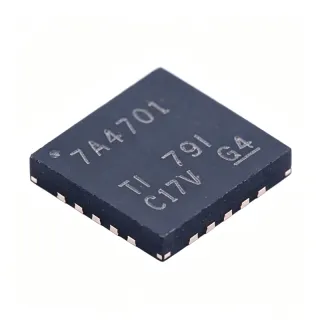
PCA9460BUKZ - PMIC for i.MX 8ULP 4 Buck + 5 LDO | NXP
MPN: PCA9460BUKZ ✓ Active| Qty | Unit Price | Extended |
|---|---|---|
| 1 | $3.95 | $3.95 |
| 10 | $3.72 | $37.20 |
| 100 | $3.45 | $345.00 |
| 500 | $3.2 | $1,600.00 |
| 1,000 | $2.95 | $2,950.00 |
PCA9460BUKZ Overview
A PMIC (power management integrated circuit) is a specialized voltage regulator subsystem that consolidates multiple power rails - buck converters for high-efficiency core supplies and LDOs for low-noise analog and I/O rails - into one device. In the power-management hierarchy, the PCA9460BUKZ sits above discrete regulators and below the system battery/charger, providing sequenced, programmable rails directly matched to an SoC power tree.
Key features include four bucks covering processor core, DDR and system rail requirements, five LDOs for analog, PLL and peripheral supplies, sequencing and configuration controlled through an I2C interface, and ultra-low standby power consumption - a headline design goal of the PCA9460 platform for always-on, battery-powered products.
Architecturally, the device pairs high-efficiency synchronous buck stages with low-quiescent LDO post-regulators, and its power-good, interrupt and enable architecture supports the complex multi-rail power-up and power-down sequencing that the i.MX 8ULP requires. Because the PCA9460BUKZ is pre-programmed for the i.MX 8ULP plus LPDDR4X power tree, board designers avoid the resistor-divider tuning and external sequencing logic otherwise needed with generic regulator arrays.
Typical applications include battery-powered industrial HMI and portable devices built on the i.MX 8ULP, ultra-low-power edge-AI and sensor-fusion nodes, and wearable or IoT gateways where standby current directly determines battery life.
Design consideration: the 42-terminal QFN package requires a solid ground plane and thermal vias under the exposed pad; follow the NXP reference design layout for the i.MX 8ULP to preserve buck-loop stability and minimize EMI.
This page synthesizes distributor pricing, drop-in family alternatives, and practical design notes not found in the manufacturer datasheet, verified as of 2026-09-13.
Drop-in alternatives for PCA9460BUKZ — same package, pin-to-pin compatible. Different-package parts requiring PCB rework are excluded.
Variants in this series
Same-series models that are drop-in compatible with PCA9460BUKZ (same form factor and footprint) — differing in Target Processor, Mounting Type, Applications Focus, Function, Package.
Quick Comparison Tool — Select alternative parts for side-by-side comparison:
PCA9460AUKZ
✅ Drop-In ⚠️ 参数待验证✓ In Stock
Contact for price
View Datasheet →PCA9460BUK
✅ Drop-In📋 Reference alternative (not in catalog)
PCA9460BUKZ Maximum Ratings & Electrical Characteristics
| Function | Power Management IC (PMIC) for i.MX 8ULP + LPDDR4X |
| Topology | 4 Buck + 5 LDO |
| Input Supply Voltage (VSUP) Minimum | 2.7 V |
| Number of Buck Regulators | 4 |
| Number of LDO Regulators | 5 |
| Control Interface | I2C |
| Target Processor | NXP i.MX 8ULP |
| Supported Memory | LPDDR4X |
| Maximum Operating Temperature | 85 C |
| Number of Terminals | 42 |
| Package Shape | Rectangular |
| Mounting Type | Surface Mount |
| Standby Power | Ultra-low standby power (per NXP general description) |
PCA9460BUKZ rectangular Pin Configuration Guide
Pin configuration for PCA9460BUKZ (rectangular package). This power device features gate, drain, and source terminals. For non-polarized packages, refer to the manufacturer datasheet for exact pin 1 orientation and footprint details. Common applications include power supply design, motor driving, and load switching.

No detailed pinout data available for PCA9460BUKZ.
Refer to the datasheet for full pin configuration.
Typical Applications
PCA9460BUKZ is suitable for 6 applications: i.MX 8ULP Industrial HMI and Portable Devices, Battery-Powered Wearables and Handhelds, Ultra-Low-Power Edge-AI and Sensor Fusion Nodes, Smart Home and IoT Gateways, Medical Portable Monitoring Devices, Security Cameras and Video Doorbells.
i.MX 8ULP Industrial HMI and Portable Devices
The PCA9460BUKZ is purpose-built to power the NXP i.MX 8ULP applications processor: its 4 bucks supply the Cortex-A/M core, DDR and system rails while the 5 LDOs feed analog, PLL and peripheral domains, all pre-sequenced for the i.MX 8ULP boot order. In industrial HMI terminals and portable data-collection devices, the integrated I2C control lets software scale rail voltages in run and low-power states, and the ultra-low standby consumption directly cuts off-state battery drain. Using one validated PMIC instead of a discrete regulator array saves board area and eliminates sequencing bring-up risk. Place the PMIC per the NXP i.MX 8ULP reference design with short, wide inductor traces and a solid exposed-pad ground connection to keep buck switching noise out of the analog LDO rails.
Recommended
Battery-Powered Wearables and Handhelds
NXP's general description states the PCA9460 is designed for ultra-low-power applications where standby power and overall PMIC consumption are critical - the defining requirements of wearables and handheld instruments. The 2.7 V minimum supply input accepts single-cell lithium battery rails through the system front end, while the 4 buck + 5 LDO rail set covers the full i.MX 8ULP plus LPDDR4X power tree in one 42-terminal package. In duty-cycled operation the PMIC's low standby current preserves battery life between wakeups, and I2C rail scaling lets firmware drop core voltage in sleep states. Thermal design is relaxed because wearable loads are far below the PMIC rating, but keep the exposed pad soldered to the ground plane for LDO stability.
Recommended
Ultra-Low-Power Edge-AI and Sensor Fusion Nodes
Edge-AI endpoints built on the i.MX 8ULP's fusion of Cortex-A cores, Cortex-M cores and DSP/NPU acceleration need multiple precisely sequenced rails that the PCA9460BUKZ delivers as a factory-validated set. The bucks handle the higher-current processor and LPDDR4X domains; the LDOs supply noise-sensitive analog, PLL and ADC blocks where switching ripple would degrade signal quality. Because inference workloads are bursty, the I2C interface allows runtime voltage scaling so the node can run at minimum power between events. The PMIC's interrupt and power-good outputs integrate cleanly with the SoC power management firmware. Verified rail sequencing from NXP removes the largest bring-up risk in multi-core edge nodes.
Recommended
Smart Home and IoT Gateways
Always-on smart-home gateways based on the i.MX 8ULP benefit from the PCA9460BUKZ's ultra-low standby power, which dominates energy use in devices that spend most of their life idle. The single 42-terminal PMIC replaces a multi-IC discrete power tree, shrinking the power section on dense gateway PCBs and cutting BOM line count. The 5 LDOs provide clean rails for RF front ends and sensor interfaces, while the bucks efficiently serve the processor and LPDDR4X. I2C control supports remote power-state management from the gateway firmware. Design the input side with a 2.7 V-or-higher adapter or battery-backed rail and follow NXP layout guidance to pass conducted-emission checks in residential environments.
Recommended
Medical Portable Monitoring Devices
Portable medical monitors built on the i.MX 8ULP require quiet analog rails for biosignal front ends and efficient core supplies for display and wireless subsystems. The PCA9460BUKZ's 5 LDOs isolate sensitive measurement circuitry from buck switching noise, improving signal integrity of ECG/SpO2-class front ends, while the 4 bucks supply the LPDDR4X and processor domains at high efficiency to extend battery run time between charges. The factory-programmed sequencing guarantees the i.MX 8ULP boots reliably every time - essential in devices where a failed power-up is a usability and safety issue. The 85 C maximum operating temperature covers typical body-worn and bedside conditions; verify enclosure thermal rise in the mechanical design.
Recommended
Security Cameras and Video Doorbells
Battery- or PoE-derived powered cameras using the i.MX 8ULP for on-device video analytics can integrate the PCA9460BUKZ as the complete system power tree in one chip. The bucks power the image-signal processor and LPDDR4X at high efficiency, which matters because video encode is the dominant load; the LDOs give the sensor and analog front end ripple-free rails that reduce image noise. Ultra-low standby consumption supports always-listening wake modes. The 2.7 V minimum input suits battery-backed designs, while I2C rail control lets firmware throttle power during night-idle periods. Follow the NXP reference layout: tight buck loops, star-grounded LDO returns, and exposed-pad thermal vias.
Recommended
Recommended Products Summary
Engineering reference data for PCA9460BUKZ — comparison, design guidance, and compliance information.
Selection Guide
Comparison with Alternatives
| Parameter | This Product | PCA9460AUKZ | PCA9460BUK (tray pack) |
|---|---|---|---|
| Package | HVQFN-42 (rectangular, 42 terminals) | HVQFN-42 - same | HVQFN-42 - same |
| Brand | NXP Semiconductors | NXP Semiconductors | NXP Semiconductors |
| Regulator Count | 4 Buck + 5 LDO | 4 Buck + 5 LDO | 4 Buck + 5 LDO |
| Target Processor Configuration | i.MX 8ULP + LPDDR4X | Different i.MX 8ULP memory variant | i.MX 8ULP + LPDDR4X - same |
| Minimum Supply Voltage | 2.7 V | 2.7 V | 2.7 V |
| Maximum Operating Temperature | 85 C | 85 C | 85 C |
| Control Interface | I2C | I2C | I2C |
Key Differentiators
- Factory pre-programmed for i.MX 8ULP + LPDDR4X (vs PCA9460AUKZ)
- Ultra-low standby power focus (vs Generic multi-rail PMICs)
- Single-package integration (4 buck + 5 LDO, 42 terminals) (vs PCA9460BUK (tray pack))
Design Notes
The 42-terminal QFN-style package has a center exposed pad that must be soldered to a solid ground plane. Use an array of thermal vias (typically 4x4 or more, filled or tented per assembly house capability) under the pad to sink buck-converter ground current and LDO heat. Follow the NXP i.MX 8ULP reference design footprint exactly - PMIC land patterns define buck loop inductance, and deviations can cause ringing on switch nodes and EMI failures.
Keep each buck's input capacitor, inductor and output capacitor loop as short and wide as possible; place the inductor adjacent to the switch pins with no vias in the high-current path. Route I2C SDA/SCL away from switch nodes and inductor fields. LDO outputs feeding analog and PLL rails need their output capacitors placed directly at the pin with a low-impedance return to the exposed pad to realize the low-noise benefit of the linear stages.
Do not substitute another PCA9460 grade (e.g., PCA9460AUKZ) on an LPDDR4X board - the factory power-tree programming differs per memory variant, and the wrong grade can apply incorrect DDR rail voltages and prevent boot. Also confirm the input front end never drags VSUP below the 2.7 V minimum during battery sag or cable-drop transients, or the PMIC will reset the i.MX 8ULP unexpectedly. Verify the maximum input rating in the NXP datasheet before finalizing the supply front end.
Compliance Information
Compliance data was not present in the provided web data; confirm RoHS/REACH status on the official NXP product page before procurement.