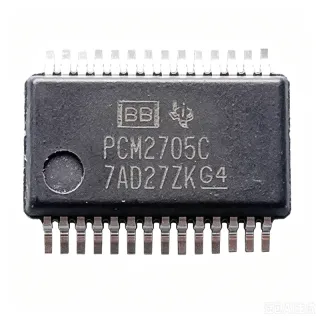
PCM3006T - 16-Bit Stereo Audio Codec | Texas Instruments
MPN: PCM3006T ✓ ActivePCM3006T Overview
An audio codec is a mixed-signal interface IC that bridges an analog audio system and a digital audio processor. In this product hierarchy, the PCM3006T is a stereo audio codec, which combines an ADC, DAC, analog input and output circuitry, and digital audio data interfaces. It is used where a system needs bidirectional conversion between analog audio signals and a serial digital audio bus rather than a complete USB audio interface or loudspeaker amplifier.
The principal functional attributes of the PCM3006T include 16-bit stereo conversion, single-ended analog input and output, 64-times delta-sigma oversampling, and a digital decimation filter in the ADC path. These features make it suitable for compact stereo audio products in which an existing digital audio engine must interface directly with analog microphones, line-level circuitry, speakers, or other analog audio stages. The integrated codec architecture also helps reduce board area compared with separate ADC and DAC devices.
The 24-SSOP package is intended for surface-mount assembly and provides a compact implementation for audio equipment. Because the codec performs both conversion directions, board layout should keep the analog input, analog output, digital interface, and supply connections arranged to minimize coupling between sensitive audio nodes and high-speed digital signals. External analog filtering, grounding, and supply-decoupling decisions remain part of the complete signal-chain design rather than being determined solely by the codec specifications.
Typical applications include stereo sound-card analog sections, portable audio products, digital mixing consoles, audio-recording interfaces, speaker and headphone subsystems, and embedded equipment that already has a separate USB or digital audio controller. The PCM3006T is particularly appropriate where single-ended analog connections are acceptable and a 16-bit stereo serial interface is sufficient. It does not itself perform USB connectivity or drive a loudspeaker directly, so those functions require suitable companion circuitry.
Designers should verify the complete pin configuration, supported digital audio format, sampling-rate range, analog signal limits, and power requirements in the manufacturer datasheet before layout release. The single-ended interface simplifies some analog routing, but it may reduce headroom or flexibility compared with a codec that offers balanced inputs and outputs. Appropriate passive networks, stable references, clean supplies, and controlled return paths remain essential for low distortion and acceptable channel matching.
This product summary combines the verified 16-bit stereo codec identity, single-ended analog I/O, 64-times oversampling, digital decimation, and 24-SSOP packaging information with practical selection guidance, comparison notes, sourcing workflow, and design-focused considerations.
Drop-in alternatives for PCM3006T — same package, pin-to-pin compatible. Different-package parts requiring PCB rework are excluded.
PCM3006T/2K
✅ Drop-In📋 Reference alternative (not in catalog)
PCM3006TG6
✅ Drop-In📋 Reference alternative (not in catalog)
PCM3006T Specifications
| Product Type | Stereo audio codec IC |
| Converter Resolution | 16 bit |
| Channel Configuration | Stereo, 2 channels |
| Conversion Functions | Stereo ADC and stereo DAC |
| Analog Input Type | Single-ended |
| Analog Output Type | Single-ended |
| Conversion Architecture | Delta-sigma modulation |
| Oversampling Ratio | 64 times |
| ADC Digital Filter | Digital decimation filter |
| Digital Audio Interface | Serial, 16-bit |
| Package | 24-SSOP (24-LSSOP), 6.00 mm width |
| Mounting Type | Surface mount |
| RoHS Status | unknown |
| REACH Status | unknown |
| AEC-Q100 Qualification | unknown |
PCM3006T 24-ssop (24-lssop), 6.00 mm width Pin Configuration Guide
Pin configuration for PCM3006T (24-ssop (24-lssop), 6.00 mm width package). Pin numbering, functions, and connection diagrams are defined in the manufacturer datasheet. Refer to it for the exact footprint and soldering guidelines.

No detailed pinout data available for PCM3006T.
Refer to the datasheet for full pin configuration.
Typical Applications
PCM3006T is suitable for 6 applications: Stereo Sound-Card Analog Interface, Portable Stereo Audio Product, USB Recording Interface, Digital Mixing Console, Embedded Audio Processing, Digital Speaker and Headphone Subsystem.
Stereo Sound-Card Analog Interface
The PCM3006T suits a stereo sound-card design that already has a separate USB or local audio controller. Its 16-bit ADC and DAC provide bidirectional conversion between analog line signals and serial digital audio, while the 24-SSOP package limits board area. The 64-times delta-sigma oversampling and ADC digital decimation filter form the core conversion path, but analog input conditioning, output reconstruction, clocking, and ground separation still require dedicated board design.
Recommended
Portable Stereo Audio Product
PCM3006T can provide the analog conversion layer in a portable stereo audio product when 16-bit resolution and single-ended analog paths meet the system requirements. The combined ADC and DAC reduce the number of conversion ICs, while the compact 24-SSOP package supports space-constrained boards. Designers should budget for headphone or speaker amplification separately and carefully manage analog return paths to prevent converter noise from reaching the audio output.
Recommended
USB Recording Interface
The PCM3006T is suitable for the analog section of a USB recording interface that separates host control from stereo audio conversion. Its 16-bit ADC captures single-ended analog inputs, and its DAC supports single-ended analog playback, while 64-times oversampling forms the basis of the delta-sigma conversion architecture. A separate USB audio controller remains necessary for USB enumeration, clocking, and data transport, so this component should be selected as part of a complete signal chain.
Recommended
Digital Mixing Console
PCM3006T can support a mono-to-stereo conversion path in a digital mixing console or line-level audio processor. Its 16-bit stereo ADC and DAC support signal capture and regeneration, while the single-ended analog architecture simplifies interconnection when balanced conversion is implemented elsewhere. The codec does not provide per-channel preamplification, gain control, or bus mixing, so those functions must remain in dedicated analog and digital processing stages.
Recommended
Embedded Audio Processing
PCM3006T fits an embedded audio subsystem in which a microcontroller or digital signal processor handles media processing while the codec handles analog conversion. The 16-bit serial interface and delta-sigma architecture support a conventional digital audio architecture, and the ADC digital decimation filter assists channel filtering. The design must still define supported clock rates, serial framing, analog reference strategy, and decoupling according to the manufacturer recommendations before firmware and layout are finalized.
Recommended
Digital Speaker and Headphone Subsystem
PCM3006T can serve as the source-side digital-to-analog converter in a digital speaker, headphone, or powered-audio subsystem. Its 16-bit stereo DAC generates single-ended analog output from serial digital audio, and the shared 24-SSOP package simplifies mixed-signal placement. Because the codec does not directly drive a loudspeaker or headphone output, an amplifier, protection network, and output filtering stage must follow the analog outputs for the intended load.
Recommended
Recommended Products Summary
Engineering reference data for PCM3006T — comparison, design guidance, and compliance information.
Selection Guide
Comparison with Alternatives
| Parameter | This Product | PCM3006T/2K | PCM3006TG6 |
|---|---|---|---|
| Package | 24-SSOP (24-LSSOP), 6.00 mm width | 24-SSOP - same | 24-SSOP - same |
| Brand | Texas Instruments | Texas Instruments | Texas Instruments |
| Converter Resolution | 16 bit | 16 bit | 16 bit |
| ADC and DAC Functions | Stereo ADC and stereo DAC | Stereo ADC and stereo DAC | Stereo ADC and stereo DAC |
| Analog Input Type | Single-ended | Single-ended | Single-ended |
| Analog Output Type | Single-ended | Single-ended | Single-ended |
| Oversampling Ratio | 64 times | 64 times | 64 times |
| Digital Audio Interface | 16-bit serial | 16-bit serial | 16-bit serial |
| USB Controller Integrated | No | No | No |
Key Differentiators
- Combines stereo conversion in one 24-SSOP device (vs PCM3060PWR)
- Single-ended analog I/O simplifies channel routing (vs PCM2901E)
- Matches the documented family ordering options (vs PCM3006T/2K)
Design Notes
Separate the analog input and output paths from the serial digital interface and clock lines. Place the required bypass capacitors adjacent to their supply pins, use a continuous analog ground region where appropriate, and route analog signals over a quiet plane. Because PCM3006T combines ADC and DAC functions in one package, a single-board partition must keep switching-node and return currents away from the analog pins.
Use the manufacturer pin-description and application schematics to define every digital interface signal, including serial data, bit clock, latch clock, and any control or mode pins. Confirm clock polarity, data timing, and supported audio format with the external audio controller. Do not infer these relationships from the 24-SSOP footprint, because incorrect clock routing can prevent valid stereo data from being captured.
Do not treat the PCM3006T as a USB codec or a loudspeaker driver. USB transport requires a separate controller, and analog playback requires an amplifier with suitable output-current capability. Also verify the exact ordering suffix, temperature grade, and reel or tube configuration before manufacturing. These distinctions prevent a footprint-compatible but system-incompatible replacement from being approved.
Compliance Information
Compliance attributes were not stated in the manufacturer or distributor records for this MPN. Confirm RoHS, REACH, AEC-Q100, lead-free, halogen-free, and conflict-mineral declarations with Texas Instruments for the selected ordering suffix.