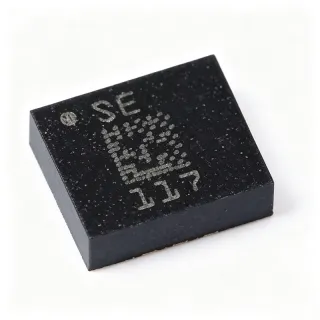
STM32F417IET6 - 168MHz ARM Cortex-M4F MCU | STMicroelectronics
MPN: STM32F417IET6 ✓ Active| Qty | Unit Price | Extended |
|---|---|---|
| 1 | $12.5 | $12.50 |
| 10 | $11.25 | $112.50 |
| 100 | $10 | $1,000.00 |
| 500 | $9 | $4,500.00 |
| 1,000 | $8.1 | $8,100.00 |
STM32F417IET6 Overview
What is a microcontroller? A microcontroller (MCU) is a compact integrated circuit designed to govern a specific operation in an embedded system. It integrates a processor core, memory (Flash and SRAM), and programmable input/output peripherals on a single chip. In the system hierarchy, an MCU sits between a microprocessor (which requires external memory and peripherals) and a system-on-chip (SoC) that may include more complex subsystems. The STM32F417IET6 belongs to the STM32F4 series, which is part of the broader STM32 family of 32-bit ARM Cortex-M based MCUs, known for their balance of performance, power efficiency, and rich peripheral sets.
Key features include 512 KB of Flash memory and 192 KB of SRAM, a 168 MHz CPU with FPU, and a comprehensive set of peripherals: 3x 12-bit ADCs, 2x DACs, 12x general-purpose timers, 2x advanced-control timers, and a true random number generator (RNG). It also integrates a camera interface (DCMI), a crypto/hash processor for AES-256, 3DES, and SHA-1/SHA-256, and a DMA controller with 16 streams. Connectivity is extensive: 4x USARTs, 2x UARTs, 3x SPI, 3x I2C, 2x CAN, 1x USB 2.0 OTG FS/HS, 1x Ethernet MAC, and an SDIO interface.
The STM32F417IET6 is built on a 90nm process technology, offering a good balance of speed and power consumption. It supports a wide supply voltage range of 1.8V to 3.6V and operates over a temperature range of -40°C to +85°C (industrial grade). The device includes a power-on reset, brown-out reset, and a programmable voltage detector, ensuring reliable operation in harsh environments. The advanced interrupt controller (NVIC) supports up to 82 interrupt vectors, enabling responsive real-time control.
Typical applications include industrial automation (PLC, motor control), medical devices (patient monitoring), consumer electronics (smart home hubs), and communication infrastructure (Ethernet gateways). The combination of high-speed processing, rich analog peripherals, and robust connectivity makes it a versatile choice for complex embedded systems.
When designing with this MCU, pay attention to the power supply decoupling: place 100nF capacitors close to each VDD pin and a 4.7uF bulk capacitor. The VDDA pin requires a dedicated analog supply with a ferrite bead to reduce noise. Also, configure the boot pins correctly to select the boot source (Flash, SRAM, or system memory) for programming and debugging.
Drop-in alternatives for STM32F417IET6 — same package, pin-to-pin compatible. Different-package parts requiring PCB rework are excluded.
Variants in this series
Same-series models that are drop-in compatible with STM32F417IET6 (same form factor and footprint) — differing in Flash Memory, Operating Temperature Range, Package, SRAM, Timers.
Quick Comparison Tool — Select alternative parts for side-by-side comparison:
STM32F417IET7
✅ Drop-In ⚠️ Specs Unverified📋 Reference alternative (not in catalog)
STM32F407IET6
✅ Drop-In ⚠️ Specs Unverified📋 Reference alternative (not in catalog)
STM32F427IIT6
✅ Drop-In ⚠️ Specs Unverified✓ In Stock
$11.2 / Unit
View Datasheet →STM32F417IET6 Maximum Ratings & Electrical Characteristics
| Core | ARM Cortex-M4F with FPU |
| Maximum Clock Frequency | 168 MHz |
| Flash Memory | 512 KB |
| SRAM | 192 KB |
| Supply Voltage Range | 1.8 V to 3.6 V |
| Operating Temperature Range | -40C to +85C |
| Package | LQFP176 (24x24 mm) |
| GPIO Pins | 140 |
| ADC Resolution | 12-bit |
| Number of ADCs | 3 |
| DAC Resolution | 12-bit |
| Number of DACs | 2 |
| Timers | 14 (including 2 advanced-control) |
| Communication Interfaces | 4x USART, 2x UART, 3x SPI, 3x I2C, 2x CAN, USB 2.0 OTG FS/HS, Ethernet MAC, SDIO |
| Crypto/Hash Processor | AES-256, 3DES, SHA-1, SHA-256 |
| DMA Channels | 16 streams |
| RoHS Status | Compliant |
STM32F417IET6 Pin Configuration
| Pin 1 | PE2 — GPIO / TRACECLK / FMC_A23 |
| Pin 2 | PE3 — GPIO / TRACED0 / FMC_A19 |
| Pin 3 | PE4 — GPIO / TRACED1 / FMC_A20 |
| Pin 4 | PE5 — GPIO / TRACED2 / FMC_A21 |
| Pin 5 | PE6 — GPIO / TRACED3 / FMC_A22 |
| Pin 6 | VBAT — Battery backup supply |
| Pin 7 | PC13 — GPIO / RTC_AF1 / WKUP2 |
| Pin 8 | PC14 — GPIO / OSC32_IN |
| Pin 9 | PC15 — GPIO / OSC32_OUT |
| Pin 10 | PF0 — GPIO / FMC_A0 |
| Pin 11 | PF1 — GPIO / FMC_A1 |
| Pin 12 | PF2 — GPIO / FMC_A2 |
| Pin 13 | PF3 — GPIO / FMC_A3 |
| Pin 14 | PF4 — GPIO / FMC_A4 |
| Pin 15 | PF5 — GPIO / FMC_A5 |
| Pin 16 | VSS — Ground |
| Pin 17 | VDD — Power supply |
| Pin 18 | PF6 — GPIO / FMC_NWAIT |
| Pin 19 | PF7 — GPIO / FMC_NCE4 |
| Pin 20 | PF8 — GPIO / FMC_NCE3 |
Typical Applications
STM32F417IET6 is suitable for 6 applications: Industrial Automation, IoT Gateway, Motor Control, Medical Devices, Consumer Electronics, Communication Infrastructure.
Industrial Automation
The STM32F417IET6 is ideal for industrial automation due to its 168 MHz Cortex-M4F core, rich connectivity (Ethernet, CAN, UART), and advanced timers for precise PWM control. It can handle complex PLC logic, motor control, and real-time communication protocols like EtherCAT. The FPU accelerates control algorithms, while the wide temperature range ensures reliability in factory environments. In a typical PLC, the MCU manages I/O scanning, communication with HMI, and executes control loops. The Ethernet MAC enables seamless integration into industrial networks, and the crypto processor secures data transmission. With 512 KB Flash and 192 KB SRAM, it can store large application code and data buffers. The multiple ADCs allow simultaneous sampling of analog sensors, and the DMA offloads data transfer, reducing CPU load. Overall, the STM32F417IET6 provides the performance and connectivity required for modern industrial control systems.
Recommended
IoT Gateway
The STM32F417IET6 is well-suited for IoT gateways that aggregate data from multiple sensors and communicate with the cloud. Its Ethernet MAC and USB OTG support wired and wireless connectivity, while the crypto processor enables secure communication (TLS/DTLS). The 168 MHz CPU can handle protocol stacks like MQTT and CoAP, and the large memory accommodates buffering and firmware updates. In a typical gateway, the MCU interfaces with sensors via SPI/I2C, processes data locally, and transmits it to the cloud via Ethernet or Wi-Fi (through an external module). The low-power modes help reduce energy consumption in battery-powered gateways. The RNG generates secure keys for authentication. With its rich peripheral set and security features, the STM32F417IET6 is a robust choice for IoT edge devices.
Recommended
Motor Control
The STM32F417IET6 excels in motor control applications, particularly for brushless DC (BLDC) and permanent magnet synchronous motors (PMSM). The 168 MHz Cortex-M4F with FPU executes field-oriented control (FOC) algorithms efficiently, while the advanced timers (TIM1 and TIM8) generate complementary PWM signals with dead-time insertion. The 3 fast 12-bit ADCs sample phase currents and DC bus voltage simultaneously, enabling precise current regulation. The device supports encoder and Hall sensor interfaces for position feedback. In a typical motor drive, the MCU reads current sensors, runs the FOC algorithm, and outputs PWM signals to the gate driver. The FPU reduces computation time, allowing higher switching frequencies and better dynamic response. The wide temperature range and robust peripherals make it suitable for industrial and automotive motor control.
Recommended
Medical Devices
The STM32F417IET6 is used in medical devices such as patient monitors, infusion pumps, and diagnostic equipment. Its high processing power enables real-time signal processing (e.g., ECG, SpO2), and the rich analog peripherals (ADCs, DACs) interface with sensors and actuators. The crypto processor ensures secure data storage and communication, complying with healthcare regulations. The device's reliability and wide temperature range are critical for medical environments. In a patient monitor, the MCU acquires vital signs from sensors, processes the signals, and displays them on a screen. The Ethernet/USB connectivity allows data transfer to hospital networks. The low-power modes extend battery life in portable devices. With its combination of performance, security, and reliability, the STM32F417IET6 is a trusted choice for medical electronics.
Recommended
Consumer Electronics
The STM32F417IET6 powers consumer electronics like smart home hubs, audio systems, and wearable devices. Its high performance supports user interfaces (touchscreens, displays) and audio processing, while the connectivity options (USB, Ethernet, CAN) enable integration with other smart devices. The crypto processor secures user data and communications. In a smart home hub, the MCU manages Zigbee/Z-Wave protocols (via external modules), processes voice commands, and controls lights and thermostats. The large memory stores configuration and logs. The low-power modes are essential for battery-powered wearables. With its rich feature set, the STM32F417IET6 enables innovative consumer products.
Recommended
Communication Infrastructure
The STM32F417IET6 is used in communication infrastructure such as network switches, routers, and base stations. Its Ethernet MAC with IEEE 1588 PTP enables precise time synchronization, critical for industrial Ethernet and telecom applications. The crypto processor accelerates VPN and secure communication. The high-speed USB OTG supports data transfer and device connectivity. In a network switch, the MCU manages the control plane, handles management protocols (SNMP), and configures the switch fabric. The multiple UARTs and SPIs interface with PHYs and other controllers. The device's reliability and long-term availability make it suitable for infrastructure equipment. With its performance and connectivity, the STM32F417IET6 is a solid choice for communication systems.
Recommended
Recommended Products Summary
Engineering reference data for STM32F417IET6 — comparison, design guidance, and compliance information.
Selection Guide
Comparison with Alternatives
| Parameter | This Product | STM32F417IET7 | STM32F407IET6 | STM32F417ZET6 | STM32F427IIT6 |
|---|---|---|---|---|---|
| Package | LQFP176 | LQFP176 | LQFP176 | LQFP144 | LQFP176 |
| Brand | STMicroelectronics | STMicroelectronics | STMicroelectronics | STMicroelectronics | STMicroelectronics |
| Core | ARM Cortex-M4F | ARM Cortex-M4F | ARM Cortex-M4F | ARM Cortex-M4F | ARM Cortex-M4F |
| Max Clock Frequency | 168 MHz | 168 MHz | 168 MHz | 168 MHz | 180 MHz |
| Flash Memory | 512 KB | 512 KB | 512 KB | 512 KB | 2 MB |
| SRAM | 192 KB | 192 KB | 192 KB | 192 KB | 256 KB |
| Crypto/Hash Processor | Yes (AES-256, 3DES, SHA-1, SHA-256) | Yes | No | Yes | Yes |
| Operating Temperature Range | -40C to +85C | -40C to +105C | -40C to +85C | -40C to +85C | -40C to +85C |
Key Differentiators
- Integrated crypto/hash processor (vs STM32F407IET6)
- True random number generator (RNG) (vs STM32F407IET6)
- Extended temperature option (vs STM32F417IET7)
Design Notes
Decouple each VDD pin with a 100nF ceramic capacitor placed as close as possible to the pin. Add a 4.7uF bulk capacitor at the power entry point. For VDDA, use a dedicated analog supply with a ferrite bead and a 1uF capacitor to filter high-frequency noise. Ensure VSSA is connected to a clean ground plane.
For the LQFP176 package, use a 4-layer PCB with dedicated power and ground planes. Route high-speed signals (Ethernet, USB) with controlled impedance (e.g., 90 ohms differential for USB). Keep crystal oscillator traces short and away from noisy signals. Place the 8 MHz HSE crystal and load capacitors close to the OSC_IN/OSC_OUT pins.
Ensure the boot pins (BOOT0 and BOOT1) are configured correctly to select the desired boot source. For programming, set BOOT0 to 1 and BOOT1 to 0 to boot from system memory. After programming, set BOOT0 back to 0 to boot from Flash. Also, do not leave unused GPIO pins floating; configure them as outputs or enable internal pull-ups/pull-downs to avoid excessive current consumption.
Compliance Information
RoHS and REACH compliant per STMicroelectronics product page. Not AEC-Q100 qualified; for automotive, consider STM32F417IET7 (extended temp) but still not AEC-Q100.