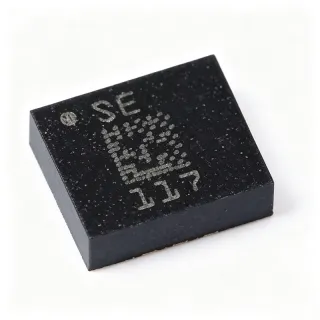
LIS3DHTR - 3-Axis Ultra-Low-Power Accelerometer | STMicroelectronics
MPN: LIS3DHTR ✓ Active| Qty | Unit Price | Extended |
|---|---|---|
| 1 | $2.5 | $2.50 |
| 10 | $2.2 | $22.00 |
| 100 | $1.8 | $180.00 |
| 500 | $1.5 | $750.00 |
| 1,000 | $1.2 | $1,200.00 |
LIS3DHTR Overview
An accelerometer is a sensor that measures proper acceleration, which is the rate of change of velocity per unit time. In the context of MEMS (Micro-Electro-Mechanical Systems), accelerometers are used to detect motion, tilt, vibration, and shock. The LIS3DHTR belongs to the category of digital-output accelerometers, which integrate sensing elements with signal conditioning and an analog-to-digital converter, providing digital data directly to a host microcontroller. This makes it a key component in motion-sensing systems, from consumer electronics to industrial monitoring.
Key features of the LIS3DHTR include an ultra-low-power consumption of 2 µA in low-power mode, a 32-level FIFO buffer to reduce host processor intervention, and an embedded temperature sensor. It also offers motion detection, free-fall detection, and 6D/4D orientation detection. The device supports both I2C and SPI interfaces, with a wide range of programmable interrupt outputs for event-driven applications.
Technically, the LIS3DHTR uses a capacitive sensing element with a dedicated ASIC for signal processing. It provides 16-bit data output, with a resolution of 1 mg per LSB at ±2g range. The device includes a self-test capability and is factory-calibrated. Its low power consumption and small footprint make it ideal for battery-powered portable devices.
Typical applications include mobile phones, wearable devices, gaming controllers, and IoT sensors. In these applications, the LIS3DHTR enables features such as screen rotation, step counting, gesture recognition, and fall detection. Its high resolution and low noise ensure accurate motion tracking.
When designing with the LIS3DHTR, ensure proper decoupling of the power supply with a 100 nF capacitor close to the VDD pin. The I2C address is selectable via the SA0 pin, allowing multiple devices on the same bus. For optimal performance, place the sensor away from high-frequency noise sources and follow the layout guidelines in the datasheet.
Drop-in alternatives for LIS3DHTR — same package, pin-to-pin compatible. Different-package parts requiring PCB rework are excluded.
Variants in this series
Same-series models that are drop-in compatible with LIS3DHTR (same form factor and footprint) — differing in Package, Acceleration Range, Supply Voltage, Mounting Type, Operating Temperature.
Quick Comparison Tool — Select alternative parts for side-by-side comparison:
LIS3DH
✅ Drop-In📋 Reference alternative (not in catalog)
LIS3DSHTR
⚡ Same Package📋 Reference alternative (not in catalog)
LIS331DLHTR
⚡ Same Package📋 Reference alternative (not in catalog)
MMA8452Q
⚡ Same Package ⚠️ Specs Unverified📋 Reference alternative (not in catalog)
LIS3DHTR Maximum Ratings & Electrical Characteristics
| Axis | X, Y, Z |
| Full Scale Range | ±2g, ±4g, ±8g, ±16g |
| Output Data Rate | 0.5 Hz to 625 Hz |
| Interface | I2C, SPI |
| Supply Voltage | 1.71 V to 3.6 V |
| Current Consumption (Low-Power Mode) | 2 µA |
| Current Consumption (Normal Mode) | 11 µA (at 25 Hz ODR) |
| Resolution | 16-bit |
| Sensitivity | 1 mg/LSB at ±2g |
| Operating Temperature | -40°C to +85°C |
| Package | 16-LGA (3x3 mm) |
| Mounting Type | Surface Mount |
| FIFO Buffer | 32-level |
| Embedded Features | Motion detection, free-fall, 6D/4D orientation |
| RoHS Status | Compliant |
LIS3DHTR Pin Configuration
| Pin 1 | VDD — Power supply |
| Pin 2 | GND — Ground |
| Pin 3 | SCL/SPC — I2C clock / SPI clock |
| Pin 4 | SDA/SDI/SDO — I2C data / SPI data in / SPI data out |
| Pin 5 | SA0 — I2C address select |
| Pin 6 | CS — Chip select (SPI) |
| Pin 7 | INT1 — Interrupt 1 |
| Pin 8 | INT2 — Interrupt 2 |
| Pin 9 | NC — Not connected |
| Pin 10 | NC — Not connected |
| Pin 11 | NC — Not connected |
| Pin 12 | NC — Not connected |
| Pin 13 | NC — Not connected |
| Pin 14 | NC — Not connected |
| Pin 15 | NC — Not connected |
| Pin 16 | NC — Not connected |
Typical Applications
LIS3DHTR is suitable for 6 applications: Wearable Devices, IoT Motion Sensing, Mobile Phones, Gaming Controllers, Industrial Vibration Monitoring, Healthcare Monitoring.
Wearable Devices
The LIS3DHTR is ideal for wearables like fitness trackers and smartwatches due to its ultra-low power consumption of 2 µA in low-power mode, which extends battery life. Its small 3x3 mm LGA package fits compact designs. It supports step counting, motion detection, and tilt sensing, enabling features like activity tracking and gesture recognition. The 32-level FIFO reduces host processor wake-ups, further saving power. According to STMicroelectronics, it is designed for battery-powered applications.
Recommended
IoT Motion Sensing
In IoT applications, the LIS3DHTR provides accurate motion sensing for asset tracking, smart home devices, and industrial monitoring. Its wide full-scale range (±2g to ±16g) allows detection of both subtle movements and strong shocks. The I2C/SPI interface simplifies integration with microcontrollers. The low power consumption enables battery-powered IoT nodes to operate for years. The embedded motion and free-fall detection can trigger alerts without waking the host processor, making it efficient for event-driven systems.
Recommended
Mobile Phones
The LIS3DHTR is used in mobile phones for screen rotation, gesture recognition, and step counting. Its high resolution (16-bit) and low noise ensure accurate motion detection. The device supports 6D/4D orientation detection, enabling automatic screen orientation. The low power consumption is crucial for battery life. The small package allows integration into slim phone designs. The I2C interface allows easy connection to the application processor.
Recommended
Gaming Controllers
The LIS3DHTR enhances gaming controllers with motion-based controls, such as tilt steering and gesture commands. Its fast output data rate (up to 625 Hz) ensures responsive motion tracking. The device's low latency and high sensitivity provide a smooth gaming experience. The 32-level FIFO helps manage data bursts. The small package fits inside compact controller designs. The interrupt outputs can be used to wake the controller from sleep on motion detection.
Recommended
Industrial Vibration Monitoring
The LIS3DHTR is suitable for industrial vibration monitoring, where it can detect abnormal vibrations in machinery. Its wide full-scale range (±16g) allows measurement of high-amplitude vibrations. The device operates over a wide temperature range (-40°C to +85°C), making it suitable for harsh environments. The SPI interface enables high-speed data transfer for real-time monitoring. The embedded free-fall detection can be used for shock detection.
Recommended
Healthcare Monitoring
In healthcare, the LIS3DHTR is used in patient monitoring devices to detect falls and track physical activity. Its low power consumption is critical for wearable health monitors that need long battery life. The device's high sensitivity and low noise enable accurate motion analysis. The 6D orientation detection can be used to detect patient position. The I2C interface allows easy integration with medical-grade microcontrollers.
Recommended
Recommended Products Summary
Engineering reference data for LIS3DHTR — comparison, design guidance, and compliance information.
Selection Guide
Comparison with Alternatives
| Parameter | This Product | LIS3DH | LIS3DSHTR | LIS331DLHTR | ADXL345 | MMA8452Q |
|---|---|---|---|---|---|---|
| Package | 16-LGA (3x3 mm) | 16-LGA (3x3 mm) | 16-LGA (3x3 mm) | 16-LGA (3x3 mm) | 14-LGA (3x3 mm) | 16-LGA (3x3 mm) |
| Brand | STMicroelectronics | STMicroelectronics | STMicroelectronics | STMicroelectronics | Analog Devices | NXP Semiconductors |
| Full Scale Range | ±2g, ±4g, ±8g, ±16g | ±2g, ±4g, ±8g, ±16g | ±2g, ±4g, ±8g, ±16g | ±2g, ±4g, ±8g | ±2g, ±4g, ±8g, ±16g | ±2g, ±4g, ±8g |
| Output Data Rate | 0.5 Hz to 625 Hz | 0.5 Hz to 625 Hz | 0.5 Hz to 1600 Hz | 0.5 Hz to 1000 Hz | 0.1 Hz to 3200 Hz | 1.56 Hz to 800 Hz |
| Supply Voltage | 1.71V to 3.6V | 1.71V to 3.6V | 1.71V to 3.6V | 2.16V to 3.6V | 2.0V to 3.6V | 1.95V to 3.6V |
| Current Consumption (Low-Power) | 2 µA | 2 µA | 2 µA | 10 µA | 23 µA | 6 µA |
| FIFO Buffer | 32-level | 32-level | 32-level | 32-level | 32-level | 32-level |
| Interface | I2C, SPI | I2C, SPI | I2C, SPI | I2C, SPI | I2C, SPI | I2C |
Key Differentiators
- Ultra-low power consumption of 2 µA in low-power mode (vs ADXL345)
- Wide full-scale range up to ±16g (vs MMA8452Q)
- Small 3x3 mm LGA package (vs ADXL345)
Design Notes
Place a 100 nF decoupling capacitor close to the VDD pin to filter power supply noise. Use a 1 µF capacitor for additional filtering if needed. Ensure the ground plane is solid and the sensor is placed away from high-frequency digital lines to minimize noise coupling. Follow the layout guidelines in the STMicroelectronics LIS3DH datasheet for optimal performance.
The LIS3DHTR operates from 1.71V to 3.6V. For battery-powered applications, use the low-power mode to reduce current consumption to 2 µA. The device automatically enters low-power mode when the output data rate is set to 1 Hz or lower. Ensure the power supply is stable and within the specified range to avoid erratic behavior.
When using the I2C interface, ensure the SA0 pin is set correctly to select the desired I2C address. The default address is 0x18 when SA0 is low, and 0x19 when SA0 is high. For SPI, ensure the CS pin is properly controlled. Also, note that the LIS3DHTR has a self-test feature that can be used to verify proper operation during production testing.
Compliance Information
RoHS compliant per STMicroelectronics product page. Not AEC-Q100 qualified. Lead-free per datasheet.