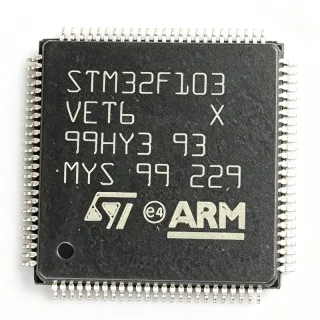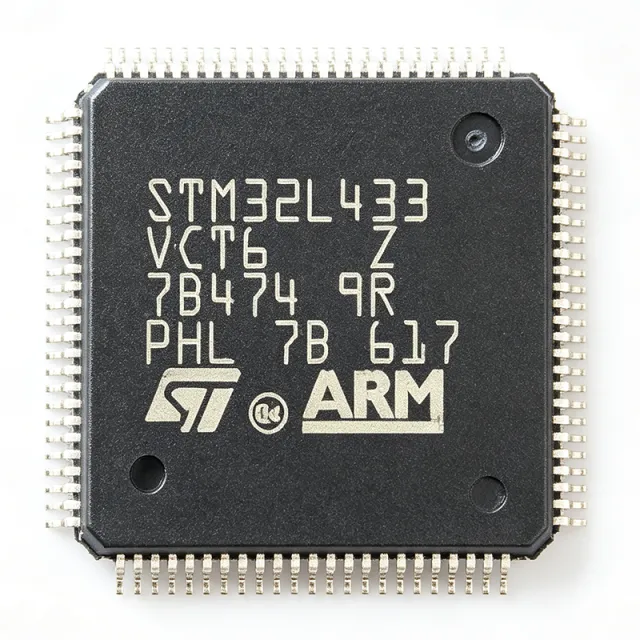
STM32F446VCT6 - 180MHz Cortex-M4 MCU, 256KB Flash | STMicroelectronics
MPN: STM32F446VCT6 ✓ Active| Qty | Unit Price | Extended |
|---|---|---|
| 1 | $8.7273 | $8.73 |
| 10 | $6.303 | $63.03 |
| 100 | $5.5758 | $557.58 |
| 360 | $5.3333 | $1,919.99 |
| 720 | $5.0909 | $3,665.45 |
| 1,080 | $4.9848 | $5,383.58 |
STM32F446VCT6 Overview
A microcontroller (MCU) is a compact integrated circuit designed to govern a specific operation in an embedded system. It contains a processor core, memory, and programmable input/output peripherals. The STM32F446VCT6 belongs to the STM32F4 series, which is part of the broader STM32 family of 32-bit microcontrollers. This family is known for its balance of performance, power efficiency, and rich peripheral integration, positioning it as a leading choice in the microcontroller market.
Key features of the STM32F446VCT6 include a 180 MHz Arm Cortex-M4 core with floating-point unit (FPU), 256 KB Flash, 128 KB SRAM, and a comprehensive set of peripherals. It supports multiple communication interfaces such as USART, SPI, I2C, CAN, USB OTG, and SDIO. The device also includes advanced analog peripherals like 12-bit ADCs and DACs, timers, and a true random number generator (RNG). These features enable complex real-time control and signal processing tasks.
Technically, the STM32F446VCT6 leverages the ARM Cortex-M4 architecture with DSP instructions and a single-precision FPU, allowing efficient execution of digital signal processing algorithms. The device operates from a 2.0V to 3.6V power supply and includes multiple power-saving modes, such as Sleep, Stop, and Standby, to optimize energy consumption. The 100-pin LQFP package provides a compact footprint while offering sufficient I/O pins for diverse applications.
Typical applications include industrial control systems, motor drives, consumer electronics, IoT devices, and audio processing. The high clock speed and FPU make it ideal for applications requiring real-time computation, such as motor control with field-oriented control (FOC) algorithms or audio effects processing. The rich peripheral set also supports connectivity in smart home and industrial automation scenarios.
When designing with this device, ensure proper decoupling of the power supply pins with 100 nF capacitors placed close to each VDD pin. Additionally, consider the thermal characteristics of the LQFP-100 package; for high-current I/O toggling, adequate PCB copper area is recommended to dissipate heat effectively.
Drop-in alternatives for STM32F446VCT6 — same package, pin-to-pin compatible. Different-package parts requiring PCB rework are excluded.
Quick Comparison Tool — Select alternative parts for side-by-side comparison:
STM32F446VET6
📋 Reference alternative (not in catalog)
STM32F446VGT6
📋 Reference alternative (not in catalog)
STM32F446RCT6
📋 Reference alternative (not in catalog)
GD32F450VIT6
📋 Reference alternative (not in catalog)
GD32F407VET6
📋 Reference alternative (not in catalog)
STM32F446VCT6 Maximum Ratings & Electrical Characteristics
| Core | ARM Cortex-M4 with FPU |
| Maximum Clock Frequency | 180 MHz |
| Flash Memory | 256 KB |
| SRAM | 128 KB |
| Package | 100-LQFP (14x14 mm) |
| Operating Voltage | 2.0V to 3.6V |
| I/O Pins | 82 |
| ADC | 3x 12-bit, 16 channels |
| DAC | 2x 12-bit |
| Timers | 12x 16-bit, 2x 32-bit |
| Communication Interfaces | USART, SPI, I2C, CAN, USB OTG, SDIO |
| Operating Temperature | -40C to +85C |
| Mounting Type | Surface Mount |
| RoHS Status | Compliant |
| DSP Instructions | Yes |
STM32F446VCT6 Pin Configuration
| Pin 1 | VBAT — Backup battery supply |
| Pin 2 | PC13 — GPIO / RTC tamper |
| Pin 3 | PC14 — GPIO / OSC32_IN |
| Pin 4 | PC15 — GPIO / OSC32_OUT |
| Pin 5 | PF0 — GPIO / OSC_IN |
| Pin 6 | PF1 — GPIO / OSC_OUT |
| Pin 7 | NRST — Reset (active low) |
| Pin 8 | PC0 — GPIO / ADC12_IN10 |
| Pin 9 | PC1 — GPIO / ADC12_IN11 |
| Pin 10 | PC2 — GPIO / ADC12_IN12 |
| Pin 11 | PC3 — GPIO / ADC12_IN13 |
| Pin 12 | VDD — Digital power supply |
| Pin 13 | VSS — Digital ground |
| Pin 14 | PC4 — GPIO / ADC12_IN14 |
| Pin 15 | PC5 — GPIO / ADC12_IN15 |
| Pin 16 | PB2 — GPIO / BOOT1 |
| Pin 17 | PE7 — GPIO / TIM1_ETR |
| Pin 18 | PE8 — GPIO / TIM1_CH1N |
| Pin 19 | PE9 — GPIO / TIM1_CH1 |
| Pin 20 | PE10 — GPIO / TIM1_CH2N |
Typical Applications
STM32F446VCT6 is suitable for 6 applications: Industrial Motor Control, IoT Gateway, Audio Processing, Consumer Electronics, Medical Devices, Robotics.
Industrial Motor Control
The STM32F446VCT6 is ideal for industrial motor control applications. Its 180 MHz Cortex-M4 core with FPU and DSP instructions efficiently executes field-oriented control (FOC) algorithms for brushless DC (BLDC) and permanent magnet synchronous motors (PMSM). The device includes advanced timers with complementary PWM outputs, 12-bit ADCs for current and voltage sensing, and CAN interface for industrial communication. In a typical motor drive, the MCU reads phase currents via ADCs, computes the FOC algorithm, and generates PWM signals to drive the inverter. The high clock speed ensures low latency in control loops, while the FPU accelerates mathematical computations. Designers should ensure proper isolation and filtering on ADC inputs to minimize noise from the power stage. The CAN interface enables seamless integration into industrial networks, making this MCU a robust choice for variable frequency drives, servo drives, and robotics.
Recommended
IoT Gateway
The STM32F446VCT6 serves as a powerful MCU for IoT gateways, providing the processing power to handle multiple communication protocols and data aggregation. With interfaces for Ethernet (via external PHY), USB OTG, CAN, and multiple UARTs/SPIs, it can connect to various sensors and actuators. The 256 KB Flash and 128 KB SRAM accommodate RTOS, TCP/IP stacks, and application logic. In a typical IoT gateway, the MCU collects data from sensors via UART or SPI, processes it, and forwards it to the cloud via Ethernet or Wi-Fi (using an external module). The high clock speed enables real-time data processing and protocol conversion. Designers should consider power consumption, as the MCU can operate in low-power modes when idle. The rich peripheral set and ample memory make it suitable for edge computing tasks, such as data filtering and local decision-making, reducing cloud latency and bandwidth usage.
Recommended
Audio Processing
The STM32F446VCT6 is well-suited for audio processing applications, such as audio effects processors, voice recognition, and active noise cancellation. The 180 MHz Cortex-M4 core with FPU and DSP instructions accelerates audio algorithms like FIR/IIR filters, FFT, and audio codecs. The device includes I2S interfaces for connecting to audio codecs and DACs, and a 12-bit DAC for direct analog output. In a typical audio application, the MCU receives digital audio via I2S, processes it in real-time (e.g., equalization, reverb), and outputs the processed signal. The high clock speed ensures low latency, critical for real-time audio. The FPU simplifies floating-point audio algorithms, improving precision and dynamic range. Designers should use high-quality audio codecs and ensure proper grounding to minimize noise. The large SRAM allows buffering of audio samples, reducing dropouts.
Recommended
Consumer Electronics
The STM32F446VCT6 is a versatile MCU for consumer electronics, including smart home devices, wearables, and portable gadgets. Its low power consumption in Stop and Standby modes extends battery life, while the high performance supports rich user interfaces and connectivity. The device includes USB OTG for direct connection to smartphones or PCs, and multiple timers for PWM dimming of LEDs or driving buzzers. In a smart home device, the MCU can manage sensors, display, and wireless communication (via external modules). The 256 KB Flash allows for feature-rich firmware, and the 128 KB SRAM supports complex applications. Designers should optimize power consumption by using low-power modes and efficient clock gating. The wide operating voltage range (2.0V to 3.6V) accommodates various battery configurations.
Recommended
Medical Devices
The STM32F446VCT6 is used in medical devices such as patient monitors, infusion pumps, and diagnostic equipment. Its high performance and rich analog peripherals enable precise data acquisition and real-time processing. The 12-bit ADCs with up to 16 channels can interface with various sensors (e.g., ECG, SpO2, temperature). The device includes a true random number generator (RNG) for security applications, and multiple communication interfaces for data logging and connectivity. In a patient monitor, the MCU acquires vital signs, processes them, and displays them on a screen or transmits to a central station. The high clock speed ensures timely processing of critical data. Designers must ensure compliance with medical standards (e.g., IEC 60601) and implement robust error handling. The large memory allows for storing patient data and firmware updates.
Recommended
Robotics
The STM32F446VCT6 is a powerful MCU for robotics, providing the computational power for control algorithms, sensor fusion, and communication. Its 180 MHz Cortex-M4 core with FPU accelerates kinematics and dynamics calculations, while the multiple timers and ADCs interface with encoders, IMUs, and motor drivers. The device supports CAN for multi-motor coordination and UART/SPI for communication with sensors and modules. In a robot, the MCU reads encoder data, processes IMU data for orientation, and generates PWM signals for motor control. The high clock speed enables real-time control loops, essential for stable and responsive robots. Designers should consider the power requirements of motors and ensure proper isolation between power and logic circuits. The rich peripheral set and memory make it suitable for autonomous robots with complex behaviors.
Recommended
Recommended Products Summary
Engineering reference data for STM32F446VCT6 — comparison, design guidance, and compliance information.
Selection Guide
Comparison with Alternatives
| Parameter | This Product | STM32F446VET6 | STM32F446VGT6 | GD32F450VIT6 |
|---|---|---|---|---|
| Package | 100-LQFP (14x14 mm) | 100-LQFP (14x14 mm) - same | 100-LQFP (14x14 mm) - same | 100-LQFP (14x14 mm) - same |
| Brand | STMicroelectronics | STMicroelectronics | STMicroelectronics | GigaDevice |
| Core Clock | 180 MHz | 180 MHz | 180 MHz | 200 MHz |
| Flash Memory | 256 KB | 512 KB | 1 MB | 512 KB |
| SRAM | 128 KB | 128 KB | 128 KB | 192 KB |
| FPU | Yes | Yes | Yes | Yes |
| Operating Voltage | 2.0V to 3.6V | 2.0V to 3.6V | 2.0V to 3.6V | 2.6V to 3.6V |
Key Differentiators
- Higher clock speed with FPU (vs STM32F103VCT6)
- More SRAM (vs STM32F407VGT6)
- Pin-compatible with larger Flash variants (vs STM32F446VET6)
Design Notes
Decouple each VDD pin with a 100 nF ceramic capacitor placed as close as possible to the pin. Additionally, use a 4.7 uF or larger bulk capacitor on the main power rail. For VDDA (analog supply), use a dedicated LC filter or ferrite bead to isolate analog noise. Ensure VSSA is connected to a clean analog ground plane.
For the 100-pin LQFP package, ensure adequate copper area for thermal dissipation. The thermal resistance (theta_JA) is approximately 45 C/W, so for high-current I/O toggling, add thermal vias under the exposed pad (if present) and connect to a ground plane. Keep high-speed traces short and use proper impedance control for USB and Ethernet interfaces.
When using the STM32F446VCT6, ensure the boot pins (BOOT0 and BOOT1) are configured correctly. BOOT0 is typically tied to ground for normal operation. Also, verify the HSE crystal load capacitors match the crystal's specification. Incorrect values can cause startup failures. For low-power modes, ensure all unused GPIOs are configured to analog mode to reduce leakage current.
Compliance Information
RoHS compliant per STMicroelectronics product page. Not AEC-Q100 qualified. Lead-free package.