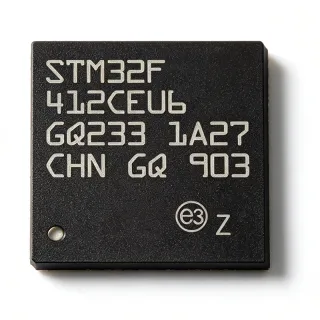
STM32WB30CEU7 - 2.4GHz Dual-Core Wireless MCU | STMicroelectronics
MPN: STM32WB30CEU7 ✓ Active| Qty | Unit Price | Extended |
|---|---|---|
| 1 | $6.5 | $6.50 |
| 10 | $5.85 | $58.50 |
| 100 | $5.2 | $520.00 |
| 500 | $4.68 | $2,340.00 |
| 1,000 | $4.16 | $4,160.00 |
STM32WB30CEU7 Overview
A wireless MCU (Microcontroller Unit) integrates a general-purpose processor with a radio transceiver on a single chip, enabling embedded systems to communicate wirelessly without external RF components. The STM32WB30CEU7 belongs to the STM32WB series, which is part of the broader STM32 family of 32-bit Arm Cortex-M microcontrollers. This architecture allows developers to leverage the rich STM32 ecosystem, including STM32CubeMX, STM32CubeWB firmware packages, and extensive middleware support for BLE and Zigbee protocols.
Key features of the STM32WB30CEU7 include a 2.4 GHz radio supporting BLE 5.0 (with 2 Mbps, long range, and advertising extensions) and 802.15.4 (Zigbee 3.0, Thread), a 12-bit ADC with up to 16 channels, multiple communication interfaces (USART, SPI, I2C, USB 2.0 FS), and a rich set of timers. The dual-core architecture offloads real-time radio stack processing to the Cortex-M0+, freeing the Cortex-M4 for application code, which improves system responsiveness and power efficiency.
The device operates from a 1.71V to 3.6V supply and features multiple low-power modes, including Sleep, Stop, and Standby, with typical current consumption as low as 2.8 uA in Stop mode with RTC. The integrated SMPS (Switched-Mode Power Supply) can be enabled to reduce RF power consumption, making it ideal for battery-powered devices. The radio achieves a sensitivity of -96 dBm for BLE and -100 dBm for 802.15.4, ensuring reliable communication in challenging environments.
Typical applications include smart home devices (sensors, locks, lighting), industrial wireless sensor networks, healthcare wearables, and asset tracking. The STM32WB30CEU7 is also supported by the STM32Cube ecosystem, which provides a comprehensive set of tools, middleware, and examples to accelerate development.
When designing with this device, pay attention to the RF layout: use a proper ground plane, place decoupling capacitors close to the supply pins, and follow the antenna design guidelines in the datasheet. The device requires a 32.768 kHz crystal for the RTC and a 32 MHz crystal for the radio, both of which must be placed near the corresponding pins to minimize parasitic capacitance.
Drop-in alternatives for STM32WB30CEU7 — same package, pin-to-pin compatible. Different-package parts requiring PCB rework are excluded.
Quick Comparison Tool — Select alternative parts for side-by-side comparison:
STM32WB35CEU7
✅ Drop-In ⚠️ Specs Unverified📋 Reference alternative (not in catalog)
STM32WB55CEU7
✅ Drop-In ⚠️ Specs Unverified📋 Reference alternative (not in catalog)
STM32WB50CGU7
✅ Drop-In ⚠️ Specs Unverified📋 Reference alternative (not in catalog)
STM32WB30CEU7 Maximum Ratings & Electrical Characteristics
| Core Processor | Arm Cortex-M4 (application) + Arm Cortex-M0+ (network) |
| Core Speed | 64 MHz (Cortex-M4), 32 MHz (Cortex-M0+) |
| Flash Memory | 512 KB |
| SRAM | 96 KB |
| Wireless Protocols | Bluetooth Low Energy 5.0, 802.15.4 (Zigbee 3.0, Thread) |
| Radio Frequency | 2.4 GHz |
| Radio Sensitivity (BLE) | -96 dBm |
| Radio Sensitivity (802.15.4) | -100 dBm |
| Supply Voltage | 1.71 V to 3.6 V |
| ADC Resolution | 12-bit |
| ADC Channels | 16 |
| Communication Interfaces | USART, SPI, I2C, USB 2.0 FS |
| Package | UFQFPN-48 (7x7 mm) |
| Operating Temperature | -40C to +85C |
| RoHS Status | Compliant |
STM32WB30CEU7 Pin Configuration
| Pin 1 | VBAT — Battery backup supply for RTC and backup registers |
| Pin 2 | PC14 — GPIO / OSC32_IN (32.768 kHz crystal input) |
| Pin 3 | PC15 — GPIO / OSC32_OUT (32.768 kHz crystal output) |
| Pin 4 | PH0 — GPIO / OSC_IN (32 MHz crystal input) |
| Pin 5 | PH1 — GPIO / OSC_OUT (32 MHz crystal output) |
| Pin 6 | NRST — Reset (active low) |
| Pin 7 | VDD — Digital power supply |
| Pin 8 | VSS — Ground |
| Pin 9 | VDDA — Analog power supply |
| Pin 10 | PA0 — GPIO / ADC_IN0 / WKUP1 |
| Pin 11 | PA1 — GPIO / ADC_IN1 |
| Pin 12 | PA2 — GPIO / USART2_TX / ADC_IN2 |
| Pin 13 | PA3 — GPIO / USART2_RX / ADC_IN3 |
| Pin 14 | PA4 — GPIO / SPI1_NSS / ADC_IN4 |
| Pin 15 | PA5 — GPIO / SPI1_SCK / ADC_IN5 |
| Pin 16 | PA6 — GPIO / SPI1_MISO / ADC_IN6 |
| Pin 17 | PA7 — GPIO / SPI1_MOSI / ADC_IN7 |
| Pin 18 | PB0 — GPIO / ADC_IN8 |
| Pin 19 | PB1 — GPIO / ADC_IN9 |
| Pin 20 | PB2 — GPIO / BOOT1 |
| Pin 21 | PB10 — GPIO / I2C2_SCL / USART3_TX |
| Pin 22 | PB11 — GPIO / I2C2_SDA / USART3_RX |
| Pin 23 | PB12 — GPIO / SPI2_NSS / I2C2_SCL |
| Pin 24 | PB13 — GPIO / SPI2_SCK / I2C2_SDA |
| Pin 25 | PB14 — GPIO / SPI2_MISO |
| Pin 26 | PB15 — GPIO / SPI2_MOSI |
| Pin 27 | PC13 — GPIO / RTC_TAMP1 / WKUP2 |
| Pin 28 | PC14 — GPIO / OSC32_IN |
| Pin 29 | PC15 — GPIO / OSC32_OUT |
| Pin 30 | VDD — Digital power supply |
| Pin 31 | VSS — Ground |
| Pin 32 | VDDA — Analog power supply |
| Pin 33 | PA8 — GPIO / USB_DP |
| Pin 34 | PA9 — GPIO / USB_DM |
| Pin 35 | PA10 — GPIO / USART1_RX |
| Pin 36 | PA11 — GPIO / USART1_TX |
| Pin 37 | PA12 — GPIO / USART1_CK |
| Pin 38 | PA13 — GPIO / SWDIO |
| Pin 39 | PA14 — GPIO / SWCLK |
| Pin 40 | PA15 — GPIO / SPI1_NSS / JTDI |
| Pin 41 | PB3 — GPIO / SPI1_SCK / JTDO |
| Pin 42 | PB4 — GPIO / SPI1_MISO / NJTRST |
| Pin 43 | PB5 — GPIO / SPI1_MOSI |
| Pin 44 | PB6 — GPIO / I2C1_SCL / USART1_TX |
| Pin 45 | PB7 — GPIO / I2C1_SDA / USART1_RX |
| Pin 46 | PB8 — GPIO / I2C1_SCL / CAN_RX |
| Pin 47 | PB9 — GPIO / I2C1_SDA / CAN_TX |
| Pin 48 | VDD — Digital power supply |
Typical Applications
STM32WB30CEU7 is suitable for 6 applications: Smart Home Devices, Industrial Wireless Sensor Networks, Healthcare Wearables, Asset Tracking, Smart Agriculture, Beacons and Indoor Positioning.
Smart Home Devices
The STM32WB30CEU7 is ideal for smart home devices such as smart locks, lighting controls, and environmental sensors. Its dual-core architecture allows the Cortex-M0+ to handle the BLE/Zigbee protocol stack while the Cortex-M4 runs the application logic, ensuring low latency and efficient power consumption. The device supports both BLE and Zigbee, enabling interoperability with major smart home ecosystems like Apple HomeKit, Google Home, and Amazon Alexa. With a supply voltage range of 1.71V to 3.6V, it can be powered directly from batteries, and its low-power modes (Stop mode with RTC at 2.8 uA) extend battery life. The integrated SMPS further reduces RF power consumption, making it suitable for battery-powered devices that need to operate for years. The 512 KB flash provides ample space for application code and protocol stacks, while the 96 KB SRAM supports complex data buffering. The device's -96 dBm BLE sensitivity ensures reliable communication even in environments with high interference, such as homes with many wireless devices. Developers can leverage the STM32CubeWB firmware package, which includes ready-to-use examples for BLE and Zigbee, accelerating time-to-market.
Recommended
Industrial Wireless Sensor Networks
In industrial settings, the STM32WB30CEU7 excels in wireless sensor networks for condition monitoring, predictive maintenance, and process control. Its support for 802.15.4 (Zigbee and Thread) enables mesh networking, which is crucial for reliable communication across large factory floors. The device's -100 dBm sensitivity for 802.15.4 ensures robust links even in noisy industrial environments. The dual-core architecture allows the network stack to run on the Cortex-M0+ while the application processor handles sensor data processing and local decision-making, reducing latency and improving system responsiveness. The wide operating temperature range (-40C to +85C) makes it suitable for harsh industrial environments. The 12-bit ADC with 16 channels can interface with various analog sensors, and the multiple USART/SPI/I2C interfaces allow connection to external sensors and actuators. The device's low-power modes are essential for battery-powered wireless nodes, and the SMPS helps minimize power consumption during RF transmission. The STM32CubeWB firmware includes support for Zigbee PRO and Thread, providing a robust and scalable networking solution. Additionally, the device's security features, such as a unique 64-bit ID and optional AES-256 (on higher variants), help protect industrial data.
Recommended
Healthcare Wearables
The STM32WB30CEU7 is well-suited for healthcare wearables such as fitness trackers, heart rate monitors, and continuous glucose monitors. Its low power consumption is critical for battery-operated devices that need to last days or weeks between charges. The device's BLE 5.0 support enables efficient data transfer to smartphones and other gateways, with features like 2 Mbps throughput and advertising extensions for faster connection. The dual-core architecture allows the Cortex-M0+ to handle the BLE stack, while the Cortex-M4 processes sensor data and runs algorithms for health monitoring. The 12-bit ADC can interface with analog sensors like photoplethysmography (PPG) sensors for heart rate measurement. The device's small form factor (UFQFPN-48, 7x7 mm) is ideal for compact wearable designs. The supply voltage range of 1.71V to 3.6V allows direct connection to a Li-ion battery, and the low-power modes (Stop mode at 2.8 uA) extend battery life. The integrated SMPS reduces RF power consumption, further improving energy efficiency. The device's security features, including a unique ID and optional AES-256 (on higher variants), help protect sensitive health data. The STM32CubeWB firmware provides BLE profiles and services for health devices, accelerating development.
Recommended
Asset Tracking
The STM32WB30CEU7 is an excellent choice for asset tracking devices that require long battery life and reliable wireless communication. Its support for BLE 5.0 and 802.15.4 allows it to communicate with both BLE beacons and Zigbee/Thread mesh networks, making it versatile for various tracking scenarios. The device's low power consumption, with Stop mode at 2.8 uA, enables battery-powered trackers to operate for months or even years. The dual-core architecture allows the Cortex-M0+ to handle the wireless protocol stack, while the Cortex-M4 runs tracking algorithms and interfaces with GPS or other location sensors. The device's multiple communication interfaces (USART, SPI, I2C) allow easy connection to GPS modules, accelerometers, and other sensors. The wide operating temperature range (-40C to +85C) ensures reliable operation in outdoor environments. The integrated SMPS reduces RF power consumption, which is critical for battery life. The device's security features, including a unique 64-bit ID, help prevent unauthorized tracking. The STM32CubeWB firmware provides examples for BLE beacons and Zigbee end devices, simplifying development. The small package size (UFQFPN-48, 7x7 mm) is ideal for compact tracker designs.
Recommended
Smart Agriculture
The STM32WB30CEU7 is well-suited for smart agriculture applications such as soil monitoring, irrigation control, and livestock tracking. Its support for 802.15.4 (Zigbee and Thread) enables mesh networking, which is essential for covering large agricultural areas with reliable wireless connectivity. The device's low power consumption is critical for battery-powered sensors deployed in the field, and the Stop mode at 2.8 uA allows for long operational lifetimes. The dual-core architecture allows the Cortex-M0+ to handle the network stack, while the Cortex-M4 processes sensor data and runs control algorithms. The 12-bit ADC can interface with soil moisture sensors, temperature sensors, and other analog sensors. The device's wide operating temperature range (-40C to +85C) ensures reliable operation in outdoor environments. The multiple communication interfaces (USART, SPI, I2C) allow connection to various sensors and actuators, such as irrigation valves. The integrated SMPS reduces RF power consumption, which is important for solar-powered or battery-powered systems. The device's security features help protect agricultural data. The STM32CubeWB firmware provides support for Zigbee PRO, enabling robust mesh networking for large-scale deployments.
Recommended
Beacons and Indoor Positioning
The STM32WB30CEU7 is ideal for BLE beacons and indoor positioning systems. Its BLE 5.0 support includes advertising extensions, which allow beacons to broadcast data more efficiently and support longer range. The device's low power consumption is critical for battery-powered beacons that need to operate for years. The dual-core architecture allows the Cortex-M0+ to handle the BLE stack, while the Cortex-M4 can run positioning algorithms or process sensor data. The device's small form factor (UFQFPN-48, 7x7 mm) is ideal for compact beacon designs. The supply voltage range of 1.71V to 3.6V allows direct battery operation, and the low-power modes (Stop mode at 2.8 uA) extend battery life. The integrated SMPS reduces RF power consumption, further improving energy efficiency. The device's -96 dBm BLE sensitivity ensures reliable signal reception for accurate positioning. The STM32CubeWB firmware provides examples for BLE beacon applications, including iBeacon and Eddystone. The device's security features, including a unique 64-bit ID, help prevent spoofing. The wide operating temperature range (-40C to +85C) ensures reliable operation in various environments.
Recommended
Recommended Products Summary
Engineering reference data for STM32WB30CEU7 — comparison, design guidance, and compliance information.
Selection Guide
Comparison with Alternatives
| Parameter | This Product | STM32WB35CEU7 | STM32WB55CEU7 | STM32WB50CGU7 | nRF52840 |
|---|---|---|---|---|---|
| Package | UFQFPN-48 (7x7 mm) | UFQFPN-48 (7x7 mm) - same | UFQFPN-48 (7x7 mm) - same | UFQFPN-48 (7x7 mm) - same | QFN-48 (6x6 mm) - different |
| Brand | STMicroelectronics | STMicroelectronics | STMicroelectronics | STMicroelectronics | Nordic Semiconductor |
| Flash Memory | 512 KB | 1 MB | 1 MB | 1 MB | 1 MB |
| SRAM | 96 KB | 256 KB | 256 KB | 256 KB | 256 KB |
| Wireless Protocols | BLE 5.0, 802.15.4 (Zigbee, Thread) | BLE 5.0, 802.15.4 (Zigbee, Thread) | BLE 5.0, 802.15.4 (Zigbee, Thread) | BLE 5.0 only | BLE 5.0, 802.15.4 (Thread, Zigbee) |
| Security Features | Unique ID, no hardware crypto | TRNG, AES-256 | TRNG, AES-256 | Unique ID, no hardware crypto | AES-128, ARM TrustZone |
| Supply Voltage | 1.71V to 3.6V | 1.71V to 3.6V | 1.71V to 3.6V | 1.71V to 3.6V | 1.7V to 5.5V |
| Operating Temperature | -40C to +85C | -40C to +85C | -40C to +85C | -40C to +85C | -40C to +85C |
Key Differentiators
- Dual-core architecture with dedicated network processor (vs nRF52840)
- Support for both BLE 5.0 and 802.15.4 (Zigbee/Thread) (vs STM32WB50CGU7)
- Lower cost with 512 KB flash (vs STM32WB55CEU7)
Design Notes
For the STM32WB30CEU7, ensure a solid ground plane under the RF section and place the 32 MHz crystal (for the radio) and 32.768 kHz crystal (for RTC) as close as possible to the PH0/PH1 and PC14/PC15 pins, respectively. Use a balun (e.g., BALF-NRG-02D3) for the RF output and match the antenna impedance to 50 ohms. Follow the layout guidelines in the STM32WB datasheet and AN5185 (RF layout guidelines) to achieve optimal RF performance.
Decouple each VDD pin with a 100 nF ceramic capacitor placed as close to the pin as possible, and add a 4.7 uF bulk capacitor on the main supply. For the VDDA pin, use a 1 uF capacitor and a ferrite bead to isolate analog noise. If using the SMPS, connect the SMPS inductor (e.g., 10 uH) and its output capacitor (e.g., 4.7 uF) as specified in the datasheet. Ensure the supply voltage stays within 1.71V to 3.6V, and consider using a low-dropout regulator for battery-powered designs.
The STM32WB30CEU7 in UFQFPN-48 package has a thermal resistance (theta_JA) of approximately 40 C/W. For typical IoT applications with low duty cycles, power dissipation is minimal, but for continuous RF transmission at high output power, the junction temperature can rise. Ensure adequate copper area on the PCB for heat dissipation, especially on the exposed pad. If the device is used in high-temperature environments, monitor the junction temperature and consider reducing RF output power or using a heatsink.
Compliance Information
RoHS compliant per STMicroelectronics product page. Not AEC-Q100 qualified (not intended for automotive).