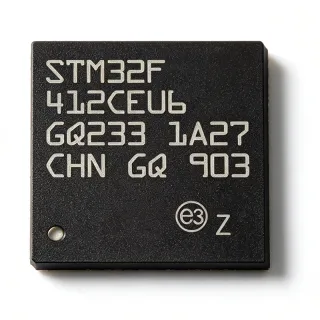
STM32WB55CEU6 - Dual-Core Wireless MCU with BLE 5.4 | STMicroelectronics
MPN: STM32WB55CEU6 ✓ Active| Qty | Unit Price | Extended |
|---|---|---|
| 1 | $6.85 | $6.85 |
| 10 | $6.16 | $61.60 |
| 100 | $5.48 | $548.00 |
| 500 | $4.93 | $2,465.00 |
| 1,000 | $4.38 | $4,380.00 |
STM32WB55CEU6 Overview
A wireless MCU (Microcontroller Unit) is a system-on-chip that combines a general-purpose microcontroller core with a radio transceiver, allowing embedded systems to communicate wirelessly without external host processors. In the system hierarchy, the STM32WB55CEU6 sits at the application processor level, managing both the user application and the wireless protocol stack, with the Cortex-M0+ core dedicated to real-time radio tasks. This dual-core architecture offloads the main CPU, ensuring deterministic wireless performance and lower power consumption.
Key features include a 2.4 GHz radio supporting BLE 5.4, Zigbee 3.0, and Thread, with a transmit power of up to +6 dBm and a receiver sensitivity of -96 dBm for BLE. The device supports a supply voltage range of 1.71V to 3.6V, with multiple low-power modes including Sleep, Stop, and Standby, achieving as low as 1.62 uA in Standby mode with RTC. It also integrates a rich set of peripherals: 12-bit ADC, multiple timers, USART, SPI, I2C, USB 2.0 FS, and a Touch Sensing controller.
The STM32WB55CEU6 is built on ST's ultra-low-power technology, featuring a proprietary radio IP that balances performance and energy efficiency. The dual-core design allows the Cortex-M0+ to handle the wireless protocol stack independently, while the Cortex-M4 runs the application, reducing software complexity and improving real-time responsiveness. The device also includes a hardware cryptographic accelerator (AES-256) and a true random number generator (TRNG) for secure wireless communication.
Typical applications include smart home hubs, wireless sensor nodes, asset tracking beacons, and industrial IoT gateways. Its support for multiple wireless protocols in a single chip makes it ideal for products that need to bridge BLE and Zigbee/Thread networks. The integrated USB and rich analog peripherals further expand its use in portable medical devices and wearable electronics.
When designing with this device, pay attention to the RF layout: use a 50-ohm impedance-controlled antenna trace and place decoupling capacitors close to the VDD pins. The dual-core architecture requires careful firmware partitioning to avoid resource contention between the two cores. Also, ensure the supply voltage stays within 1.71V to 3.6V and consider using the SMPS (switched-mode power supply) mode for improved efficiency in battery-powered designs.
Drop-in alternatives for STM32WB55CEU6 — same package, pin-to-pin compatible. Different-package parts requiring PCB rework are excluded.
Variants in this series
Same-series models that are drop-in compatible with STM32WB55CEU6 (same form factor and footprint) — differing in Operating Temperature, Wireless Protocols.
Quick Comparison Tool — Select alternative parts for side-by-side comparison:
STM32WB55CGU6
✅ Drop-In ⚠️ 参数待验证📋 Reference alternative (not in catalog)
STM32WB55CCU6
✅ Drop-In ⚠️ 参数待验证📋 Reference alternative (not in catalog)
STM32WB55CEU6TR
✅ Drop-In ⚠️ 参数待验证📋 Reference alternative (not in catalog)
nRF52840
⚡ Same Package ⚠️ 参数待验证📋 Reference alternative (not in catalog)
EFR32MG21
⚡ Same Package ⚠️ 参数待验证📋 Reference alternative (not in catalog)
STM32WB55CEU6 Maximum Ratings & Electrical Characteristics
| Core | Arm Cortex-M4 (application) + Arm Cortex-M0+ (radio) |
| Max CPU Frequency | 64 MHz (M4), 32 MHz (M0+) |
| Flash Memory | 512 KB |
| SRAM | 128 KB |
| Wireless Protocols | Bluetooth Low Energy 5.4, Zigbee 3.0, Thread, 802.15.4 |
| Radio Frequency | 2.4 GHz |
| Transmit Power | +6 dBm (max) |
| Receiver Sensitivity (BLE) | -96 dBm |
| Supply Voltage | 1.71 V to 3.6 V |
| Standby Current (with RTC) | 1.62 uA |
| Operating Temperature | -40C to +85C |
| Package | UFQFPN-48 (7x7 mm) |
| Mounting Type | Surface Mount |
| ADC | 12-bit, 16 channels |
| Communication Interfaces | USART, SPI, I2C, USB 2.0 FS |
| Security | AES-256, TRNG |
| RoHS Status | Compliant |
STM32WB55CEU6 Pin Configuration
| Pin 1 | VBAT — Backup battery supply for RTC and backup registers |
| Pin 2 | PC14 — GPIO / OSC32_IN |
| Pin 3 | PC15 — GPIO / OSC32_OUT |
| Pin 4 | PH0 — GPIO / OSC_IN |
| Pin 5 | PH1 — GPIO / OSC_OUT |
| Pin 6 | NRST — Reset (active low) |
| Pin 7 | PC0 — GPIO / ADC_IN |
| Pin 8 | PC1 — GPIO / ADC_IN |
| Pin 9 | PC2 — GPIO / ADC_IN |
| Pin 10 | PC3 — GPIO / ADC_IN |
| Pin 11 | VDD — Digital power supply |
| Pin 12 | VSS — Ground |
| Pin 13 | PA0 — GPIO / ADC_IN / WKUP |
| Pin 14 | PA1 — GPIO / ADC_IN |
| Pin 15 | PA2 — GPIO / USART2_TX |
| Pin 16 | PA3 — GPIO / USART2_RX |
| Pin 17 | PA4 — GPIO / SPI1_NSS |
| Pin 18 | PA5 — GPIO / SPI1_SCK |
| Pin 19 | PA6 — GPIO / SPI1_MISO |
| Pin 20 | PA7 — GPIO / SPI1_MOSI |
| Pin 21 | PA8 — GPIO / USB_DP |
| Pin 22 | PA9 — GPIO / USB_DM |
| Pin 23 | PA10 — GPIO / USART1_RX |
| Pin 24 | PA11 — GPIO / USART1_TX |
| Pin 25 | PA12 — GPIO / CAN_RX |
| Pin 26 | PA13 — GPIO / SWDIO |
| Pin 27 | PA14 — GPIO / SWCLK |
| Pin 28 | PA15 — GPIO / JTDI |
| Pin 29 | PB0 — GPIO / ADC_IN |
| Pin 30 | PB1 — GPIO / ADC_IN |
| Pin 31 | PB2 — GPIO / BOOT1 |
| Pin 32 | PB3 — GPIO / JTDO |
| Pin 33 | PB4 — GPIO / NJTRST |
| Pin 34 | PB5 — GPIO / I2C1_SMBA |
| Pin 35 | PB6 — GPIO / I2C1_SCL |
| Pin 36 | PB7 — GPIO / I2C1_SDA |
| Pin 37 | PB8 — GPIO / I2C1_SCL |
| Pin 38 | PB9 — GPIO / I2C1_SDA |
| Pin 39 | VDD — Digital power supply |
| Pin 40 | VSS — Ground |
| Pin 41 | PC4 — GPIO / ADC_IN |
| Pin 42 | PC5 — GPIO / ADC_IN |
| Pin 43 | PC6 — GPIO / USART6_TX |
| Pin 44 | PC7 — GPIO / USART6_RX |
| Pin 45 | PC8 — GPIO / USART6_CK |
| Pin 46 | PC9 — GPIO / USART6_CTS |
| Pin 47 | RF — RF input/output |
| Pin 48 | GND — RF ground |
Typical Applications
STM32WB55CEU6 is suitable for 6 applications: Smart Home Hub, Wireless Sensor Node, Asset Tracking Beacon, Industrial IoT Gateway, Wearable Health Monitor, Smart Lighting Control.
Smart Home Hub
The STM32WB55CEU6 is ideal for smart home hubs that need to bridge BLE and Zigbee/Thread devices. Its dual-core architecture allows the Cortex-M0+ to handle multiple wireless protocols concurrently, while the Cortex-M4 runs the hub application. The 512 KB flash provides ample space for protocol stacks and application code. With support for BLE 5.4, Zigbee 3.0, and Thread, it can connect to a wide range of smart home sensors, locks, and lights. The low-power modes ensure efficient operation in always-on hub devices, and the integrated security features (AES-256, TRNG) protect communication.
Recommended
Wireless Sensor Node
The STM32WB55CEU6 is well-suited for wireless sensor nodes in industrial and agricultural IoT. Its ultra-low power consumption (1.62 uA standby) enables battery-powered operation for years. The integrated 12-bit ADC and multiple timers allow precise sensor data acquisition. The BLE 5.4 radio provides reliable data transmission to a central gateway, while the Cortex-M4 handles sensor fusion and data processing. The wide supply voltage range (1.71V to 3.6V) allows direct battery connection, and the SMPS mode improves efficiency. The device's small 48-pin package is ideal for compact sensor designs.
Recommended
Asset Tracking Beacon
The STM32WB55CEU6 is perfect for asset tracking beacons that require long battery life and reliable BLE connectivity. Its low-power modes and efficient radio (TX power up to +6 dBm) allow for configurable advertising intervals to balance range and power consumption. The 512 KB flash can store configuration data and firmware updates over the air. The device's small form factor and wide voltage range make it easy to integrate into tags and trackers. The Cortex-M4 can process location algorithms, while the Cortex-M0+ handles the BLE stack, ensuring real-time performance.
Recommended
Industrial IoT Gateway
The STM32WB55CEU6 serves as a compact gateway for industrial IoT networks, bridging BLE sensors to a central cloud or local network. Its support for multiple protocols (BLE, Zigbee, Thread) allows it to aggregate data from various sensor types. The dual-core design ensures deterministic handling of time-critical wireless communication, while the Cortex-M4 runs the gateway application and MQTT client. The integrated USB 2.0 FS can be used for wired connectivity or firmware updates. The device's robust operating temperature range (-40C to +85C) makes it suitable for harsh industrial environments.
Recommended
Wearable Health Monitor
The STM32WB55CEU6 is an excellent choice for wearable health monitors that require low power and wireless data transmission. Its ultra-low standby current (1.62 uA) extends battery life, and the integrated ADC can interface with biosensors for heart rate, SpO2, or ECG monitoring. The BLE 5.4 radio enables continuous streaming of health data to a smartphone app. The Cortex-M4 can run signal processing algorithms, while the Cortex-M0+ handles the BLE stack, ensuring efficient operation. The small 48-pin package and wide voltage range support compact, battery-powered designs.
Recommended
Smart Lighting Control
The STM32WB55CEU6 is ideal for smart lighting systems that need to support Zigbee or Thread for mesh networking. Its dual-core architecture allows the radio core to handle the Zigbee stack, while the application core manages lighting effects and schedules. The device's low-power modes are beneficial for battery-powered lighting controls, and the integrated touch sensing controller can be used for touch dimmers. The 512 KB flash provides enough space for complex lighting algorithms and OTA updates. The device's support for multiple protocols enables interoperability with various smart home ecosystems.
Recommended
Recommended Products Summary
Engineering reference data for STM32WB55CEU6 — comparison, design guidance, and compliance information.
Selection Guide
Comparison with Alternatives
| Parameter | This Product | STM32WB55CGU6 | STM32WB55CCU6 | STM32WB55CEU6TR | nRF52840 | EFR32MG21 |
|---|---|---|---|---|---|---|
| Package | UFQFPN-48 (7x7 mm) | UFQFPN-48 (7x7 mm) - same | UFQFPN-48 (7x7 mm) - same | UFQFPN-48 (7x7 mm) - same | QFN-48 (6x6 mm) - different | QFN-32 (5x5 mm) - different |
| Brand | STMicroelectronics | STMicroelectronics | STMicroelectronics | STMicroelectronics | Nordic Semiconductor | Silicon Labs |
| Flash Memory | 512 KB | 1 MB | 256 KB | 512 KB | 1 MB | 512 KB |
| SRAM | 128 KB | 256 KB | 64 KB | 128 KB | 256 KB | 64 KB |
| Wireless Protocols | BLE 5.4, Zigbee, Thread | BLE 5.4, Zigbee, Thread | BLE 5.4, Zigbee, Thread | BLE 5.4, Zigbee, Thread | BLE 5, Zigbee, Thread | Zigbee, Thread (no BLE) |
| Max TX Power | +6 dBm | +6 dBm | +6 dBm | +6 dBm | +8 dBm | +20 dBm |
| RX Sensitivity (BLE) | -96 dBm | -96 dBm | -96 dBm | -96 dBm | -96 dBm | -104 dBm (Zigbee) |
| Supply Voltage | 1.71V to 3.6V | 1.71V to 3.6V | 1.71V to 3.6V | 1.71V to 3.6V | 1.7V to 5.5V | 1.8V to 3.8V |
| Standby Current | 1.62 uA (with RTC) | 1.62 uA (with RTC) | 1.62 uA (with RTC) | 1.62 uA (with RTC) | 1.5 uA (with RTC) | 1.3 uA (with RTC) |
Key Differentiators
- Dual-core architecture with dedicated radio core (vs nRF52840)
- Multi-protocol support (BLE, Zigbee, Thread) in a single chip (vs EFR32MG21)
- Ultra-low standby current of 1.62 uA (vs nRF52840)
Design Notes
For the STM32WB55CEU6, ensure a clean RF layout: use a 50-ohm impedance-controlled trace from the RF pin to the antenna, with a ground plane underneath. Place decoupling capacitors (100 nF and 1 uF) close to each VDD pin, and a 10 uF bulk capacitor near the main power input. The RF pin (pin 47) should be kept away from noisy digital traces to avoid interference.
The STM32WB55CEU6 supports a supply voltage from 1.71V to 3.6V. For battery-powered designs, use the internal SMPS (switched-mode power supply) mode to improve efficiency. When using SMPS, place the required external inductor (typically 10 uH) and capacitors as specified in the datasheet. Ensure the input voltage does not exceed 3.6V to prevent damage.
A common pitfall is neglecting the dual-core architecture: the Cortex-M0+ handles the wireless stack, so do not overload it with application tasks. Use the inter-processor communication (IPC) mechanism to manage data exchange between cores. Also, ensure the RF firmware is properly flashed to the M0+ core; otherwise, the radio will not function. Follow the STM32CubeWB example projects for correct setup.
Compliance Information
RoHS compliant per STMicroelectronics product page. Not AEC-Q100 qualified (not intended for automotive).