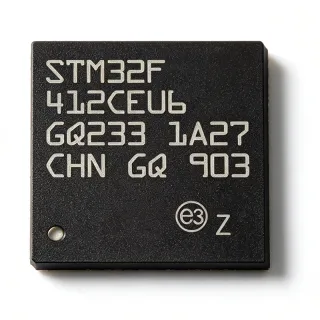
STM32F401CEU6 - 256KB Flash ARM Cortex-M4 MCU | STMicroelectronics
MPN: STM32F401CEU6 ✓ Active| Qty | Unit Price | Extended |
|---|---|---|
| 1 | $4.5 | $4.50 |
| 10 | $4.05 | $40.50 |
| 100 | $3.6 | $360.00 |
| 500 | $3.24 | $1,620.00 |
| 1,000 | $2.88 | $2,880.00 |
STM32F401CEU6 Overview
An ARM Cortex-M4 microcontroller is a 32-bit processor core designed for embedded systems, offering a balance of performance, power efficiency, and advanced features such as a single-cycle multiply-accumulate (MAC) instruction and a hardware floating-point unit. The Cortex-M4 core is part of the ARM Cortex-M family, which includes the M0, M0+, M3, M4, and M7 variants, each targeting different performance and power requirements. The STM32F401CEU6 leverages the Cortex-M4's DSP instructions and FPU to accelerate signal processing tasks, making it ideal for applications requiring real-time computation.
Key features of the STM32F401CEU6 include an 84 MHz maximum CPU frequency, 256 KB Flash, 64 KB SRAM, and a rich set of peripherals: 3 USARTs, 4 I2Cs, 3 SPIs, 1 SDIO, 1 USB 2.0 OTG FS, 1 CAN, 12-bit ADC with 16 channels, and multiple timers including advanced-control timers. The device also supports a comprehensive set of low-power modes (Sleep, Stop, Standby) and features a true random number generator (RNG) and a real-time clock (RTC).
The STM32F401CEU6 is built on ST's advanced 90nm process technology, offering a good balance between performance and power consumption. The Cortex-M4 core with FPU enables efficient execution of complex algorithms, while the ART Accelerator™ allows zero-wait-state execution from Flash, maximizing throughput. The device also includes a memory protection unit (MPU) for enhanced safety and security.
Typical applications include industrial control, motor drives, consumer electronics, IoT devices, and portable medical equipment. Its combination of processing power, memory, and peripheral integration makes it a versatile choice for many embedded designs.
When designing with this device, ensure proper decoupling of the power supply pins and consider the thermal characteristics of the UFQFPN package. The device supports in-circuit programming and debugging via SWD, and a comprehensive ecosystem of development tools and libraries is available from STMicroelectronics.
Drop-in alternatives for STM32F401CEU6 — same package, pin-to-pin compatible. Different-package parts requiring PCB rework are excluded.
Variants in this series
Same-series models that are drop-in compatible with STM32F401CEU6 (same form factor and footprint) — differing in Core, Flash Memory, Operating Temperature, SRAM, Timers.
Quick Comparison Tool — Select alternative parts for side-by-side comparison:
STM32F401CCU6
✅ Drop-In ⚠️ Specs Unverified📋 Reference alternative (not in catalog)
STM32F411CEU6
✅ Drop-In ⚠️ Specs Unverified✓ In Stock
$3.48 / Unit
View Datasheet →STM32F401CBU6
✅ Drop-In ⚠️ Specs Unverified📋 Reference alternative (not in catalog)
STM32F401CDU6
✅ Drop-In ⚠️ Specs Unverified✓ In Stock
$2.7 / Unit
View Datasheet →STM32F401REU6
✅ Drop-In ⚠️ Specs Unverified📋 Reference alternative (not in catalog)
STM32F401VEU6
✅ Drop-In ⚠️ Specs Unverified📋 Reference alternative (not in catalog)
STM32F401CEU6TR
✅ Drop-In ⚠️ Specs Unverified📋 Reference alternative (not in catalog)
STM32F401CEU6
✅ Drop-In✓ In Stock
$2.88 / Unit
View Datasheet →ATSAMD21G18A-AU
⚡ Same Package ⚠️ Specs Unverified✓ In Stock
$2.78 / Unit
View Datasheet →STM32F401CEU6 Maximum Ratings & Electrical Characteristics
| Core | ARM Cortex-M4 with FPU |
| Maximum Clock Frequency | 84 MHz |
| Flash Memory | 256 KB |
| SRAM | 64 KB |
| Supply Voltage | 1.7 V to 3.6 V |
| Package | UFQFPN-48 (7x7 mm) |
| Operating Temperature | -40C to +85C |
| Number of I/O Pins | 36 |
| ADC Resolution | 12-bit |
| ADC Channels | 16 |
| USARTs | 3 |
| I2Cs | 4 |
| SPIs | 3 |
| USB | USB 2.0 OTG FS |
| CAN | 1 |
| Timers | 11 (including advanced-control) |
| DMA Channels | 16 |
| RTC | Yes |
| Random Number Generator | Yes |
| RoHS Status | Compliant |
STM32F401CEU6 Pin Configuration
| Pin 1 | VBAT — Backup battery supply |
| Pin 2 | PC13 — GPIO / RTC output |
| Pin 3 | PC14 — GPIO / OSC32_IN |
| Pin 4 | PC15 — GPIO / OSC32_OUT |
| Pin 5 | PF0 — GPIO / OSC_IN |
| Pin 6 | PF1 — GPIO / OSC_OUT |
| Pin 7 | NRST — Reset (active low) |
| Pin 8 | VSSA — Analog ground |
| Pin 9 | VDDA — Analog power supply |
| Pin 10 | PA0 — GPIO / ADC_IN0 / TIM2_CH1 |
| Pin 11 | PA1 — GPIO / ADC_IN1 / TIM2_CH2 |
| Pin 12 | PA2 — GPIO / ADC_IN2 / USART2_TX |
| Pin 13 | PA3 — GPIO / ADC_IN3 / USART2_RX |
| Pin 14 | PA4 — GPIO / ADC_IN4 / SPI1_NSS |
| Pin 15 | PA5 — GPIO / ADC_IN5 / SPI1_SCK |
| Pin 16 | PA6 — GPIO / ADC_IN6 / SPI1_MISO |
| Pin 17 | PA7 — GPIO / ADC_IN7 / SPI1_MOSI |
| Pin 18 | PB0 — GPIO / ADC_IN8 / TIM3_CH3 |
| Pin 19 | PB1 — GPIO / ADC_IN9 / TIM3_CH4 |
| Pin 20 | PB2 — GPIO / BOOT1 |
| Pin 21 | PB10 — GPIO / I2C2_SCL / USART3_TX |
| Pin 22 | PB11 — GPIO / I2C2_SDA / USART3_RX |
| Pin 23 | PB12 — GPIO / SPI2_NSS / I2C2_SMBA |
| Pin 24 | PB13 — GPIO / SPI2_SCK |
| Pin 25 | PB14 — GPIO / SPI2_MISO |
| Pin 26 | PB15 — GPIO / SPI2_MOSI |
| Pin 27 | PC6 — GPIO / TIM3_CH1 / SDIO_D6 |
| Pin 28 | PC7 — GPIO / TIM3_CH2 / SDIO_D7 |
| Pin 29 | PC8 — GPIO / TIM3_CH3 / SDIO_D0 |
| Pin 30 | PC9 — GPIO / TIM3_CH4 / SDIO_D1 |
| Pin 31 | PA8 — GPIO / MCO1 / TIM1_CH1 |
| Pin 32 | PA9 — GPIO / USART1_TX / TIM1_CH2 |
| Pin 33 | PA10 — GPIO / USART1_RX / TIM1_CH3 |
| Pin 34 | PA11 — GPIO / USB_DM / TIM1_CH4 |
| Pin 35 | PA12 — GPIO / USB_DP / TIM1_ETR |
| Pin 36 | PA13 — GPIO / SWDIO |
| Pin 37 | PA14 — GPIO / SWCLK |
| Pin 38 | PA15 — GPIO / JTDI |
| Pin 39 | PB3 — GPIO / JTDO |
| Pin 40 | PB4 — GPIO / NJTRST |
| Pin 41 | PB5 — GPIO / I2C1_SMBA |
| Pin 42 | PB6 — GPIO / I2C1_SCL / TIM4_CH1 |
| Pin 43 | PB7 — GPIO / I2C1_SDA / TIM4_CH2 |
| Pin 44 | BOOT0 — Boot mode selection |
| Pin 45 | PB8 — GPIO / I2C1_SCL / CAN_RX |
| Pin 46 | PB9 — GPIO / I2C1_SDA / CAN_TX |
| Pin 47 | VSS — Ground |
| Pin 48 | VDD — Power supply |
Typical Applications
STM32F401CEU6 is suitable for 6 applications: Industrial Control, IoT Devices, Consumer Electronics, Medical Devices, Motor Control, Audio Processing.
Industrial Control
The STM32F401CEU6 is ideal for industrial control systems due to its 84 MHz Cortex-M4 core, advanced timers, and 12-bit ADC. It can handle real-time control loops, motor control, and PLC applications. The device's robust communication interfaces (CAN, USART, SPI) enable seamless integration with industrial networks. Its wide operating temperature range (-40C to +85C) ensures reliability in harsh environments. The FPU accelerates complex control algorithms, while the low-power modes help reduce energy consumption in remote monitoring stations.
Recommended
IoT Devices
The STM32F401CEU6 is well-suited for IoT devices, offering a balance of performance and power efficiency. Its 256 KB Flash and 64 KB SRAM provide ample space for firmware and data buffering. The device supports multiple low-power modes, enabling battery-powered operation for extended periods. With USB OTG FS, it can connect directly to smartphones or PCs for data transfer and firmware updates. The integrated RNG enhances security for cloud connectivity. The compact UFQFPN-48 package fits into small form-factor designs, making it ideal for smart sensors and wearables.
Recommended
Consumer Electronics
The STM32F401CEU6 powers a wide range of consumer electronics, from smart home devices to portable gadgets. Its high processing capability enables rich user interfaces and audio processing. The device's USB OTG FS allows direct connection to peripherals, while the multiple timers generate precise PWM for LED dimming and motor control. The FPU accelerates audio algorithms, and the low-power modes extend battery life in portable devices. The device's small package and low cost make it a popular choice for mass-market products.
Recommended
Medical Devices
The STM32F401CEU6 is used in portable medical devices such as glucose meters, pulse oximeters, and patient monitors. Its low power consumption and high processing capability enable continuous monitoring and real-time data processing. The 12-bit ADC accurately samples biosignals, while the FPU handles signal filtering and analysis. The device's small package allows for compact, wearable designs. The wide operating temperature range and robust design ensure reliable operation in clinical environments. The integrated RNG can be used for secure data encryption in compliance with medical data regulations.
Recommended
Motor Control
The STM32F401CEU6 excels in motor control applications, including brushless DC (BLDC) and stepper motors. Its advanced-control timers generate high-resolution PWM signals, and the 12-bit ADC samples phase currents and voltages. The FPU accelerates field-oriented control (FOC) algorithms, enabling efficient and smooth motor operation. The device's multiple communication interfaces allow integration with motor drivers and encoders. The low-power modes help reduce energy consumption in battery-powered motor applications, such as drones and robotics.
Recommended
Audio Processing
The STM32F401CEU6 is suitable for audio processing applications, such as voice recognition, audio effects, and sound synthesis. Its Cortex-M4 core with FPU provides the computational power needed for real-time audio algorithms. The device's multiple I2S interfaces (via SPI) can connect to audio codecs and DACs. The 12-bit ADC can sample analog audio signals, and the DMA channels offload data transfer to reduce CPU load. The device's low power consumption is beneficial for portable audio devices, and its small package fits into compact designs.
Recommended
Recommended Products Summary
Engineering reference data for STM32F401CEU6 — comparison, design guidance, and compliance information.
Selection Guide
Comparison with Alternatives
| Parameter | This Product | STM32F401CCU6 | STM32F411CEU6 | STM32F401CBU6 |
|---|---|---|---|---|
| Package | UFQFPN-48 (7x7 mm) | UFQFPN-48 (7x7 mm) - same | UFQFPN-48 (7x7 mm) - same | UFQFPN-48 (7x7 mm) - same |
| Brand | STMicroelectronics | STMicroelectronics | STMicroelectronics | STMicroelectronics |
| Core | ARM Cortex-M4 with FPU | ARM Cortex-M4 with FPU | ARM Cortex-M4 with FPU | ARM Cortex-M4 with FPU |
| Maximum Clock Frequency | 84 MHz | 84 MHz | 100 MHz | 84 MHz |
| Flash Memory | 256 KB | 128 KB | 256 KB | 128 KB |
| SRAM | 64 KB | 64 KB | 64 KB | 64 KB |
| Supply Voltage | 1.7V to 3.6V | 1.7V to 3.6V | 1.7V to 3.6V | 1.7V to 3.6V |
| Number of I/O Pins | 36 | 36 | 36 | 36 |
| ADC Resolution | 12-bit | 12-bit | 12-bit | 12-bit |
| USB | USB 2.0 OTG FS | USB 2.0 OTG FS | USB 2.0 OTG FS | USB 2.0 OTG FS |
Key Differentiators
- Higher Flash memory than STM32F401CCU6 (vs STM32F401CCU6)
- Lower clock frequency than STM32F411CEU6 (vs STM32F411CEU6)
- Same package and pinout as STM32F401CCU6 (vs STM32F401CCU6)
Design Notes
Decouple the VDD and VDDA pins with 100 nF ceramic capacitors placed as close to the pins as possible. Additionally, use a 4.7 uF capacitor on VDDA for analog noise filtering. The VBAT pin should be connected to a backup battery or tied to VDD if not used.
For the UFQFPN-48 package, ensure the exposed pad is soldered to a ground plane for proper thermal dissipation. Use thermal vias under the pad to improve heat transfer. Follow the recommended land pattern in the datasheet for reliable soldering.
When using the STM32F401CEU6, ensure the BOOT0 pin is properly configured to select the desired boot mode. Also, note that the PF0 and PF1 pins are used for the external crystal oscillator; if not used, they can be configured as GPIO. Avoid exceeding the absolute maximum ratings for supply voltage and I/O pins.
Compliance Information
RoHS compliant per STMicroelectronics product page. Not AEC-Q100 qualified - this is a standard-grade MCU.