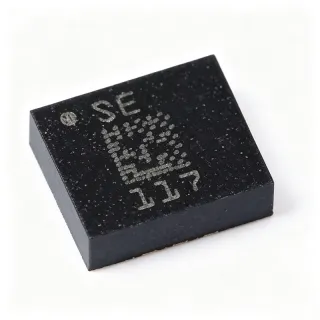
STM32WBA65RIV6 - BLE 5.4 802.15.4 MCU 2MB Flash | ST
MPN: STM32WBA65RIV6 ✓ Active| Qty | Unit Price | Extended |
|---|---|---|
| 1 | $9.65 | $9.65 |
| 10 | $9.17 | $91.70 |
| 100 | $8.69 | $869.00 |
| 500 | $8.21 | $4,105.00 |
| 1,000 | $7.72 | $7,720.00 |
STM32WBA65RIV6 Overview
A wireless MCU (microcontroller unit) combines a general-purpose processor, memory, and a radio transceiver on one die, sitting within the hierarchy of embedded processors: MCU -> Arm Cortex-M-based MCU -> wireless SoC -> multiprotocol connectivity IC. Wireless MCUs eliminate the complexity and power cost of a discrete radio-plus-MCU two-chip solution, and the STM32WBA6xxx series is STMicroelectronics' flagship ultra-low-power entry in this class, targeting Bluetooth LE, Zigbee, and Thread mesh networks on a single silicon platform.
Key differentiating features include the 100 MHz Cortex-M33 with hardware TrustZone security and FPU, 2 Mbytes of embedded Flash for large application and stack footprints, an ultra-low-power radio supporting Bluetooth SIG Low Energy specification 5.4 and IEEE 802.15.4-2015 (Zigbee and Thread), and independent power domains including a dedicated supply input for the 2.4 GHz radio and an analog independent supply for ADC and comparators. The family offers four packages from 48 to 121 pins, with or without an integrated SMPS option for extended battery life.
Architecturally, the device uses ST state-of-the-art patented radio technology with a dedicated 2.4 GHz radio core, allowing concurrent multiprotocol operation and secure over-the-air updates. TrustZone-based isolation partitions secure and non-secure firmware, supporting PSA-aligned security architectures common in smart-home and industrial sensor ecosystems.
Typical applications include Zigbee and Thread smart-home devices (sensors, lighting, actuators), Bluetooth LE accessories such as beacons and wearables, and industrial 802.15.4 mesh nodes where ultra-low average current determines battery replacement intervals.
Design consideration: plan the RF matching network and power supply partitioning early - the dedicated RADIO supply input and exposed pad require a solid ground pour for RF performance, and the SMPS versus LDO supply variant affects layout and efficiency trade-offs.
This page synthesizes distributor pricing, family drop-in variants, comparison data, and practical design notes not found on a single manufacturer datasheet page. Pricing references are as of 2026-09-13.
Drop-in alternatives for STM32WBA65RIV6 — same package, pin-to-pin compatible. Different-package parts requiring PCB rework are excluded.
Quick Comparison Tool — Select alternative parts for side-by-side comparison:
STM32WBA65RIV6Q
✅ Drop-In ⚠️ 参数待验证📋 Reference alternative (not in catalog)
STM32WBA64RIV6
✅ Drop-In ⚠️ 参数待验证📋 Reference alternative (not in catalog)
STM32WBA65RIY6
✅ Drop-In ⚠️ 参数待验证📋 Reference alternative (not in catalog)
STM32WBA65RIV6 Maximum Ratings & Electrical Characteristics
| Core | Arm Cortex-M33 with TrustZone and FPU |
| Core Frequency | 100 MHz |
| Flash Memory | 2 Mbytes |
| Wireless Protocol 1 | Bluetooth LE 5.4 |
| Wireless Protocol 2 | IEEE 802.15.4-2015 (Zigbee, Thread) |
| Radio Band | 2.4 GHz |
| Package | 68-VFQFPN Exposed Pad |
| Package Pin Count | 68 |
| Mounting Type | Surface Mount |
| Family Package Range | 48 to 121 pins |
| SMPS Option | Available with or without SMPS (family) |
| Independent Power Supplies | Analog independent supply (ADC/comparators), USB OTG high-speed, dedicated 2.4 GHz RADIO supply, 14 GPIOs with dedicated supply inputs |
STM32WBA65RIV6 48 to 121 pins Pin Configuration Guide
Pin configuration for STM32WBA65RIV6 (48 to 121 pins package). This digital IC includes GPIO, communication interfaces (UART, SPI, I2C), and power pins. Refer to the manufacturer datasheet for alternate pin functions and configuration options. Essential for embedded system design and PCB layout.

No detailed pinout data available for STM32WBA65RIV6.
Refer to the datasheet for full pin configuration.
Typical Applications
STM32WBA65RIV6 is suitable for 6 applications: Zigbee Smart-Home Sensors and Actuators, Thread / Matter Connectivity Devices, Bluetooth LE Wearables and Beacons, Industrial 802.15.4 Mesh Networks, Multiprotocol Gateways and Connected Hubs, Medical and Health Monitoring Accessories.
Zigbee Smart-Home Sensors and Actuators
The STM32WBA65RIV6 fits Zigbee end devices because its IEEE 802.15.4-2015-compliant 2.4 GHz radio and ultra-low-power architecture directly target mesh node duty cycles measured in microseconds of active time. The 2 Mbyte Flash holds the full Zigbee stack, application logic, and a second image bank for over-the-air firmware updates without external memory. The 100 MHz Cortex-M33 with FPU handles sensor fusion and local control logic, while TrustZone isolates commissioning keys and network credentials required by smart-home security specifications. Placed in a sensor node with the optional SMPS supply variant, the device reduces conversion losses versus LDO-only operation, extending coin-cell or AA battery life in motion detectors, door/window sensors, smart plugs, and lighting control nodes across a residential mesh network.
Recommended
Thread / Matter Connectivity Devices
Thread and Matter-over-Thread products require 802.15.4 radio compliance, secure key storage, and adequate code space for the IPv6-based Thread stack - all delivered natively by the STM32WBA65RIV6. The IEEE 802.15.4-2015 radio provides the Thread PHY/MAC, while the Arm Cortex-M33 TrustZone architecture partitions secure boot, device attestation, and Matter credential storage from the application domain, aligning with the security expectations of the Matter ecosystem. The 2 Mbyte Flash accommodates the Thread stack plus OpenThread-derived firmware and leaves headroom for OTA updates. STMicroelectronics explicitly lists Thread support on the STM32WBA65RI product page. For border-router edge nodes and always-on router-role devices, the dedicated radio power supply input maintains RF performance while other domains are power-optimized.
Recommended
Bluetooth LE Wearables and Beacons
The STM32WBA65RIV6 supports Bluetooth LE 5.4 (with Bluetooth LE 6.0 per ST product page), making it suitable for wearables, health trackers, asset tags, and beacons. Wearables demand long battery life from small cells; the ultra-low-power WBA6 architecture with optional integrated SMPS reduces supply conversion losses, and the 100 MHz Cortex-M33 completes sensor sampling and BLE stack processing in short active windows, minimizing average current. The 2 Mbyte Flash supports feature-rich applications including OTA bootloader, logging, and BLE 6.0-era channel-sounding firmware. The 68-VFQFPN exposed-pad package (approximately 8x8 mm class) fits compact wearable PCBs while providing a solid ground pad for the 2.4 GHz RF section, and dedicated supply inputs for the radio isolate noise from the digital domains.
Recommended
Industrial 802.15.4 Mesh Networks
Industrial wireless sensor networks built on IEEE 802.15.4 (Zigbee Green Power, proprietary 15.4 stacks, Thread) benefit from the STM32WBA65RIV6's combination of an industrial-capable Cortex-M33, TrustZone security, and 2 Mbyte Flash for protocol redundancy. The extended-temperature STM32WBA65RIV6Q variant addresses factory-floor temperature extremes per the family qualification. The FPU accelerates local signal processing - vibration or current-signature analysis - before transmission, cutting radio airtime and network congestion. Independent analog supply input for ADC and comparators preserves measurement accuracy beside noisy motor-drive environments, while the dedicated 2.4 GHz radio supply keeps RF sensitivity stable. Battery-replacement intervals in industrial nodes are dominated by sleep-mode current, the parameter ST emphasizes for this ultra-low-power family.
Recommended
Multiprotocol Gateways and Connected Hubs
Smart-home hubs often must bridge Bluetooth LE and 802.15.4 (Zigbee/Thread) networks concurrently. The STM32WBA65RIV6's multiprotocol radio plus 100 MHz Cortex-M33 and 2 Mbyte Flash support concurrent stack operation and channel-switching coordination within a single chip, eliminating a second MCU-radio pair from the BOM. TrustZone separates the connectivity-critical radio firmware from third-party application code, a common requirement for gateway platform security certification. Fourteen GPIOs with dedicated supply inputs and USB OTG high-speed support provide interface expansion to host processors or peripherals in hub designs. The 68-VFQFPN exposed-pad footprint enables compact hub PCBs, and mains-powered hubs relax the battery budget, letting designers trade the SMPS variant for cost-optimized LDO operation where duty cycle is less critical.
Recommended
Medical and Health Monitoring Accessories
Connected medical accessories - glucose meters, pulse oximeters, temperature patches - require low-power wireless, secure data handling, and reliable OTA updates. The STM32WBA65RIV6 addresses each: Bluetooth LE 5.4 connectivity to phones and gateways, TrustZone-based isolation for patient-data confidentiality and secure boot chains, and 2 Mbyte Flash for dual-image OTA plus measurement firmware. The analog independent supply input for the ADC supports clean physiological-signal acquisition separate from digital switching noise, improving measurement integrity in battery-powered patch form factors. The ultra-low-power design philosophy of the WBA6 family targets multi-week to multi-month battery life from small cells in continuous-monitoring use cases. The 68-VFQFPN package suits compact disposable and reusable medical accessory PCBs alike.
Recommended
Recommended Products Summary
Engineering reference data for STM32WBA65RIV6 — comparison, design guidance, and compliance information.
Selection Guide
Comparison with Alternatives
| Parameter | This Product | STM32WBA65RIV6Q | STM32WBA64RIV6 | STM32WBA65RIY6 |
|---|---|---|---|---|
| Package | 68-VFQFPN Exposed Pad | 68-VFQFPN - same | 68-VFQFPN - same | 68-VFQFPN - same |
| Brand | STMicroelectronics | STMicroelectronics | STMicroelectronics | STMicroelectronics |
| Core | Arm Cortex-M33 + TrustZone + FPU | Cortex-M33 + TrustZone + FPU | Cortex-M33 + TrustZone + FPU | Cortex-M33 + TrustZone + FPU |
| Core Frequency | 100 MHz | 100 MHz | 100 MHz | 100 MHz |
| Flash Memory | 2 Mbytes | 2 Mbytes | 1 Mbyte | 2 Mbytes |
| Bluetooth LE | LE 5.4 (LE 6.0 per ST page) | LE 5.4 / 6.0 | LE 5.4 / 6.0 | LE 5.4 / 6.0 |
| 802.15.4 / Zigbee / Thread | Yes (IEEE 802.15.4-2015) | Yes | Yes | Yes |
| Grade | Standard | Extended/qualified (Q suffix) | Standard | Standard |
Key Differentiators
- 2 Mbytes Flash in a compact 68-pin QFN (vs STM32WBA64RIV6)
- Extended-temperature option without footprint change (vs STM32WBA65RIV6Q)
- Multiprotocol BLE + 802.15.4 on one die (vs STM32WBA64RIV6)
Design Notes
The 68-VFQFPN exposed pad is the primary RF and thermal ground. Connect the exposed pad to a continuous, unbroken ground pour with an array of vias (typically 5x5 or denser per standard 2.4 GHz QFN practice) to the internal ground plane. Route the 2.4 GHz matching network with 50-ohm controlled impedance traces, keep it symmetric and short, and place the crystal and DC-DC (if the SMPS variant is used) away from the antenna feed. Refer to the RF layout guidance in the STM32WBA6xxx hardware getting-started application note from STMicroelectronics before finalizing the stackup.
The STM32WBA6xxx family supports independent power domains: analog supply for ADC/comparators, dedicated 2.4 GHz RADIO supply input, and 14 GPIOs with dedicated supply inputs. Filter the RADIO supply with an RC or ferrite network per the datasheet reference design to prevent digital noise from degrading receiver sensitivity. Decide SMPS versus LDO operation early: the SMPS variant improves efficiency for battery nodes but requires careful inductor placement; the LDO configuration is simpler but less efficient. Estimate average battery life from the datasheet sleep-mode current plus your BLE connection interval - not peak Tx current.
Confirm Flash sizing against your OTA strategy before committing to this part. A full BLE plus Zigbee/Thread multiprotocol build with dual-bank OTA can consume a large fraction of the 2 Mbytes; if your image needs less, the same-footprint STM32WBA64RIV6 (1 Mbyte) reduces cost. Also verify the exact Bluetooth feature set of your STM32CubeWBA firmware release versus the silicon's BLE 5.4/6.0 capability, and budget flash for stack updates over the product lifetime. Do not assume pin-compatibility with other WBA packages - only same-package (68-VFQFPN) family members are drop-in.
Compliance Information
Compliance data was not present in the provided verified web data; consult the ST product page and ECOPACK certificate for STM32WBA65RIV6 RoHS/REACH status.