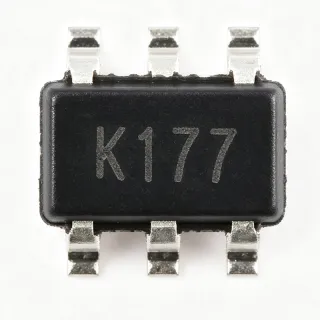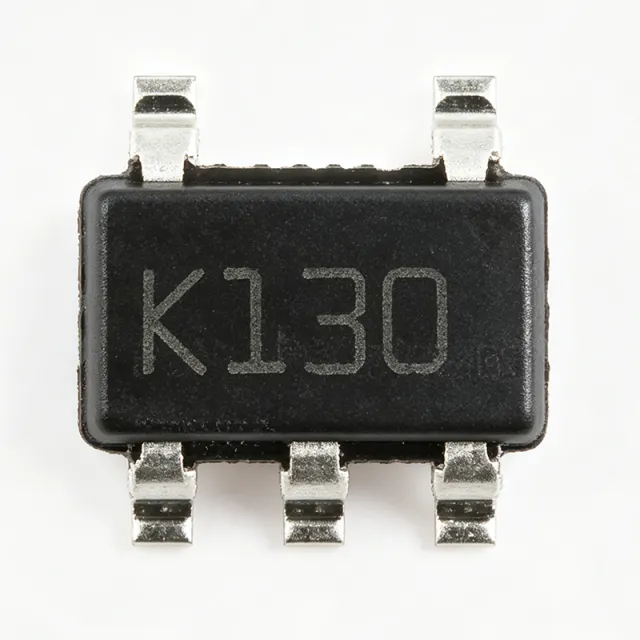
TSV991ILT - 20MHz Rail-to-Rail Op Amp | STMicroelectronics
MPN: TSV991ILT ✓ Active| Qty | Unit Price | Extended |
|---|---|---|
| 10 | $0.43 | $4.30 |
| 100 | $0.41 | $41.00 |
| 500 | $0.36 | $180.00 |
| 1,000 | $0.35 | $350.00 |
| 3,000 | $0.34 | $1,020.00 |
TSV991ILT Overview
An operational amplifier (op-amp) is a high-gain voltage amplifier with differential inputs and a single-ended output. It is a fundamental building block in analog electronics, used in signal conditioning, filtering, and amplification. The TSV991ILT belongs to the family of general-purpose op-amps, which are characterized by their versatility and ease of use. In the hierarchy of analog components, op-amps are part of the broader category of linear integrated circuits, which also includes comparators and voltage regulators.
Key features of the TSV991ILT include rail-to-rail input and output stages, which maximize the dynamic range in low-voltage applications. The device also features a low input offset voltage of 1.5 mV (max) and a low input bias current of 1 pA (typ), ensuring high accuracy in precision circuits. The 20 MHz bandwidth and 10 V/µs slew rate enable the amplifier to handle high-frequency signals, making it suitable for video and communication applications.
The TSV991ILT is built on STMicroelectronics' advanced BiCMOS process, which combines the benefits of bipolar and CMOS technologies. This process achieves a good balance between speed, power consumption, and noise performance. The amplifier's quiescent current is typically 1.1 mA, providing a favorable trade-off between speed and power efficiency for battery-operated devices.
Typical applications include active filters, signal conditioning, portable instrumentation, and audio processing. The rail-to-rail output capability allows the amplifier to drive ADC inputs directly, maximizing the usable input range. In sensor interfaces, the low input bias current minimizes errors when interfacing with high-impedance sensors.
When designing with the TSV991ILT, ensure proper power supply decoupling with a 0.1 µF ceramic capacitor placed close to the VCC pin. The input common-mode voltage range extends beyond the supply rails, but care should be taken to avoid exceeding the absolute maximum ratings. The output can swing within 50 mV of the rails, which is beneficial for single-supply operation.
This page synthesizes distributor pricing, drop-in alternatives, and practical design notes not found in the STMicroelectronics datasheet, providing a comprehensive resource for engineers evaluating the TSV991ILT.
Drop-in alternatives for TSV991ILT — same package, pin-to-pin compatible. Different-package parts requiring PCB rework are excluded.
Quick Comparison Tool — Select alternative parts for side-by-side comparison:
TSV991AILT
📋 Reference alternative (not in catalog)
TSV991IDT
📋 Reference alternative (not in catalog)
TSV991IYLT
📋 Reference alternative (not in catalog)
TSV991ILT Maximum Ratings & Electrical Characteristics
| Number of Channels | 1 |
| Gain Bandwidth Product | 20 MHz |
| Slew Rate | 10 V/µs |
| Supply Voltage Range | 2.5 V to 5.5 V |
| Input Offset Voltage | 1.5 mV (max) |
| Input Bias Current | 1 pA (typ) |
| Quiescent Current | 1.1 mA (typ) |
| Rail-to-Rail Input | Yes |
| Rail-to-Rail Output | Yes |
| Operating Temperature Range | -40°C to +125°C |
| Package | SOT-23-5 |
| Mounting Type | Surface Mount |
| RoHS Status | Compliant |
TSV991ILT Pin Configuration
| Pin 1 | OUT — Output |
| Pin 2 | VCC — Positive power supply |
| Pin 3 | IN+ — Non-inverting input |
| Pin 4 | IN- — Inverting input |
| Pin 5 | GND — Ground |
Typical Applications
TSV991ILT is suitable for 6 applications: Active Filters, Signal Conditioning, Portable Instrumentation, Audio Processing, Photodiode Amplifier, Battery-Powered Devices.
Active Filters
The TSV991ILT's 20 MHz gain bandwidth product and rail-to-rail output make it ideal for active filter designs. In a Sallen-Key low-pass filter, the high bandwidth ensures accurate signal processing up to several MHz. The rail-to-rail output allows the filter to drive ADC inputs directly, maximizing dynamic range. The low input bias current (1 pA) minimizes errors when using high-value resistors in the filter network. For a 1 MHz cutoff frequency, the TSV991ILT provides sufficient gain margin and phase margin, ensuring stable operation. The low quiescent current (1.1 mA) makes it suitable for battery-powered filter circuits. When designing, use 1% tolerance resistors and 5% capacitors to maintain filter accuracy. The TSV991ILT's low offset voltage (1.5 mV max) ensures minimal DC error at the output. Overall, the TSV991ILT is a versatile choice for active filters in communication and instrumentation systems.
Recommended
Signal Conditioning
The TSV991ILT is well-suited for signal conditioning in sensor interfaces. Its low input bias current (1 pA) minimizes loading on high-impedance sensors, such as photodiodes and pH probes. The rail-to-rail input allows the amplifier to handle signals near the supply rails, which is common in single-supply systems. The 20 MHz bandwidth enables amplification of fast sensor signals without significant distortion. The low offset voltage (1.5 mV max) ensures accurate DC signal processing. In a typical photodiode amplifier, the TSV991ILT is configured as a transimpedance amplifier with a feedback resistor. The low input capacitance of the amplifier reduces noise and improves stability. The output can drive an ADC directly, thanks to the rail-to-rail output stage. The wide operating temperature range (-40°C to +125°C) makes it suitable for industrial sensors. The TSV991ILT's low power consumption is beneficial for remote sensor nodes. Overall, the TSV991ILT provides a reliable and accurate solution for signal conditioning.
Recommended
Portable Instrumentation
The TSV991ILT is ideal for portable instrumentation due to its low supply voltage (2.5 V to 5.5 V) and low quiescent current (1.1 mA). In a battery-powered multimeter, the TSV991ILT can be used in the input buffer and gain stages. The rail-to-rail output allows the amplifier to drive the ADC with maximum dynamic range. The 20 MHz bandwidth ensures accurate measurement of AC signals. The low offset voltage (1.5 mV max) contributes to measurement accuracy. The SOT-23-5 package saves board space, which is critical in handheld devices. The wide operating temperature range ensures reliable operation in various environments. The TSV991ILT's high slew rate (10 V/µs) allows it to handle fast transients without distortion. In a typical portable device, the TSV991ILT operates from a 3.3 V supply, providing a good balance between performance and power consumption. The low input bias current (1 pA) minimizes errors when measuring high-impedance sources. Overall, the TSV991ILT is a compact and efficient solution for portable instrumentation.
Recommended
Audio Processing
The TSV991ILT can be used in audio processing applications such as headphone amplifiers and active crossovers. Its 20 MHz bandwidth ensures minimal phase shift in the audio band (20 Hz to 20 kHz). The rail-to-rail output allows the amplifier to deliver maximum voltage swing to the headphones. The low distortion characteristics of the TSV991ILT, combined with its low noise, make it suitable for high-fidelity audio. In a typical headphone amplifier, the TSV991ILT is configured as a non-inverting amplifier with a gain of 2. The low quiescent current (1.1 mA) is beneficial for battery-powered audio devices. The SOT-23-5 package is compact, allowing for small form-factor designs. The TSV991ILT's high slew rate (10 V/µs) ensures accurate reproduction of fast audio transients. The input offset voltage (1.5 mV max) is acceptable for audio applications where DC offset is not critical. The wide supply voltage range allows operation from a single lithium-ion battery (3.7 V). Overall, the TSV991ILT provides a cost-effective solution for portable audio devices.
Recommended
Photodiode Amplifier
The TSV991ILT is well-suited for photodiode amplifier circuits due to its low input bias current (1 pA) and high bandwidth. In a transimpedance amplifier configuration, the low bias current minimizes dark current errors. The 20 MHz bandwidth allows the amplifier to respond to fast optical signals, making it suitable for optical communication. The rail-to-rail output enables the amplifier to drive an ADC directly. The low offset voltage (1.5 mV max) ensures accurate DC photocurrent measurement. The TSV991ILT's low input capacitance reduces noise and improves stability. In a typical photodiode amplifier, a feedback resistor of 1 MΩ is used, and the TSV991ILT's low bias current ensures that the voltage drop across the resistor is negligible. The wide operating temperature range makes it suitable for industrial sensing. The low power consumption is beneficial for battery-powered optical sensors. The SOT-23-5 package is compact, allowing for integration into small sensor modules. Overall, the TSV991ILT is an excellent choice for photodiode amplification.
Recommended
Battery-Powered Devices
The TSV991ILT is ideal for battery-powered devices due to its low supply voltage (2.5 V to 5.5 V) and low quiescent current (1.1 mA). In a wearable health monitor, the TSV991ILT can be used in the signal conditioning stage for biosensors. The rail-to-rail output allows the amplifier to drive the ADC with maximum dynamic range. The 20 MHz bandwidth is sufficient for most biomedical signals, which are typically below 1 kHz. The low input bias current (1 pA) minimizes errors when interfacing with high-impedance electrodes. The SOT-23-5 package is compact, making it suitable for small wearable devices. The wide operating temperature range ensures reliable operation in various conditions. The TSV991ILT's low power consumption extends battery life, which is critical for portable devices. In a typical wearable device, the TSV991ILT operates from a 3 V coin cell battery. The low offset voltage (1.5 mV max) ensures accurate signal processing. Overall, the TSV991ILT is a power-efficient solution for battery-powered applications.
Recommended
Recommended Products Summary
Engineering reference data for TSV991ILT — comparison, design guidance, and compliance information.
Selection Guide
Comparison with Alternatives
| Parameter | This Product | TSV991AILT | TSV991IDT | TSV991IYLT |
|---|---|---|---|---|
| Package | SOT-23-5 | SOT-23-5 - same | SOT-23-5 - same | SOT-23-5 - same |
| Gain Bandwidth Product | 20 MHz | 20 MHz | 20 MHz | 20 MHz |
| Slew Rate | 10 V/µs | 10 V/µs | 10 V/µs | 10 V/µs |
| Supply Voltage Range | 2.5 V to 5.5 V | 2.5 V to 5.5 V | 2.5 V to 5.5 V | 2.5 V to 5.5 V |
| Input Offset Voltage (max) | 1.5 mV | 0.5 mV | 1.5 mV | 1.5 mV |
| Quiescent Current (typ) | 1.1 mA | 1.1 mA | 1.1 mA | 1.1 mA |
| Automotive Grade | No | No | No | Yes (AEC-Q100) |
| Price (1pc) | $0.85 | $0.95 | $0.85 | $1.10 |
Key Differentiators
- Lower offset voltage option available (vs TSV991AILT)
- Automotive grade variant (vs TSV991IYLT)
- Cost-effective general-purpose option (vs TSV991AILT)
Design Notes
Place a 0.1 µF ceramic capacitor as close as possible to the VCC pin and a 1 µF capacitor in parallel for low-frequency decoupling. The TSV991ILT operates from 2.5 V to 5.5 V, so ensure the supply is stable and within this range. For battery-powered applications, consider a low-dropout regulator to maintain a clean supply.
For optimal performance, keep the feedback network components close to the inverting input (IN-) to minimize parasitic capacitance. Use a ground plane to reduce noise and provide a low-impedance return path. The SOT-23-5 package has a small footprint, so ensure adequate copper pour for thermal dissipation if the amplifier is driving heavy loads.
Do not exceed the absolute maximum supply voltage of 6 V. The input common-mode voltage range extends beyond the rails, but avoid applying voltages outside the supply range to prevent latch-up. Ensure the output is not shorted to ground for extended periods, as this can cause overheating. Use proper ESD protection on the inputs, as the device is sensitive to electrostatic discharge.
Compliance Information
RoHS compliant per STMicroelectronics product page. Not AEC-Q100 qualified - choose TSV991IYLT for automotive.