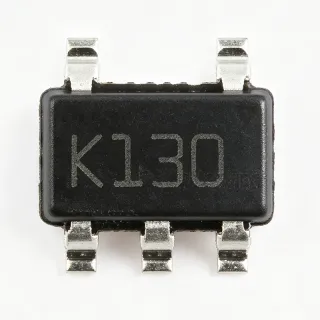
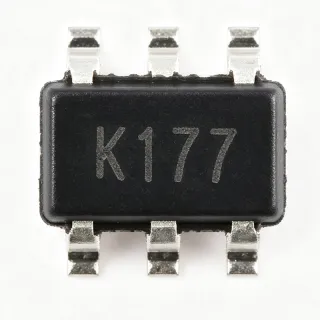
AD8628ARTZ-REEL7 - Zero-Drift Op Amp | Analog Devices
MPN: AD8628ARTZ-REEL7 ✓ Active| Qty | Unit Price | Extended |
|---|---|---|
| 1 | $2.85 | $2.85 |
| 10 | $2.56 | $25.60 |
| 100 | $2.28 | $228.00 |
| 500 | $2.05 | $1,025.00 |
| 1,000 | $1.85 | $1,850.00 |
AD8628ARTZ-REEL7 Overview
A zero-drift amplifier is a type of operational amplifier that uses auto-zeroing or chopper-stabilization techniques to continuously correct offset voltage and drift. This makes it ideal for applications where DC precision is critical, such as sensor signal conditioning, precision current sensing, and medical instrumentation. Zero-drift amplifiers belong to the broader category of precision operational amplifiers, which are essential building blocks in analog signal processing chains.
Key features of the AD8628 include an ultralow offset voltage of 1 µV (typical), offset drift of 0.02 µV/°C, and bias current of 30 pA (typical). It provides a gain bandwidth product of 2.5 MHz and a slew rate of 1 V/µs. The amplifier operates over the extended industrial temperature range of -40°C to +125°C and is fully specified for single-supply operation from 2.7 V to 5.5 V.
The AD8628 uses a proprietary auto-zero topology that eliminates the need for an external capacitor, reducing digital switching noise compared to traditional chopper-stabilized amplifiers. This results in low noise performance and high DC accuracy without the complexity of external components. The rail-to-rail input and output stages allow maximum dynamic range in low-voltage applications.
Typical applications include precision sensor interfaces, thermocouple and RTD signal conditioning, battery-powered instrumentation, and medical devices such as glucose monitors and pulse oximeters. The low power consumption and small package make it suitable for portable and space-constrained designs.
When designing with the AD8628, ensure proper power supply decoupling with 0.1 µF ceramic capacitors placed close to the supply pins. The auto-zero architecture provides excellent DC performance, but for AC-coupled applications, consider the amplifier's bandwidth and noise characteristics.
Drop-in alternatives for AD8628ARTZ-REEL7 — same package, pin-to-pin compatible. Different-package parts requiring PCB rework are excluded.
Variants in this series
Same-series models that are drop-in compatible with AD8628ARTZ-REEL7 (same form factor and footprint) — differing in Amplifier Type, Number of Channels, Package, Output Type, Operating Temperature Range.
Quick Comparison Tool — Select alternative parts for side-by-side comparison:
AD8605ARTZ-REEL7
✅ Drop-In📋 Reference alternative (not in catalog)
OPA188AIDBVT
✅ Drop-In ⚠️ Specs Unverified📋 Reference alternative (not in catalog)
MCP6V11T-E/OT
✅ Drop-In ⚠️ Specs Unverified📋 Reference alternative (not in catalog)
AD8628ARTZ-REEL7 Maximum Ratings & Electrical Characteristics
| Number of Channels | 1 |
| Supply Voltage - Single | 2.7 V to 5.5 V |
| Supply Voltage - Dual | ±1.35 V to ±2.75 V |
| Offset Voltage | 1 µV (typical) |
| Offset Drift | 0.02 µV/°C |
| Bias Current | 30 pA (typical) |
| Gain Bandwidth Product | 2.5 MHz |
| Slew Rate | 1 V/µs |
| Rail-to-Rail Input | Yes |
| Rail-to-Rail Output | Yes |
| Operating Temperature Range | -40°C to +125°C |
| Package | SOT-23-5 |
| Mounting Type | Surface Mount |
| RoHS Status | Compliant |
| Amplifier Type | Zero-Drift |
AD8628ARTZ-REEL7 Pin Configuration
| Pin 1 | OUT — Output |
| Pin 2 | V- — Negative supply (ground in single-supply) |
| Pin 3 | +IN — Non-inverting input |
| Pin 4 | -IN — Inverting input |
| Pin 5 | V+ — Positive supply |
Typical Applications
AD8628ARTZ-REEL7 is suitable for 6 applications: Precision Sensor Signal Conditioning, Medical Instrumentation, Battery-Powered Instrumentation, Thermocouple and RTD Signal Conditioning, Precision Current Sensing, Active Filter and Buffer Circuits.
Precision Sensor Signal Conditioning
The AD8628ARTZ-REEL7's ultralow offset voltage (1 µV) and drift (0.02 µV/°C) ensure accurate amplification of small sensor signals without calibration. Its rail-to-rail input and output maximize dynamic range in single-supply systems. The auto-zero architecture eliminates offset errors over temperature, making it ideal for bridge sensors, thermocouples, and RTDs. With a bias current of 30 pA, it minimizes loading on high-impedance sensors. The 2.5 MHz bandwidth supports moderate-speed sensing applications. For best performance, use a 0.1 µF decoupling capacitor close to the supply pins.
Recommended
Medical Instrumentation
In medical devices like glucose monitors and pulse oximeters, the AD8628ARTZ-REEL7 provides the precision and low power required for battery-operated equipment. Its 1 µV offset and 30 pA bias current ensure accurate measurement of tiny physiological signals. The small SOT-23-5 package fits space-constrained designs. Operating from 2.7 V to 5.5 V, it is compatible with standard battery voltages. The extended temperature range (-40°C to +125°C) ensures reliability in clinical environments. Proper PCB layout with ground planes and decoupling is essential for noise performance.
Recommended
Battery-Powered Instrumentation
The AD8628ARTZ-REEL7's low supply current (typical 1 mA) and wide supply range (2.7 V to 5.5 V) make it ideal for portable instruments. Its rail-to-rail output allows full-scale output even at low supply voltages, maximizing battery life. The auto-zero feature maintains accuracy as the battery discharges. The small SOT-23-5 package minimizes board space. For extended battery life, consider powering down the amplifier when not in use, as the AD8628 has no shutdown pin. Use low-leakage capacitors for input filtering to preserve accuracy.
Recommended
Thermocouple and RTD Signal Conditioning
The AD8628ARTZ-REEL7 is well-suited for thermocouple and RTD conditioning due to its ultra-low offset and drift. A thermocouple produces only microvolt-level signals, and the 1 µV offset ensures minimal error. The 0.02 µV/°C drift prevents temperature-induced inaccuracies. The 30 pA bias current reduces self-heating errors in RTDs. The rail-to-rail input allows direct connection to the sensor without level shifting. For cold-junction compensation, pair with a temperature sensor and ADC. The 2.5 MHz bandwidth is sufficient for slow temperature changes.
Recommended
Precision Current Sensing
The AD8628ARTZ-REEL7 can amplify small voltages across shunt resistors for current sensing. Its low offset voltage (1 µV) allows accurate measurement of low currents. The rail-to-rail input and output enable sensing at both supply rails. The 2.5 MHz bandwidth supports fast current transients. The auto-zero feature eliminates offset drift over temperature, crucial for long-term monitoring. For high-side sensing, ensure the input common-mode range is respected. Use a precision shunt resistor with low temperature coefficient for best accuracy.
Recommended
Active Filter and Buffer Circuits
The AD8628ARTZ-REEL7 can be used in active filters and buffer circuits where DC accuracy is important. Its 2.5 MHz gain bandwidth allows implementation of low-pass filters up to a few hundred kHz. The rail-to-rail output provides maximum signal swing. The low offset and drift ensure accurate DC levels in filters. The auto-zero architecture reduces 1/f noise, beneficial for low-frequency filters. For higher-order filters, multiple stages can be cascaded. Ensure stability by using appropriate feedback capacitors and resistors.
Recommended
Recommended Products Summary
Engineering reference data for AD8628ARTZ-REEL7 — comparison, design guidance, and compliance information.
Selection Guide
Comparison with Alternatives
| Parameter | This Product | AD8628ARZ-REEL7 | AD8629ARZ-REEL7 | AD8605ARTZ-REEL7 | ADA4522-1ARZ-RL7 | OPA188AIDBVT | MCP6V11T-E/OT |
|---|---|---|---|---|---|---|---|
| Package | SOT-23-5 | SOIC-8 | SOIC-8 | SOT-23-5 | SOIC-8 | SOT-23-5 | SOT-23-5 |
| Brand | Analog Devices | Analog Devices | Analog Devices | Analog Devices | Analog Devices | Texas Instruments | Microchip Technology |
| Offset Voltage | 1 µV | 1 µV | 1 µV | 50 µV | 1.5 µV | 25 µV | 2 µV |
| Offset Drift | 0.02 µV/°C | 0.02 µV/°C | 0.02 µV/°C | 0.5 µV/°C | 0.015 µV/°C | 0.03 µV/°C | 0.05 µV/°C |
| Bias Current | 30 pA | 30 pA | 30 pA | 1 pA | 50 pA | 160 pA | 1 pA |
| Gain Bandwidth Product | 2.5 MHz | 2.5 MHz | 2.5 MHz | 10 MHz | 5.5 MHz | 2 MHz | 1 MHz |
| Supply Voltage Range | 2.7 V to 5.5 V | 2.7 V to 5.5 V | 2.7 V to 5.5 V | 2.7 V to 5.5 V | 4.5 V to 36 V | 4 V to 36 V | 1.8 V to 5.5 V |
| Rail-to-Rail I/O | Yes | Yes | Yes | Yes | Yes | Yes | Yes |
Key Differentiators
- Ultralow offset voltage of 1 µV (vs AD8605ARTZ-REEL7)
- Near-zero offset drift of 0.02 µV/°C (vs OPA188AIDBVT)
- Auto-zero topology with no external capacitor (vs MCP6V11T-E/OT)
Design Notes
The AD8628ARTZ-REEL7 operates from 2.7 V to 5.5 V single supply. Use a 0.1 µF ceramic capacitor close to the V+ pin and a 10 µF bulk capacitor for low-frequency decoupling. For dual-supply operation, ensure both supplies are properly decoupled to ground. The amplifier's quiescent current is typically 1 mA, so power dissipation is minimal, but consider thermal effects in high-temperature environments.
For optimal performance, place the AD8628ARTZ-REEL7 on a PCB with a solid ground plane. Keep input traces short and shielded to minimize noise pickup. Use guard rings around the input pins to reduce leakage currents, especially in high-impedance sensor applications. The SOT-23-5 package has a thermal pad; connect it to the ground plane for better heat dissipation.
Avoid exceeding the absolute maximum supply voltage of 6 V. The auto-zero architecture eliminates the need for an external capacitor, but ensure the input common-mode voltage stays within the specified range. For AC-coupled applications, be aware of the amplifier's bandwidth and noise. Do not leave unused inputs floating; tie them to a suitable voltage.
Compliance Information
RoHS compliant per Analog Devices product page. Not AEC-Q100 qualified.