VNH7100BASTR - 12A Automotive H-Bridge Driver | STMicroelectronics
MPN: VNH7100BASTR ✓ Active| Qty | Unit Price | Extended |
|---|---|---|
| 1 | $4.48 | $4.48 |
| 10 | $4.1 | $41.00 |
| 100 | $3.6 | $360.00 |
| 500 | $3.2 | $1,600.00 |
| 1,000 | $2.9 | $2,900.00 |
VNH7100BASTR Overview
An H-bridge motor driver is a power management IC that controls the direction and speed of a DC motor by selectively activating four transistors in a bridge configuration. It is a type of motor driver, which falls under the broader category of power management ICs. The VNH7100BASTR integrates the control logic and power stage, simplifying PCB design and reducing component count compared to discrete implementations.
Key features include a low on-resistance of 60 mOhm per switch, which minimizes power dissipation and improves efficiency. The device supports PWM control up to 20 kHz, enabling precise speed regulation. It includes comprehensive protection features such as undervoltage lockout, overvoltage clamp, thermal shutdown, and load current limitation. The VNH7100BASTR also features a diagnostic output that reports fault conditions, enhancing system reliability.
The VNH7100BASTR uses STMicroelectronics' VIPower M0 technology, which integrates the control logic and power stage on a single die. This architecture provides robust performance in harsh automotive environments, with an operating temperature range of -40°C to +150°C. The device is AEC-Q100 qualified, ensuring reliability for automotive applications.
Typical applications include automotive DC motor control for power windows, mirrors, seat adjusters, and HVAC actuators. It is also suitable for industrial automation, robotics, and other battery-powered motor control systems. The wide supply voltage range and high current capability make it a versatile choice for various motor control applications.
When designing with this device, ensure adequate PCB copper area for heat dissipation, especially at high currents. The exposed pad should be soldered to a thermal via array to improve thermal performance. Additionally, place a 100nF ceramic capacitor close to the supply pins for decoupling.
This page synthesizes distributor pricing, drop-in alternatives, and practical design notes not found in the STMicroelectronics datasheet, providing engineers with a comprehensive resource for selecting and implementing the VNH7100BASTR.
Drop-in alternatives for VNH7100BASTR — same package, pin-to-pin compatible. Different-package parts requiring PCB rework are excluded.
Quick Comparison Tool — Select alternative parts for side-by-side comparison:
VNH7070BASTR
✅ Drop-In📋 Reference alternative (not in catalog)
VNH7100ASTR
✅ Drop-In ⚠️ 参数待验证📋 Reference alternative (not in catalog)
VNH7100BASTR Maximum Ratings & Electrical Characteristics
| Output Current | 12 A (continuous) |
| Supply Voltage Range | 4 V to 28 V |
| On-Resistance (per switch) | 60 mOhm |
| PWM Frequency | Up to 20 kHz |
| Operating Temperature Range | -40°C to +150°C |
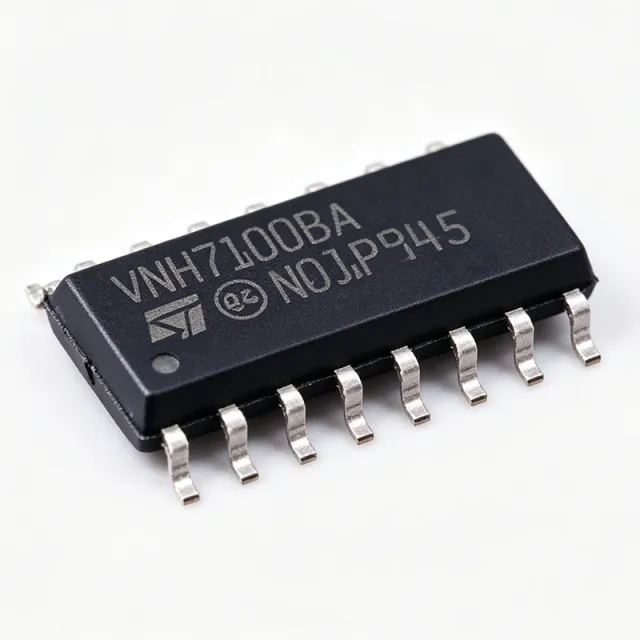
| Package | PowerSSO-16 (SO-16N) |
| Mounting Type | Surface Mount |
| Number of Outputs | 1 (H-bridge) |
| Motor Type | DC Brushed |
| Protection Features | Undervoltage lockout, overvoltage clamp, thermal shutdown, load current limitation |
| Diagnostic Output | Yes |
| Technology | VIPower M0 |
| AEC-Q100 Qualified | Yes |
| RoHS Compliant | Yes |
| Lead-Free | Yes |
VNH7100BASTR Pin Configuration
| Pin 1 | OUT1 — H-bridge output 1 |
| Pin 2 | OUT1 — H-bridge output 1 |
| Pin 3 | GND — Ground |
| Pin 4 | GND — Ground |
| Pin 5 | IN1 — Input control 1 |
| Pin 6 | IN2 — Input control 2 |
| Pin 7 | EN — Enable input |
| Pin 8 | DIAG — Diagnostic output |
| Pin 9 | VCC — Logic supply voltage |
| Pin 10 | GND — Ground |
| Pin 11 | GND — Ground |
| Pin 12 | OUT2 — H-bridge output 2 |
| Pin 13 | OUT2 — H-bridge output 2 |
| Pin 14 | VS — Power supply voltage |
| Pin 15 | VS — Power supply voltage |
| Pin 16 | GND — Ground |
Typical Applications
VNH7100BASTR is suitable for 6 applications: Automotive Power Windows, Seat Adjusters, HVAC Actuators, Industrial Automation, Robotics, Battery-Powered Tools.
Automotive Power Windows
The VNH7100BASTR drives DC motors for power windows with up to 12A continuous current, ensuring reliable operation under varying load conditions. Its 4-28V supply range accommodates 12V automotive systems, while the low 60mOhm on-resistance minimizes power loss. The integrated protection features, including thermal shutdown and load current limitation, safeguard the motor and driver during stall conditions. PWM control up to 20kHz allows smooth speed regulation, and the AEC-Q100 qualification ensures durability in harsh automotive environments.
Recommended
Seat Adjusters
The VNH7100BASTR provides robust motor control for seat adjusters, handling high inrush currents during adjustment. Its wide supply voltage range and high current capability ensure compatibility with various seat motor configurations. The device's diagnostic output enables fault detection, improving system reliability. With a compact PowerSSO-16 package, it fits space-constrained designs. The low on-resistance reduces heat generation, and the thermal shutdown protection prevents damage during prolonged operation.
Recommended
HVAC Actuators
The VNH7100BASTR drives HVAC actuators in automotive climate control systems, providing precise speed and direction control. Its PWM capability up to 20kHz enables smooth airflow regulation, while the 4-28V supply range supports both 12V and 24V systems. The integrated protection features, including overvoltage clamp and load current limitation, protect the actuator from electrical faults. The AEC-Q100 qualification ensures reliable operation in extreme temperatures, making it ideal for under-dash applications.
Recommended
Industrial Automation
The VNH7100BASTR is suitable for industrial automation applications such as conveyor belts and robotic arms, where reliable motor control is essential. Its high current capability and wide supply voltage range make it versatile for various motor types. The device's low on-resistance improves efficiency, reducing energy consumption in continuous operation. The diagnostic output allows for predictive maintenance, and the robust protection features ensure safe operation in industrial environments. The PowerSSO-16 package with exposed pad aids thermal management.
Recommended
Robotics
The VNH7100BASTR provides efficient motor control for robotics applications, including wheel drives and actuator arms. Its 12A continuous current capability supports high-torque motors, while the PWM control enables precise speed and position control. The device's compact package and low on-resistance make it ideal for space-constrained robot designs. The integrated protection features, such as thermal shutdown and load current limitation, enhance system reliability. The wide supply voltage range allows operation from various battery configurations.
Recommended
Battery-Powered Tools
The VNH7100BASTR is used in battery-powered tools such as drills and saws, providing robust motor control with high efficiency. Its low on-resistance minimizes power loss, extending battery life. The wide supply voltage range supports various battery voltages, from 4V to 28V. The device's protection features, including undervoltage lockout and thermal shutdown, ensure safe operation under heavy loads. The compact PowerSSO-16 package fits into handheld tool designs, and the AEC-Q100 qualification ensures durability in demanding conditions.
Recommended
Recommended Products Summary
Engineering reference data for VNH7100BASTR — comparison, design guidance, and compliance information.
Selection Guide
Comparison with Alternatives
| Parameter | This Product | VNH7070BASTR | VNH7100ASTR | VNH5019 |
|---|---|---|---|---|
| Package | PowerSSO-16 | PowerSSO-16 | PowerSSO-16 | PowerSSO-36 |
| Brand | STMicroelectronics | STMicroelectronics | STMicroelectronics | STMicroelectronics |
| Supply Voltage Range | 4 V to 28 V | 4 V to 28 V | 4 V to 28 V | 5.5 V to 18 V |
| PWM Frequency | Up to 20 kHz | Up to 20 kHz | Up to 20 kHz | Up to 20 kHz |
| AEC-Q100 Qualified | Yes | Yes | Yes | Yes |
| Protection Features | UVLO, OV clamp, thermal shutdown, current limit | UVLO, OV clamp, thermal shutdown, current limit | UVLO, OV clamp, thermal shutdown, current limit | UVLO, OV clamp, thermal shutdown, current limit |
Key Differentiators
- Higher continuous current rating (12A) compared to VNH7070BASTR (10A) (vs VNH7070BASTR)
- AEC-Q100 qualified for automotive applications (vs VNH7100ASTR)
- Low on-resistance (60mOhm) improves efficiency (vs VNH5019)
Design Notes
At 12A continuous current, power dissipation can be significant. With 60mOhm on-resistance, each switch dissipates about 8.6W. The PowerSSO-16 package with exposed pad requires a thermal via array and adequate copper area to keep junction temperature below 150°C. Use at least 2 square inches of copper on the PCB for heat spreading.
Place a 100nF ceramic capacitor close to the VS and VCC pins for decoupling. Use a 10uF electrolytic capacitor on the VS pin for bulk energy storage. Ensure the exposed pad is soldered to a thermal pad with multiple vias to improve thermal performance. Keep high-current traces short and wide to minimize inductance and resistance.
Do not exceed the absolute maximum supply voltage of 28V. Ensure the enable pin is properly driven to avoid unintended operation. The diagnostic output is open-drain and requires a pull-up resistor. When driving inductive loads, ensure proper freewheeling diodes are used to prevent voltage spikes.
Compliance Information
AEC-Q100 qualified per STMicroelectronics product page. RoHS compliant per distributor data.