CIs Amplificadores
Produtos (563)

OPA1612AIDR - 1.1nV/√Hz Dual Audio Op Amp | Texas Instruments
The Texas Instruments OPA1612AIDR is a dual-channel, bipolar-input audio operational amplifier with 1.1 nV/√Hz noise density, 0.000015% distortion at 1 kHz, and rail-to-rail output swing in an 8-pin SOIC package. The two amplifiers share a package but operate independently, making the device suitable for stereo audio signal paths, active filtering, line-level buffering, and precision analog front ends. What is a bipolar-input operational amplifier? A bipolar-input operational amplifier uses bipolar transistor input devices to provide low-voltage noise and precise analog signal handling. In the broader hierarchy, an operational amplifier is an analog IC, an amplifier IC, and part of a signal-conditioning or active-filter system. Audio applications require low noise, low total harmonic distortion, adequate output drive, and predictable behavior with capacitive and feedback networks. The verified data identifies the OPA1612 as a high-performance audio amplifier with 1.1 nV/√Hz noise density. The manufacturer datasheet states rail-to-rail output swing to within 600 mV with a 2 kΩ load and output drive capability of ±30 mA. Those figures help preserve dynamic range and allow the amplifier to drive downstream audio stages more effectively than a low-current precision op amp. The OPA1612AIDR is identified as an 8-SOIC, dual-circuit device. The bipolar input architecture is intended for low-noise audio signal conditioning rather than general-purpose low-power sensing. Its distortion specification of 0.000015% at 1 kHz is particularly relevant for headphone buffers, mixing-console stages, active crossovers, and studio signal paths. The rail-to-rail output characteristic improves usable swing near the supply limits, although input and output common-mode behavior must still be checked against the system rails. Typical applications include stereo line-input amplification, headphone-driver buffering, active low-pass and high-pass filters, microphone preamplifier stages, audio ADC drivers, and balanced audio signal-chain interfaces. The dual-channel configuration reduces the number of amplifiers required in a stereo design while keeping the two channels in one standard 8-SOIC footprint. The principal design consideration is to preserve low-noise performance with suitable bypassing, stable feedback compensation, and careful grounding. Keep input and feedback traces short, place decoupling capacitors close to the supply pins, and account for the amplifier’s ±30 mA output-drive capability when selecting the next stage. For a direct PCB substitution, confirm the exact package, pinout, supply range, and electrical limits against the replacement datasheet.
OPA1642AIDR - Dual JFET Audio Op Amp | Texas Instruments
The Texas Instruments OPA1642AIDR is a dual SoundPlus™ high-performance, JFET-input audio operational amplifier specified for high-end audio applications, supplied in an 8-pin SOIC (D) package on tape and reel. It delivers 5.1 nV/√Hz input voltage noise density, 0.00005% THD+N, and rail-to-rail output swing that increases headroom in low-voltage single-supply designs. Each channel integrates a precision JFET input stage, EMI/RFI-hardened inputs, and Unity-Gain Stable topology, providing the combination of low noise, low distortion, and high input impedance required by professional audio signal chains. A JFET-input operational amplifier is a type of analog amplifier whose input stage uses junction field-effect transistors instead of bipolar transistors, yielding extremely low input bias current and high input impedance while presenting a near-ideal voltage-follower load to preceding sources. The OPA1642 belongs to the broader hierarchy of audio operational amplifiers (audio op amp → operational amplifier → amplifier IC → integrated circuit → semiconductor), and within that taxonomy it sits in the high-performance sub-class defined by sub-1 µVrms noise floors and harmonic distortion below 0.001%. Because audio signal quality is dominated by the op amp's intrinsic noise and linearity, parts like the OPA1642 directly set the achievable dynamic range and channel separation of line-level stages, headphone amplifiers, ADC input buffers, and DAC I/V converters. The OPA1642AIDR combines 5.1 nV/√Hz noise density, 0.00005% THD+N, ±2.5 mV typical input offset voltage, and a 2 pA typical input bias current. The 8-SOIC variant specified here runs over a -40 °C to +85 °C commercial temperature range and operates from ±2.25 V to ±18 V dual supplies or 4.5 V to 36 V single supply. Internal EMI/RFI filters on the input pins suppress conducted and radiated interference that otherwise leaks into the audio band from nearby switching converters or wireless modules. The output swings within ~600 mV of either rail at 2 kΩ load, giving the designer extra usable dynamic range in 5 V and 6 V single-supply audio paths. The JFET front end eliminates the input-bias current errors that plague bipolar audio op amps, while the bipolar output stage delivers the high slew rate and clean large-signal response required by professional-grade equipment. Designers should still observe the datasheet's input common-mode range, output swing, and decoupling recommendations; this configuration provides single-channel noise below 1 µVrms and channel separation exceeding the limits of typical board layouts. Typical applications include high-fidelity preamplifier stages, professional mixing-console line inputs, headphone amplifiers, active crossover filters, studio microphone preamps, and DAC I/V conversion networks. Compared to general-purpose op amps such as the TL072, the OPA1642AIDR offers an order-of-magnitude lower noise and lower distortion, making it a clear upgrade where source-impedance is moderate. This page synthesizes distributor pricing, drop-in alternative guidance, and practical design notes that complement the manufacturer datasheet.

OPA1688 - 36V 10MHz Low Noise Audio Op Amp | TI
The Texas Instruments OPA1688ID is a 36-V, single-supply, low-noise SoundPlus audio operational amplifier operating on supplies from 4.5 V (±2.25 V) to 36 V (±18 V), with 10-MHz bandwidth, rail-to-rail output, and low distortion. It is offered in SOIC-8 and WSON-8 packages. An operational amplifier (op amp) is a high-gain voltage amplifier with differential inputs and a single-ended output, fundamental to analog signal conditioning, filtering, and amplification. The OPA1688 belongs to the SoundPlus family of audio op amps, optimized for low noise, low distortion, and high output drive within the broader linear amplifier category used across audio, instrumentation, and communication systems. Key features include 4.5 nV/√Hz input voltage noise, an 8 V/µs slew rate, and low quiescent current of 1.5 mA per channel. Excellent capacitive load stability allows direct drive of up to 1000 pF without oscillation, and ±75 mA output current enables direct headphone drive. The rail-to-rail output (RRO) stage maximizes dynamic range in single-supply designs. Technically, the OPA1688 uses a complementary bipolar input stage with laser-trimmed input offset voltage of 0.5 mV (typical). The wide supply range supports both battery-powered and industrial systems, and the -40C to +85C operating range ensures reliability in demanding environments. THD+N of 0.00005% at 1 kHz and high PSRR preserve signal fidelity in high-fidelity audio paths. Typical applications include headphone amplifiers, audio DAC output buffers, active filters, and professional audio mixing consoles. High output current and capacitive load stability make it especially suited to direct headphone drive, while low noise and distortion preserve audio integrity in portable devices where 1.5 mA quiescent current extends battery life. Design tip: decouple supply pins with 0.1 µF ceramic capacitors placed close to the device, keep feedback paths short to minimize parasitic capacitance, and use an isolation resistor for capacitive loads beyond 1000 pF. Pricing references are as of 2026-08-30.

OPA170AIDBVT - 36V, 1.2MHz, Low-Power Op Amp | Texas Instruments
The Texas Instruments OPA170AIDBVT is a single-channel, 36-V, 1.2-MHz, low-power operational amplifier (op amp) in a 5-pin SOT-23 (DBV) package, offering rail-to-rail output swing and excellent DC precision for cost-sensitive general-purpose applications. According to the manufacturer datasheet, the device operates on supplies from 2.7 V (±1.35 V) to 36 V (±18 V), supports 1.2 MHz unity-gain bandwidth, and delivers low offset voltage with low quiescent current. What is a low-power operational amplifier? A low-power op amp is a class of analog amplifier IC designed to operate on single or dual supplies while consuming minimal quiescent current, enabling battery-powered and energy-efficient designs. Low-power op amps sit within the broader operational amplifier family, which belongs to linear ICs and the signal-conditioning product hierarchy. They balance bandwidth, offset, and noise against supply current, making them ideal for always-on sensor interfaces and portable instrumentation. Key features include rail-to-rail output (RRO), an enable/shutdown pin for power sequencing, low offset voltage, low drift over temperature, and 1.2 MHz gain-bandwidth product. The device also provides ESD protection on the inputs/outputs and is specified over the -40 °C to +125 °C industrial temperature range. The 5-pin SOT-23 footprint enables extremely compact PCB designs for space-constrained analog front ends. Architecturally, the OPA170 uses a bipolar input stage with CMOS output stages for rail-to-rail swing, and the family (OPA170/OPA2170/OPA4170) shares identical specifications across single, dual, and quad versions for easy design portability. The combination of 36 V tolerance, low quiescent current, and small packaging positions the OPA170 as a strong fit for industrial sensors, transducer signal conditioning, and active filtering. Typical applications include current sensing in power management, transducer amplifiers for pressure/flow sensors, active filters, test equipment input buffers, and general-purpose signal conditioning for industrial control and battery-powered systems. Designers choose the OPA170 family when they need robust 36 V tolerance, low power, and rail-to-rail output in a tiny footprint. When designing with this device, place a 0.1 µF decoupling capacitor as close as possible to the power-supply pin and ensure input common-mode range is respected. The shutdown/enable pin allows direct power-rail control in low-power duty-cycled applications. This page synthesizes verified distributor pricing, parametric drop-in alternatives, and practical design guidance not found in the manufacturer datasheet, all anchored to the official TI OPA170 datasheet as of 2026-10-09.

OPA171AIDRLT - 36V 3MHz Single Op Amp | Texas Instruments
The Texas Instruments OPA171AIDRLT is a single-channel, 36V, 3MHz, low-power operational amplifier (op amp) in a 5-pin SOT-553 (DRL) micropackage with rail-to-rail output (RRO). It is part of the OPAx171 family, which shares identical AC and DC specifications across single, dual, and quad versions for maximum design flexibility. The device operates from a single supply of 2.7V to 36V (or dual ±1.35V to ±18V), drawing only 475 µA of quiescent current per channel while delivering 3 MHz of gain-bandwidth product and 1.5 V/µs slew rate. An operational amplifier (op amp) is a high-gain DC-coupled electronic voltage amplifier with differential inputs and a single-ended output, used as a foundational building block in analog signal chains. Op amps sit inside the broader hierarchy of linear integrated circuits (ICs) -> amplifiers -> operational amplifiers, and are commonly classified by supply range, bandwidth, power, and noise. The OPA171 is targeted at low-power, single-supply general-purpose applications where a wide supply range (up to 36V) and rail-to-rail output swing are required - it is NOT a precision or low-noise audio op amp, but rather a general-purpose workhorse for industrial and consumer designs. Key features of the OPA171AIDRLT include 3 MHz GBW, 1.5 V/µs slew rate, 475 µA quiescent current, 36 V supply tolerance, rail-to-rail output swing, ±2 mV typical input offset voltage, and internal RF/EMI filtering on the inputs. The SOT-553 (DRL) package is a low-profile (~0.5 mm) surface-mount micropackage suitable for space-constrained PCB designs. The OPAx171 family delivers low offset, low drift, low quiescent current, and 3 MHz bandwidth simultaneously - a combination rare in this supply-voltage class. Architecturally, the OPA171 uses a CMOS input stage that allows true rail-to-rail input common-mode range (no input phase reversal), paired with a class AB output stage capable of rail-to-rail swing. Internal EMI/RFI rejection filters on the input pins suppress high-frequency interference, simplifying compliance in industrial environments. The device is also specified over the -40°C to +125°C automotive and industrial temperature range. Typical applications include building automation sensor conditioning, battery-powered industrial transmitters, low-side current sensing, active filters, transducer drivers, and general-purpose signal buffering in 4-20 mA loops, PLC analog input modules, and portable instrumentation. The wide supply range (2.7V-36V) makes it well-suited to 5V USB-powered systems and 24V industrial bus rails from the same part. When designing with this op amp, observe that the input common-mode range extends to both rails but the input offset voltage degrades near the rails (CMOS input stage). Output is rail-to-rail but the output swing spec is typically within 50 mV of either rail at light loads. Decouple the supply pin with at least 0.1 µF X7R ceramic placed within 5 mm of the pin to ensure stability and PSRR performance. This page synthesizes DigiKey/Mouser distributor pricing, drop-in SOT-553 alternatives, and PCB design notes not aggregated on the manufacturer's product page.
OPA206 - 240uA Low-Noise Precision Op Amp, OVP | TI
The Texas Instruments OPA206 is a low-power, low-noise precision operational amplifier from the OPAx206 family, combining e-trim(TM) factory calibration with super-beta inputs and integrated input overvoltage protection (OVP) up to 40 V beyond either supply rail, in a standard 8-pin SOIC package. It draws only 240 uA of quiescent current while delivering 8 nV/rtHz broadband noise. A precision operational amplifier is a high-accuracy analog amplifier within the hierarchy of operational amplifiers, amplifier ICs, and analog signal chain semiconductors. Precision op amps minimize DC error sources - input offset voltage, offset drift, and input bias current - so small sensor and reference signals can be amplified faithfully in instrumentation, data acquisition, and control systems. Key features include a maximum input offset voltage of 25 uV (e-trim calibrated), a maximum offset voltage drift of 0.5 uV/degC, and a maximum input bias current of 500 pA enabled by super-beta input transistors. The integrated OVP protects inputs up to 40 V beyond the supplies - a feature few precision op amps offer - eliminating external clamp diode networks that add leakage and noise. The push-pull, rail-to-rail output stage maximizes dynamic range on low supply rails. The OPAx206 family is positioned by TI as the next generation of the industry-standard OPAx277 family, retaining low-drift precision character while adding OVP. E-trim factory trimming removes the dominant offset error at manufacture, achieving temperature stability that discrete trimming cannot easily match. According to the TI datasheet, the family spans single (OPA206), dual (OPA2206), and quad (OPA4206) versions for design scalability. Typical applications include transducer signal conditioning, precision data-acquisition front ends, industrial PLC analog input modules, test-and-measurement instrumentation, and battery-powered precision systems where 240 uA quiescent current conserves power. Supply operation from 4.5 V to 36 V total suits both 5 V single-supply and plus/minus 15 V dual-supply systems. Design consideration: choose the OPA206 when inputs may be exposed to fault voltages; if inputs are inherently protected and minimum noise is paramount, the pin-compatible OPA205 offers slightly better noise without OVP.

OPA2107AP - Precision Dual Difet Op Amp 4.5MHz | TI
The Texas Instruments OPA2107AP is a precision dual Difet (dielectrically isolated FET) operational amplifier delivering 4.5 MHz gain-bandwidth, 18 V/us slew rate, and 10 pA maximum input bias current in an 8-pin PDIP package, operating from dual supplies of plus/minus 10 V to plus/minus 18 V. An operational amplifier is a high-gain DC-coupled voltage amplifier that, with external feedback networks, forms the core building block of analog signal processing. Within the component hierarchy, the OPA2107AP sits in the precision JFET-input op amp family: operational amplifier -> amplifier IC -> analog integrated circuit. Dual (two-amplifier) packaging halves board area versus two singles, which is why duals dominate multi-channel analog front ends. Key differentiating features per the TI datasheet include very low noise at 10 kHz, low input offset voltage of 1 mV maximum, low offset drift of 10 uV per degree C maximum, and low input bias current of 10 pA maximum. The device is unity-gain stable and offers fast settling to 0.01 percent, making it a direct performance upgrade path for legacy BIFET-type amplifiers such as the classic TL072/TL082 class. Technically, the Difet process uses dielectrically isolated JFET input transistors on a precision bipolar process, combining FET-class input bias currents with bipolar-class output drive and noise performance. The dielectric isolation reduces junction capacitances, enabling the 4.5 MHz bandwidth and 18 V/us slew rate that distinguish this part from slower BIFET designs. Typical applications include data acquisition front ends, DAC output amplifiers, optoelectronic transimpedance stages, and high-impedance sensor interfaces such as photodiode and pH probe amplifiers, where picoampere bias current preserves signal fidelity across megaohm source impedances. Design consideration: as a non-RRIO dual-supply precision amplifier, the input common-mode range does not include either rail; provide at least 2 to 3 V of headroom and place 0.1 uF ceramic decoupling capacitors directly at pins 8 and 4. This page synthesizes verified distributor data, drop-in alternatives, and practical design guidance not consolidated in the manufacturer datasheet.

OPA2107AU - Dual 4.5MHz Precision DifET Op Amp | Texas Instruments
The Texas Instruments OPA2107AU is a precision dual DifET (dielectrically isolated FET) operational amplifier delivering 4.5 MHz gain-bandwidth, 18 V/µs slew rate, and a maximum input bias current of 10 pA in an 8-pin SOIC package operating from ±4.5 V to ±18 V supplies (9 V to 36 V total). An operational amplifier is a high-gain DC-coupled voltage amplifier with differential inputs and a single-ended output, forming the foundational building block of the analog signal chain hierarchy: op amp -> amplifier IC -> analog front end -> signal conditioning system. Precision FET-input op amps like the OPA2107 combine JFET input stages with laser-trimmed thin-film resistors to achieve very low input bias current without sacrificing DC accuracy, a combination bipolar-input devices cannot match for high-impedance sources. Key features include very low noise at 10 kHz, low offset voltage of 1 mV maximum, low offset drift of 10 µV/°C maximum, and fast settling to 0.01%, while remaining unity-gain stable. The 40 mA per-channel output drive and 80 dB open-loop gain make it suitable for driving ADC inputs and cables directly. The DifET dielectrically isolated process isolates each transistor, reducing junction capacitance and enabling the high slew rate and fast settling that conventional JFET processes cannot deliver. Input bias current of only a few picoamperes allows megohm-level source impedances with minimal DC error, and the dual-channel integration halves board space versus two singles while improving thermal tracking between channels. Typical applications include data acquisition front ends, DAC output buffers, optoelectronic receivers (photodiode transimpedance amplifiers), and high-impedance sensor conditioning such as pH probes and piezoelectric accelerometers. Design consideration: preserve DC accuracy by guarding the high-impedance input node on the PCB and keeping feedback resistor values moderate, since the 10 pA bias current through 1 MΩ already contributes 10 µV of error. This page synthesizes distributor pricing, pin-compatible alternatives, and practical design guidance not found in the manufacturer datasheet alone.
OPA2107AU/2K5 - Precision Dual Difet Op Amp 4.5MHz SOIC-8 | TI
The Texas Instruments OPA2107AU/2K5 is a precision dual Difet (dielectrically isolated FET) operational amplifier delivering 4.5 MHz gain bandwidth, 1 mV maximum offset voltage, and 10 pA maximum input bias current in an 8-pin SOIC (D) package. It operates from supplies up to 30 V total (typically +/-15 V) across a -25C to +85C temperature range. An operational amplifier is a high-gain voltage amplifier with differential inputs and a single-ended output that forms the core building block of analog signal chains. Within the amplifier hierarchy, the OPA2107 belongs to the precision JFET-input (Difet) family: precision op amps trade some speed for ultra-low offset, low drift, and low bias current, positioning them above general-purpose amplifiers for measurement-grade signal conditioning but below high-speed amplifiers for video or RF applications. Key features include very low noise at 10 kHz, a maximum offset voltage of 1 mV with maximum drift of 10 uV/C, and a maximum input bias current of 10 pA enabled by the Difet junction-isolation process. The dual-channel integration matches two matched amplifiers on one die, improving thermal tracking between channels. Fast settling to 0.01% and unity-gain stability allow use in active filters and DAC buffers without external compensation. The Difet dielectric isolation technology keeps bias current low across the full temperature range, unlike standard JFET parts whose bias doubles roughly every 10C. This preserves high-impedance sensor accuracy in warm environments. Typical applications from the manufacturer datasheet include data acquisition front ends, DAC output amplifiers, optoelectronic receivers, and high-impedance sensor interfaces such as photodiode and pH probe amplifiers. Design consideration: note this part is in the process of being discontinued per TI, so new designs should qualify a replacement early. The /2K5 suffix denotes tape-and-reel packaging of the standard OPA2107AU die. This page synthesizes distributor pricing, drop-in alternatives, pinout data, and practical design notes not found in the manufacturer datasheet, with availability verified as of 2026-09-13.

OPA2107BM - Dual Precision Difet Op Amp, 4.5MHz | TI
The Texas Instruments OPA2107BM is a precision dual Difet operational amplifier offering 4.5 MHz bandwidth, operation up to a 36V total supply (±18V), and a maximum input offset voltage of 1000 uV, housed in an 8-pin TO-99 hermetic metal can package (MBCY8). Originally introduced by Burr-Brown, this part combines precision Difet (dielectrically isolated JFET) performance with the cost and space savings of a dual op amp. An operational amplifier is a high-gain DC-coupled voltage amplifier that, with external feedback networks, forms the fundamental building block of analog signal chains; the op amp sits within the amplifier IC hierarchy of analog integrated circuits and power/analog signal conditioning devices. FET-input amplifiers like the OPA2107 provide extremely low input bias currents compared to bipolar-input predecessors, which is essential when amplifying signals from high-impedance sources. Key features include precision Difet input technology delivering very low input bias current, low input offset voltage drift over temperature, a 4.5 MHz gain-bandwidth suitable for precision audio and instrumentation signals, and the hermetic TO-99 metal can, which offers superior thermal and environmental stability versus plastic packages - a major reason this package remains specified in avionics and military systems. Architecturally, the OPA2107 uses a Difet (dielectrically isolated JFET) process, an advancement over the BIFET process that reduces input bias current and offset drift while preserving slew rate and bandwidth. TI positions it as a drop-in performance upgrade for legacy BIFET-type amplifiers in existing sockets. Typical applications include precision instrumentation front ends, active filter stages in professional audio equipment, integrators and sample-hold circuits, and photodiode or high-impedance sensor preamplifiers where low bias current directly determines measurement accuracy. A key design consideration is that the metal-can package does not dissipate heat as effectively as modern surface-mount packages, so total power dissipation should be checked at high supply voltages. Output drive should also be kept within datasheet limits for stability with capacitive loads. This page synthesizes cross-reference data, drop-in alternative analysis, and practical design guidance not found in the manufacturer datasheet.
OPA211ID - 1.1nV/Hz Precision Op Amp 80MHz SOIC-8 | TI
The Texas Instruments OPA211ID is a precision operational amplifier delivering an ultra-low voltage noise density of 1.1 nV/√Hz while consuming only 3.6 mA of quiescent supply current. The single-channel amplifier comes in an 8-pin SOIC package and is fully specified from -40C to +125C. It is unity-gain stable with a rail-to-rail output stage. An operational amplifier (op amp) is a high-gain voltage amplifier with differential inputs and a single-ended output, a fundamental building block of analog signal chains. Precision op amps such as the OPA211 sit within the amplifier hierarchy: amplifier > operational amplifier > precision op amp, characterized by low offset, low noise, and high open-loop gain. They are essential in instrumentation, medical equipment, and test systems where signal accuracy is critical. Key features include the 1.1 nV/√Hz input-referred noise density - among the lowest available for a precision op amp - plus a gain-bandwidth product of 80 MHz and 20 V/µs slew rate for high-speed signals. The rail-to-rail output maximizes dynamic range in low-supply designs. DC accuracy is strong with 50 µV typical offset voltage and 60 nA input bias current, and total harmonic distortion plus noise is a very low 0.000015%. Technically, the OPA211 uses a bipolar input stage with laser trimming to minimize offset and drift. The class-AB output stage provides low distortion and solid capacitive-drive capability. Single (OPA211) and dual (OPA2211) versions exist, with shutdown options on single-channel family members, packaged in SON-8 (3x3 mm), VSSOP-8, and SOIC-8. Typical applications include low-noise audio preamplifiers, precision instrumentation front ends, active filters, and data-acquisition stages driving high-resolution ADCs such as the ADS1262. The 80 MHz bandwidth also suits photodiode transimpedance amplifiers and RF/IF signal chains. Design tip: place 0.1 µF ceramic decoupling capacitors close to the supply pins, and respect the input common-mode range to avoid phase reversal. For a second channel, the OPA2211 shares the same performance in one package. Prices as of 2026-08-30.

OPA2134UA/2K5 - Dual Audio Op-Amp 0.00008% THD | TI
The Texas Instruments OPA2134UA/2K5 is a dual SoundPlus high-performance audio operational amplifier in an 8-pin SOIC package, supplied in 2,500-unit tape-and-reel format. It combines ultra-low distortion (0.00008% THD), low noise (8 nV/rtHz), true FET input (5 pA bias current), 20 V/us slew rate, and 8 MHz gain-bandwidth, operating from +/-2.5 V to +/-18 V supplies. An audio operational amplifier is a precision linear amplifier optimized to pass audio-band signals with minimal added harmonic distortion, noise, and phase error. It sits in the analog signal chain between transducers, DACs, and loudspeakers, and is a specialized subclass of the general op amp: an audio op amp is a linear amplifier within the analog signal processing chain of consumer, professional, and automotive audio electronics. Key features include the 0.00008% total harmonic distortion figure that keeps the device transparent in the audible signal path, 8 nV/rtHz voltage noise for low hiss in high-gain stages, and 5 pA FET input bias current that prevents loading of high-impedance sources such as guitar pickups and passive EQ networks. The 8 MHz bandwidth and 20 V/us slew rate preserve full-power performance across the entire 20 Hz to 20 kHz audio band, and the wide +/-18 V supply range matches standard professional audio rails. Architecturally, the OPA2134 uses a true FET input stage with a high open-loop gain of 600 V/mV (per TI datasheet), delivering excellent DC precision alongside audio-grade AC performance. The dual-channel SOIC-8 configuration enables compact stereo designs without performance compromise, and the single (OPA134) and quad (OPA4134) family members share identical core specifications for BOM flexibility. Typical applications include audio DAC output buffering (I/V conversion), line drivers, active crossovers, microphone preamplifiers, and audio test instrumentation, where the OPA2134UA/2K5 is often the limiting factor in signal purity. Design tip: bypass each supply pin with a 0.1 uF ceramic capacitor placed close to the package, and maintain adequate input/output headroom since this is not a rail-to-rail op amp. Prices as of 2026-08-30.
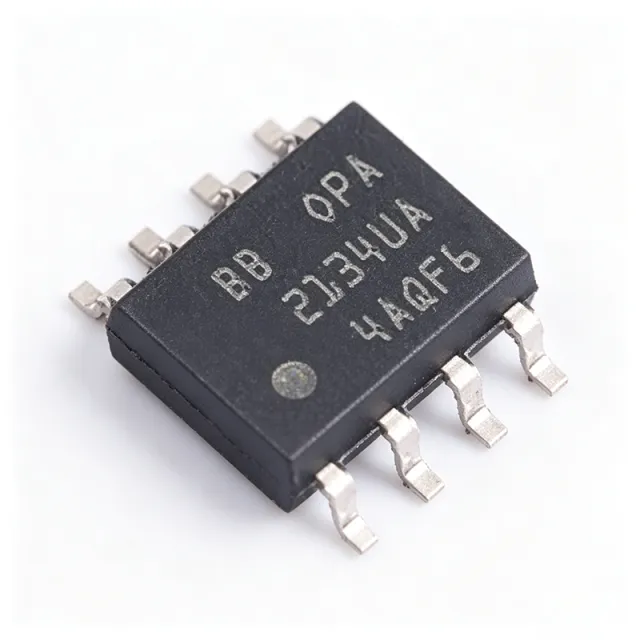
OPA2134UA/2K5 - Dual Audio Op-Amp 0.00008% THD | TI
The Texas Instruments OPA2134UA/2K5 is a dual SoundPlus high-performance audio operational amplifier delivering 0.00008% total harmonic distortion, 8 nV per root-hertz input voltage noise, and a 20 V/us slew rate in an 8-pin SOIC package, supplied in 2,500-unit tape-and-reel format. An audio operational amplifier is a precision linear amplifier optimized to pass audio-band signals with minimal added harmonic distortion, noise, and phase error. It sits in the analog signal chain between transducers, DACs, and loudspeakers, and is a specialized subclass of the general op amp: an audio op amp is a linear amplifier within the analog signal processing chain of consumer, professional, and automotive audio electronics. Key features include the 0.00008% total harmonic distortion figure that keeps the device transparent in the audible signal path, 8 nV/rtHz voltage noise for low hiss in high-gain stages, and 5 pA FET input bias current that prevents loading of high-impedance sources such as guitar pickups and passive EQ networks. The 8 MHz gain-bandwidth product and 20 V/us slew rate preserve full-power performance across the entire 20 Hz to 20 kHz audio band, and the wide +/-2.5 V to +/-18 V supply range matches standard professional audio rails. Architecturally, the OPA2134 uses a true FET input stage with a high open-loop gain of 600 V/mV per the TI datasheet, delivering excellent DC precision alongside audio-grade AC performance. The dual-channel SOIC-8 configuration enables compact stereo designs without performance compromise, and the single (OPA134) and quad (OPA4134) family members share identical core specifications for BOM flexibility. Typical applications include audio DAC output buffering (I/V conversion), line drivers, active crossovers, and microphone preamplifiers, where the OPA2134UA/2K5 is often the limiting factor in signal purity. Design tip: bypass each supply pin with a 0.1 uF ceramic capacitor placed close to the package, and maintain adequate input/output headroom since this is not a rail-to-rail op amp. This page synthesizes distributor pricing, drop-in alternatives, pinout data, and practical design notes not found in the manufacturer datasheet.

OPA2170AIDCUR - 36V Dual Op Amp, Rail-to-Rail Output, VSSOP-8 | Texas Instruments
The Texas Instruments OPA2170AIDCUR is a dual-channel, 36 V, single-supply, low-power operational amplifier in a VSSOP-8 (DCU) micro-package, featuring rail-to-rail output swing, 1.2 MHz gain-bandwidth product, and 0.4 V/us slew rate for general-purpose analog signal conditioning. Each channel delivers a low offset voltage and low offset drift while consuming only 110 uA per channel of quiescent current, making this op amp suitable for battery-powered and always-on sensor interfaces. An operational amplifier (op amp) is a high-gain DC-coupled electronic voltage amplifier with differential inputs and a single-ended output, forming the fundamental building block of analog signal chains. It belongs to the broader category of linear integrated circuits within power management and analog signal conditioning, and is used for amplification, filtering, level shifting, buffering, and comparator functions. The OPA2170AIDCUR is part of TI's OPAx170 value-line family, alongside the single-channel OPA170 and quad-channel OPA4170, all sharing identical specifications to simplify design reuse across channel densities. The OPAx170 architecture operates from a single 2.7 V to 36 V supply (or dual ±1.35 V to ±18 V), eliminating the need for negative rails in single-supply systems. Key differentiating features include 19 nV/√Hz input voltage noise density, RFI-filtered inputs to reject out-of-band RF interference, and an input common-mode range that extends to the negative supply rail, which is critical for ground-referenced single-supply sensing. The device also includes internal ESD protection on the inputs and outputs, simplifying board-level robustness. Combined, these features enable precision measurement in noisy industrial environments. Typical applications include transducer signal conditioning for bridge sensors, temperature sensor interfaces (thermocouples, RTDs, thermistors), active filtering for audio and instrumentation, low-side current sensing, and portable medical or test equipment. The 36 V supply tolerance also supports 24 V industrial bus interfaces and automotive load-dump-protected rails. When designing with this part, place a 0.1 uF decoupling capacitor as close as possible to the V+ pin, and use a low-ESR ceramic at the supply. For unity-gain buffer or low-gain stages, a 10 nF to 100 nF compensation capacitor between V+ and the output node may improve capacitive load drive. This page synthesizes distributor pricing, pin-compatible drop-in alternatives, and practical design notes not found on the manufacturer datasheet cover page.
OPA2170AIDGK - 36V Dual Op Amp, RRO, 1.2MHz | Texas Instruments
The Texas Instruments OPA2170AIDGK is a dual-channel, 36V, single-supply, low-power operational amplifier (op amp) housed in an 8-pin MSOP/VSSOP package (DGK). It delivers a 1.2 MHz gain-bandwidth product, a 0.4 V/us slew rate, and a low 19 nV/sqrt(Hz) input-referred voltage noise density while drawing only 110 uA of quiescent current per channel. The device operates from 2.7V to 36V single supply (or +/-1.35V to +/-18V dual supply), making it well-suited to industrial 24V rails as well as 3.3V / 5V low-voltage analog signal chains. An operational amplifier (op amp) is a high-gain differential voltage amplifier that uses external feedback components to set closed-loop gain, bandwidth, and transfer function. Op amps are fundamental building blocks in analog signal conditioning: they amplify, buffer, filter, sum, and convert signals. Within the broader hierarchy, a dual low-power op amp like the OPA2170 sits below the "linear IC" family, adjacent to instrumentation amplifiers, comparators, and programmable gain amplifiers. The "value line" label from TI indicates it is positioned for cost-sensitive, high-volume designs without sacrificing key specs. Key features of the OPA2170 include 0.0035 uA input bias current (CMOS input stage), 120 dB CMRR, rail-to-rail output (RRO), an input common-mode range that includes the negative rail, and EMI/RFI filtered inputs to improve immunity in harsh electrical environments. The unity-gain-stable design requires no external compensation and supports capacitive loads up to 1 nF. Architecturally, the OPA2170 uses a CMOS input stage for high input impedance and low bias current, combined with a class AB output stage that achieves rail-to-rail swing on a single supply. This combination makes the part equally suitable for low-voltage sensor signal chains (where input bias current matters) and higher-voltage industrial loops (where supply tolerance matters). Typical applications include transducer signal conditioning, 4-20 mA loop drivers, low-side current sensing, active filters, audio signal buffering, general-purpose amplification in PLC analog input modules, and battery-powered instrumentation that needs wide supply tolerance. When designing in the OPA2170AIDGK, be mindful that although the inputs include the negative rail, the inputs do NOT include the positive rail - common-mode voltage must remain at least a few hundred mV below V+ for linear operation. Use the dual-channel part when two related signals (e.g., a differential sensor) need matched amplifier paths; switch to the quad-channel OPA4170 only when the PCB area savings of one IC outweigh the loss of channel-level routing flexibility. This page synthesizes distributor pricing, verified cross-reference alternatives in the same VSSOP-8 footprint, and practical design considerations not found in the manufacturer datasheet alone.
OPA2171AIDR - Dual 36V 3MHz Low-Power Op Amp | Texas Instruments
The Texas Instruments OPA2171AIDR is a dual-channel, 36V, 3MHz, low-power operational amplifier in an 8-pin SOIC package. The OPA2171AIDR is part of the OPAx171 family (single/dual/quad) and is designed for single-supply operation from 2.7V (±1.35V) to 36V (±18V). It features rail-to-rail output (RRO), low offset voltage, low drift, and low quiescent current, making it well-suited for cost-sensitive general-purpose analog signal conditioning. An operational amplifier (op amp) is a high-gain DC-coupled electronic voltage amplifier with differential inputs and a single-ended output. It is the fundamental building block of analog signal chains, used for amplification, filtering, comparison, buffering, and mathematical operations. The OPA2171 belongs to the lineage of low-power, general-purpose amplifiers, sitting between precision op amps (high accuracy, high power) and high-speed op amps (wide bandwidth, higher noise), optimized for applications requiring moderate bandwidth and low current draw. Key features of the OPA2171AIDR include 3MHz gain-bandwidth product, 1.5V/µs slew rate, low quiescent current, rail-to-rail output swing, and 36V maximum supply voltage. The 3MHz gain-bandwidth product enables stable operation in active filter circuits, sensor signal conditioning, and transducer amplification. The wide supply range supports industrial 24V bus systems, automotive 12V rails (post-protection), and battery-powered portable equipment operating down to 2.7V. The OPA2171 uses a CMOS input stage for low input bias current, paired with a rail-to-rail output stage that maximizes dynamic range on low-voltage supplies. Internal EMI/RFI filtering on the inputs improves robustness in harsh electrical environments. The dual op-amp configuration in the SOIC-8 package provides two independent amplifiers in a small footprint, enabling compact multi-channel designs. Typical applications include transducer amplification, sensor signal conditioning, industrial process control, battery-powered instrumentation, active filters, and voltage reference buffers. The wide input range allows direct interfacing with 24V industrial sensors, while the rail-to-rail output maximizes dynamic range on 3.3V or 5V ADC rails. When designing with this device, pay attention to input common-mode range, especially near the negative rail where CMOS input stages exhibit degraded behavior. Decouple supply pins with 0.1µF ceramic capacitors placed close to the IC. This page synthesizes distributor pricing, drop-in alternatives (including same-brand OPA2171AID and OPA4171 variants), and practical design notes not found in the manufacturer datasheet alone.

OPA2172 - 36V 10MHz Dual Rail-to-Rail Op Amp | Texas Instruments
The Texas Instruments OPA2172 is a dual, 36-V, 10-MHz, rail-to-rail output (RRO) operational amplifier in an 8-pin SOIC (D) package. It operates on supplies from +4.5 V (±2.25 V) to +36 V (±18 V), combining wide dynamic range with low power consumption of 1.6 mA per amplifier. An operational amplifier (op amp) is a high-gain differential voltage amplifier used as the building block of analog signal chains - a subcategory of amplifier ICs within the broader power-management and signal-conditioning hierarchy. The OPA2172 belongs to TI's OPAx172 family (OPA172 single, OPA2172 dual, OPA4172 quad), which is engineered for high-voltage, single-supply designs where the output must swing close to the rails. Key features include a gain-bandwidth product of 10 MHz, low input offset voltage of ±0.2 mV, and ultra-low offset drift of ±0.3 uV/degC, ensuring accuracy across the industrial temperature range. Input bias current is a low ±8 pA thanks to the JFET-input front end, and broadband noise is 7 nV/rtHz, making the part suitable for precision, low-noise signal conditioning. High slew rate supports fast settling in active filters and ADC drivers. Architecturally, the OPA2172 uses a precision input stage with rail-to-rail output stage that maintains low distortion even when driving loads near the supply rails. The 36-V tolerance provides headroom against industrial 24-V bus transients, and operation down to +4.5 V supports 5-V single-supply systems. Typical applications include 24-V industrial instrumentation front ends, active filter and data-acquisition signal conditioning ahead of ADCs such as the ADS131M08, sensor buffering, and output amplification in audio and synth-DIY circuits where it replaces noisier TL072-class devices. Design tip: keep total supply below 36 V, and for maximum output swing at low loads, ensure load impedance keeps output current within datasheet limits; bypass both supply pins with 100 nF ceramics placed close to the device.
OPA2172 - Dual 36V 10MHz Low-Noise Op Amp | Texas Instruments
The Texas Instruments OPA2172ID is a dual, 36-V, 10-MHz, low-power rail-to-rail output operational amplifier in an 8-SOIC package, part of the OPAx172 family that also includes the single OPA172 and quad OPA4172. It operates on supplies from +4.5 V to +36 V (or ±2.25 V to ±18 V), making it versatile for single-supply and dual-supply industrial systems. An operational amplifier (op amp) is a high-gain voltage amplifier with differential inputs and a single-ended output, and is a fundamental building block of analog signal conditioning, filtering, and amplification. The OPA2172 sits in the hierarchy of amplifiers -> operational amplifiers -> precision, rail-to-rail output amplifiers, balancing bandwidth, noise, and power in one general-purpose part. Key specifications include ±0.2 mV offset voltage, ±0.3 uV/C offset drift, 10 MHz gain-bandwidth product, ±8 pA input bias current, 1.6 mA quiescent current per amplifier, and 7 nV/√Hz broadband noise. The rail-to-rail output stage maximizes dynamic range in low-voltage designs, while the wide supply range supports industrial 24 V buses directly. The CMOS input stage provides high input impedance and picoampere bias currents suitable for high-impedance sensors and photodiode circuits. The output stage swings to within millivolts of the rails at light load and is stable with substantial capacitive loads, simplifying buffer designs. Low quiescent current permits use in battery-powered and thermally constrained equipment. Typical applications include motor-control current sensing, solar inverters, power-supply feedback loops, active filters, and audio signal chains, where low noise and high slew rate preserve signal fidelity. The dual channel saves board space versus two singles. Design tip: decouple supply pins with 0.1 uF ceramics close to the device, keep feedback resistors low-valued for best noise, and verify output swing headroom under heavy load.
OPA2192IDGK - 36V Precision RRIO Op Amp Dual | TI
The Texas Instruments OPA2192IDGK is a dual-channel, 36-V precision operational amplifier with rail-to-rail input/output (RRIO), low offset voltage, and low input bias current, implemented in TI's e-trim chopper-stabilized architecture and packaged in an 8-pin MSOP (PowerPAD). It carries an automotive temperature grade and supports up to +/-18 V or 36 V single-supply operation from a 4.5 V to 36 V rail. Background: An operational amplifier (op amp) is a high-gain DC-coupled analog building block that uses external feedback to set gain, filter response, and signal conditioning behavior. The OPA2192IDGK belongs to the precision op-amp family, characterized by microvolt-level input offset voltage, picoampere-range input bias current, and low drift over temperature - a category that sits above general-purpose op amps and below zero-drift chopper amplifiers in the precision signal-chain hierarchy. Rail-to-rail input/output op amps accept and produce signals that swing to both supply rails, which maximizes dynamic range in low-voltage single-supply designs and is critical for driving successive-approximation ADCs without headroom loss. Key specifications include 5 pA typical input bias current, 25 uV maximum input offset voltage, 0.5 uV/degC typical offset drift, 10 MHz unity-gain bandwidth, and 20 V/us slew rate. The e-trim architecture provides 5 uV/degC offset drift without the chopping sidebands or large inrush currents of classic chopper amplifiers. EMI-hardened inputs reject RF interference from adjacent switching converters and motor drivers in industrial environments. The MSOP-8 package with PowerPAD delivers a thermal resistance of approximately 50 C/W, enabling dual-channel operation at full bandwidth without external heatsinking. Typical applications include precision weigh scales, sensor signal conditioning for thermocouples and strain gauges, battery management current sensing, and industrial analog input modules. Designers select the OPA2192IDGK for systems requiring sub-100 uV total DC accuracy across the full -40C to +125C automotive temperature range and tight PCB footprints where two precision channels must fit into a 3 mm x 3 mm outline. Designers should note the OPA2192IDGK is pin-compatible with the OPA2191 (lower precision), OPA2188 (zero-drift), and OPA2227 (lower precision), enabling drop-in upgrades. For optimal performance, bypass supplies with 0.1 uF ceramic capacitors placed within 5 mm of the V+ and V- pins. This page consolidates real-time distributor pricing, drop-in alternatives, and design notes beyond the manufacturer datasheet to accelerate part selection.

OPA2192IDGKR - 36V Precision RRIO Dual Op Amp | Texas Instruments
The Texas Instruments OPA2192IDGKR is a 36-V, precision, rail-to-rail input/output (RRIO), low-offset-voltage, low-input-bias-current operational amplifier with e-trim, delivered in an 8-pin VSSOP (DGK) package. Key headline parameters include 10-MHz unity-gain bandwidth, 20-V/µs slew rate, ±5-µV typical offset voltage, ±0.2-µV/°C typical offset drift, and 4.5-V to 36-V single-supply operation (or ±2.25-V to ±18-V dual). The e-trim calibration architecture trims input offset and offset drift at the wafer level, eliminating the need for external nulling components. An operational amplifier (op amp) is a high-gain DC-coupled analog circuit block that amplifies differential input voltages. The OPA2192 belongs to the precision amplifier sub-class, where DC accuracy (low offset, low drift) and rail-to-rail signal swing matter more than raw speed. It sits in the broader hierarchy of linear ICs -> amplifiers -> operational amplifiers -> precision RRIO op amps -> semiconductor, and competes with parts such as the ADA4522 and OPA2188. Its main role in a system is to condition small analog signals (sensor bridges, shunt currents, thermocouples) with minimal added error and to drive ADC reference or output stages up to the supply rails. Distinctive features include differential input-voltage range to the supply rail, high-output current drive with no phase reversal, low-input-bias current with e-trim, and integrated EMI/RFI rejection at 1 GHz. The OPA2192 also offers independent short-circuit protection on the outputs and a wide 4.5-V to 36-V supply headroom that lets a single device serve both 5-V analog rails and 24-V industrial transducers. Architecturally, the OPA2192 uses a bipolar input stage with chopper-free e-trim post-package calibration, preserving low noise while achieving 10-MHz GBW at 20 V/µs. The RRIO output stage swings within millivolts of either rail at moderate loads, eliminating headroom loss in low-voltage ADC interfaces and giving designers full dynamic range on 5-V or 12-V rails. Typical applications include precision analog input modules, 4-20 mA loop transmitters, multi-channel data acquisition front ends, test and measurement instruments, and active filtering in audio paths. Designers favor it where both 5-V digital-rail operation and 24-V industrial transducers must share one BOM line. When using the OPA2192, observe the maximum differential input-voltage limit and add an input-series resistor for true over-voltage protection; a 2-kΩ resistor on each input typically prevents fault-current damage during 36-V transients. This page also synthesizes distributor pricing, drop-in alternates, and practical design notes that the TI datasheet alone does not surface.
OPA2192IDGKT - 36V Precision RRIO Op Amp, 10MHz, Dual | Texas Instruments
The Texas Instruments OPA2192IDGKT is a dual-channel, 36-V, e-trim precision operational amplifier that delivers rail-to-rail input and output (RRIO) swing, 10 MHz unity-gain bandwidth, and 20 V/µs slew rate in an 8-pin VSSOP (DGK) package. According to the manufacturer datasheet, the OPA2192 family offers typical input offset voltage of ±5 µV, offset drift of ±0.2 µV/°C, and a 1 mA per-channel quiescent supply current while supporting output current up to 65 mA per channel for direct drive of low-impedance loads. A precision operational amplifier (op amp) is a high-gain DC-coupled analog building block used to amplify small differential signals in instrumentation, signal conditioning, and active-filter chains. The OPA2192 belongs to the e-trim chopper-stabilized family that achieves CMOS-class input bias current with bipolar-class DC accuracy, positioning it above general-purpose op amps in the precision amplifier hierarchy: precision op amp -> operational amplifier -> analog IC -> signal chain -> semiconductor. Key features include differential input range that extends to both supply rails, integrated EMI/RFI rejection input filtering, and 6 V to 36 V single-supply operation (or ±3 V to ±18 V dual-supply). The e-trim process eliminates the traditional chopper chopping artifacts, making the part suitable for DC-coupled precision paths where chopper noise would otherwise be unacceptable. Architecture-wise, the OPA2192 combines a CMOS input differential pair with TI's e-trim calibration to correct residual input-referred offset at the wafer level. This achieves laser-trim performance without active chopping, providing clean DC behavior at low frequencies while still supporting the 10 MHz GBW required by audio and wide-bandwidth transducer signal conditioning. Typical applications include industrial process-control analog front ends, precision analog-input modules for PLCs, multi-channel data-acquisition (DAQ) signal conditioning, precision active filters, and transducer excitation/readout such as bridge amplifiers and RTD conditioners. The wide supply range allows direct interface to ±15 V industrial rails as well as 24 V loop-powered systems. When designing with this device, ensure that the input common-mode voltage stays within the rail-to-rail range (which includes both rails). Decouple the supply pins with a 100 nF ceramic capacitor placed within 5 mm of the device, and consider a 10 µF bulk capacitor for high-output-current transients. The exposed thermal pad (if present on the package variant) must be soldered to a copper pour for rated thermal performance. This page synthesizes distributor pricing, drop-in alternatives, pinout guidance, and practical design notes that go beyond the manufacturer datasheet, helping engineers shorten selection time and avoid common layout pitfalls.

OPA2192IDR - 36V Precision RRIO Dual Op Amp e-Trim | TI
The Texas Instruments OPA2192IDR is a dual-channel, 36V precision operational amplifier with rail-to-rail input and output (RRIO), delivered in an 8-pin SOIC (D) package rated from -40C to +125C. It combines low offset voltage, low input bias current, and TI e-trim calibration technology for outstanding DC precision in a cost-effective general-purpose amplifier. A precision operational amplifier is a type of analog amplifier IC designed to amplify small differential signals with minimal error, positioned within the hierarchy of op amps > precision amplifiers > analog front-end ICs > linear ICs. Unlike general-purpose op amps, precision amplifiers minimize input offset voltage, bias current, and drift so sensor and measurement signal chains remain accurate without external trimming. Key features include operation from 4.5V to 36V single supply (or +/-2.25V to +/-18V dual supply), a 10MHz gain-bandwidth product, and a 20V/us slew rate - a rare combination of DC precision and AC performance. The e-trim architecture achieves very low offset voltage without system-level trimming, while rail-to-rail inputs allow the common-mode range to extend to both supplies and rail-to-rail output maximizes dynamic range on low-voltage rails. Architecturally, the OPA2192 uses an input stage that seamlessly transitions between two differential pairs to maintain rail-to-rail common-mode operation, with e-trim calibration performed at wafer test to null residual offset. The low input bias current suits high-impedance sources, and low total harmonic distortion supports precision AC signal chains. Typical applications include industrial data acquisition front ends, transimpedance and sensor signal conditioning, precision active filters, and single-supply battery-powered instrumentation. The wide 36V supply rating also allows direct connection to industrial 24V rails with simple headroom management. Design tip: reference the input common-mode near mid-supply to minimize crossover distortion inherent in dual-pair input stages, and verify AC behavior near the rails in high-precision designs.
OPA2206ADGKR - ±40V OVP Dual Precision Op Amp | Texas Instruments
The Texas Instruments OPA2206ADGKR is a dual-channel, input-overvoltage-protected (OVP) precision operational amplifier housed in an 8-pin VSSOP (DGK) package, with integrated input protection up to ±40 V beyond the supplies, an input offset voltage of 4 µV (typical) / 25 µV (maximum), an input offset voltage drift of ±0.08 µV/°C (typical), and an input bias current of ±5 pA (typical) via super-beta input transistors. An operational amplifier (op amp) is a DC-coupled high-gain electronic voltage amplifier with differential inputs and, typically, a single-ended output. Precision op amps form a distinct sub-category characterized by very low offset voltage, low offset drift, low bias current, and low noise, sitting hierarchically under amplifier ICs (integrated circuits) and analog signal-chain components. The OPA2206 is the dual-channel member of TI's OPAx206 family and represents the next-generation evolution of the long-standing OPAx277 series, retaining the OPAx277's low-noise, low-drift e-trim™ precision architecture while adding integrated ±40 V input OVP, eliminating the need for external input clamping in many industrial designs. Key features include 4 µV (typ) / 25 µV (max) offset voltage achieved via TI's proprietary e-trim™ trimming technology, ±0.08 µV/°C (typ) offset drift, ±5 pA (typ) input bias current enabled by super-beta input transistors, integrated ±40 V input OVP that survives ESD and transients beyond the rails, and a wide supply range of 4.5 V to 36 V (single supply) or ±2.25 V to ±18 V (dual supply). The device is specified over the −40 °C to +125 °C industrial temperature range. Architecturally, the OPA2206 uses a bipolar e-trim™ process with super-beta input stages, which decouple bias current from base current, dramatically reducing input bias current while preserving the low-noise and low-drift characteristics of a precision bipolar op amp. The e-trim™ trim step digitally calibrates each die's offset to <25 µV at room temperature and minimizes drift across temperature. Typical applications include industrial process-control analog input modules, precision sensor signal conditioning (load cells, strain gauges, thermocouple front-ends), test and measurement equipment, battery monitoring systems, and any high-voltage-tolerant precision front-end where input transients or wiring faults could otherwise destroy a conventional op amp. The wide supply and ±40 V OVP make it a strong fit for 24-V industrial-bus sensor interfaces. When designing with this device, place the input series resistors as close to the OPA2206 inputs as possible to maximize the effectiveness of the integrated OVP clamp structure and to limit fault current through the ESD diodes. The OPA2206 does not include rail-to-rail output; output swing is typically within ~1 V of each rail at 10 kΩ load. This page synthesizes distributor pricing, drop-in alternatives in the VSSOP-8 footprint, and practical design notes that are not found in the manufacturer datasheet alone.
OPA2237EA/2K5 - Dual 1.5MHz Op Amp, 750µV Offset | TI
The Texas Instruments OPA2237EA/2K5 is a dual-channel, single-supply operational amplifier from TI's MicroAmplifier™ Series, offering 1.5 MHz bandwidth and 0.5 V/µs slew rate in an 8-pin MSOP/VSSOP package. The device features a maximum offset voltage of 750 µV, a low quiescent current of 350 µA per channel maximum, and operates from a wide supply range of +2.7V to +36V single supply (±1.35V to ±18V dual supply). The tape-and-reel /2K5 suffix indicates a 2,500-unit reel packaging for high-volume SMT assembly. A dual operational amplifier (op amp) is a single integrated circuit that contains two independent op-amp cells sharing common power pins; it is a member of the broader linear IC hierarchy that includes op amps -> amplifiers -> signal conditioning ICs -> analog ICs -> semiconductors. The OPA2237's dual configuration saves PCB area versus two single op amps while keeping channel-to-channel matching tight for instrumentation paths. Key features include low input bias current (~20 nA), wide bandwidth suitable for active filters and audio preamplifiers, and MicroAmplifier-series miniaturization that targets space-limited portable designs. The 750 µV maximum offset makes the part accurate enough for sensor signal conditioning without external trimming, while the 350 µA quiescent current keeps battery drain modest. Architecturally, the OPA2237 uses a bipolar input stage optimized for low-offset single-supply operation, with internal compensation that stabilizes the part at unity gain. The wide supply range (±18V or +36V single-supply) lets one part cover both low-voltage battery and higher-voltage industrial signal chains. Typical applications include battery-powered instrumentation, PCMCIA cards, portable medical devices, transducer amplifiers, and general-purpose signal conditioning in industrial and consumer designs. The MSOP-8 footprint is footprint-compatible with the SOIC-8 OPA2237UA variant for layout reuse. When designing with this op amp, observe the input common-mode range that includes the negative rail (true single-supply operation) and use a low-impedance ground return to keep offset drift under temperature. Add an output resistor if driving capacitive loads above 1 nF to maintain phase margin. This page synthesizes verified distributor pricing, drop-in alternatives, comparison data, and engineering design notes not found in the manufacturer datasheet alone.