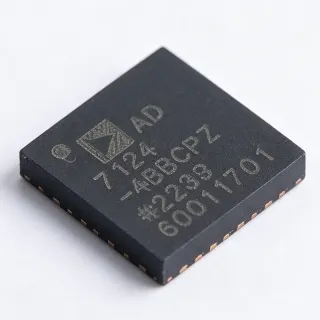
AD7576BQ - 8-Bit 10us Parallel ADC | Analog Devices
N.º da peça: AD7576BQ ✗ Fim de vidaAD7576BQ Visão geral
An 8-bit ADC is a data-conversion IC that samples an analog voltage and represents it with 256 discrete codes. The AD7576 belongs to the successive-approximation ADC hierarchy, where an internal successive-approximation register compares the analog input with a generated reference voltage. This architecture combines relatively rapid conversion, moderate resolution, low cost, and a parallel interface suitable for microprocessor and microcontroller data acquisition.
The AD7576's principal features include 8-bit resolution, 10 µs conversion time, parallel access, microprocessor-compatible interfacing, and operation from a 5 V supply. The manufacturer specifies a nominal +1.23 V external reference, which provides a 0 V to 2 V reference-based conversion range. Using an external reference allows the converter to track the precision and temperature behavior of the reference circuit used by the host system.
The successive-approximation conversion process resolves the analog input over eight bit periods. Because the result appears on parallel output lines, no serial clock is required during conversion. The interface is intended for systems in which the host processor reads the complete eight-bit word directly. The AD7576BQ also uses LC2MOS technology, combining low-power operation with the analog switching functions needed for a compact converter.
Typical uses include industrial control, instrumentation, digital panel meters, process monitoring, and embedded measurement systems. The 10 µs conversion time supports sampled measurements where the monitored signal changes more slowly than the acquisition interval. The device may also be used in feedback-control systems when its sampling rate and input bandwidth satisfy the loop requirements.
The principal design consideration is signal conditioning. The converter expects an analog input referenced to ground, while the conversion scale is established by the external +1.23 V reference. Input filtering, source impedance, reference decoupling, and digital-bus timing should be reviewed against the manufacturer's application guidance. Digital output timing and acquisition sequencing must be coordinated with the connected microprocessor.
This product page combines the manufacturer family information with package, interface, sourcing, and replacement guidance. It also provides practical design notes and a parameter comparison intended to help engineers identify a pin-compatible replacement without overlooking resolution, conversion time, reference behavior, or supply requirements.
Alternativas drop-in para AD7576BQ — mesmo encapsulamento, compatível pino a pino. Peças de encapsulamento diferente que exigem retrabalho na PCB são excluídas.
MX7576TQ
✅ Drop-In📋 Alternativa de referência (fora do catálogo)
MX7576JN+
✅ Drop-In📋 Alternativa de referência (fora do catálogo)
MX7576KN+
✅ Drop-In📋 Alternativa de referência (fora do catálogo)
AD7576BQ Classificações máximas e características elétricas
| Converter Type | Successive-approximation ADC |
| Resolução | 8 bit |
| Conversion Time | 10 µs |
| Output Interface | Parallel |
| Input Signal Range | 0 V to 2 V reference |
| External Reference | +1.23 V |
| Architecture | LC2MOS |
| Microprocessor Compatibility | Microprocessor compatible |
| Power Class | Low power |
| Encapsulamento | 18-pin CERDIP, 0.300 inch lead spacing |
| Tipo de montagem | Through-hole |
| Número de pinos | 18 pins |
| Faixa de tensão de entrada | 0 V to 2 V reference |
Guia de Configuração de Pinos do AD7576BQ 18-pin cerdip, 0.300 inch lead spacing
Configuração de pinos para AD7576BQ (pacote 18-pin cerdip, 0.300 inch lead spacing). Este componente analógico possui pinos de entrada, saída e alimentação. Consulte o datasheet do fabricante para configurações de offset null, compensação e pino de enable. Ideal para circuitos de condicionamento de sinal e amplificadores.

Nenhum dado detalhado de pinagem disponível para AD7576BQ.
Consulte a ficha técnica para a configuração completa dos pinos.
Aplicações típicas
AD7576BQ é adequado para 6 aplicaçãos: Industrial Process Measurement, Digital Panel Meter, Microcontroller Data Acquisition, Laboratory Test and Measurement, Embedded Control System, Legacy Equipment Repair.
Industrial Process Measurement
The AD7576BQ fits industrial process-measurement systems that need a compact, low-power 8-bit conversion stage near a sensor-conditioning circuit. Its 10 µs conversion time permits rapid sampling of slowly varying pressure, temperature, or level signals, while the parallel output can be read directly by a microprocessor input port. The external +1.23 V reference makes the measurement scale repeatable when paired with a stable reference circuit. For reliable deployment, place decoupling close to the supply and reference pins, condition the analog input before the converter, and verify that source impedance and acquisition timing satisfy the AD7576 family specifications.
Recomendado
Digital Panel Meter
The AD7576BQ is appropriate for digital panel-meter designs that acquire a slowly changing sensor voltage and present the result through a digital display controller. Its 8-bit resolution provides 256 quantization levels, which can be appropriate for basic status indication, while the 10 µs conversion time supports repeated measurements without adding serial-clock overhead. The parallel data bus reduces firmware complexity in a processor-based meter. Designers should scale the sensor signal into the converter's reference-based input range, calibrate offset and gain, and provide filtering that prevents display instability without unnecessarily slowing the measurement response.
Recomendado
Microcontroller Data Acquisition
The AD7576BQ can serve as an 8-bit parallel data-acquisition front end for a legacy microcontroller or microprocessor-based controller. Because the converter presents all eight result bits together, the host can capture the measurement through a dedicated input port and initiate the next conversion with minimal timing complexity. The 10 µs conversion interval supports moderately fast control or monitoring loops, but the application must observe the required acquisition delay. Decoupling, grounding, input filtering, and bus routing should be arranged to prevent digital switching activity from disturbing the low-level analog input.
Recomendado
Laboratory Test and Measurement
The AD7576BQ is useful in laboratory and bench-top instrumentation that requires a simple eight-bit measurement channel rather than a high-resolution converter. Its microprocessor-compatible parallel interface permits the host controller to acquire successive samples, calculate operating points, and implement averaging or threshold comparisons. The external reference also allows the measurement scale to be tied to a known laboratory reference. For best repeatability, use a stable reference source, short analog traces, and an input buffer when the source impedance is high; otherwise, settling and offset errors can obscure the converter's intended measurement behavior.
Recomendado
Embedded Control System
The AD7576BQ can be integrated into an embedded control system as the ADC for a feedback variable such as actuator position, supply state, or a conditioned sensor output. The 10 µs successive-approximation conversion provides a short measurement interval, allowing control software to update a duty cycle or status decision more frequently than it could with a slow serial ADC. Because the part is an 8-bit device, design the signal-conditioning path and control loop around its limited code width. Validate startup timing, conversion latency, and reference drift during worst-case supply and temperature conditions.
Recomendado
Legacy Equipment Repair
The AD7576BQ is particularly relevant to repair and continuation designs for legacy equipment that used an 18-pin ceramic DIP 8-bit converter. Retaining the original function reduces the scope of schematic, firmware, and layout changes compared with introducing a converter with a different interface or package. The repair organization should confirm the pin assignment, device marking, reference arrangement, and timing behavior against the original equipment documentation. For repeated production use, an approved modern substitute may be preferable, but any alternative must pass a full pinout and electrical comparison before it is treated as interchangeable.
Recomendado
Resumo dos produtos recomendados
Dados de referência de engenharia para AD7576BQ — comparação, orientação de projeto e informações de conformidade.
Guia de seleção
Comparação com alternativas
| Parâmetro | Este produto | MX7576TQ | MX7576JN+ | MX7576KN+ |
|---|---|---|---|---|
| Brand | Analog Devices | Maxim Integrated | Maxim Integrated | Maxim Integrated |
| Package | 18-pin CERDIP | 18-pin DIP | 18-pin DIP | 18-pin DIP |
| Resolution | 8 bit | 8 bit | 8 bit | 8 bit |
Principais diferenciais
- Exact legacy ceramic-package option (vs MX7576TQ)
- Manufacturer-defined 10 µs conversion time (vs MX7576JN+)
- Parallel microprocessor-compatible output (vs MX7576KN+)
Notas de projeto
Do not substitute a converter based only on its 8-bit rating and 10 µs conversion class. Confirm that the alternative's pin 1 location, analog input connection, reference pins, control inputs, and eight parallel outputs match the original AD7576BQ footprint. The MX7576 candidates are 18-pin DIP devices, while the target is an 18-pin ceramic DIP; verify the exact lead geometry and manufacturer ordering information before approving a substitution.
Place the bypass capacitor at the device supply pins and a suitable decoupling capacitor at the external reference with the shortest practical return path to ground. Keep the analog input and reference traces away from parallel output traces and high-current switching paths. A solid ground plane and short reference route reduce pickup and ground-potential errors that can appear as measurement instability or code-to-code variation.
The AD7576BQ uses an external +1.23 V reference, so reference noise and temperature drift become part of the measurement result. Use a low-noise reference with adequate stability for the required measurement resolution, place its decoupling capacitor close to the converter, and return the reference ground cleanly. Calibrate offset and gain against a known input after the complete analog front end has reached thermal equilibrium.
Acquisition timing must include the 10 µs conversion interval, reference settling, and output update behavior before the host reads the parallel word. Define control signals so that the converter is not sampled during a code transition. Check the manufacturer's timing diagram for the exact read and write-cycle arrangement rather than relying on the nominal conversion time alone.
Informações de conformidade
No explicit RoHS, REACH, AEC-Q100, lead-free, halogen-free, or conflict-minerals status was identified for the exact AD7576BQ ordering code.