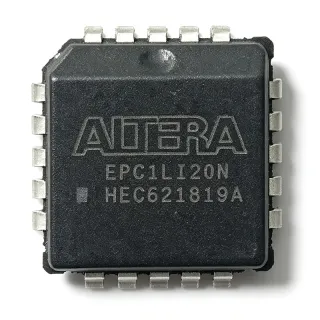
EPC2L20N - 1.6Mb Altera FPGA Config PROM | PLCC-20
N.º da peça: EPC2L20N ✗ Fim de vida| Qtd. | Preço unitário | Total |
|---|---|---|
| 1 | $23.54 | $23,54 |
| 10 | $22.1 | $221,00 |
| 100 | $20.4 | $2.040,00 |
| 500 | $18.75 | $9.375,00 |
| 1.000 | $17.2 | $17.200,00 |
EPC2L20N Visão geral
What is a configuration PROM? A configuration PROM is a non-volatile serial memory that stores the FPGA's configuration bitstream and serially shifts it into the FPGA during power-up or reconfiguration. It sits between the system flash and the FPGA in the boot hierarchy: microprocessor -> flash -> configuration PROM -> SRAM-based FPGA. By isolating the bitstream from system flash, the PROM lets engineers update FPGA firmware in-system without recompiling the host firmware.
The EPC2L20N uses an in-system-programmable (ISP) interface so the bitstream can be reloaded through JTAG-style four-wire programming without removing the device from the board. Cascading of multiple PROMs is supported via the chip-enable control to handle configuration images larger than 1.6 Mb, which historically let designers support Cyclone II and APEX 20K designs. Internal oscillator and clock-management circuitry generate the serial configuration clock for the target FPGA.
The PLCC-20 (J-lead) package is through-hole-compatible and socket-compatible, allowing easy field replacement and prototype iteration. Operating temperature spans the commercial 0C to +70C range as the standard grade, with industrial-grade variants available for harsher environments.
Typical applications include Altera FPGA configuration bitstream storage for industrial control boards, telecom line cards, prototyping platforms, and embedded compute modules where the SRAM-based LUT FPGA must be reconfigured at power-up.
When designing with this device, observe Altera's configuration interface timing requirements and verify the cascaded PROM chain supports the total bitstream length for the chosen FPGA family. For new designs, designers should evaluate newer serial configuration devices, as the EPC2 family has been in mature production for many years.
This page synthesizes Altera/Intel configuration-device specifications, distributor availability and pricing, drop-in alternatives, and engineering notes not consolidated in any single manufacturer document.
Alternativas drop-in para EPC2L20N — mesmo encapsulamento, compatível pino a pino. Peças de encapsulamento diferente que exigem retrabalho na PCB são excluídas.
Variantes desta série
Modelos da mesma série compatíveis como drop-in com EPC2L20N (mesmo formato e footprint) — diferindo em Mounting Type, Package, Memory Type, Supported FPGA Families, RoHS Status.
Ferramenta de comparação rápida — selecione peças alternativas para comparação lado a lado:
EPC2LI20N
✅ Drop-In✓ Em estoque
$5.1 / unidade
Ver ficha técnica →EPC2LC20N
✅ Drop-In✓ Em estoque
$7.4 / unidade
Ver ficha técnica →EPC2L120N
✅ Drop-In ⚠️ Especificações não verificadas✓ Em estoque
$7.85 / unidade
Ver ficha técnica →EPC2L20
✅ Drop-In ⚠️ Especificações não verificadas✓ Em estoque
$25.8 / unidade
Ver ficha técnica →EPC2C20
✅ Drop-In ⚠️ Especificações não verificadas✓ Em estoque
Consulte o preço
Ver ficha técnica →EPC2L20N Classificações máximas e características elétricas
| Função | In-System Programmable Configuration PROM for SRAM-based LUT FPGAs |
| Tamanho da memória | 1.6 Mbit |
| Programmable Type | In System Programmable (ISP) |
| Supply Voltage - VCCINT/VCCIO | 3.0 V to 3.6 V or 4.5 V to 5.5 V |
| Encapsulamento / Caixa | 20-LCC (J-Lead), PLCC-20 |
| Packaging | Tube |
| Temperatura de operação | 0C to +70C (commercial) |
| Supported FPGA Families | Altera APEX, ACEX, Cyclone, FLEX 10K, Mercury (per datasheet) |
| Configuration Interface | Serial (Altera FPP / PS configuration scheme) |
| Cascade Support | Yes (multi-PROM chain via CE control) |
| Programming Method | In-system via 4-wire ISP / JTAG-style |
| Tipo de montagem | Surface Mount (J-Lead PLCC) |
| Contagem de pinos | 20 |
| Lead Finish | Matte Tin (Pb-free) |
| Nível MSL | 3 (168 hours) |
| Status RoHS | Compliant |
Guia de Configuração de Pinos do EPC2L20N 20-lcc (j-lead), plcc-20
Configuração de pinos para EPC2L20N (pacote 20-lcc (j-lead), plcc-20). Este CI digital inclui GPIO, interfaces de comunicação (UART, SPI, I2C) e pinos de alimentação. Consulte o datasheet do fabricante para funções alternativas dos pinos e opções de configuração. Essencial para projeto de sistemas embarcados e layout de PCB.

Nenhum dado detalhado de pinagem disponível para EPC2L20N.
Consulte a ficha técnica para a configuração completa dos pinos.
Aplicações típicas
EPC2L20N é adequado para 6 aplicaçãos: Altera APEX 20K FPGA Configuration Storage, Altera Cyclone FPGA Bitstream Loading, Industrial Control Board Firmware Storage, Telecom Line Card FPGA Configuration, FPGA Prototyping and Development Boards, Legacy Avionics and Defense Systems.
Altera APEX 20K FPGA Configuration Storage
The EPC2L20N is purpose-built for storing the configuration bitstream of Altera APEX 20K series SRAM-based LUT FPGAs. With 1.6 Mbit of non-volatile storage per the Altera datasheet, it covers APEX 20K100 and 20K200 bitstreams when used standalone, and can be cascaded for larger 20K400/600/1000 images via the nCE chip-enable chain. The 3.0 V to 3.6 V / 4.5 V to 5.5 V dual-voltage operation lets it drive APEX configuration pins directly without external level shifters. PLCC-20 J-lead sockets simplify prototyping and field replacement.
Recomendado
Altera Cyclone FPGA Bitstream Loading
Original-generation Altera Cyclone (EP1C3, EP1C6, EP1C12, EP1C20) FPGAs used the EPC2 family of configuration PROMs to load bitstream at power-up. The EPC2L20N's 1.6 Mbit matches the smaller Cyclone devices, while larger Cyclones can be served via cascaded EPC2 chains. Engineers migrating legacy Cyclone designs can drop in the EPC2L20N on existing PCBs that follow the Altera PS (passive serial) configuration scheme. ISP via four-wire programming enables field firmware updates without removing the PROM.
Recomendado
Industrial Control Board Firmware Storage
Industrial control boards running legacy Altera FPGA logic (PLCs, motor controllers, machine vision front-ends) frequently use the EPC2L20N to store the FPGA firmware bitstream independent of system flash. The PLCC-20 J-lead package supports socketed mounting for easy field replacement during maintenance cycles. Operating at 3.3 V or 5 V, the EPC2L20N interfaces directly to Altera FPGAs on industrial 5 V backplanes. The in-system programmable interface lets technicians update bitstream revisions through JTAG.
Recomendado
Telecom Line Card FPGA Configuration
Telecom infrastructure equipment (line cards, multiplexer shelves) built around Altera FLEX 10K and APEX 20K FPGAs relied on EPC2 PROMs for FPGA configuration. The EPC2L20N supports these designs with 1.6 Mbit storage in a socketable PLCC-20 J-lead package for serviceability. The dual-voltage (3.3 V/5 V) operation matches telecom backplane rails. Multiple PROMs can cascade via nCE to handle line-card bitstreams exceeding 1.6 Mb.
Recomendado
FPGA Prototyping and Development Boards
FPGA development boards targeting Altera APEX, ACEX, Cyclone, FLEX 10K, and Mercury devices historically used the EPC2L20N for quick prototype bring-up. The PLCC-20 socketable package lets developers swap bitstreams rapidly during bring-up, and ISP allows direct in-circuit programming. The 1.6 Mbit capacity covers most early-generation Altera FPGA bitstreams. Modern development kits have transitioned to EPCQ/EPCQL SOIC-8 PROMs, but legacy boards still benefit from the EPC2L20N.
Recomendado
Legacy Avionics and Defense Systems
Long-life defense and avionics platforms designed around Altera APEX 20K or FLEX 10K FPGAs continue to require EPC2 configuration PROMs through multi-decade support programs. The EPC2L20N, with its mature Altera pedigree and PLCC-20 socketable form factor, supports the obsolescence-management strategy of these programs. Industrial-temperature variants (EPC2LI20N) extend operating range for harsher environments.
Recomendado
Resumo dos produtos recomendados
Dados de referência de engenharia para EPC2L20N — comparação, orientação de projeto e informações de conformidade.
Guia de seleção
Comparação com alternativas
| Parâmetro | Este produto | EPC2LI20N | EPC2LC20N | EPC2L120N | EPC2L20 | EPC2C20 |
|---|---|---|---|---|---|---|
| Brand | Altera / Intel | Altera / Intel | Altera / Intel | Altera / Intel | Altera / Intel | Altera / Intel |
| Package | PLCC-20 (J-Lead) | PLCC-20 (J-Lead) - same | PLCC-20 (J-Lead) - same | PLCC-20 (J-Lead) - same | PLCC-20 (J-Lead) - same | PLCC-20 (J-Lead) - same |
| Memory Size | 1.6 Mbit | 1.6 Mbit | 1.6 Mbit | 1.6 Mbit (variant label) | 1.6 Mbit | 1.6 Mbit (EPC2 family) |
| Supply Voltage | 3.0-3.6 V / 4.5-5.5 V | 3.0-3.6 V / 4.5-5.5 V | 3.0-3.6 V / 4.5-5.5 V | 3.0-3.6 V / 4.5-5.5 V | 3.0-3.6 V / 4.5-5.5 V | 3.0-3.6 V / 4.5-5.5 V |
| Programmable Type | In-System Programmable (ISP) | ISP | ISP | ISP | ISP | ISP |
| Function | FPGA Configuration PROM | FPGA Configuration PROM | FPGA Configuration PROM | FPGA Configuration PROM | FPGA Configuration PROM | FPGA Configuration PROM |
| Lifecycle Status | NRND | NRND | NRND | NRND | NRND | NRND |
| Operating Temperature | 0C to +70C (commercial) | Industrial grade variant | 0C to +70C (commercial) | 0C to +70C (commercial) | 0C to +70C (commercial) | 0C to +70C (commercial) |
Principais diferenciais
- Mature Altera pedigree with broad legacy FPGA family support (vs EPC2LC20N)
- Documented in-system programmable (ISP) interface (vs EPC1 family (older generation))
- Dual-voltage (3.3 V / 5 V) operation in one part (vs EPCQ serial configuration devices)
Notas de projeto
Do not assume EPC2 family part-number suffixes (L20 vs LI20 vs LC20) are interchangeable without verifying against the manufacturer datasheet. The 'I' or 'C' suffix may denote industrial-grade temperature range or packaging variants. When designing for new production, verify the exact ordering code with Intel/Altera part-number decoder. The EPC2 family is NRNR; new designs should use EPCQ or EPCQL serial configuration devices in SOIC-8 instead.
Use a 20-pin PLCC socket for the EPC2L20N to allow field replacement during maintenance cycles and bitstream updates. Place the PROM close to the FPGA's configuration pins to minimize trace length on DCLK and DATA lines. Add 0.1 uF decoupling capacitors at VCC and VPP pins, located within 100 mils of the package. Observe the configuration interface timing diagrams in the Altera datasheet when designing cascade chains across multiple PROMs.
When cascading multiple EPC2 PROMs for bitstreams larger than 1.6 Mbit, route the nCE chip-enable signal in a daisy chain from the FPGA's nCONFIG-driven logic. Each PROM's DATA output connects to the next PROM's DATA input through a small buffer if trace length exceeds 2 inches. Refer to the Altera Configuration Devices datasheet for the exact cascade timing diagram. Maintain consistent impedance on DCLK traces to avoid configuration errors.
The EPC2L20N's configuration interface uses single-ended DCLK and DATA signals. Keep these traces short and well-separated from switching-power and high-current traces to avoid coupling noise that could cause FPGA configuration failures. Add a series damping resistor (22-33 ohm) on the DCLK output if the load is more than 4 inches or crosses multiple board layers. Verify signal integrity with the Altera configuration timing analysis tools.
Informações de conformidade
RoHS compliant per Altera/Intel datasheet and distributor listings. REACH, halogen-free, and conflict-mineral status not explicitly documented in the verified web data; set to 'unknown' rather than assumed. AEC-Q100 is not applicable (Altera configuration PROMs are not automotive-qualified).