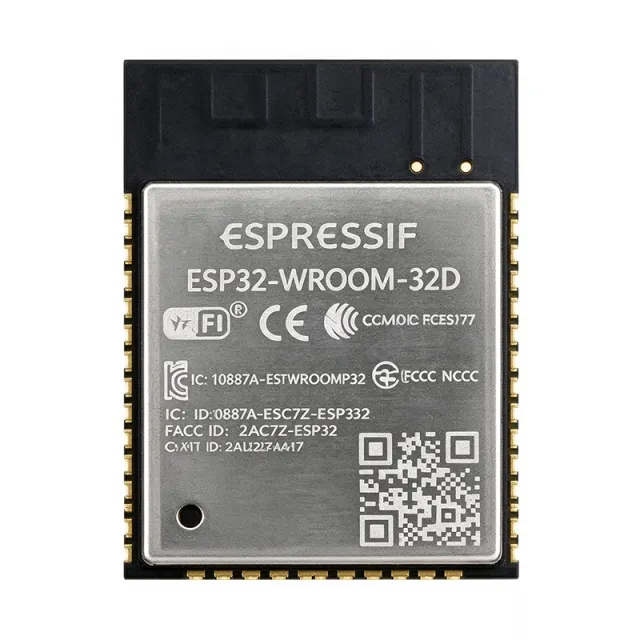
ESP32-WROOM-32E-N8R2 - WiFi/BT 4.2 Module, 8MB Flash | Espressif
N.º da peça: ESP32-WROOM-32E-N8R2 ✓ Ativo| Qtd. | Preço unitário | Total |
|---|---|---|
| 1 | $5.0625 | $5,06 |
| 10 | $3.6563 | $36,56 |
| 100 | $3.2344 | $323,44 |
| 500 | $3.0938 | $1.546,90 |
| 1.000 | $2.9531 | $2.953,10 |
ESP32-WROOM-32E-N8R2 Visão geral
A Wi-Fi MCU module is a self-contained wireless system that integrates a microcontroller, radio transceiver, antenna, RF matching network, flash memory and power management on one certified PCB. Within the product hierarchy it sits between a bare SoC and a full development board: it offers complete radio certification and shielding without the overhead of a carrier board, making it the standard building block for power management, connectivity and edge computing in IoT endpoints.
Key features of the N8R2 variant include 802.11 b/g/n Wi-Fi with 150 Mbps PHY rate, Bluetooth v4.2 BR/EDR and BLE, dual-core LX6 operation for concurrent application and protocol processing, and 26 GPIOs with a rich peripheral set (SPI, I2S, I2C, UART, ADC, DAC, PWM, touch). The 8 MB flash plus 2 MB PSRAM configuration gives headroom for OTA update partitions, larger TLS stacks and display frame buffers that smaller N4/N8 variants cannot support.
Technically, the module integrates antenna switches, RF balun, power amplifier, low-noise receive amplifier, filters and power management on the embedded ESP32-D0WD-V3 silicon, achieving higher stability and safety performance than the original ESP32-WROOM-32. The V3 die revision adds security features such as flash encryption and secure boot support.
Typical applications include smart-home devices, industrial controllers and wireless sensor nodes where both Wi-Fi and Bluetooth connectivity and extra RAM are required in a single certified footprint.
Design-wise, supply the module from a clean 3.3 V rail capable of delivering 500 mA peaks, and keep the antenna region free of copper and enclosures with high dielectric constants.
This page synthesizes distributor pricing, memory-variant drop-in options and practical design notes not found in the manufacturer datasheet. Pricing references are as of 2026-09-15.
Alternativas drop-in para ESP32-WROOM-32E-N8R2 — mesmo encapsulamento, compatível pino a pino. Peças de encapsulamento diferente que exigem retrabalho na PCB são excluídas.
Ferramenta de comparação rápida — selecione peças alternativas para comparação lado a lado:
ESP32-WROOM-32E-N8
✓ Em estoque
$3.7734 / unidade
Ver ficha técnica →ESP32-WROOM-32E-N8R8
📋 Alternativa de referência (fora do catálogo)
ESP32-WROOM-32E-N4
📋 Alternativa de referência (fora do catálogo)
ESP32-WROOM-32E-N16
📋 Alternativa de referência (fora do catálogo)
ESP32-WROOM-32UE-N8
📋 Alternativa de referência (fora do catálogo)
ESP32-WROOM-32E-N8R2 Especificações (publicadas pelo fabricante)
| RF Frequency | 2.4 GHz |
| Wi-Fi Standard | 802.11 b/g/n |
| Bluetooth | v4.2 BR/EDR and BLE, Class 1, 2 and 3 |
| MCU Core | Xtensa dual-core 32-bit LX6 (ESP32-D0WD-V3 / ESP32-D0WDR2-V3) |
| Flash Memory | 8 MB |
| PSRAM | 2 MB |
| Tensão de alimentação | 3 V to 3.6 V |
| GPIO Count | 26 |
| Antenna | Onboard PCB trace antenna |
| Tipo de montagem | Surface Mount |
| Embedded Security | Flash encryption and secure boot support (V3 silicon) |
| Peripherals | SPI, I2C, I2S, UART, ADC, DAC, PWM, touch sensor |
| Status RoHS | Compliant |
Configuração de pinos do ESP32-WROOM-32E-N8R2
| Pino 1 | GND — Ground |
| Pino 2 | 3V3 — Power supply (3.0 V to 3.6 V) |
| Pino 3 | EN — RF enable, active high (chip enable) |
| Pino 4 | SENSOR_VP — ADC pre-amplifier positive input (GPIO36) |
| Pino 5 | SENSOR_VN — ADC pre-amplifier negative input (GPIO39) |
| Pino 6 | IO34 — GPIO34, input only, ADC1_CH6 |
| Pino 7 | IO35 — GPIO35, input only, ADC1_CH7 |
| Pino 8 | IO32 — GPIO32, ADC1_CH4, touch sensor 9 |
| Pino 9 | IO33 — GPIO33, ADC1_CH5, touch sensor 8 |
| Pino 10 | IO25 — GPIO25, DAC1, ADC2_CH8 |
| Pino 11 | IO26 — GPIO26, DAC2, ADC2_CH9 |
| Pino 12 | IO27 — GPIO27, ADC2_CH7, touch sensor 7 |
| Pino 13 | IO14 — GPIO14, ADC2_CH6, touch sensor 6, HS2_CLK |
| Pino 14 | IO12 — GPIO12, MTDI strapping pin (flash voltage), ADC2_CH5 |
| Pino 15 | GND — Ground |
| Pino 16 | IO13 — GPIO13, ADC2_CH4, touch sensor 4, HS2_DATA3 |
| Pino 17 | SHD/SD2 — Flash/PSRAM data 2 (reserve, do not use externally) |
| Pino 18 | SWP/SD3 — Flash/PSRAM data 3 (reserve, do not use externally) |
| Pino 19 | SCS/CMD — Flash/PSRAM command (reserve, do not use externally) |
| Pino 20 | SCK/CLK — Flash/PSRAM clock (reserve, do not use externally) |
| Pino 21 | SDO/SD0 — Flash/PSRAM data 0 (reserve, do not use externally) |
| Pino 22 | SDI/SD1 — Flash/PSRAM data 1 (reserve, do not use externally) |
| Pino 23 | IO15 — GPIO15, MTDO strapping (debug output), ADC2_CH3 |
| Pino 24 | IO2 — GPIO2, boot-mode strapping pin, must be low/floating for download boot |
| Pino 25 | IO0 — GPIO0, boot-mode strapping pin (high = flash boot, low = download) |
| Pino 26 | IO4 — GPIO4, ADC2_CH0, touch sensor 0 |
| Pino 27 | NC — Not connected (per datasheet) |
| Pino 28 | NC — Not connected (per datasheet) |
| Pino 29 | IO5 — GPIO5, strapping (timing of SDIO slave), VSPI_CS0 |
| Pino 30 | IO18 — GPIO18, VSPI_CLK |
| Pino 31 | IO23 — GPIO23, VSPI_MOSI |
| Pino 32 | IO19 — GPIO19, VSPI_MISO |
| Pino 33 | IO22 — GPIO22, UART1 RTS |
| Pino 34 | U0RXD — UART0 receive (GPIO3), download-mode serial RX |
| Pino 35 | U0TXD — UART0 transmit (GPIO1), download-mode serial TX |
| Pino 36 | IO21 — GPIO21, I2C SDA |
| Pino 37 | GND — Ground |
| Pino 38 | GND — Ground |
Características de potência e térmicas
| Entrada de Potência | 3 V to 3.6 V |
Parâmetros de entrada de potência e térmicos para ESP32-WROOM-32E-N8R2, conforme publicados pelo fabricante.
Aplicações típicas
ESP32-WROOM-32E-N8R2 é adequado para 6 aplicaçãos: Smart Home Devices, Industrial IoT Controllers, Wireless Sensor Networks, Wearable Electronics, Embedded Systems and Gateways, Security and Camera-Adjacent IoT.
Smart Home Devices
The ESP32-WROOM-32E-N8R2 fits smart plugs, lighting controllers and thermostats because one module provides both Wi-Fi 802.11 b/g/n for cloud connectivity and Bluetooth v4.2 BLE for local commissioning via a phone app. The dual-core LX6 runs the Wi-Fi stack on one core and application logic on the other, and the 2 MB PSRAM comfortably holds TLS session state and JSON payloads for MQTT or REST cloud links. The module is pre-certified, removing per-product RF lab work. Place it near the enclosure edge with the antenna keep-out respected, and budget a 3.3 V rail with 500 mA headroom for Wi-Fi TX bursts of several hundred milliamps.
Recomendado
Industrial IoT Controllers
In industrial monitoring and control nodes, the N8R2's 8 MB flash supports large OTA update images with dual-partition A/B schemes, so controllers can be re-flashed remotely without a service visit, and rolling back on failure is automatic. The 2 MB PSRAM buffers sensor time-series during network outages, and the ESP32-D0WD-V3 adds flash encryption and secure boot for field-deployed security. The module's shielded construction reduces EMI coupling with nearby relays and motor drives. Pair it with isolated RS-485 or CAN transceivers, keep the PCB antenna at least 10 mm from metal enclosures, and power from an industrial 3.3 V rail with brownout supervision.
Recomendado
Wireless Sensor Networks
Battery-powered sensor nodes benefit from the module's deep-sleep mode, in which only the RTC domain remains powered, letting a node wake on timer or GPIO, sample an ADC or I2C sensor, publish over Wi-Fi or BLE, and return to microamp-level sleep. The 26 GPIOs cover multiple sensor buses, and input-only pins on GPIO34/35 suit high-impedance analog channels. The 2 MB PSRAM is optional here but useful for caching readings between uplinks. Design the supply from a low-quiescent-current LDO or buck, since the module sleeps most of the time and regulator standby current dominates battery life in multi-year deployments.
Recomendado
Wearable Electronics
The ESP32-WROOM-32E-N8R2 supports wearables that need BLE connectivity plus occasional Wi-Fi sync. In BLE-only operation the radio duty cycle is low, and light-sleep between connection intervals keeps average current within battery budgets; the dual-core LX6 offloads BLE to the controller while user-interface code runs on the application core. The 2 MB PSRAM supports small graphical UIs with LVGL frame buffers that single-chip MCUs struggle to hold. The PCB antenna requires clearance from the body and metal straps; detuning near tissue is manageable with the antenna at the wristband end. Verify SAR and regulatory exposure compliance for body-worn operation.
Recomendado
Embedded Systems and Gateways
As a gateway bridge between Wi-Fi/Ethernet upstream and BLE, Zigbee-adjacent sensors or UART devices downstream, the module's concurrent dual-radio operation and 240 MHz dual-core LX6 handle protocol translation while the 8 MB flash stores web-server assets and configuration. The 2 MB PSRAM allows multiple TLS sessions simultaneously, critical for cloud-plus-local connections. PSRAM access consumes SPI pins internally, so the exposed SD_x/CLK/CMD pads remain on the flash bus and should stay reserved. Use hardware flow control on UART bridges and keep the module away from switching converters above 100 MHz harmonics to preserve 2.4 GHz receiver sensitivity.
Recomendado
Security and Camera-Adjacent IoT
The N8R2 serves networked security accessories - door locks, PIR hubs, alarm panels - where encrypted cloud links matter. The ESP32-D0WD-V3's flash encryption and secure boot protect firmware and keys on tamper-accessible hardware, and 2 MB PSRAM holds camera-adjacent workloads such as JPEG buffers from SPI cameras or AES session contexts. The 8 MB flash stores signed firmware plus on-device event logs. Power the module through a supervisor with brownout detection because lock-actuator solenoids can sag the 3.3 V rail during Wi-Fi TX bursts, and place the PCB antenna away from the metal strike plate and hinge hardware common in lock housings.
Recomendado
Resumo dos produtos recomendados
Dados de referência de engenharia para ESP32-WROOM-32E-N8R2 — comparação, orientação de projeto e informações de conformidade.
Guia de seleção
Comparação com alternativas
| Parâmetro | Este produto | ESP32-WROOM-32E-N8 | ESP32-WROOM-32E-N8R8 | ESP32-WROOM-32E-N4 | ESP32-WROOM-32E-N16 | ESP32-WROOM-32UE-N8 |
|---|---|---|---|---|---|---|
| Package | Shielded SMD module with PCB antenna (18.0 x 19.5 mm class) | Same shielded SMD module with PCB antenna | Same shielded SMD module with PCB antenna | Same shielded SMD module with PCB antenna | Same shielded SMD module with PCB antenna | Same footprint, external antenna connector |
| Brand | Espressif Systems | Espressif Systems | Espressif Systems | Espressif Systems | Espressif Systems | Espressif Systems |
| Flash Memory | 8 MB | 8 MB | 8 MB | 4 MB | 16 MB | 8 MB |
| PSRAM | 2 MB | None | 8 MB | None | None | None |
| Wi-Fi Standard | 802.11 b/g/n, 2.4 GHz | 802.11 b/g/n, 2.4 GHz | 802.11 b/g/n, 2.4 GHz | 802.11 b/g/n, 2.4 GHz | 802.11 b/g/n, 2.4 GHz | 802.11 b/g/n, 2.4 GHz |
| Bluetooth | v4.2 BR/EDR + BLE, Class 1/2/3 | v4.2 BR/EDR + BLE | v4.2 BR/EDR + BLE | v4.2 BR/EDR + BLE | v4.2 BR/EDR + BLE | v4.2 BR/EDR + BLE |
| Embedded SoC | ESP32-D0WD-V3 / ESP32-D0WDR2-V3, dual-core LX6 | ESP32-D0WD-V3, dual-core LX6 | ESP32-D0WDR2-V3, dual-core LX6 | ESP32-D0WD-V3, dual-core LX6 | ESP32-D0WD-V3, dual-core LX6 | ESP32-D0WD-V3, dual-core LX6 |
| Antenna | Onboard PCB trace | Onboard PCB trace | Onboard PCB trace | Onboard PCB trace | Onboard PCB trace | External antenna connector (U.FL class) |
| Supply Voltage | 3.0 V to 3.6 V | 3.0 V to 3.6 V | 3.0 V to 3.6 V | 3.0 V to 3.6 V | 3.0 V to 3.6 V | 3.0 V to 3.6 V |
Principais diferenciais
- 2 MB PSRAM for memory-heavy firmware (vs ESP32-WROOM-32E-N8)
- Balanced 8 MB flash + 2 MB RAM pairing (vs ESP32-WROOM-32E-N8R8)
- PCB antenna with no external RF BOM (vs ESP32-WROOM-32UE-N8)
- Double the flash for OTA-heavy products (vs ESP32-WROOM-32E-N4)
Notas de projeto
Size the 3.3 V supply for RF transmit bursts, not average current. Wi-Fi TX peaks draw several hundred milliamps for milliseconds; a rail that sags below the brownout threshold resets the module mid-packet. Place a low-ESR bulk capacitor of at least 22 uF within a few millimeters of the 3V3 pin plus 100 nF high-frequency decoupling, per Espressif hardware design guidelines. Avoid sharing this rail with motors or solenoids without local bulk storage. Estimated: a 500 mA-headroom LDO or buck with 22 uF bulk covers typical burst scenarios.
Keep all layers of copper, traces and vias out of the antenna keep-out region extending from the module edge over the PCB antenna; Espressif recommends no copper beneath the antenna area on any layer. Route the module at the PCB edge with the antenna facing outward, and never enclose it inside a metal can or near ground pours on the top layer. For the N8R2 specifically, note that PSRAM traffic uses the reserved SD_x/CLK/CMD pads internally, so these pins must remain unconnected on the carrier PCB.
Respect the strapping pins at boot: GPIO0 high selects normal flash boot and low selects the serial download mode; GPIO2 must be low or floating for download boot; GPIO12 (MTDI) sets flash voltage and must not be pulled high at reset with standard modules; GPIO15 sets debug output timing. Level-shifters or peripherals driving these pins at reset are the most frequent cause of 'module will not boot' support tickets. Also expose UART0 (U0TXD/U0RXD) and EN on test points for reprogramming in production.
The module is shielded, but its own 2.4 GHz radio still radiates; conversely, nearby switching converters in the tens-of-MHz range and their harmonics can desensitize the receiver. Keep buck converters and crystal oscillators away from the antenna side, and route high-speed SPI/UART buses on inner layers with ground return paths. Where the module coexists with other 2.4 GHz radios, implement Espressif's coexistence scheme in software (Wi-Fi/BT time-division) rather than relying on layout alone.
Informações de conformidade
RoHS compliant per DigiKey/LCSC/Mouser distributor listings for the WROOM-32E series. REACH, halogen-free and conflict-minerals declarations not found in provided data - obtain the current compliance package from Espressif.
