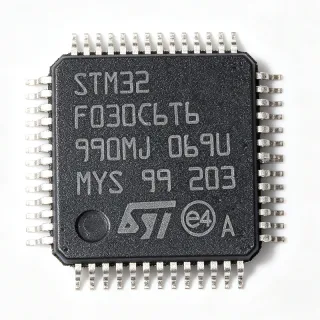
MC68HC908GZ60CFA - 8-Bit HC08 MCU 60KB Flash 48-LQFP | NXP
N.º da peça: MC68HC908GZ60CFA ✗ Fim de vida| Qtd. | Preço unitário | Total |
|---|---|---|
| 1 | $11.25 | $11,25 |
| 10 | $10.4 | $104,00 |
| 100 | $9.55 | $955,00 |
| 500 | $8.7 | $4.350,00 |
| 1.000 | $7.85 | $7.850,00 |
MC68HC908GZ60CFA Visão geral
A microcontroller (MCU) is a single-chip computer that contains a CPU core, program memory (FLASH/ROM), working memory (RAM), and peripheral set. The HC08 is a mature 8-bit M68HC08 architecture from NXP (originally Motorola/Freescale), positioned as a low-cost, high-performance successor to the HC05 family. LDOs, switching regulators, and bus transceivers normally surround the MCU on the board, while the HC08 itself sits at the LDO -> linear regulator -> voltage regulator -> power management IC -> semiconductor hierarchy on the BOM. The MC68HC908GZ60CFA belongs to the CAN-enabled GZ sub-family, which adds an automotive-style CAN controller.
Key features include 60 KB FLASH with security, 2 KB RAM, an 8-channel 10-bit ADC, an 8-bit keyboard interrupt module, a serial peripheral interface (SPI) and serial communications interface (SCI), and a clock generation module (CGM) with phase-locked loop (PLL). On-chip programming firmware allows in-system FLASH programming from a personal computer without external programmers, and FLASH security prevents unauthorized read-back.
The device is built around the HC08 CPU core with a von Neumann-style unified memory map and 16-bit stack pointer. The 8 MHz internal bus is sourced from either a crystal (1-8 MHz) or the on-chip PLL. The MSCAN08 controller implements the BOSCH CAN 2.0B specification dated September 1991, supporting both standard (11-bit) and extended (29-bit) identifiers, with hardware acceptance filtering for bus offload.
Typical applications include automotive body controllers, CAN nodes, HVAC modules, industrial sensor interfaces, low-cost appliance controllers, and instrumentation. The wide operating temperature range and robust peripheral set also suit battery management and CAN-connected supervisory nodes.
When designing with this MCU, ensure the supply rail (VDD/VSS) is decoupled close to the pins with at least a 100 nF ceramic capacitor, route the crystal traces short and symmetric, and confirm the chosen CAN transceiver matches the MSCAN08's TX/RX logic levels. FLASH security must be set after final firmware load to prevent in-circuit extraction.
This page synthesizes distributor pricing, drop-in same-family alternatives, and practical design notes not found in the manufacturer datasheet, helping engineers shorten sourcing and design-review cycles.
Alternativas drop-in para MC68HC908GZ60CFA — mesmo encapsulamento, compatível pino a pino. Peças de encapsulamento diferente que exigem retrabalho na PCB são excluídas.
Ferramenta de comparação rápida — selecione peças alternativas para comparação lado a lado:
MC68HC908GZ60CFU
✅ Drop-In📋 Alternativa de referência (fora do catálogo)
MC68HC908GZ60VFA
✅ Drop-In📋 Alternativa de referência (fora do catálogo)
MC68HC908GZ48CFA
✅ Drop-In📋 Alternativa de referência (fora do catálogo)
MC68HC908GZ32CFA
✅ Drop-In📋 Alternativa de referência (fora do catálogo)
MC9S08GB60CFGE
✅ Drop-In📋 Alternativa de referência (fora do catálogo)
MC68HC908GZ60CFA Classificações máximas e características elétricas
| Core Architecture | HC08 (M68HC08 Family, 8-bit) |
| Maximum Internal Bus Frequency | 8 MHz |
| Program Memory (FLASH) | 60 KB (60K x 8) |
| ADC | 10-bit, 8 channels |
| CAN Controller | MSCAN08 (CAN 2.0B, BOSCH spec Sept 1991) |
| Serial Interfaces | SCI (UART), SPI |
| Clock Generation | CGM with PLL, 1 MHz to 8 MHz crystal support |
| Keyboard Interrupt Module | 8-bit KBI |
| Encapsulamento | 48-pin LQFP (7x7 mm) |
| Tipo de montagem | Surface Mount |
| FLASH Security | Yes (security bit) |
| On-Chip Programming | Yes (host-PC firmware loader) |
Configuração de pinos do MC68HC908GZ60CFA
| Pino 1 | PTE0/TxD1 — Port E bit 0 / SCI1 transmit |
| Pino 2 | PTE1/RxD1 — Port E bit 1 / SCI1 receive |
| Pino 3 | PTE2 — Port E bit 2 |
| Pino 4 | PTE3 — Port E bit 3 |
| Pino 5 | PTE4 — Port E bit 4 |
| Pino 6 | PTE5 — Port E bit 5 |
| Pino 7 | PTE6 — Port E bit 6 |
| Pino 8 | PTE7 — Port E bit 7 |
| Pino 9 | VDD — Positive supply |
| Pino 10 | VSS — Ground |
| Pino 11 | PTA0/KBD0 — Port A bit 0 / keyboard interrupt 0 |
| Pino 12 | PTA1/KBD1 — Port A bit 1 / keyboard interrupt 1 |
| Pino 13 | PTA2/KBD2 — Port A bit 2 / keyboard interrupt 2 |
| Pino 14 | PTA3/KBD3 — Port A bit 3 / keyboard interrupt 3 |
| Pino 15 | PTA4/KBD4 — Port A bit 4 / keyboard interrupt 4 |
| Pino 16 | PTA5/KBD5 — Port A bit 5 / keyboard interrupt 5 |
| Pino 17 | PTA6/KBD6 — Port A bit 6 / keyboard interrupt 6 |
| Pino 18 | PTA7/KBD7 — Port A bit 7 / keyboard interrupt 7 |
| Pino 19 | PTB0/AD0 — Port B bit 0 / ADC channel 0 |
| Pino 20 | PTB1/AD1 — Port B bit 1 / ADC channel 1 |
| Pino 21 | PTB2/AD2 — Port B bit 2 / ADC channel 2 |
| Pino 22 | PTB3/AD3 — Port B bit 3 / ADC channel 3 |
| Pino 23 | PTB4/AD4 — Port B bit 4 / ADC channel 4 |
| Pino 24 | PTB5/AD5 — Port B bit 5 / ADC channel 5 |
| Pino 25 | PTB6/AD6 — Port B bit 6 / ADC channel 6 |
| Pino 26 | PTB7/AD7 — Port B bit 7 / ADC channel 7 |
| Pino 27 | PTC0 — Port C bit 0 |
| Pino 28 | PTC1 — Port C bit 1 |
| Pino 29 | PTC2 — Port C bit 2 |
| Pino 30 | PTC3 — Port C bit 3 |
| Pino 31 | PTC4 — Port C bit 4 |
| Pino 32 | PTC5 — Port C bit 5 |
| Pino 33 | PTC6 — Port C bit 6 |
| Pino 34 | PTC7 — Port C bit 7 |
| Pino 35 | PTD0/MISO — Port D bit 0 / SPI MISO |
| Pino 36 | PTD1/MOSI — Port D bit 1 / SPI MOSI |
| Pino 37 | PTD2/SPSCK — Port D bit 2 / SPI clock |
| Pino 38 | PTD3/SS — Port D bit 3 / SPI slave select |
| Pino 39 | PTD4/CANTx — Port D bit 4 / MSCAN08 transmit |
| Pino 40 | PTD5/CANRx — Port D bit 5 / MSCAN08 receive |
| Pino 41 | OSC1 — Crystal oscillator input |
| Pino 42 | OSC2 — Crystal oscillator output |
| Pino 43 | RESET — External reset (active low) |
| Pino 44 | IRQ — External interrupt request (active low) |
| Pino 45 | VREFH — ADC high reference |
| Pino 46 | VREFL/VSSAD — ADC low reference / analog ground |
| Pino 47 | VDD — Positive supply (second pin) |
| Pino 48 | VSS — Ground (second pin) |
Aplicações típicas
MC68HC908GZ60CFA é adequado para 6 aplicaçãos: Automotive Body Control Modules (CAN nodes), Industrial CAN Sensor Nodes, HVAC and Appliance Controllers, Low-Cost Instrumentation and Data Loggers, Battery-Management Supervisory Nodes, Smart Sensor and IoT Edge Nodes (CAN-attached).
Automotive Body Control Modules (CAN nodes)
The MC68HC908GZ60CFA's MSCAN08 CAN 2.0B controller and industrial-grade temperature rating make it well suited to automotive body-electronics nodes such as HVAC controllers, door modules, and lighting controllers. Its 60 KB FLASH is large enough for full CAN stack + diagnostics + application code, while the 48-LQFP package fits behind the wiring connector. With 8 MHz HC08 core and hardware acceptance filtering, the device offloads message-ID matching from the CPU, freeing cycles for sensor processing. Drop it onto the bus with a TJA1050 or TJA1040 transceiver and a 5V LDO, and you have a complete automotive-grade node. The wide operating temperature range and FLASH security bit also support OEM traceability requirements.
Recomendado
Industrial CAN Sensor Nodes
Factory-floor CANopen or DeviceNet slave nodes can use the MC68HC908GZ60CFA as the host MCU because the MSCAN08 controller delivers 11-bit and 29-bit identifier support and the 10-bit ADC accepts 0-5 V transducer outputs directly. The on-chip 8-channel ADC, SPI port for digital sensors, and SCI for commissioning are sufficient for pressure, flow, and level transmitters. With 60 KB FLASH you can host full CANopen stack (CiA 401) plus calibration data. The 48-LQFP survives vibration-mount industrial enclosures, and FLASH security protects OEM calibration. Power the MCU from an MC78M05 5V LDO with a TVS across the CAN bus for surge protection.
Recomendado
HVAC and Appliance Controllers
The MC68HC908GZ60CFA's 8-channel 10-bit ADC, PWM-capable timer, and SCI interface support HVAC thermostat, washing-machine, and dishwasher controller designs that need to read NTC temperature sensors, drive TRIAC outputs, and talk to a remote control panel. FLASH security protects proprietary compressor control algorithms. The 60 KB program memory fits a full state-machine plus look-up tables for PID loops, while the 48-LQFP's small 7x7 mm outline eases mounting inside plastic enclosures. Pair the MCU with a zero-cross TRIAC driver (MOC3021) for AC load switching and a step-down regulator for motor supplies. Industrial temperature grade covers most indoor and garage installations.
Recomendado
Low-Cost Instrumentation and Data Loggers
Portable data loggers for field instrumentation can use the MC68HC908GZ60CFA because it integrates 8 ADC channels, SPI for an external serial FLASH memory, SCI for RS-232 or USB-UART bridge, and 60 KB FLASH for protocol stacks. The 8 MHz core is sufficient for 100 Hz sample logging with on-chip averaging. Industrial-grade temperature tolerance lets the logger sit inside instrument enclosures outdoors. Add an external 24LC256 EEPROM via I2C bit-banging for non-volatile log storage, and a MAX232 for PC link. FLASH security prevents end users from cloning calibration curves.
Recomendado
Battery-Management Supervisory Nodes
Small lithium-ion or lead-acid battery-management slaves that need CAN connectivity can use the MC68HC908GZ60CFA as the supervisory MCU. Its 10-bit ADC reads cell voltages through a divider, the SCI connects to a charger-side master, and MSCAN08 reports SoC and SoH over the battery CAN bus. Industrial temperature rating covers under-seat automotive battery packs, and 60 KB FLASH hosts lookup tables for cell impedance vs SoC. Pair with an MC33771 battery monitor for high-voltage stacks, or use the on-chip ADC alone for low-cost 6S packs. The 48-LQFP package fits inside the battery enclosure lid.
Recomendado
Smart Sensor and IoT Edge Nodes (CAN-attached)
Industrial IoT gateways that aggregate CAN sensors can use the MC68HC908GZ60CFA as a sub-node MCU when CAN backhaul is preferred over IP. The 8 MHz HC08 core is enough to buffer, timestamp, and forward sensor frames, while 60 KB FLASH runs MQTT-over-CAN or CANopen application layers. SPI talks to an external Wi-Fi or LoRa module for uplinks; SCI provides a local console. FLASH security protects network credentials. Industrial-grade temperature operation lets the node live inside a sealed IP67 housing. Add a 3.3V LDO and reverse-polarity protection for battery-powered field installations.
Recomendado
Resumo dos produtos recomendados
Dados de referência de engenharia para MC68HC908GZ60CFA — comparação, orientação de projeto e informações de conformidade.
Guia de seleção
Comparação com alternativas
| Parâmetro | Este produto | MC68HC908GZ60CFU | MC68HC908GZ60VFA | MC68HC908GZ48CFA | MC68HC908GZ32CFA | MC9S08GB60CFGE |
|---|---|---|---|---|---|---|
| Brand | NXP Semiconductors | NXP Semiconductors | NXP Semiconductors | NXP Semiconductors | NXP Semiconductors | NXP Semiconductors |
| Package | 48-LQFP (7x7 mm) | 48-LQFP (7x7 mm) - same | 48-LQFP (7x7 mm) - same | 48-LQFP (7x7 mm) - same | 48-LQFP (7x7 mm) - same | 48-LQFP (7x7 mm) - same |
| Core / Max Frequency | HC08 / 8 MHz | HC08 / 8 MHz - same | HC08 / 8 MHz - same | HC08 / 8 MHz - same | HC08 / 8 MHz - same | S08 / 40 MHz - much faster |
| FLASH Program Memory | 60 KB | 60 KB - same | 60 KB - same | 48 KB (-20%) | 32 KB (-47%) | 60 KB - same |
| MSCAN08 CAN Controller | Yes (CAN 2.0B) | Yes - same | Yes - same | Yes - same | Yes - same | Yes (MSCAN08 compatible) |
| ADC | 10-bit, 8 channels | 10-bit, 8 channels - same | 10-bit, 8 channels - same | 10-bit, 8 channels - same | 10-bit, 8 channels - same | 10-bit, 8 channels - same |
| Temperature Grade | Industrial (-40C to +85C) | Industrial - same | Extended (-40C to +105C) | Industrial - same | Industrial - same | Industrial - same |
| FLASH Security | Yes | Yes - same | Yes - same | Yes - same | Yes - same | Yes - same |
Principais diferenciais
- Highest FLASH density in the HC908GZ family (vs MC68HC908GZ48CFA)
- Industrial temperature range fits the broadest use cases (vs MC68HC908GZ60VFA)
- Same 48-LQFP footprint as the modern S08 successor (vs MC9S08GB60CFGE)
Notas de projeto
Place a 100 nF ceramic decoupling capacitor as close as possible to each VDD/VSS pair (pins 9-10 and 47-48) to suppress switching noise from the HC08 core. Add a bulk 4.7-10 uF tantalum or ceramic on the VDD rail to handle in-rush when the internal regulator and PLL start up. Power the analog VREFH pin from a low-impedance source and decouple it with a 100 nF plus 1 uF pair to keep ADC reference noise below 1 LSB.
Route the crystal traces (OSC1/OSC2) as short, symmetric, ground-guarded loops and place the load capacitors within 5 mm of the pins. Keep CAN bus traces away from high-current switching paths and place a 120 ohm termination at each end of the bus. The ADC inputs (PTB0-PTB7) should be guarded by a ground trace to prevent digital switching noise from coupling into the analog conversion.
Do not skip setting the FLASH security byte after programming - the on-chip bootloader allows unrestricted read-back of unsecured FLASH, exposing your firmware. When upgrading to MC9S08GB60CFGE the vector table layout and register names changed, so HC08 firmware must be re-built with the S08 CodeWarrior toolchain. Do not assume the GZ60, GZ48, and GZ32 share the same RAM size; the GZ60 has 2 KB, the GZ48 has 1.5 KB, and the GZ32 has 1 KB.
Informações de conformidade
RoHS compliant per 'FA' suffix designation in NXP ordering information. AEC-Q100 not stated on the standard datasheet; verify with NXP for automotive-grade qualifications before use in safety-critical systems.