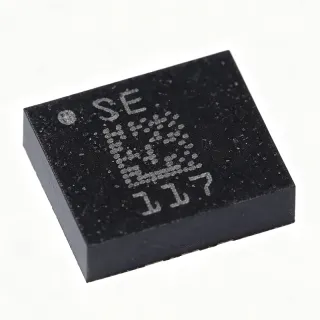
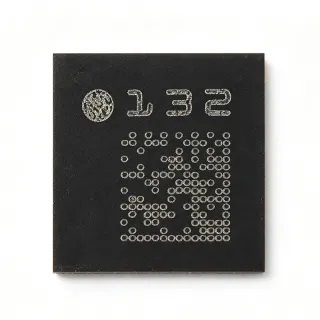
MMA6270Q - ±1.5g/2g/4g/6g Dual-Axis MEMS Accelerometer | NXP
N.º da peça: MMA6270Q ⚠ Última compra| Qtd. | Preço unitário | Total |
|---|---|---|
| 1 | $12.5 | $12,50 |
| 10 | $11.2 | $112,00 |
| 100 | $9.85 | $985,00 |
| 500 | $8.6 | $4.300,00 |
| 1.000 | $7.4 | $7.400,00 |
MMA6270Q Visão geral
An accelerometer is a MEMS sensor that converts mechanical acceleration into an analog voltage proportional to the applied inertial force, enabling motion, tilt, and vibration detection in electronic systems. As a low-g dual-axis part, the MMA6270Q sits in a hierarchy of MEMS sensors: accelerometer -> motion sensor -> inertial measurement unit (IMU) building block -> semiconductor sensor IC. The MMA6270Q integrates signal conditioning, a 1-pole low-pass filter, temperature compensation, and g-Select (logic-level sensitivity switching), which together replace the discrete op-amp chain that older discrete accelerometer circuits required.
Key features include four user-selectable sensitivity ranges (with sensitivity values of 740-860 mV/g at ±2g nominal, 555-645 mV/g at ±4g, 277.5-322.5 mV/g at ±1.5g, and 185-215 mV/g at ±6g), a low 1.5 mA maximum supply current, self-test capability, and a low-profile 16-pin QFN package that simplifies PCB layout. The g-Select pins (g-SEL1, g-SEL2) allow dynamic range selection at runtime, useful for applications that transition between high-motion and low-motion states.
Architecturally, the MMA6270Q uses a capacitive MEMS proof-mass with on-chip CMOS signal conditioning. The sensor's surface micromachined polysilicon structure forms differential capacitors that change capacitance proportionally to acceleration; these capacitances are read out through a charge-integrating front-end and converted to a ratiometric analog output centered at VDD/2 (approximately 1.65 V at 3.3 V supply). The ratiometric output scales automatically with supply voltage, simplifying ADC interface.
Typical applications include tilt sensing in consumer electronics, automotive body control modules, hard-disk drive freefall detection, vibration monitoring in appliances, and motion-activated user interfaces. The dual-axis X-Y configuration is well suited for 2-D tilt and gesture applications but not full 3-D inertial measurement, where a 3-axis part such as the MMA7261Q would be required instead.
When designing with the MMA6270Q, treat the analog outputs as low-impedance buffered rails rather than high-impedance nodes, and place the 0.1 µF bypass capacitor as close as possible to the VDD pin. Use g-Select pins either tied to logic levels through 100 kΩ resistors or driven by GPIO to avoid glitches during range transitions.
This page synthesizes DigiKey and Mouser pricing, NXP/Freescale datasheet specifications, and drop-in alternative analysis not found on any single distributor listing, including side-by-side parametric comparisons against the MMA6261Q, MMA6280Q, and MMA7261Q family members and pin-compatible ST/Analog Devices equivalents.
Alternativas drop-in para MMA6270Q — mesmo encapsulamento, compatível pino a pino. Peças de encapsulamento diferente que exigem retrabalho na PCB são excluídas.
Variantes desta série
Modelos da mesma série compatíveis como drop-in com MMA6270Q (mesmo formato e footprint) — diferindo em Output Type, Package, Sensor Type, RoHS Status, Acceleration Range.
Ferramenta de comparação rápida — selecione peças alternativas para comparação lado a lado:
MMA6270QT
✅ Drop-In✓ Em estoque
$4.35 / unidade
Ver ficha técnica →MMA6261Q
✅ Drop-In📋 Alternativa de referência (fora do catálogo)
MMA6280Q
✅ Drop-In ⚠️ Especificações não verificadas✓ Em estoque
$3.3 / unidade
Ver ficha técnica →MMA7261Q
✅ Drop-In ⚠️ Especificações não verificadas✓ Em estoque
$4.45 / unidade
Ver ficha técnica →MMA6271QT
✅ Drop-In✓ Em estoque
$5.05 / unidade
Ver ficha técnica →MMA6270Q Classificações máximas e características elétricas
| Tipo de sensor | Accelerometer, Dual-Axis (X, Y) |
| Technology | MEMS, Capacitive Micromachined |
| Acceleration Range | ±1.5g, ±2g, ±4g, ±6g (user selectable via g-Select) |
| Sensitivity (±2g) | 740 mV/g to 860 mV/g |
| Sensitivity (±4g) | 555 mV/g to 645 mV/g |
| Sensitivity (±1.5g) | 277.5 mV/g to 322.5 mV/g |
| Sensitivity (±6g) | 185 mV/g to 215 mV/g |
| Tipo de saída | Analog, Ratiometric (centered at VDD/2) |
| Bandwidth | 350 Hz (1-pole low-pass filter) |
| Tensão de alimentação | 2.2 V to 3.6 V |
| Corrente de alimentação | 1.5 mA max (typ 500 µA) |
| Self-Test | Yes (logic-level input) |
| g-Select Inputs | 2 (g-SEL1, g-SEL2, 4-state logic) |
| Temperatura de operação | -20 °C to +85 °C |
| Encapsulamento | 16-QFN (6 mm × 6 mm) [CASE 1631-01] |
| Tipo de montagem | Surface Mount |
| Status RoHS | RoHS Compliant |
| Lead-Free | Lead Free |
Configuração de pinos do MMA6270Q
| Pino 1 | g-SEL2 — g-Select input 2 (range selection logic; tie low or high per datasheet) |
| Pino 2 | g-SEL1 — g-Select input 1 (range selection logic; tie low or high per datasheet) |
| Pino 3 | ST — Self-Test input (drive high for MEMS electrostatic self-test) |
| Pino 4 | NC — Not connected (no internal bond; leave floating) |
| Pino 5 | NC — Not connected (no internal bond; leave floating) |
| Pino 6 | NC — Not connected (no internal bond; leave floating) |
| Pino 7 | NC — Not connected (no internal bond; leave floating) |
| Pino 8 | VDD — Power supply input (2.2 V to 3.6 V); decouple with 0.1 µF to GND |
| Pino 9 | GND — Common ground reference for analog outputs and supply return |
| Pino 10 | NC — Not connected (no internal bond; leave floating) |
| Pino 11 | YOUT — Y-axis analog output (ratiometric, centered at VDD/2) |
| Pino 12 | XOUT — X-axis analog output (ratiometric, centered at VDD/2) |
| Pino 13 | NC — Not connected (no internal bond; leave floating) |
| Pino 14 | NC — Not connected (no internal bond; leave floating) |
| Pino 15 | NC — Not connected (no internal bond; leave floating) |
| Pino 16 | NC — Not connected (no internal bond; leave floating) |
Aplicações típicas
MMA6270Q é adequado para 6 aplicaçãos: Hard-Drive Freefall Detection, 2-Axis Tilt Sensing (Consumer Electronics), Automotive Body Control Modules, Industrial Vibration Monitoring, Motion-Activated User Interfaces, Washing Machine Imbalance Detection.
Hard-Drive Freefall Detection
The MMA6270Q detects when a laptop or portable device begins to freefall, allowing the disk head to park before impact. It measures acceleration on both X and Y axes with selectable ±6g range best suited for impact/fall detection (185-215 mV/g sensitivity). The 350 Hz low-pass filter rejects high-frequency mechanical noise from chassis vibration while preserving the DC-to-low-frequency gravity signal. With a typical 500 µA supply current and 2.2-3.6 V supply range, it integrates cleanly into battery-powered designs. The X and Y outputs drive a comparator/ADC channel of the disk controller and trigger head park within milliseconds when 0g is sustained for a short window. Companion parts include the NXP MMA7261Q for designs needing full 3-axis coverage, and STMicroelectronics LIS3DH for newer lower-power designs.
Recomendado
2-Axis Tilt Sensing (Consumer Electronics)
The MMA6270Q's ratiometric analog output centered at VDD/2 maps directly to gravity (1g = ~800 mV at ±2g range), making it ideal for tilt and orientation sensing in remote controls, game controllers, and appliances. Selecting the ±1.5g range yields the highest sensitivity (277.5-322.5 mV/g) for fine tilt resolution, while the ±6g range supports shake and gesture modes. The dual-axis X-Y output drives a microcontroller ADC channel pair; designers tie g-Select pins to GPIO for runtime range switching between tilt and shake detection modes. Operating from 2.2-3.6 V, the part integrates into 3.3 V MCU rails without level translation. Companion parts include the NXP MMA8451Q digital-output 3-axis accelerometer for designs ready to drop the ADC, and the Freescale MPL3115A for altitude/pressure additions.
Recomendado
Automotive Body Control Modules
The MMA6270Q serves automotive body controllers for alarm/rollover detection, seat occupancy, and suspension leveling. Its dual-axis X-Y sensing detects lateral acceleration (important for vehicle stability events) and longitudinal events. Selectable g-ranges (±1.5g/±2g/±4g/±6g) let designers tune dynamic range in firmware. The 16-QFN package is qualified to automotive shock/vibration profiles per Freescale qualification data. The analog ratiometric output interfaces with legacy body controllers that already use ADC inputs; modern designs migrate to digital parts like the NXP MMA6855BKWR2 with SPI output. For new automotive designs AEC-Q100 qualified successors (MMA27xx family) are now preferred; the MMA6270Q remains acceptable in non-safety body-control applications.
Recomendado
Industrial Vibration Monitoring
The MMA6270Q monitors machine vibration in industrial equipment such as pumps, motors, and HVAC systems. It measures vibration along X and Y axes at a 350 Hz bandwidth that captures most mechanical fault signatures (imbalance at 1× RPM, misalignment at 2× RPM, bearing faults at higher harmonics). The selectable ±6g range handles most industrial vibration amplitudes. Analog outputs feed spectrum analyzer front-ends or MCUs running FFT algorithms for predictive maintenance. The wide supply tolerance (2.2-3.6 V) accommodates 3.3 V industrial backplanes, and the lead-free 16-QFN package withstands industrial reflow profiles. Companion parts include the STMicroelectronics LIS344ALH for higher-bandwidth vibration and the Analog Devices ADXL345 for digital-output vibration analysis.
Recomendado
Motion-Activated User Interfaces
Gesture recognition in smart appliances and IoT devices uses the MMA6270Q's dual-axis sensing to detect directional taps, shakes, and tilts. Selecting the ±6g range captures rapid gesture transients with 185-215 mV/g sensitivity. The two g-Select pins enable firmware to switch between ±1.5g (precision tilt detection) and ±6g (gesture detection) at runtime. The 500 µA supply current is acceptable for battery-powered smart-home remotes; standby current during idle periods drops to microampere levels by gating VDD. The 16-QFN form factor is small enough to fit inside handheld remote enclosures. Companion parts include the NXP FXLS8471Q for I²C/SPI digital interface and the STMicroelectronics LIS2DH for ultra-low-power gesture ICs.
Recomendado
Washing Machine Imbalance Detection
Appliance designers use the MMA6270Q in washing machines to detect drum imbalance during the high-speed spin cycle, which protects bearings and reduces noise/vibration. The dual-axis X-Y sensing measures centrifugal acceleration as the drum reaches unbalance; the ±6g range handles the high-g transients of an imbalanced load. The 350 Hz bandwidth captures the drum oscillation envelope while rejecting the high-frequency noise of motor commutation. Analog outputs feed the appliance microcontroller's ADC which controls motor RPM to redistribute laundry. The 16-QFN package handles the typical 85 °C operating environment of home appliances. Companion parts include NXP's MMA8451Q for digital-output smart appliances.
Recomendado
Resumo dos produtos recomendados
Dados de referência de engenharia para MMA6270Q — comparação, orientação de projeto e informações de conformidade.
Guia de seleção
Comparação com alternativas
| Parâmetro | Este produto | MMA6270QT | MMA6261Q | MMA6280Q | MMA7261Q | MMA6271QT |
|---|---|---|---|---|---|---|
| Brand | NXP Semiconductors | NXP Semiconductors | NXP Semiconductors | NXP Semiconductors | NXP Semiconductors | NXP Semiconductors |
| Package | 16-QFN (6x6) | 16-QFN (6x6) | 16-QFN (6x6) | 16-QFN (6x6) | 16-QFN (6x6) | 16-QFN (6x6) |
| Axes | X, Y (dual-axis) | X, Y | X, Y | X, Z (different orientation) | X, Y, Z (3-axis) | X, Y |
| Selectable g-Range | ±1.5g / ±2g / ±4g / ±6g (g-Select) | ±1.5g / ±2g / ±4g / ±6g (g-Select) | ±1.5g fixed (no g-Select) | ±1.5g / ±2g / ±4g / ±6g (g-Select) | ±2.5g / ±3.3g / ±6.7g / ±10g (g-Select) | ±1.5g / ±2g / ±4g / ±6g (g-Select) |
| Bandwidth | 350 Hz (1-pole LPF) | 350 Hz | 350 Hz | 350 Hz | 350 Hz | 350 Hz |
| Supply Voltage | 2.2 V to 3.6 V | 2.2 V to 3.6 V | 2.2 V to 3.6 V | 2.2 V to 3.6 V | 2.2 V to 3.6 V | 2.2 V to 3.6 V |
| Supply Current (typ) | 500 µA | 500 µA | 500 µA | 500 µA | 500 µA | 500 µA |
| Self-Test | Yes (logic input) | Yes | Yes | Yes | Yes | Yes |
| Output Type | Analog ratiometric (X, Y) | Analog ratiometric (X, Y) | Analog ratiometric (X, Y) | Analog ratiometric (X, Z) | Analog ratiometric (X, Y, Z) | Analog ratiometric (X, Y) |
Principais diferenciais
- Configurable dual-axis g-range without hardware rework (vs MMA6261Q)
- Dual-axis X-Y vs single-axis X-Z orientation (vs MMA6280Q)
- Higher dynamic range in 3-axis variant (vs MMA7261Q)
Notas de projeto
Power the MMA6270Q from a clean 2.2-3.6 V rail. Place a 0.1 µF X7R ceramic bypass capacitor within 5 mm of the VDD pin (pin 8) to GND to suppress supply noise. For designs where the supply comes from a switching regulator, add a 10 µF tantalum or polymer bulk capacitor near the device. The 500 µA typical supply current is constant across g-ranges, so budgeting for worst-case 1.5 mA maximum guarantees headroom during self-test and power-up transients.
Solder the 16-QFN exposed thermal pad to a continuous ground copper pour, both for thermal dissipation and for the internal substrate ground connection. The exposed pad must be electrically tied to GND per the datasheet; floating the pad will cause elevated noise and unstable offset. Route the X and Y analog outputs as differential-style guarded traces over a continuous ground plane, keeping them away from switching nodes and digital clocks. Use a 10-100 kΩ resistor in series with each analog output if the downstream ADC sample capacitor is large, to prevent charge-inject kickback.
Do not apply more than 3.6 V to VDD or leave it floating during board-level testing - both conditions can permanently damage the MEMS structure. Avoid g-Select pin mid-level (between defined logic-threshold zones): the datasheet specifies a precise logic-low/high band, and mid-band levels can cause the device to enter indeterminate range states that produce unexpected sensitivity. Last, the self-test pin should be pulsed (not held) high; long-duration ST activation is not specified and may invalidate the self-test diagnostic. Estimate: end-of-life safe-operating time at continuous ST-high is unspecified - keep ST pulses under 100 ms.
Informações de conformidade
RoHS compliant and lead-free per DigiKey and Freescale/NXP product page. REACH, AEC-Q100, halogen-free, and conflict-minerals declarations should be confirmed through NXP regulatory documentation portal for new production designs. The original Freescale-era datasheet does not include explicit AEC-Q100 qualification; MMA6270Q is generally used in consumer and non-safety industrial designs.