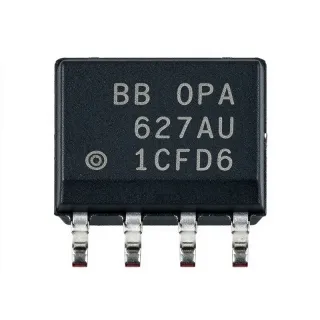
OPA602AU - 6.5MHz Precision Difet Op Amp, SOIC-8 | TI
N.º da peça: OPA602AU ✓ Ativo| Qtd. | Preço unitário | Total |
|---|---|---|
| 1 | $12.5 | $12,50 |
| 10 | $11.25 | $112,50 |
| 100 | $9.8 | $980,00 |
| 500 | $8.9 | $4.450,00 |
| 1.000 | $8.1 | $8.100,00 |
OPA602AU Visão geral
A precision operational amplifier is a type of analog signal-conditioning IC that amplifies small differential voltages while adding minimal DC error. Within the amplifier hierarchy, the op amp sits above general amplifiers and below full instrumentation amplifiers, which integrate multiple op amps plus laser-trimmed resistor networks. Precision op amps prioritize offset, drift, and bias current over raw speed, and the OPA602 is unusual in combining both.
Key features include unity-gain stability, fast settling to 0.01% for pulse and data-conversion applications, and low distortion across its 6.5 MHz bandwidth. The Difet process isolates FET input transistors with a dielectric layer, enabling high speed without the input leakage typical of junction-isolated FET processes.
Technically, laser trimming of the input circuitry yields offset and drift performance normally associated with precision bipolar amplifiers, while the FET input keeps bias current at the picoampere level, ideal for high-impedance sources. TI rates all specifications with a 1 kOhm resistor in parallel with a 500 pF load, and the device easily drives capacitive loads up to 1500 pF.
Typical applications include precision instrumentation, optoelectronics, and sonar/ultrasound signal chains, where fast settling and low DC error are simultaneously required. The OPA602AU is the -25C to +85C grade in the SOIC-8 package.
Design consideration: as a decompensated-speed FET amplifier at unity gain, always verify phase margin with large capacitive loads and use the offset trim pins (1 and 5) carefully, since trim range exceeds offset magnitude.
This page synthesizes distributor pricing, pin-compatible drop-in alternatives, and practical design notes not found in the manufacturer datasheet.
Alternativas drop-in para OPA602AU — mesmo encapsulamento, compatível pino a pino. Peças de encapsulamento diferente que exigem retrabalho na PCB são excluídas.
Variantes desta série
Modelos da mesma série compatíveis como drop-in com OPA602AU (mesmo formato e footprint) — diferindo em Package, Settling Time, Amplifier Type, Mounting Type, Slew Rate.
Ferramenta de comparação rápida — selecione peças alternativas para comparação lado a lado:
OPA627AU
✅ Drop-In ⚠️ Especificações não verificadas✓ Em estoque
$12.1 / unidade
Ver ficha técnica →OPA627BP
✅ Drop-In ⚠️ Especificações não verificadas✓ Em estoque
$21.3 / unidade
Ver ficha técnica →OPA637AU
✅ Drop-In ⚠️ Especificações não verificadas✓ Em estoque
$35.86 / unidade
Ver ficha técnica →OPA602BM
✅ Drop-In ⚠️ Especificações não verificadas📋 Alternativa de referência (fora do catálogo)
OPA602AU Classificações máximas e características elétricas
| Amplifier Type | High-Speed Precision Difet Operational Amplifier |
| Number of Channels | 1 |
| Bandwidth | 6.5 MHz |
| Slew Rate | 35 V/us |
| Input Offset Voltage (Max) | +/-250 uV |
| Input Bias Current (Max) | +/-1 pA |
| Settling Time (to 0.01%) | Fast settling, unity-gain stable |
| Capacitive Load Drive | up to 1500 pF |
| Rated Load Condition | 1 kOhm in parallel with 500 pF |
| Faixa de temperatura de operação | -25C to +85C |
| Encapsulamento | SOIC (D), 8 pins |
| Tipo de montagem | Surface Mount |
| Input Process Technology | Difet (dielectrically isolated FET), laser-trimmed |
| Stability | Unity-gain stable |
| Status RoHS | Compliant |
Configuração de pinos do OPA602AU
| Pino 1 | TRIM A — Offset null trim terminal A |
| Pino 2 | -IN — Inverting input |
| Pino 3 | +IN — Non-inverting input |
| Pino 4 | V- — Negative supply |
| Pino 5 | TRIM B — Offset null trim terminal B (trim pot to V-) |
| Pino 6 | OUT — Output |
| Pino 7 | V+ — Positive supply |
| Pino 8 | NC — Not connected (per datasheet) |
Aplicações típicas
OPA602AU é adequado para 6 aplicaçãos: Precision Instrumentation Front Ends, Optoelectronics / Photodiode Amplifiers, Sonar and Ultrasound Receive Chains, Data Acquisition and Pulse Amplification, Active Filters and Precision Integrators, Test and Measurement Equipment.
Precision Instrumentation Front Ends
The OPA602AU fits precision instrumentation signal chains that need both DC accuracy and fast settling, with +/-250 uV maximum offset, +/-1 pA maximum bias current, and 6.5 MHz bandwidth from the Difet process. In a transducer amplifier, the picoampere bias current keeps loading on high-impedance bridges and photodiode outputs negligible, while laser-trimmed offset minimizes system-level calibration requirements. Placed as the first gain stage ahead of a 16-bit or higher ADC, the amplifier settles to 0.01% fast enough for multiplexed channels and pulse-style sampling. The unity-gain stability and ability to drive 1500 pF make it tolerant of cable and filter capacitance on test-system inputs, and the offset trim pins allow fine zeroing of residual system offset during production calibration.
Recomendado
Optoelectronics / Photodiode Amplifiers
Photodiode and photomultiplier receivers benefit directly from the OPA602AU's +/-1 pA maximum bias current, which sets the theoretical floor of dark-current error, and its 6.5 MHz bandwidth, which supports megahertz-class optical data links and light detectors. The Difet input keeps current noise low at the large feedback resistors (1 MOhm to 1 GOhm) typical of transimpedance stages, so shot-noise-limited sensitivity is achievable. TI explicitly lists optoelectronics as a target application. In practice the part is wired as a transimpedance amplifier with the photodiode into the inverting input; the compensation capacitor is sized against diode capacitance, and the op amp's tolerance of capacitive loading helps with output cable capacitance. Operate within the -25C to +85C grade for stable dark-current behavior.
Recomendado
Sonar and Ultrasound Receive Chains
Sonar and ultrasound front ends are a datasheet-listed application for the OPA602: the 35 V/us slew rate and fast settling to 0.01% preserve pulse fidelity from transducer receive bursts, while the +/-250 uV maximum offset prevents baseline error in time-gain-compensation stages. A typical chain places the OPA602AU as a fixed-gain preamplifier immediately after the transducer matching network, exploiting unity-gain stability and 1500 pF load tolerance for filter and cable capacitance. The 6.5 MHz bandwidth covers most diagnostic-ultrasound receive bands, and low distortion across the band minimizes harmonic artifacts in imaging. For deeper front ends, pair it with a variable-gain amplifier stage and a fast ADC; the picoampere bias current also suits high-impedance hydrophone elements in sonar arrays.
Recomendado
Data Acquisition and Pulse Amplification
High-speed settling makes the OPA602AU a strong candidate for ADC drivers and pulse amplifiers in data-conversion systems: high slew rate and fast settling to 0.01% allow accurate signal processing in pulse and data-conversion applications, per the TI datasheet. Driving an ADC input, the amplifier recovers from input sampling glitches quickly, preserving accuracy at kHz-to-MHz sample rates. The low +/-1 pA bias current allows direct interface with high-impedance charge-integrator outputs, and the offset trim pins support system calibration. Because TI rates the device with 1 kOhm parallel 500 pF loading, RC anti-alias filters of that order on the ADC input are well within its drive capability, though an isolation resistor is recommended for larger capacitors to maintain phase margin.
Recomendado
Active Filters and Precision Integrators
Precision active filters, integrators, and log-amp front ends exploit the OPA602AU's picoampere bias current, which keeps integrator droop at femtoampere-second levels and prevents filter corner drift from input leakage. The 6.5 MHz bandwidth permits filters with corners well into the hundreds of kilohertz while retaining loop gain for accurate Q and gain definition, and low distortion preserves filter stopband performance. In an integrator, the Difet input means reset-switch charge injection dominates error rather than op amp bias, simplifying calibration. The unity-gain stability protects against oscillation in Sallen-Key topologies, and the ability to drive 1500 pF accommodates large filter capacitors directly. Use the offset trim pins to null residual integrator offset before calibration of the overall system.
Recomendado
Test and Measurement Equipment
Bench instruments, data-loggers, and automated-test channels use the OPA602AU as an input amplifier where a fast, accurate buffer in front of the measurement core is required. The combination of +/-250 uV maximum offset, +/-1 pA bias current, and fast settling to 0.01% supports both DC accuracy specifications and quick per-channel settling in multiplexed scanners. Its tolerance of 1500 pF capacitive loads makes it forgiving of probes, long cables, and relay-mux capacitance on instrument inputs. Within the -25C to +85C grade it covers typical laboratory environments, and offset trim supports factory calibration against traceable references. For output stages that must drive 50-Ohm systems, follow the OPA602AU with a BUF634-class buffer to keep the op amp within its thermal and load limits.
Recomendado
Resumo dos produtos recomendados
Dados de referência de engenharia para OPA602AU — comparação, orientação de projeto e informações de conformidade.
Guia de seleção
Comparação com alternativas
| Parâmetro | Este produto | OPA627AU | OPA627BP | OPA637AU | OPA602BM |
|---|---|---|---|---|---|
| Package | SOIC-8 (D) | SOIC-8 (D) - same | SOIC-8 (D) - same | SOIC-8 (D) - same | TO-99 metal can - differs |
| Brand | Texas Instruments | Texas Instruments | Texas Instruments | Texas Instruments | Texas Instruments |
| Bandwidth | 6.5 MHz | 16 MHz | 16 MHz | 80 MHz | 6.5 MHz |
| Slew Rate | 35 V/us | 55 V/us | 55 V/us | 135 V/us | 35 V/us |
| Stability | Unity-gain stable | Unity-gain stable | Unity-gain stable | Stable at gain >= 5 | Unity-gain stable |
| Bias Current Class | +/-1 pA max | pA class (FET) | pA class (FET) | pA class (FET) | +/-1 pA max (B grade tighter) |
| Performance Grade | A grade | A grade | B grade (tighter limits) | A grade | B grade (tighter limits) |
Principais diferenciais
- Unity-gain stability at 6.5 MHz bandwidth (vs OPA637AU)
- Lower cost for equivalent DC precision class (vs OPA627AU)
- Surface-mount SOIC-8 packaging (vs OPA602BM)
Notas de projeto
The OPA602AU is unity-gain stable and drives up to 1500 pF, but large capacitive loads combined with feedback-network capacitance can erode phase margin. If a larger load capacitor is present, add an isolation resistor (typically 50-100 Ohm) between OUT and the load, or place the capacitor inside the feedback loop of a transimpedance-style topology. TI rates all specifications with a 1 kOhm resistor in parallel with a 500 pF load, so designs near that loading are within validated conditions.
The +/-1 pA maximum bias current is only realized with proper guarding and board hygiene: leakage across the PCB can exceed the input current by orders of magnitude. Ring the +IN and -IN traces with guard rings driven from a low-impedance potential, clean flux thoroughly, and consider Teflon or lifted-lead connections for feedback resistors above 1 MOhm. Also note the offset trim range exceeds the +/-250 uV maximum offset - over-trimming injects trim-pot drift into the signal path, so trim minimally after thermal soak.
The OPA602AU is specified for operation on symmetrical supplies within its rated range; consult the TI datasheet table for absolute maximum supply before designing the rail. Decouple V+ and V- with 0.1 uF ceramics placed within a few millimeters of pins 7 and 4, plus 4.7-10 uF bulk per rail. Estimated: at quiescent current of a few milliamps and +/-15 V rails, self-heating is below 100 mW, so no thermal pad is required in the SOIC-8; verify at maximum output current into low-impedance loads.
Informações de conformidade
RoHS compliance per distributor listing; detailed REACH/halogen status should be confirmed on the TI product page.