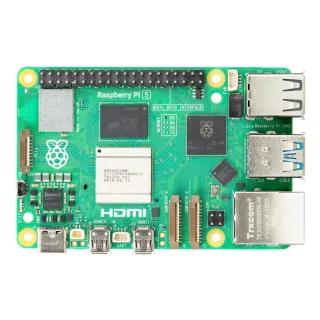
SC1112 - Raspberry Pi 5 8GB SBC, 2.4GHz Cortex-A76 | Raspberry Pi | Edge AI & IoT
N.º da peça: SC1112 ✓ Ativo| Qtd. | Preço unitário | Total |
|---|---|---|
| Fale conosco para preços por volume | ||
SC1112 Visão geral
A single-board computer (SBC) is a complete computer fabricated on a single printed circuit board, integrating processor, memory, storage I/O, and connectivity. The Raspberry Pi 5 sits at the top of the Raspberry Pi single-board computer family, which belongs to the broader category of embedded computers, and was developed by Raspberry Pi with its own in-house silicon (BCM2712), a first for the company.
Key features of the SC1112 include the 2.4GHz Cortex-A76 quad-core CPU, an 8GB memory configuration (a mid-tier option in the Raspberry Pi 5 series), and the standard 40-pin GPIO header for Hardware Attached on Top (HAT) expansion. Per the official Raspberry Pi product brief, the Pi 5 architecture enables two to three times the speed of other generations.
From a technical standpoint, the BCM2712 integrates four Arm Cortex-A76 cores, a high-performance Armv8.2-A-class microarchitecture, with a modern GPU subsystem and I/O fabric. The 8GB LPDDR4X memory pool is the defining differentiator of SC1112 versus the 2GB, 4GB, and 8GB variants, allowing larger working sets for in-memory data processing, multi-container edge deployments, and desktop-class multitasking.
Typical applications include edge AI inference and data logging, industrial IoT gateways, robotics control, and desktop-class computing where a compact, low-power Linux computer is required. The 40-pin GPIO header and broad OS support (Raspberry Pi OS, Ubuntu, and others) make it a strong fit for automation and prototyping.
A practical design consideration: the higher CPU and memory throughput of Raspberry Pi 5 increases sustained power draw versus Raspberry Pi 4; plan the 5V USB-C power supply and thermal management (heatsink or fan) according to the official Raspberry Pi documentation.
Beyond the datasheet, this page provides an SC1112 vs SC1111 (4GB) vs cross-brand SBC comparison, terminal-level 40-pin GPIO wiring reference, design notes, and sourcing information with prices refreshed as of 2026-09-13.
Alternativas drop-in para SC1112 — mesmo encapsulamento, compatível pino a pino. Peças de encapsulamento diferente que exigem retrabalho na PCB são excluídas.
Variantes desta série
Modelos da mesma série compatíveis como drop-in com SC1112 (mesmo formato e footprint) — diferindo em Processor, Form Factor, GPIO, Memory, OS Support.
Ferramenta de comparação rápida — selecione peças alternativas para comparação lado a lado:
SC1111
✅ Drop-In✓ Em estoque
$68.56 / unidade
Ver ficha técnica →SC1110
✅ Drop-In ⚠️ Especificações não verificadas📋 Alternativa de referência (fora do catálogo)
SC1113
✅ Drop-In ⚠️ Especificações não verificadas✓ Em estoque
Consulte o preço
Ver ficha técnica →ORANGEPI5-16G
⚡ Mesmo encapsulamento ⚠️ Especificações não verificadas📋 Alternativa de referência (fora do catálogo)
CM5102032
⚡ Mesmo encapsulamento ⚠️ Especificações não verificadas📋 Alternativa de referência (fora do catálogo)
SC1112 Especificações (publicadas pelo fabricante)
| Product Series | Raspberry Pi 5 |
| MPN | SC1112 |
| Memory Capacity | 8GB |
| Processor | 64-bit quad-core Arm Cortex-A76, 2.4 GHz (Broadcom BCM2712) |
| CPU Performance | 2-3x increase in CPU performance compared to Raspberry Pi 4 |
| Form Factor | Full-size Raspberry Pi SBC, 85.6 x 56.5 mm |
| SoC Origin | In-house designed silicon (Raspberry Pi RP1/BCM2712 platform) |
| GPIO | Standard 40-pin GPIO header |
| OS Support | Raspberry Pi OS, Ubuntu, and other Linux distributions |
Configuração de pinos do SC1112
| Pino 1 | 3V3 — 3.3V power rail for HATs and peripherals |
| Pino 2 | 5V — 5V power rail directly from the supply |
| Pino 3 | GPIO2 (SDA1) — I2C1 data line |
| Pino 4 | 5V — 5V power rail |
| Pino pin 5 | GPIO3 (SCL1) — I2C1 clock line |
| Pino 6 | GND — Ground |
| Pino 8 | GPIO14 (TXD) — UART transmit |
| Pino 10 | GPIO15 (RXD) — UART receive |
| Pino 19 | GPIO10 (MOSI) — SPI0 master-out/slave-in |
| Pino 21 | GPIO9 (MISO) — SPI0 master-in/slave-out |
| Pino 23 | GPIO11 (SCLK) — SPI0 serial clock |
| Pino 27 | GPIO0 (ID_SD) — HAT EEPROM ID data (I2C0) |
Aplicações típicas
SC1112 é adequado para 6 aplicaçãos: Edge AI Inference, Industrial IoT Gateway, Desktop Computing / Thin Client, Robotics Control, Home Media Server / NAS, Test & Measurement / Data Logger.
Edge AI Inference
The SC1112's 2.4GHz quad-core Cortex-A76 and 8GB memory pool make it well suited to running compact neural network models such as MobileNet-class image classifiers or object detection pipelines directly on the device. The 8GB capacity allows larger model weights and input buffers to reside in RAM, and the 40-pin GPIO header connects sensors and actuators for closed-loop vision systems. Per the official Raspberry Pi documentation, the Pi 5's CPU uplift of two to three times over Raspberry Pi 4 translates directly into faster per-frame inference for CPU-bound workloads.
Recomendado
Industrial IoT Gateway
As an industrial IoT gateway, the Raspberry Pi 5 8GB aggregates fieldbus, Modbus, and MQTT traffic between shop-floor sensors and cloud platforms. The 8GB memory supports multiple containerized protocol converters running side by side, while the 40-pin GPIO header interfaces with relay and sensor HATs. Ethernet networking plus the standard Raspberry Pi OS toolchain shortens integration time versus bespoke gateways. Use a DIN-rail enclosure and industrial-grade power supply for field deployment, and verify the exact Ethernet and wireless specifications in the official Raspberry Pi 5 documentation.
Recomendado
Desktop Computing / Thin Client
The Raspberry Pi 5 SC1112 serves as a low-power desktop computer or thin client for office, education, and digital-signage environments. Its 8GB RAM comfortably supports web browsing with many tabs, office productivity suites, and multi-monitor desktop sessions. Per the official Raspberry Pi product brief, the Pi 5 was engineered in-house for full-size desktop-class use with two to three times the CPU performance of Raspberry Pi 4. For best results, pair it with the official power supply and an active cooler to sustain peak CPU clocks under desktop load.
Recomendado
Robotics Control
Robotics platforms benefit from the SC1112's combination of compute and I/O: the quad-core Cortex-A76 runs ROS 2 nodes, sensor fusion, and path-planning while the 40-pin GPIO header drives motor controllers and reads encoders. The 8GB memory pool holds map data and vision pipelines without swapping. The broad Raspberry Pi accessory ecosystem - camera modules, servo HATs, and motor driver boards - integrates with standard Raspberry Pi OS images. Estimated: CPU headroom of 2-3x over Raspberry Pi 4 allows real-time control loops to coexist with perception stacks on one board.
Recomendado
Home Media Server / NAS
With 8GB of RAM and desktop-class CPU performance, the Raspberry Pi 5 SC1112 operates as a home media server, network-attached storage frontend, or Plex/Jellyfin host. Memory buffering smooths transcode bursts and multi-client streaming, and the Pi 5's in-house silicon provides modern I/O bandwidth for external storage. Consult the official Raspberry Pi 5 documentation for exact USB and storage interface capabilities, which are not detailed in the data on this page. Add an SSD via the appropriate interface rather than relying on SD card storage for sustained read/write media workloads.
Recomendado
Test & Measurement / Data Logger
The SC1112 functions as a networked data acquisition and logging node: high-rate sensor sampling over the GPIO/serial interfaces with local buffering in the 8GB memory, then batch upload to a historian or cloud database. The 2.4GHz Cortex-A76 sustains timestamping and preprocessing that earlier Raspberry Pi models offloaded to a PC. Using Python and the standard Raspberry Pi OS stack, engineers can deploy logging pipelines quickly, and the standard form factor fits existing Raspberry Pi 4 enclosures and HAT stacks. Estimated: the Pi 5 generation's performance uplift reduces sample-dropout risk versus Raspberry Pi 4 at equivalent sampling rates.
Recomendado
Resumo dos produtos recomendados
Dados de referência de engenharia para SC1112 — comparação, orientação de projeto e informações de conformidade.
Guia de seleção
Comparação com alternativas
| Parâmetro | Este produto | SC1111 | SC1113 | ORANGEPI5-16G |
|---|---|---|---|---|
| Package / Form Factor | Full-size Raspberry Pi 5, 85.6 x 56.5 mm, 40-pin GPIO | identical Raspberry Pi 5 form factor | identical Raspberry Pi 5 form factor | ~85 x 56 mm, different connector layout |
| Brand | Raspberry Pi | Raspberry Pi | Raspberry Pi | Orange Pi (Shenzhen Xunlong) |
| RAM | 8GB | 4GB | 16GB | 16GB |
| CPU | 64-bit quad-core Arm Cortex-A76, 2.4 GHz (BCM2712) | same quad-core Cortex-A76, 2.4 GHz | same quad-core Cortex-A76, 2.4 GHz | Rockchip RK3588S octa-core |
| GPIO Header | Standard 40-pin Raspberry Pi GPIO | Standard 40-pin (identical) | Standard 40-pin (identical) | 40-pin, different pin mapping |
| OS Ecosystem | Raspberry Pi OS (primary), Ubuntu, other Linux | identical | identical | Armbian/Debian-based images |
| Drop-in Compatibility with SC1112 | - | Yes - same board, RAM only differs | Yes - same board, RAM only differs | No - functional alternative only |
Principais diferenciais
- 8GB memory, a mid-tier Raspberry Pi 5 configuration (vs SC1111 (4GB))
- 2-3x CPU performance over Raspberry Pi 4 via 2.4GHz Cortex-A76 (vs Raspberry Pi 4 series)
- Drop-in mechanical compatibility across the Pi 5 series (vs SC1111 / SC1113 / SC1110)
- Full-size ecosystem vs module form factor (vs CM5102032 (Compute Module 5))
Notas de projeto
The Raspberry Pi 5 generation draws more power under sustained CPU load than Raspberry Pi 4 due to the 2.4GHz Cortex-A76 cores and higher memory bandwidth. Use the official Raspberry Pi 5 power supply (5V USB-C) rated per the official Raspberry Pi 5 documentation, and avoid underspecified phone chargers: brownouts under peak load are a leading cause of SD card filesystem corruption on Pi-class boards. When powering via a HAT or backplane, ensure the 5V rail can carry the combined load of the board plus peripherals.
Estimated: the Pi 5's higher sustained CPU power versus Pi 4 means passive cooling alone may not sustain peak 2.4GHz clocks in enclosed spaces. Plan for the official Raspberry Pi Active Cooler or a heatsink with airflow for continuous heavy workloads such as AI inference or transcoding. Verify ambient temperature derating against the official documentation before finalizing enclosure design.
Note that 'SC1112' is shared with an unrelated Semtech triple linear controller IC (visible on aggregator sites such as alldatasheet.com). When sourcing, always qualify the part with the brand 'Raspberry Pi' and the descriptor 'Raspberry Pi 5 16GB' to avoid receiving the wrong component. Also verify 40-pin GPIO function changes from Raspberry Pi 4 before reusing existing HATs, and consult the official Raspberry Pi 5 documentation for pin function updates.
The SC1112 retains the full-size Raspberry Pi form factor, so enclosures, HAT stacking hardware, and DIN-rail brackets designed for Raspberry Pi 4 generally fit mechanically. Confirm clearance for the taller Pi 5 components and active cooler in tight enclosures, and use standoffs to prevent GPIO header stress from cable pull.
Informações de conformidade
Compliance declarations for SC1112 are not included in the provided verified data. Raspberry Pi publishes Declarations of Conformity (CE/UKCA and similar) on its official compliance documentation pages; obtain the current declarations directly from Raspberry Pi before specifying in regulated products.