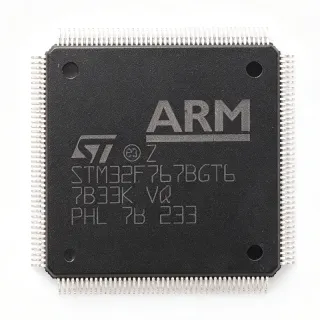
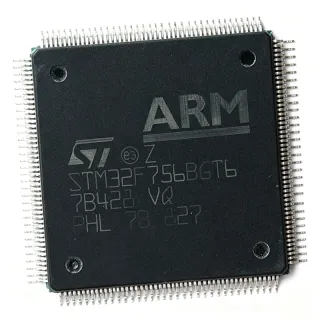
STM32F746BET6 - 216MHz Cortex-M7 MCU, 512KB Flash | STMicroelectronics
N.º da peça: STM32F746BET6 ✓ Ativo| Qtd. | Preço unitário | Total |
|---|---|---|
| 1 | $22.29 | $22,29 |
| 10 | $20.06 | $200,60 |
| 100 | $17.83 | $1.783,00 |
| 500 | $16.05 | $8.025,00 |
| 1.000 | $14.49 | $14.490,00 |
STM32F746BET6 Visão geral
A microcontroller (MCU) is a compact integrated circuit designed to govern a specific operation in an embedded system. It contains a processor core, memory, and programmable input/output peripherals on a single chip. The STM32F7 series represents the high-performance tier of STMicroelectronics' STM32 family, positioned above the mainstream F4 series and the low-power L4 series. Within the STM32F7 family, the STM32F746 is a flagship model offering a rich set of connectivity and multimedia features, including a TFT-LCD controller, a camera interface, and an Ethernet MAC.
Key features of the STM32F746BET6 include the 216 MHz Cortex-M7 core with double-precision FPU, a Chrom-ART Accelerator for 2D graphics, an L1 cache (I-Cache and D-Cache), and support for external SDRAM. The device also integrates a comprehensive set of peripherals: multiple USARTs, SPIs, I2Cs, a USB 2.0 OTG HS/FS, an Ethernet MAC, a camera interface, and a 12-bit ADC with up to 24 channels. The TFT-LCD controller supports up to XGA resolution, enabling rich graphical user interfaces.
From a technical architecture perspective, the Cortex-M7 core is a 6-stage, dual-issue pipeline processor that delivers 2.14 CoreMark/MHz, significantly outperforming the Cortex-M4. The Chrom-ART Accelerator offloads 2D graphics operations from the CPU, freeing processing power for application tasks. The L1 cache reduces latency for frequently accessed code and data, improving overall system performance. The device also includes a memory protection unit (MPU) and a Nested Vectored Interrupt Controller (NVIC) for efficient interrupt handling.
Typical applications for the STM32F746BET6 include industrial control systems, motor drives, home automation, smart appliances, audio processing, and human-machine interfaces (HMIs). Its combination of high CPU performance, rich connectivity, and graphics capabilities makes it ideal for applications requiring real-time control and advanced user interfaces. For example, in an industrial HMI, the TFT controller and Chrom-ART Accelerator enable smooth rendering of complex dashboards, while the Ethernet MAC provides connectivity to factory networks.
When designing with this device, ensure adequate decoupling of the power supply pins with 100nF and 4.7uF capacitors placed close to the VDD pins. The VDDA pin must be connected to a clean analog supply, and the VCAP pins require a 2.2uF capacitor for the internal voltage regulator. For high-speed interfaces like Ethernet and USB, follow the layout guidelines in the STM32F7 hardware development application note (AN4666) to ensure signal integrity.
Alternativas drop-in para STM32F746BET6 — mesmo encapsulamento, compatível pino a pino. Peças de encapsulamento diferente que exigem retrabalho na PCB são excluídas.
Variantes desta série
Modelos da mesma série compatíveis como drop-in com STM32F746BET6 (mesmo formato e footprint) — diferindo em Core, Flash Memory, Mounting Type, SRAM.
Ferramenta de comparação rápida — selecione peças alternativas para comparação lado a lado:
STM32F746BGT6
✅ Drop-In ⚠️ Especificações não verificadas✓ Em estoque
$11.05 / unidade
Ver ficha técnica →STM32F746BET7
✅ Drop-In ⚠️ Especificações não verificadas📋 Alternativa de referência (fora do catálogo)
STM32F746BET6TR
✅ Drop-In ⚠️ Especificações não verificadas📋 Alternativa de referência (fora do catálogo)
STM32F746BET6 Classificações máximas e características elétricas
| Core | ARM Cortex-M7 with FPU |
| Frequência máxima de clock | 216 MHz |
| Flash Memory | 512 KB |
| SRAM | 256 KB |
| Largura do barramento de dados | 32-bit |
| Supply Voltage Range | 1.8V to 3.6V |
| Encapsulamento | 208-LQFP (28x28 mm) |
| Tipo de montagem | Surface Mount |
| Number of I/O Pins | 168 |
| ADC Resolution | 12-bit |
| ADC Channels | 24 |
| DAC Resolution | 12-bit |
| DAC Channels | 2 |
| Faixa de temperatura de operação | -40C to +85C |
| Status RoHS | Compliant |
Configuração de pinos do STM32F746BET6
| Pino 1 | PE2 — General-purpose I/O or TRACECLK |
| Pino 10 | PE3 — General-purpose I/O or TRACED0 |
| Pino 20 | VDD — Digital power supply |
| Pino 30 | VSS — Digital ground |
| Pino 40 | PC14 — General-purpose I/O or OSC32_IN |
| Pino 50 | PC15 — General-purpose I/O or OSC32_OUT |
| Pino 60 | PH0 — General-purpose I/O or OSC_IN |
| Pino 70 | PH1 — General-purpose I/O or OSC_OUT |
| Pino 80 | NRST — Reset (active low) |
| Pino 90 | VDDA — Analog power supply |
| Pino 100 | VSSA — Analog ground |
| Pino 110 | PA0 — General-purpose I/O or ADC_IN0 |
| Pino 120 | PA1 — General-purpose I/O or ADC_IN1 |
| Pino 130 | PB2 — General-purpose I/O or BOOT1 |
| Pino 140 | PC0 — General-purpose I/O or ADC_IN10 |
| Pino 150 | PD0 — General-purpose I/O or FMC_D2 |
| Pino 160 | PE0 — General-purpose I/O or FMC_NBL0 |
| Pino 170 | PF0 — General-purpose I/O or FMC_A0 |
| Pino 180 | PG0 — General-purpose I/O or FMC_A10 |
| Pino 190 | PH2 — General-purpose I/O or FMC_SDCKE0 |
| Pino 200 | PI0 — General-purpose I/O or FMC_D16 |
| Pino 208 | VDD — Digital power supply |
Aplicações típicas
STM32F746BET6 é adequado para 6 aplicaçãos: Industrial Control Systems, Human-Machine Interface (HMI), Audio Processing, Smart Home Automation, Medical Devices, Networking and Communication.
Industrial Control Systems
The STM32F746BET6 is ideal for industrial control systems due to its high-performance Cortex-M7 core running at 216 MHz, which provides the computational power needed for complex control algorithms. The device integrates multiple timers, a 12-bit ADC with 24 channels, and communication interfaces like Ethernet and CAN, enabling precise motor control, process automation, and real-time monitoring. In a typical motor drive application, the MCU reads current and position sensors via the ADC, executes a field-oriented control (FOC) algorithm, and generates PWM signals to drive the inverter. The Ethernet MAC allows for remote monitoring and diagnostics, while the L1 cache ensures low-latency execution of time-critical code. The industrial temperature range (-40C to +85C) and robust peripheral set make it a reliable choice for factory automation equipment.
Recomendado
Human-Machine Interface (HMI)
The STM32F746BET6 excels in HMI applications thanks to its integrated TFT-LCD controller and Chrom-ART Accelerator, which offload 2D graphics rendering from the CPU. This allows for smooth, responsive user interfaces with high-resolution displays. The device supports up to XGA resolution and can drive TFT panels directly, reducing the need for external graphics controllers. In a typical HMI design, the MCU renders dashboards, charts, and touch controls on an LCD, while the capacitive touch controller (e.g., STMPE811) interfaces via I2C. The Ethernet MAC enables remote updates and data visualization, and the large flash memory (512 KB) provides ample space for GUI assets. The high CPU performance ensures that even complex animations run smoothly, making it suitable for smart appliances, industrial panels, and medical devices.
Recomendado
Audio Processing
The STM32F746BET6 is well-suited for audio processing applications due to its high-speed Cortex-M7 core with DSP instructions and FPU, which can handle real-time audio algorithms such as filtering, equalization, and audio codecs. The device includes multiple I2S interfaces for connecting to audio codecs and DACs, and a SAI (Serial Audio Interface) for multi-channel audio. In a typical audio application, the MCU reads audio data from an I2S microphone or codec, processes it with DSP routines, and outputs the result via I2S to a DAC or amplifier. The high clock speed (216 MHz) ensures low latency, and the large SRAM (256 KB) can buffer audio samples. The Chrom-ART Accelerator can also be used for audio visualizations on a connected display. This makes it ideal for smart speakers, audio mixers, and voice-controlled devices.
Recomendado
Smart Home Automation
The STM32F746BET6 is a powerful choice for smart home automation hubs, offering a rich set of connectivity options including Ethernet, USB, and multiple UARTs/SPIs/I2Cs for interfacing with various sensors and actuators. The high-performance core can handle complex protocols like Zigbee, Z-Wave, or Thread via external transceivers, while the TFT-LCD controller enables a local touchscreen interface for user control. In a typical smart home hub, the MCU aggregates data from temperature, humidity, and motion sensors, controls lighting and HVAC systems, and communicates with cloud services via Ethernet or Wi-Fi (through an external module). The large flash memory allows for storing configuration data and logs. The device's low-power modes help reduce energy consumption in always-on applications, making it suitable for energy-efficient smart home devices.
Recomendado
Medical Devices
The STM32F746BET6 is suitable for medical devices that require high performance and reliability, such as patient monitors, infusion pumps, and diagnostic equipment. The Cortex-M7 core with FPU can handle complex signal processing algorithms for ECG, EEG, or blood pressure analysis. The device includes a 12-bit ADC with 24 channels for acquiring analog sensor data, and multiple communication interfaces for transmitting data to a central monitoring system. The TFT-LCD controller can display vital signs in real-time, and the Ethernet MAC enables network connectivity for remote patient monitoring. The industrial temperature range and robust design make it reliable for continuous operation. In a patient monitor, the MCU reads ECG signals via the ADC, processes them with digital filters, and displays the waveform on an LCD, while also sending alerts via Ethernet or USB.
Recomendado
Networking and Communication
The STM32F746BET6 is well-suited for networking and communication applications due to its integrated Ethernet MAC, USB 2.0 OTG, and multiple communication interfaces. The high-performance Cortex-M7 core can handle network protocol stacks like TCP/IP, and the large SRAM (256 KB) provides buffer space for network packets. In a typical application, the MCU acts as a gateway between different communication protocols, such as Ethernet to serial or USB to CAN. The device can also be used in industrial IoT gateways, where it collects data from sensors via UART/SPI/I2C and forwards it to the cloud via Ethernet or Wi-Fi (through an external module). The Chrom-ART Accelerator can be used for network status visualization on a local display. The device's rich connectivity and high performance make it ideal for routers, gateways, and protocol converters.
Recomendado
Resumo dos produtos recomendados
Dados de referência de engenharia para STM32F746BET6 — comparação, orientação de projeto e informações de conformidade.
Guia de seleção
Comparação com alternativas
| Parâmetro | Este produto | STM32F746BGT6 | STM32F746BET7 | STM32F746VGT6 | GD32F750ZIT6 |
|---|---|---|---|---|---|
| Package | 208-LQFP (28x28 mm) | 208-LQFP (28x28 mm) - same | 208-LQFP (28x28 mm) - same | 100-LQFP (14x14 mm) - different | 144-LQFP (20x20 mm) - different |
| Brand | STMicroelectronics | STMicroelectronics | STMicroelectronics | STMicroelectronics | GigaDevice |
| Core | ARM Cortex-M7 | ARM Cortex-M7 | ARM Cortex-M7 | ARM Cortex-M7 | ARM Cortex-M7 |
| Maximum Clock Frequency | 216 MHz | 216 MHz | 216 MHz | 216 MHz | 200 MHz |
| Flash Memory | 512 KB | 1 MB | 512 KB | 512 KB | 512 KB |
| SRAM | 256 KB | 320 KB | 256 KB | 256 KB | 256 KB |
| Number of I/O Pins | 168 | 168 | 168 | 82 | 114 |
| TFT-LCD Controller | Yes | Yes | Yes | Yes | Yes |
| Ethernet MAC | Yes | Yes | Yes | Yes | Yes |
| Operating Temperature Range | -40C to +85C | -40C to +85C | -40C to +105C | -40C to +85C | -40C to +85C |
Principais diferenciais
- Higher flash memory option (vs STM32F746BGT6)
- Extended temperature range option (vs STM32F746BET7)
- More I/O pins and larger package (vs STM32F746VGT6)
Notas de projeto
The STM32F746BET6 requires a clean power supply. Connect a 100nF ceramic capacitor and a 4.7uF capacitor to each VDD pin, placed as close to the pin as possible. The VDDA pin must be connected to a clean analog supply, and a 1uF capacitor should be placed between VDDA and VSSA. The VCAP pins require a 2.2uF capacitor for the internal voltage regulator. Refer to the STM32F7 hardware development application note (AN4666) for detailed power supply design guidelines.
For high-speed interfaces like Ethernet and USB, follow the layout guidelines in AN4666. Keep differential pairs (e.g., USB D+/D-) matched in length and impedance (90 ohms for USB). For the Ethernet PHY interface, use a 50-ohm controlled impedance for the TX/RX pairs. Place the crystal oscillator (HSE) close to the PH0/PH1 pins and keep the load capacitors (typically 20pF) within 5mm of the crystal. Avoid routing high-speed signals near the crystal to prevent interference.
The STM32F746BET6 in a 208-LQFP package has a thermal resistance (theta_JA) of approximately 40 C/W. At 216 MHz with all peripherals active, the power dissipation can reach 500mW, resulting in a temperature rise of 20C above ambient. Ensure adequate airflow or a thermal pad connected to a copper pour on the PCB to keep the junction temperature within the specified range. For high-temperature environments, consider the STM32F746BET7 variant with an extended temperature range.
Informações de conformidade
RoHS compliant per STMicroelectronics product page. Not AEC-Q100 qualified - choose STM32F746BET7 for extended temperature range, but it is not automotive qualified either.