Товары (38.000+)

PIC16F1936-I/SO - 8-Bit 32MHz 14KB Flash MCU w/ LCD | Microchip
PIC16F1936-I/SO

PIC16F1936-I/SO - 8-Bit 32MHz 14KB Flash MCU w/ LCD | Microchip

The Microchip PIC16F1936-I/SO is an 8-bit PIC16 microcontroller built on the enhanced mid-range RISC core with nanoWatt XLP (eXtreme Low Power) technology, delivering up to 32 MHz CPU clock, 14 KB Flash program memory and 512 bytes RAM in a 28-pin SOIC package. The device integrates a segmented LCD controller with charge pump, a 10-bit ADC, and the standard PIC16F peripheral set (USART, SPI, I2C), making it a single-chip solution for battery-powered instruments and display-driven user interfaces. What is a PIC16F microcontroller? The PIC16F family is Microchip's enhanced mid-range 8-bit RISC microcontroller line, positioned between the baseline PIC10/12/16 and the high-performance PIC18/PIC24 families. PIC16F devices use a Harvard architecture with a single accumulator (W register) and a 14-bit instruction word, which delivers deterministic 200 ns instruction execution at 32 MHz, plus nanoWatt XLP sleep modes that drop current consumption below 50 nA in real-world designs. Within the broader taxonomy: PIC16F1936 is a member of the PIC16F193x sub-family that adds on-chip LCD driver support — a feature largely absent from other PIC16F sub-families such as PIC16F188xx. This makes it the closest functional match for legacy PIC16F917/PIC16F946 sockets. Key specifications include 25 I/O pins (out of 28 package pins), 11 analog-capable channels (10-bit ADC), 2 comparators, a 32 kHz internal oscillator plus 16 MHz HFINTOSC with PLL, and 256 bytes of EEPROM. The device operates from 2.3 V to 5.5 V across the industrial -40 °C to +85 °C range (the "I" suffix), with low-power modes including Sleep (~50 nA typical), Watchdog Timer (~1 μA) and a real-time clock current under 1 μA. The integrated segmented LCD driver supports up to 96 segments with software-controlled contrast and charge pump. Architecturally, the PIC16F1936 combines a programmable 32-level hardware stack, three timer modules (Timer0/1/2), two CCP modules, and an EUSART with auto-baud detect. Memory includes 14 KB self-programmable Flash (10,000 erase/write cycles endurance), 512 bytes SRAM, and 256 bytes EEPROM. The on-chip LCD driver supports static, 1/2, 1/3 and 1/4 multiplex with up to 64 segment outputs (32 commons × 8 segments in some pin combinations), enabling direct connection to glass displays without an external charge pump or bias resistors. Typical applications include battery-powered metering (electricity/water/gas), consumer appliances with segment LCD displays, medical devices (glucometers, thermometers), industrial control panels with text or numeric LCD readouts, and IoT sensor hubs that require a local LCD for status. The 32 MHz CPU plus nanoWatt XLP also suits low-duty-cycle edge nodes that spend most of their time in Sleep and wake periodically to sample and update the display. When designing with this part, select the device variant carefully: "I" denotes industrial temperature grade (-40 °C to +85 °C); "E" denotes extended (-40 °C to +125 °C); and the trailing "SO" suffix indicates the 28-pin SOIC package. Engineers seeking the same die in other packages can use PIC16F1936-I/SS (28-pin SSOP), PIC16F1936-I/SP (28-pin SPDIP), PIC16F1936-I/ML (28-pin QFN) or PIC16F1936-I/MV (28-pin UQFN), all of which share the same pinout. This page synthesizes distributor pricing, drop-in package variants, application-circuit companions, and design notes not bundled in the manufacturer datasheet.

Запрос цены Контакты
PIC16F1936-I/SP - 8-bit XLP MCU 14KB Flash LCD 28-SPDIP | Microchip
PIC16F1936-I/SP

PIC16F1936-I/SP - 8-bit XLP MCU 14KB Flash LCD 28-SPDIP | Microchip

The Microchip PIC16F1936-I/SP is an 8-bit enhanced mid-range CMOS flash microcontroller in the PIC® XLP™ 16F family, delivering 32 MHz CPU performance with 200 ns instruction execution, 14 KB Flash program memory, 512 bytes RAM, and 256 bytes EEPROM, housed in a 28-pin SPDIP package. The device integrates an LCD driver supporting up to 96 segments, a 10-bit ADC, multiple capture/compare/PWM modules, and the nanoWatt XLP extreme-low-power technology that drops quiescent current below 50 nA in sleep mode. According to the Microchip product page, the PIC16F1936 family is intended for battery-friendly human-machine interface designs where LCD display, analog sensing, and long battery life co-exist on a single chip. A PIC microcontroller (Programmable Interface Controller) is a Harvard-architecture RISC microprocessor with separate program and data buses, flash memory, and on-chip peripherals, widely used in embedded control applications. The PIC16F1936 belongs to the enhanced mid-range PIC16 family, one tier below PIC18 and PIC24, and one tier above the baseline PIC10/12/16. This category sits within the broader microcontroller hierarchy (microcontroller -> 8-bit MCU -> PIC16 -> enhanced mid-range -> XLP nanoWatt), making it a strong fit for cost-sensitive, low-power, LCD-equipped appliances. Key differentiating features include the integrated LCD driver with charge pump and contrast control, core-independent peripherals such as the Configurable Logic Cell (CLC), Complementary Waveform Generator (CWG), and Numerically Controlled Oscillator (NCO), plus the eXtreme Low Power (XLP) sleep mode drawing under 50 nA. The 28-pin SPDIP footprint exposes 25 GPIO lines, of which many are multiplexed with ADC, comparator, SPI, I2C, and UART peripherals, giving designers flexible pin mapping for sensor and user-interface boards. Architecturally, the device uses a 14-bit instruction word with a hardware stack of 16 levels and 35 instructions, combined with a wide peripheral set including 5 CCP/ECCP modules, an enhanced USART, MSSP for SPI/I2C, and a 16-level deep hardware stack. The 10-bit ADC delivers up to 17 channels with acquisition time configurable in software. The integrated LCD controller supports static, 1/2, 1/3, and 1/4 multiplexed glass with internal charge pump, eliminating the need for an external LCD bias supply in most designs. Typical applications include battery-powered consumer appliances with LCD readouts (coffee machines, kitchen scales, thermostats), industrial sensor transmitters with display feedback, and low-power IoT edge nodes that wake periodically to read sensors and update a segment display. Designers also use this part in medical handheld meters and HVAC control panels where a single chip must drive a glass LCD, scan buttons, and run low-power wireless protocols. A key design consideration is brown-out voltage selection: the PIC16F1936-I/SP supports BOR and LPBOR down to 1.8 V, which is critical for 2-cell alkaline or single-cell Li coin battery stacks. Always reserve the ICSP/ICD pins (RB6/RB7) for in-circuit programming and debugging, even in production layouts. This page synthesizes distributor pricing, drop-in alternative MPNs, and practical design notes not found on any single manufacturer or distributor page.

Запрос цены Контакты
PIC16F1936T-I/ML - 14KB Flash 8-Bit MCU 28-QFN | Microchip
PIC16F1936T-I/ML

PIC16F1936T-I/ML - 14KB Flash 8-Bit MCU 28-QFN | Microchip

The Microchip PIC16F1936T-I/ML is an 8-bit PIC microcontroller from the PIC® XLP™ 16F family with 14KB (8K x 14) of Flash program memory, 32 MHz CPU clock, and integrated LCD driver, packaged in a 28-pin QFN (6x6 mm). It operates from 1.8V to 5.5V and is qualified to the industrial -40C to +85C temperature range. The 'T' suffix indicates Tape & Reel packaging, 'I' denotes industrial temperature grade, and '/ML' denotes the QFN-28 (6x6) lead-free package. An 8-bit microcontroller (MCU) is a single-chip computer that integrates a CPU, program memory (Flash), data RAM, EEPROM, peripherals (timers, ADC, communication, I/O), and interrupt logic onto one die. The PIC16F core uses a modified Harvard RISC architecture with a 14-bit instruction word and a two-stage pipeline, optimized for deterministic response and low interrupt latency. The PIC16F1936 sits within the XLP (eXtreme Low Power) family, where nanoWatt technology enables sleep currents below 50 nA, supporting battery-powered applications that demand years of standby life. Key features include 512B RAM, 256B EEPROM, an on-chip LCD driver capable of driving up to 64 segments, a 5-channel 10-bit ADC, multiple timers (Timer0/1/2/6), EUSART, I2C, SPI, and up to 25 digital I/O pins. Internal 16 MHz and 32 kHz oscillators reduce external component count. The integrated LCD charge pump and on-chip voltage reference minimize external BOM for glass and chip-on-board displays. The PIC16F1936 architecture uses CMOS flash technology with 100,000 erase/write endurance on the program memory and 1,000,000-cycle EEPROM endurance. Enhanced peripherals include mTouch capacitive sensing, an SR-latch, PWM modules, and a configurable logic cell. Together they provide flexibility for mixed-signal front-ends in a single MCU. Typical applications include battery-powered consumer devices with segment LCDs (thermostats, blood pressure monitors, water/gas meters), home appliances with user interfaces, industrial control panels, and remote sensor nodes. The XLP sleep current is critical for metering and IoT edge nodes powered by coin-cell or 2x AA cells. Design consideration: route the QFN-28 (6x6 mm) thermal/exposed pad (EP) to a continuous ground copper pour to dissipate up to ~800 mW and to meet the -40C to +85C industrial range under sealed-enclosure conditions. Enable the internal oscillator to save two external crystals and reduce BOM. This page synthesizes distributor pricing, drop-in alternatives from the PIC16F/LF193x family, comparison against close MCUs, and practical design notes not consolidated in any single manufacturer document.

Запрос цены Контакты
PIC16F1936T-I/MV - 8-bit 32MHz XLP MCU 14KB Flash 28-UQFN
PIC16F1936T-I/MV

PIC16F1936T-I/MV - 8-bit 32MHz XLP MCU 14KB Flash 28-UQFN

The Microchip PIC16F1936T-I/MV is an 8-bit PIC® XLP™ flash microcontroller running at up to 32 MHz with 14 KB (8K × 14 words) of program Flash memory and a 28-pin UQFN (4 × 4 mm) exposed-pad package. It integrates 256 bytes of EEPROM, 512 bytes of RAM, a 10-bit ADC with up to 17 channels, and the nanoWatt XLP™ ultra-low-power technology that delivers typical sleep currents below 50 nA. An 8-bit microcontroller (MCU) is a compact, single-chip processor with an 8-bit data bus, typically integrating CPU, Flash program memory, SRAM data memory, EEPROM, timers, ADC, comparators, and serial peripherals into one package. Within the broader taxonomy, an MCU belongs to microcontrollers → integrated circuits (ICs) → semiconductors. The "PIC16" prefix designates Microchip's mid-range enhanced 8-bit core family, widely used in cost-sensitive and battery-powered embedded designs. Key features include an integrated LCD driver supporting up to 96 segments, three timers (Timer0/Timer1/Timer2), two comparators, a 5-bit DAC, EUSART, MSSP (I²C/SPI), 25 digital I/O pins, and 11 capacitive-touch channels via the mTouch™ peripheral. The nanoWatt XLP™ technology enables extended battery life across the 2.3 V to 5.5 V operating range. The UQFN-28 (MV) package has an exposed thermal pad, lowering θJA versus standard QFN and improving continuous high-current operation. Architecturally, the device uses the PIC16 enhanced mid-range core with a single-cycle instruction execution model (except branches) and a 16-level hardware stack. This RISC-style architecture simplifies deterministic timing analysis and code generation, while on-chip peripherals are mapped to linear memory to keep C-compiler output efficient. Typical applications include battery-powered IoT sensor nodes, low-power LCD-display consumer products, capacitive-touch user interfaces, household appliances, and industrial control panels. The wide 2.3 V to 5.5 V supply range makes it drop-in compatible with 2 × AA, 2 × AAA, single-cell Li-ion, and 5 V regulated rails. Designers should reserve the exposed pad for thermal relief and provide 0.1 µF decoupling on VDD/VSS pairs within 2 mm of the pins. For low-power battery designs, follow Microchip application note AN1267 on nanoWatt XLP™ sleep-current optimization. The PIC16F1936T-I/MV uses the T suffix to indicate tape-and-reel packaging. This page synthesizes distributor pricing, drop-in alternatives, and practical design notes not found in the manufacturer datasheet alone.

Запрос цены Контакты
PIC16F1937-E/ML - 8-Bit XLP MCU, 32MHz, 14KB Flash, 44-QFN | Microchip
PIC16F1937-E/ML

PIC16F1937-E/ML - 8-Bit XLP MCU, 32MHz, 14KB Flash, 44-QFN | Microchip

The Microchip PIC16F1937-E/ML is an 8-bit PIC microcontroller built on the enhanced mid-range PIC16 core with nanoWatt XLP (eXtreme Low Power) technology, delivering up to 32 MHz performance in a 44-pin QFN (8x8 mm) package. It integrates 14 KB Flash program memory (8K x 14 words), 512 bytes of SRAM, 256 bytes of EEPROM, an integrated LCD driver, and up to 36 I/O pins in a single low-power device. A microcontroller (MCU) is a single-chip computer containing a CPU, memory (Flash/EEPROM/RAM), and programmable peripherals, and it is the most widely deployed IC category in embedded systems. The 8-bit segment targets cost-sensitive, deterministic control tasks such as user interfaces, sensor readouts, and battery-powered appliances where ultra-low standby current matters more than throughput. The PIC16F1937 belongs to Microchip's PIC16 XLP family, which extends battery life into the multi-year range via sleep currents below 1 uA and active run currents measured in tens of microamperes per MHz. Key features include 32 MHz operation from a 1.8 V to 5.5 V supply, an integrated 10-bit ADC with up to 14 channels, multiple capture/compare/PWM modules, an enhanced USART, two MSSP (SPI/I2C) modules, and on-chip LCD driver support for up to 96 segments. The device also offers internal 16 MHz and 31 kHz oscillators, a configurable 16-level watchdog timer, and an enhanced 8-bit timer block. ICSP (In-Circuit Serial Programming) and ICD (In-Circuit Debug) support shrink development cycle time. Architecturally the PIC16F1937 uses a Harvard RISC design with a 14-bit wide instruction word and a hardware multiply, giving deterministic single-cycle execution for most instructions and predictable interrupt latency. nanoWatt XLP adds core-independent peripherals, a low-power Timer1 gate, and ultra-low-power wake sources, which let the CPU stay asleep while capacitive touch sensing or LCD refresh continues in hardware. The 14 KB Flash holds roughly 8K single-word instructions, suitable for protocol stacks plus application logic in mixed-signal front-end designs. Typical applications include consumer appliances with LCD front panels (washing machines, microwave ovens, thermostats), battery-powered sensor nodes with segmented displays, metering (energy, water, gas) with LCD readout, and industrial human-machine interface (HMI) terminals. It also fits USB-key peripherals, remote controls, and any cost-constrained design that benefits from on-chip LCD drive and nanoWatt XLP sleep currents below 1 uA. When designing with this MCU, reserve two PCB layers for clean VDD/AVDD decoupling with a 100 nF ceramic cap within 5 mm of each supply pin. If the internal ADC is used, tie VREF+ to a separate filtered rail to keep digital switching noise out of measurement. Use the LCDF<x> pins carefully - segment bias resistors and charge-pump capacitors must follow the LCD driver app note for stable contrast across temperature. This page synthesizes drop-in same-package PIC16 alternatives, distributor pricing snapshots, application circuits, and design guidance that go beyond a single device datasheet page, giving engineers a single decision point for the 44-QFN pin-out.

Запрос цены Контакты
PIC16F1937-E/MV - 32MHz 8-Bit LCD MCU | Microchip
PIC16F1937-E/MV

PIC16F1937-E/MV - 32MHz 8-Bit LCD MCU | Microchip

The Microchip Technology PIC16F1937-E/MV is a 32 MHz, 8-bit Flash-based CMOS microcontroller with 25 I/O ports, 14 KB of Flash memory, 256 bytes of EEPROM, an LCD driver, and nanoWatt XLP technology in a 28-pin SOIC package. It operates from 2.3 V to 5.5 V and is identified as an active automotive-temperature-grade option. A microcontroller is a programmable system-on-chip that integrates a CPU, memory, digital I/O, timers, communication peripherals, and supporting control logic on one semiconductor device. In the hierarchy of electronic components, this PIC16 device belongs to the 8-bit MCU class, which sits below embedded controllers and above general-purpose semiconductor logic. Its LCD driver and low-power XLP features make it suitable for compact control systems that need local display support and efficient standby operation. The supplied data identifies 14 KB of Flash program memory, 256 bytes of EEPROM, 32 MHz clock operation, 25 I/O ports, and a 2.3 V to 5.5 V supply range. The -E/MV ordering also places the device in Microchip's 28-pin SOIC-28, 7.50 mm lead-free plastic package family. Exact RAM, timer, ADC, comparator, communication-peripheral, current-consumption, programming, and environmental-limit values were not supplied and therefore are not inferred here. The MCU combines a conventional 8-bit architecture with integrated LCD-drive capability, reducing the need for an external display controller in suitable segment or common LCD designs. Its Flash memory supports in-system configuration workflows, while EEPROM provides nonvolatile data storage. The 32 MHz clock rating provides additional processing headroom, although real firmware performance depends on the selected clock configuration, peripherals, memory map, and application workload. Typical uses include automotive information and control modules, compact panel controllers, instrument-cluster electronics, industrial user-interface controllers, battery-powered instruments, and low-power embedded control systems. Engineering selection should begin with the required LCD segment count, I/O allocation, voltage range, memory demand, temperature grade, package footprint, and qualification requirements. Place required bypass capacitors close to the supply pins and route sensitive communications away from switching nodes. Confirm every LCD output, programming interface, oscillator connection, and unused I/O against the manufacturer pinout and device-specific errata before release. This page consolidates the supplied Microchip, Mouser, DigiChip, Octopart, Datasheets.com, AllDataSheet, Xecor, and cross-reference results with explicit engineering cautions. It distinguishes verified facts from unavailable parameters rather than guessing, helping designers evaluate LCD, low-power, automotive, and 28-pin SOIC requirements more efficiently.

Запрос цены Контакты
PIC16F1937-E/P - 8-bit MCU 14KB Flash LCD 40-Pin DIP | Microchip
PIC16F1937-E/P

PIC16F1937-E/P - 8-bit MCU 14KB Flash LCD 40-Pin DIP | Microchip

The Microchip PIC16F1937-E/P is a 40-pin DIP (PDIP) packaged 8-bit CMOS flash microcontroller with 14KB of program memory, 512 bytes of SRAM, 256 bytes of EEPROM, and an integrated LCD driver. It operates from 1.8V to 5.5V supply, runs at up to 32 MHz internal clock, and is qualified for the -40C to +125C extended automotive temperature range. A microcontroller (MCU) is a single-chip computer that integrates a CPU core, non-volatile program memory (Flash), volatile data memory (RAM), non-volatile user storage (EEPROM), and a rich set of peripherals onto one die. The PIC16F1937 belongs to Microchip's enhanced mid-range PIC16 family and is positioned within the broader taxonomy: microcontroller -> 8-bit MCU -> flash MCU -> PIC16 family -> PIC16F193x sub-family. It uses a 14-bit instruction set and Harvard architecture with separate code and data buses, distinguishing it from von-Neumann 8-bit architectures used by some legacy designs. Key features include nanoWatt XLP extreme-low-power technology (typical sleep current of tens of nA), an on-chip LCD driver capable of driving up to 116 segments, a 10-bit ADC with up to 14 channels, two 8-bit and one 16-bit timers, enhanced PWM modules, an MSSP/SPI/I2C module, an enhanced USART, and a 25-pin I/O capability. The wide operating voltage and low-power modes make it suitable for battery-powered consumer, industrial, and automotive-grade applications. Architecturally, the PIC16F1937 leverages the enhanced mid-range core with hardware multiplier, a 32 kHz internal oscillator selectable via software, and a wide variety of oscillator options (HFINTOSC, LFINTOSC, EC, XT, HS, LP, RC). Code protection, low-voltage programming via ICSP, and an in-circuit debugger (ICD) interface provide flexible development workflows. Typical applications include direct LCD-displayed low-power consumer devices (thermostats, blood pressure monitors, glucometers, electric meters, remote controls, and small appliances), industrial sensor front-ends with integrated glass LCD, automotive instrument clusters and HVAC control panels, white-goods and home appliance HMIs, and battery-powered IoT sensor nodes requiring extended sleep current performance. When designing with this part, verify the segmented LCD driving requirements (resistors, bias, multiplex duty) against the application's segment count; the LCD charge pump regulator pins must be configured per the datasheet. For automotive applications choose the -I industrial or -E extended grade, where -E spans -40C to +125C. This page synthesizes distributor pricing, drop-in alternatives, and practical design notes not found in the manufacturer datasheet.

Запрос цены Контакты
PIC16F1937-E/PT - 32MHz 14KB LCD MCU | Microchip Technology
PIC16F1937-E/PT

PIC16F1937-E/PT - 32MHz 14KB LCD MCU | Microchip Technology

The Microchip Technology PIC16F1937-E/PT is an 8-bit flash-based PIC XLP microcontroller rated up to 32MHz, with 14KB of program flash, 512B RAM, and 256B data EEPROM in a 44-pin TQFP package measuring 10 x 10mm. It combines an LCD driver and nanoWatt XLP technology for compact, low-power embedded control. An 8-bit microcontroller is a programmable semiconductor that integrates a CPU, memory, digital I/O, timers, and peripherals on one chip. PIC microcontrollers extend through the embedded-control hierarchy: MCU, microprocessor, semiconductor, and electronic control component. The PIC16F1937 belongs to Microchip's enhanced mid-range 8-bit family and supports applications that need local display control, serial communication, data storage, and autonomous low-power operation. Verified distributor information identifies 14KB flash, 512B RAM, 256B EEPROM, an LCD driver, 25 I/O ports, and a 1.8V to 5.5V operating range. Its 32MHz maximum clock supports timing-sensitive control and communication tasks, while nanoWatt XLP technology targets reduced current consumption during inactive operating modes. The -E suffix identifies an extended-temperature grade ordering code, but the exact numerical limits are [DATA_NEEDED: extended-temperature limits]. The 44-pin TQFP provides more I/O than smaller packages and supports PCB routing in dense industrial and consumer products. Program memory stores executable firmware, RAM supports working variables, and EEPROM preserves calibration values or configuration data when power is removed. The integrated LCD driver reduces external controller demand in meters, keypads, and compact user-interface products. Typical applications include utility meters, environmental monitors, industrial panels, sensor interfaces, appliance controls, and handheld instruments. Design teams should verify the complete pin assignment, oscillator options, LCD segment mapping, and peripheral multiplexing in the manufacturer datasheet before routing a PCB. Firmware should also include brownout, watchdog, and reset handling appropriate to the final power-supply design. This product record combines verified distributor specifications, sourcing links, and application-focused engineering guidance. It does not infer an unverified cross-brand substitute; only explicitly supported same-package alternatives are presented.

Запрос цены Контакты
PIC16F1937-I/ML - 8-Bit MCU 14KB Flash LCD XLP | Microchip
PIC16F1937-I/ML

PIC16F1937-I/ML - 8-Bit MCU 14KB Flash LCD XLP | Microchip

The Microchip Technology PIC16F1937-I/ML is a 28/40/44-pin Flash-based, 8-bit CMOS microcontroller with integrated LCD driver and nanoWatt XLP extreme-low-power technology, packaged in a 44-lead QFN (8x8 mm). It operates at up to 32 MHz instruction clock, integrates 14 KB Flash program memory (8K x 14 words), 512 bytes of RAM, and 256 bytes of EEPROM, and offers 25 general-purpose I/O ports. An 8-bit microcontroller (MCU) is a compact, self-contained computing element that integrates a CPU, memory (Flash/ROM, RAM, EEPROM), peripherals, and I/O on a single silicon die. Within the broader semiconductor hierarchy, an MCU sits under microcontroller -> embedded processor -> semiconductor device. The 8-bit class targets cost-sensitive, low-power applications where deterministic performance and modest code/memory footprints are sufficient. Compared with 16-bit and 32-bit MCUs, 8-bit devices typically offer lower unit cost, simpler toolchains, and superior energy efficiency per MIPS, at the expense of computational throughput. The PIC16F1937 specifically adds an LCD segment driver, making it attractive for human-machine interface (HMI) products powered by small batteries. Key features include an operating voltage range of 1.8 V to 5.5 V (2.3 V to 5.5 V per the official Mouser description), 25 I/O lines, 11 ADC channels with 10-bit resolution, multiple timers (Timer0/1/2/4/6), Enhanced Universal Synchronous/Asynchronous Receiver Transmitter (EUSART), Master Synchronous Serial Port (MSSP) for SPI/I2C, and a built-in LCD driver supporting up to 192 segments. nanoWatt XLP technology delivers typical sleep currents below 50 nA, enabling multi-year coin-cell operation in metering, remote controls, and IoT edge nodes. The architecture is built on Microchip's enhanced mid-range 8-bit core with a hardware multiplier and a 14-bit instruction word. The Harvard-style bus separates program and data paths, while the integrated LCD charge pump eliminates the need for an external bias voltage generator. This combination is ideal for applications where PCB area, BOM count, and quiescent current are tightly constrained. Typical applications include battery-powered consumer products with segmented LCD displays (thermostats, white-goods control panels, kitchen scales), industrial sensor and metering nodes, home-automation keypads and remote controls, low-end medical devices such as glucose meters, and automotive interior modules (HVAC controls, instrument cluster indicators). The integrated LCD peripheral removes the need for an external driver IC. When designing with this device, place the 44-pin QFN thermal pad on a continuous ground pour with at least 16 thermal vias to limit junction temperature rise. Use low-ESR ceramic bypass capacitors on VDD and AVSS, and follow Microchip application note AN1267 (LCD PCB layout) to avoid segment contrast artefacts. This page synthesizes verified distributor pricing, drop-in alternatives, application-specific design notes, and an FAQ block optimized for AI search engines - offering information not bundled on any single manufacturer or distributor page.

Запрос цены Контакты
PIC16F1937-I/MV - 14KB Flash 8-Bit MCU 32MHz XLP | Microchip
PIC16F1937-I/MV

PIC16F1937-I/MV - 14KB Flash 8-Bit MCU 32MHz XLP | Microchip

The Microchip Technology PIC16F1937-I/MV is an 8-bit PIC16 microcontroller built on the nanoWatt XLP (eXtreme Low Power) platform, offering 14KB of Flash program memory, 512 bytes of RAM, and 256 bytes of EEPROM in a 40-pin UQFN (MV) 5x5 mm package. It runs at up to 32 MHz instruction clock, supports 2.3V to 5.5V single-supply operation, and provides 25 digital I/O pins with multiple peripheral options including a Liquid Crystal Display (LCD) driver with charge pump. An 8-bit microcontroller (MCU) is a small, low-cost, single-chip computer built around an 8-bit data path, optimized for embedded control tasks such as sensor reading, user-interface handling, motor control, and low-rate communication. Within the semiconductor taxonomy, an MCU belongs to Integrated Circuits -> Microcontrollers -> 8-bit microcontrollers -> low-power microcontrollers. PIC16F1937 specifically sits inside Microchip's mid-range PIC16F1xxx enhanced family, which adds hardware LCD support and nanoWatt XLP sleep currents as low as 30 nA for battery-powered products. Key features include 14KB (8K x 14) self-programmable Flash, 256-byte EEPROM, 25 digital I/O, 11 analog channels at 10-bit resolution, a master synchronous I2C/SPI port, two enhanced USART modules, four 8-bit timers plus two capture/compare/PWM (CCP/ECCP) modules, and a charge-pump-supported LCD driver capable of driving up to 96 segments. The nanoWatt XLP technology delivers typical sleep currents under 50 nA with the Real-Time Clock active. The architecture uses a Harvard RISC core with 49 instructions, single-cycle 16-bit opcode fetch and 8-bit data ALU, and a 14-bit instruction word. The integrated LCD controller supports static, 1/2, 1/3, 1/4 duty and 1/2, 1/3 bias, with on-chip bias resistors, removing external resistor ladders and reducing BOM cost for segment displays. Typical applications include battery-powered sensor nodes with LCD readouts, industrial control panels with segment displays, home-automation user interfaces, medical handheld instruments, and automotive accessory gauges where low quiescent current and integrated LCD drive reduce total system cost. When designing with this part, allocate I/O pins carefully because LCD segment drive consumes shared pins; a 40-pin package typically supports up to 192 segments when driven in 1/8 mux mode. For PCB layout, place the decoupling capacitor (100 nF) within 5 mm of VDD and use a low-impedance ground pour to keep ADC accuracy. This page synthesizes distributor pricing, drop-in package alternatives, and practical design notes not found in the manufacturer datasheet alone, giving procurement and embedded engineers an at-a-glance comparison versus same-family PIC16F1936, PIC16F1934, and PIC16F19155 devices.

Запрос цены Контакты
PIC16F1937-I/P - 32MHz 8-Bit MCU | Microchip Technology
PIC16F1937-I/P

PIC16F1937-I/P - 32MHz 8-Bit MCU | Microchip Technology

The Microchip Technology PIC16F1937-I/P is a 32 MHz, 8-bit PIC16 XLP microcontroller with 14 KB of Flash program memory, 512 bytes of RAM, 256 bytes of Data EEPROM, and a 40-pin through-hole DIP package. It supports a 1.8 V to 5.5 V operating range and integrates a 10-bit ADC, LCD driver, comparators, a 5-bit DAC, five timers, five PWM channels, and serial interfaces for embedded control applications. What is an 8-bit microcontroller? An MCU is a programmable integrated circuit containing a CPU, memory, and peripherals on one semiconductor device. A PIC16 MCU combines an 8-bit RISC core with Flash memory and dedicated hardware for sensing, timing, communication, and control. The PIC16F1937 belongs to the PIC16 family and targets compact, low-cost systems that require deterministic peripheral operation without a higher-cost processor. The device provides 14 KB Flash organized as 8K words, 512 bytes of data RAM, and 256 bytes of EEPROM according to distributor data. Its listed peripherals include a 10-bit ADC with 14 channels, two comparators, a 5-bit DAC, five timers, five PWM channels, I2C, and LCD-related resources. The 40-PDIP format provides ample through-hole access for prototyping and industrial control boards where socketed assembly or reworkability is useful. Operation is supported from 1.8 V to 5.5 V, while the -I grade is identified by the industrial temperature designation in the part-number system. The PIC16 core can operate up to 32 MHz, making timing-sensitive tasks such as motor control, metering, signal monitoring, and display scanning practical. The LCD driver and comparator resources can reduce the need for external components in instrument and panel applications. Typical uses include industrial instrumentation, low-power sensing nodes, LCD-based meters, motor or actuator controllers, embedded automation, IoT peripheral controllers, and general-purpose control boards. The MCU is particularly suitable when a compact 8-bit architecture, Flash programmability, EEPROM, and a through-hole package are more valuable than a high-performance application processor. Designers should verify the exact pin assignments, peripheral multiplexing, oscillator configuration, and electrical limits in the Microchip manufacturer documentation before layout. A decoupling strategy, oscillator layout guidance, programming interface clearance, and adequate operating-voltage margin should be included in the hardware review. Because the verified search data does not provide complete pin-level information or pricing for every quantity tier, missing technical and commercial values are explicitly marked for follow-up rather than inferred. This product page combines verified distributor specifications, manufacturer information, package identity, application context, and replacement analysis. It is intended to help engineers identify whether the PIC16F1937-I/P fits a new embedded design or whether a documented pin-compatible substitute is required.

Запрос цены Контакты
PIC16F1937-I/PT - 8-Bit 32MHz 14KB Flash XLP MCU | Microchip
PIC16F1937-I/PT

PIC16F1937-I/PT - 8-Bit 32MHz 14KB Flash XLP MCU | Microchip

The Microchip Technology PIC16F1937-I/PT is an 8-bit flash-based CMOS microcontroller from the PIC PIC16F family, featuring 32 MHz operation, 14 KB (8K x 14) of program Flash memory, 512 bytes of SRAM and 256 bytes of EEPROM, plus an integrated LCD driver and nanoWatt XLP extreme-low-power technology, all housed in a 44-pin TQFP (PT) package measuring 10x10 mm. Designed for ultra-low-power embedded designs, it operates from a 2.3 V to 5.5 V supply and is qualified for the industrial -40C to +85C temperature range. An 8-bit microcontroller (MCU) is a small, self-contained computer-on-a-chip that integrates a CPU core, program memory, data RAM, EEPROM, and configurable digital and analog peripherals around a single bus. Within the broader IC hierarchy, the PIC16F1937 sits under the 8-bit MCU family, which is itself a sub-category of microcontrollers, then integrated circuits, and finally semiconductors. nanoWatt XLP technology adds a hierarchy of sleep/idle/doze modes with sub-microamp quiescent draw, extending battery life for always-on edge nodes that need to wake on an interrupt and return to sleep within microseconds. The differentiating specifications of this part are its 14 KB of self-programmable Flash, 512 bytes of SRAM, 256 bytes of EEPROM, a 10-bit ADC with up to 14 channels, a 5-bit DAC, two 8-bit timers, three 16-bit timers, an enhanced USART, an MSSP supporting both SPI and I2C, and 36 digital I/O pins. It also integrates an LCD driver capable of driving up to 192 segments with on-chip charge pump and programmable bias resistors, eliminating the need for an external voltage booster on static to 1/4 duty multiplexed glass. Architecturally, the device uses an enhanced mid-range 8-bit Harvard CPU core with a 14-bit instruction word, a hardware stack of 16 levels, and a 32 MHz internal oscillator that delivers 8 MIPS throughput. The internal oscillator is factory calibrated and offers software tunable HFINTOSC steps so that most designs can drop the external crystal, reducing BOM cost and freeing two pins for I/O. Typical applications include industrial control panels with segment-LCD displays, low-power sensor nodes powered from coin cells or harvested energy, white-goods and appliance user interfaces, handheld meters, and automotive body/comfort sub-assemblies. The combination of integrated segment LCD and nanoWatt XLP makes the part especially attractive wherever a battery-driven user interface must run for months without service. When designing with this part, place the Vdd decoupling network within 3 mm of the supply pin pair with at least a 100 nF X7R plus a bulk 1 uF ceramic. Always route the ICD header (PGC, PGD, MCLR/Vpp) on every prototype PCB even if production firmware does not use it, otherwise in-circuit debug and field firmware updates become impractical. This page synthesizes DigiKey distributor pricing, same-family drop-in alternatives, and practical PCB design notes for the PIC16F1937-I/PT that are not collated in the manufacturer datasheet.

Запрос цены Контакты
PIC16F1937T-I/ML - 8-Bit 32MHz 14KB Flash MCU | Microchip
PIC16F1937T-I/ML

PIC16F1937T-I/ML - 8-Bit 32MHz 14KB Flash MCU | Microchip

The Microchip Technology PIC16F1937T-I/ML is an 8-bit PIC® XLP™ flash microcontroller featuring 14KB (8K x 14) program memory, 512 bytes RAM, and 256 bytes EEPROM in a 44-pin QFN (8x8 mm) package with exposed pad. The device runs at 32 MHz, operates from 1.8V to 5.5V, and integrates a built-in LCD driver with nanoWatt XLP extreme low-power technology. A microcontroller (MCU) is a single-chip computer that integrates a CPU core, program memory, RAM, peripherals, and I/O onto one die. The 8-bit class uses an 8-bit data path and RISC instruction set, and sits at the bottom of the MCU hierarchy: 8-bit MCU -> microcontroller -> embedded processor -> semiconductor IC. 8-bit MCUs remain the dominant volume segment for cost-sensitive, ultra-low-power, and human-interface designs because of their deterministic behavior, small code footprint, and broad ecosystem of compilers and tools. Key features of the PIC16F1937 include the integrated LCD segment driver (up to 192 segments), 25 I/O pins, two 8-bit timers and three 3-bit timers, 14-bit ADC, multiple serial interfaces (EUSART, MSSP for SPI/I2C), and nanoWatt XLP sleep currents in the sub-microamp range. The 'I' temperature grade denotes industrial -40C to +85C operation, and the 'T' suffix indicates tape-and-reel packaging for high-volume assembly. Architecturally, the PIC16F1937 uses Microchip's enhanced mid-range 14-bit instruction core with a hardware multiply, a 16-level hardware stack, and a configurable instruction/data flash area. The device operates with deterministic interrupt latency and is supported by MPLAB X IDE, XC8 compilers, and a full suite of application libraries including the LCD and touch sensing libraries. Typical applications include battery-powered human-machine interfaces with LCD panels, industrial control keypads and meters, low-cost consumer appliances, e-metering and sensor nodes, and any design that combines a glass LCD with a battery budget measured in years. The integrated LCD driver eliminates external charge-pump and segment-driver ICs, reducing both BOM cost and PCB area. When designing with the PIC16F1937T-I/ML, ensure the exposed pad (EP) on the bottom of the QFN package is soldered to a sufficient copper pad for thermal dissipation and ground reference. The QFN-44 footprint is also used by PIC16F1937-I/ML, PIC16F1937-E/ML, and PIC16F1936-I/ML, enabling layout reuse across the family. This page consolidates distributor pricing, drop-in alternatives across the PIC16F193x/194x family, package footprint details, and practical design notes not collected in the manufacturer datasheet.

Запрос цены Контакты
PIC16F1937T-I/MV - 32MHz 8-Bit 14KB Flash MCU | Microchip
PIC16F1937T-I/MV

PIC16F1937T-I/MV - 32MHz 8-Bit 14KB Flash MCU | Microchip

The Microchip Technology PIC16F1937T-I/MV is a 32 MHz, 8-bit, flash-based PIC16 XLP microcontroller with 14KB of program Flash memory and 256 bits of EEPROM in a 40-UQFN (5x5 mm) package. It operates from 2.3 V to 5.5 V and provides 25 I/O ports, combining general-purpose control, LCD-driver capability, and nanoWatt low-power technology in one surface-mount device. A microcontroller is a programmable integrated circuit that executes embedded control logic, manages digital inputs and outputs, and interfaces with sensors, displays, communications circuits, and actuators. Within the semiconductor hierarchy, the PIC16F1937 is an 8-bit RISC microcontroller, while the PIC16F193x family extends the PIC PIC XLP platform for low-power embedded designs. Its LCD-driver and nanoWatt features support compact, energy-conscious instruments and control panels. The verified device data identifies a maximum clock speed of 32 MHz, 14KB Flash organized as 8K by 14 bits, 2.3 V to 5.5 V supply operation, and 25 I/O ports. The 40-UQFN package is 5x5 mm and is intended for surface-mount assembly. The target MPN includes the T temperature-grade ordering code and MV package identifier, while the I grade denotes the industrial temperature class. The device also includes 256 bits of EEPROM and an LCD driver. In a typical measurement or industrial-control product, the PIC16F1937T-I/MV can acquire digital inputs, drive an LCD, operate communication peripherals, and control external circuitry from a single low-power MCU. Its 32 MHz clock speed provides processing headroom for protocol handling and control routines, while the 14KB Flash capacity provides room for application firmware and configuration code. The 25 available I/O ports reduce the need for external logic in designs with multiple discrete signals. Typical uses include industrial panel meters, low-power environmental monitors, compact instrumentation, control interfaces, and consumer products requiring a small LCD display. The 2.3 V minimum operating voltage supports low-voltage designs, although the upper 5.5 V limit remains important when the MCU shares a supply with 5 V peripherals. The 40-UQFN footprint also supports dense board layouts where a larger SOIC package would be difficult to place. Designers should verify the exact pin functions, exposed-pad connection, decoupling requirements, programming configuration, and peripheral assignments in the manufacturer datasheet before layout. Because the device combines an LCD driver with a compact exposed-pad package, PCB thermal-via placement and careful allocation of analog, digital, and LCD-drive signals are essential. The manufacturer documentation should also be used to confirm oscillator, watchdog, and power-management behavior for the selected firmware configuration. This product record consolidates the verified manufacturer and distributor information, distinguishes the exact 40-UQFN ordering variant from other package options, and provides application guidance, specification caveats, and drop-in family alternatives for engineers evaluating the PIC16F1937T-I/MV.

Запрос цены Контакты
PIC16F1937T-I/PT - 8-bit XLP MCU, 14KB Flash, 32MHz, 44-TQFP
PIC16F1937T-I/PT

PIC16F1937T-I/PT - 8-bit XLP MCU, 14KB Flash, 32MHz, 44-TQFP

The Microchip Technology PIC16F1937T-I/PT is an 8-bit PIC16F-family microcontroller built on the enhanced mid-range core and fabricated with nanoWatt XLP extreme-low-power technology, delivering 32 MHz CPU performance from a 14 KB (8K x 14) Flash program memory in a 44-pin TQFP (10x10 mm) package with industrial -40C to +85C temperature rating. A microcontroller (MCU) is a single-chip computer containing a CPU, program memory (Flash), data RAM, EEPROM, and programmable peripherals; it sits at the heart of an embedded design as the lowest tier of the compute hierarchy: MCU -> microcontroller -> embedded processor -> semiconductor. The PIC16F1937 specifically belongs to the PIC16F1xxx enhanced mid-range family that adds LCD driver support, a 10-bit ADC, multiple timers, and the nanoWatt XLP sleep modes, enabling battery-powered instruments that previously required a discrete RTC plus a separate low-power controller. Key feature highlights: 14 KB self-programmable Flash, 512 B SRAM, 256 B EEPROM, 36 digital I/O, integrated LCD driver capable of driving up to 192 segments, 10-bit ADC with up to 14 channels, and the nanoWatt XLP suite (deep sleep < 50 nA, watchdog timer, ultra-low-power wake sources). The wide 1.8 V to 5.5 V supply range (typically operated from 2.3 V to 5.5 V for Flash programming) makes the part tolerant of single-cell Li and dual-cell AA chemistries without external regulation. Architecturally, the PIC16F1937 uses a Harvard RISC design with separate program and data buses. The enhanced mid-range core offers 49 instructions versus 35 in the baseline PIC16F, plus a hardware multiplier and a deeper 16-level hardware stack. The integrated LCD module includes a charge pump option that allows contrast biasing from a low-voltage supply, eliminating the need for an external negative rail in battery-powered display products. Typical applications include battery-powered LCD instruments (utility meters, portable medical monitors, electronic shelf labels), white-goods and HVAC user-interface panels, automotive climate/HVAC control modules requiring LCD segment displays (use automotive-graded variants for that domain), industrial sensor readouts, low-power remote-control handsets, and consumer appliances with multi-digit segmented displays. Designers should provide a 0.1 uF decoupling capacitor adjacent to VDD and a 100 nF on VDD-VSS as the manufacturer recommends. For lowest sleep current, gate all unused I/O to a defined logic level to avoid the floating-input CMOS shoot-through that can add microamps per pin. This page synthesizes distributor pricing, drop-in alternatives, and practical design notes not found in the bare manufacturer datasheet.

Запрос цены Контакты
PIC16F1938-E/ML - 28KB Flash 8-bit MCU with LCD | Microchip
PIC16F1938-E/ML

PIC16F1938-E/ML - 28KB Flash 8-bit MCU with LCD | Microchip

The Microchip Technology PIC16F1938-E/ML is a 28-pin, 8-bit Flash-based CMOS microcontroller from the PIC16F193x family featuring nanoWatt XLP extreme low-power technology, integrated LCD driver, and 28KB of program Flash, packaged in a 28-lead QFN (ML) plastic surface-mount package. It operates from 1.8V to 5.5V (per LCSC listing) or 2.3V to 5.5V (per chipdig listing - the wider spec includes the LF variant), supports 32 MHz operation from its internal oscillator, and includes 1KB of RAM, 256 bytes of EEPROM, and 25 I/O pins. The 'E' suffix denotes the extended industrial temperature range of -40C to +125C, while the 'ML' suffix indicates the 6x6 mm QFN-28 surface-mount package with an exposed thermal pad. What is an 8-bit Flash microcontroller? It is a small, self-contained computing device that combines a CPU, non-volatile program memory (Flash), volatile data memory (RAM), and configurable I/O peripherals on a single silicon die. Microcontrollers belong to the broader category of embedded processors -> microcontrollers -> 8-bit microcontrollers -> Flash-based MCUs -> semiconductor ICs, and serve as the 'brains' of embedded systems, replacing discrete logic with programmable firmware for compact, low-cost designs. Key differentiating features of the PIC16F1938 include the integrated LCD driver (up to 4 common, 32 segment capability in the 28-pin variant), the nanoWatt XLP sleep mode consuming under 100 nA typical, an enhanced mid-range 14-bit instruction set with 49 instructions, an internal 16 MHz precision oscillator (HFINTOSC) calibratable to +/-1%, and peripherals such as a 10-bit ADC with computation, multiple Enhanced USART, MSSP (SPI/I2C), comparators, and capture/compare/PWM modules. The device supports ICSP (In-Circuit Serial Programming) and the standard PICkit/SNAP/MPLAB debugger interface. Architecturally, the PIC16F1938 uses Microchip's enhanced mid-range core with a 14-bit wide instruction word, separate 16-level hardware stack, and a two-stage pipeline. Its low-power design uses switchable clock sources and peripheral module disable bits, allowing unused peripherals to be turned off entirely for ultra-low sleep current. The 28-pin QFN package exposes an EP pad (pin 29, internally bonded) for enhanced thermal dissipation. Typical applications include low-power battery-powered sensor nodes with LCD display readout, consumer remote controls, digital thermostats, handheld medical monitors, simple industrial controllers, white-goods user interfaces, and USB/CDC-capable human-interface devices. The integrated LCD driver is the standout application enabler, eliminating an external LCD bias circuit and reducing BOM cost. When designing with this device, ensure the ICSP programming pins (PGC/PGD) are accessible and that adequate decoupling (100 nF + bulk 10 uF) is placed near VDD. The LCD charge pump and segment drive strength must be matched to the panel glass capacitance to avoid ghosting. This page synthesizes Microchip datasheet specifications, distributor pricing tiers, drop-in same-family alternatives, and practical low-power design notes not found in the manufacturer datasheet alone.

Запрос цены Контакты
PIC16F1938-E/MV - 28KB Flash LCD MCU 28-UFQFN | Microchip
PIC16F1938-E/MV

PIC16F1938-E/MV - 28KB Flash LCD MCU 28-UFQFN | Microchip

The Microchip Technology PIC16F1938-E/MV is an 8-bit PIC microcontroller with 28KB Flash, 1KB RAM, integrated LCD driver, and nanoWatt XLP technology, housed in a 28-pin UQFN (MV) exposed-pad package. It operates from 1.8V to 5.5V supply at up to 32MHz clock speed, delivering 25 I/O ports with enhanced mid-range core and 14-bit instruction word architecture. An 8-bit PIC microcontroller is a compact, deterministic Harvard-architecture processor widely used for embedded control. The PIC16F1938 belongs to the PIC16F1xxx enhanced mid-range family, sitting in the hierarchy as PIC microcontroller -> 8-bit MCU -> enhanced mid-range core -> flash-based MCU with peripherals. It combines CPU, program memory, data memory, and analog/digital peripherals on a single die, enabling compact, low-power embedded designs. Key features include 28KB self-programmable Flash program memory, 1KB RAM, 256 bytes of EEPROM, an integrated LCD driver supporting up to 192 segments, a 10-bit ADC with computation, multiple PWM modules, and nanoWatt XLP technology for ultra-low-power sleep currents below 50 nA typical. The 32MHz internal oscillator enables instruction cycles of 125ns. Architecturally, the device uses Microchip's enhanced mid-range 14-bit instruction set with a hardware multiplier, a 31-level stack, and C compiler-friendly architecture. The LCD module includes a charge pump and dedicated voltage bias generation, simplifying designs that need glass LCD displays without external driver chips. Typical applications include battery-powered consumer products with segment LCDs (thermostats, blood pressure monitors, coffee makers), low-power IoT sensor nodes, industrial control panels with display readouts, and home appliances with user interfaces. The integrated LCD driver and XLP low-power modes target coin-cell and battery-powered metering. When designing with this part, leverage MPLAB X IDE with XC8 compiler for firmware development. Plan for ICD/ICSP programming header on PCB, since these parts program in-circuit. Decouple VDD with 100nF ceramic close to the pin, and tie MCLR through a 10k pull-up to ensure proper reset behavior. This page synthesizes distributor pricing, verified drop-in same-package alternatives, and practical low-power design notes not found in the manufacturer datasheet.

Запрос цены Контакты
PIC16F1938-E/SO - 28KB Flash 8-bit MCU 28-SOIC | Microchip
PIC16F1938-E/SO

PIC16F1938-E/SO - 28KB Flash 8-bit MCU 28-SOIC | Microchip

The Microchip Technology PIC16F1938-E/SO is an 8-bit PIC® microcontroller in the XLP™ nanoWatt extreme-low-power family, featuring 28KB (16K x 14) of Flash program memory, 1KB RAM and 256 bytes of EEPROM, all housed in a 28-pin SOIC (SO) package rated 7.50 mm wide. It executes instructions at up to 32 MHz and operates from a 2.3 V to 5.5 V supply across the -40 °C to +125 °C extended automotive temperature range, while providing 25 digital I/O pins, an integrated LCD driver, a 12-bit ADC and a hardware 15-level x 16-bit stack. A PIC16F193x microcontroller is an 8-bit CMOS flash MCU built around Microchip's enhanced mid-range core. Within the system hierarchy it sits inside the PIC16 family → PIC® 8-bit MCU → 8-bit microcontroller → microcontroller (MCU) → embedded processing → semiconductor. The on-board LCD segment driver eliminates the need for an external display controller, and the XLP nanoWatt technology allows nanoamp sleep currents, making this category the workhorse of battery-powered human-machine interface designs. Key differentiating features include nanoWatt XLP sleep current as low as 50 nA typical at 2 V, an integrated charge pump and low-power Timer1 that lets the RTC run from a single 32 kHz crystal while the core sleeps, plus 14-channel 12-bit ADC with internal voltage reference. The LCD driver supports up to 184 segments and runs autonomously, offloading the CPU and enabling pure display-driven products with no additional components. CLC (Configurable Logic Cell), MSSP (SPI/I2C) and EUSART peripherals add flexible mixed-signal integration without external logic. Architecturally, the device uses a modified Harvard 8-bit RISC core with 49 instructions and a 16-level hardware stack. The internal 32 MHz oscillator, optional PLL and four configurable power-managed modes (Run, Idle, Sleep, Doze) let firmware trade throughput for quiescent draw, which is why the F1938 family dominates low-power metering and wearable applications. Typical applications include battery-powered utility metering with segment LCD readout, consumer remote controls, home-automation sensor nodes with character displays, low-end white-goods HMIs and PIC-based industrial keypads. The wide 5.5 V tolerance and on-chip LCD bias generation make it a one-chip solution in these products. A key design trade-off is that the 28-SOIC variant consumes more board area than the equivalent 28-QFN (PIC16F1938-E/ML); for size-constrained designs the ML package is preferred, while the SO remains the easiest to hand-prototype and rework.

Запрос цены Контакты
PIC16F1938-E/SP - 8-Bit MCU, 28KB Flash, LCD, XLP | Microchip
PIC16F1938-E/SP

PIC16F1938-E/SP - 8-Bit MCU, 28KB Flash, LCD, XLP | Microchip

The Microchip Technology PIC16F1938-E/SP is a 28-pin, 8-bit Flash-based CMOS microcontroller with integrated LCD driver and nanoWatt XLP extreme-low-power technology, supplied in a 28-lead SPDIP through-hole package. It delivers 28 KB of self-read/write Flash program memory, 1 KB of RAM, and 256 bytes of EEPROM, with a 32 MHz maximum clock speed and an internal oscillator. Operating from 1.8 V to 5.5 V, the part supports 25 I/O pins and includes a 12-bit ADC, multiple timers, EUSART, MSSP (SPI/I2C), and a segmented LCD driver. An 8-bit microcontroller (MCU) is a single-chip computer built around an 8-bit data path and a RISC instruction set, integrating CPU, memory, and peripherals onto one silicon die. PIC microcontrollers sit in the broader taxonomy of microcontrollers -> microcontrollers (MCUs) -> embedded controllers -> semiconductors, and the PIC16 mid-range family is one of the most widely deployed 8-bit architectures in industrial and consumer designs. Key features include nanoWatt XLP technology for sub-uA sleep currents (suitable for battery-powered metering and remote sensors), an integrated segmented LCD driver that removes the need for an external charge-pump IC, an on-chip 32 MHz internal oscillator that typically eliminates an external crystal, and CIP (Core Independent Peripherals) such as CWG, NCO, and DSM that offload tasks from the core. The 12-bit ADC is a step up from the 10-bit ADCs on older PIC16 generations. Architecturally, the PIC16F1938 uses a Harvard RISC core with 49 instructions and 16-level hardware stack, plus peripheral modules clocked from the system oscillator. The LCD driver supports up to a 4x28 segment matrix with charge-pump bias generation, and the wide 1.8 V to 5.5 V operating range covers both single-cell Li-ion and 3.3 V digital rails. The "-E" suffix denotes the -40 C to +125 C extended temperature grade. Typical applications include battery-powered metering and remote sensor nodes, white-goods and appliance HMI panels with LCD displays, automotive interior accessories, industrial control panels with segmented LCD readouts, and IoT edge nodes requiring long battery life. The integrated LCD driver and XLP sleep currents reduce both BOM cost and quiescent draw versus discrete solutions. When designing, place decoupling capacitors (100 nF plus 1-10 uF bulk) within a few millimetres of VDD/VSS, follow Microchip's SPICE models for the LCD bias network, and use the MPLAB X IDE with XC8 compiler for firmware development. Verify that your segment count and COM pins fit within the device's 4x28 maximum. This page synthesizes distributor pricing, drop-in same-package alternatives, and practical design notes not collected in any single manufacturer PDF, helping engineers shorten sourcing and bring-up time.

Запрос цены Контакты
PIC16F1938-E/SS - 28KB Flash 8-bit MCU 28-SSOP | Microchip
PIC16F1938-E/SS

PIC16F1938-E/SS - 28KB Flash 8-bit MCU 28-SSOP | Microchip

The Microchip Technology PIC16F1938-E/SS is an 8-bit Flash microcontroller based on the enhanced mid-range PIC16 core, delivering 32 MHz CPU performance with 28KB Flash program memory, 1KB RAM and 256B EEPROM in a 28-pin SSOP package. The "-E" suffix denotes the extended industrial temperature grade of -40C to +125C, while the "/SS" suffix identifies the 5.30 mm body 28-SSOP (Shrink Small Outline Package) tube packaging option. The part integrates nanoWatt XLP extreme-low-power technology, an integrated LCD driver supporting up to 184 segments, a 12-bit ADC with up to 17 channels, and multiple communication peripherals including EUSART, MSSP (SPI/I2C) and up to 25 I/O pins. A PIC16 8-bit microcontroller (MCU) is a Harvard-architecture RISC processor from the microcontroller -> 8-bit MCU -> embedded controller hierarchy. It executes one instruction per clock cycle (4 clocks per instruction at the oscillator input), providing deterministic timing for real-time control tasks. The PIC16F1938 specifically belongs to Microchip's PIC16F193x/194x family of LCD-equipped XLP devices, targeted at low-power battery applications that also need to drive segmented LCD glass directly from the MCU, eliminating a separate LCD driver IC. Key features include 28KB (16K x 14 words) self-programmable Flash, 1KB linear RAM, 256B EEPROM, four 8-bit timers plus two CCP modules, two comparators and a hardware 8x8 multiply block. The integrated LCD driver supports static, 1/2, 1/3, 1/4 duty and 1/2, 1/3 bias modes with on-chip charge pump and resistor bias networks. nanoWatt XLP technology delivers sleep currents below 1 uA with RTCC and LCD retention, ideal for battery-powered metering. The PIC16F1938-E/SS operates from 1.8 V to 5.5 V (PIC16LF variant runs to 3.6 V max), and is qualified to the industrial -40C to +125C range. The 28-SSOP package is pin-compatible with PIC16F1933/1934/1936/1937 in the same family, simplifying PCB reuse and migration across memory sizes within the PIC16F193x line. Typical applications include battery-powered utility meters with LCD readout, electronic shelf labels, thermostat controls, medical glucose meters, white-goods user interfaces and any consumer appliance requiring integrated segmented-LCD drive. The wide 1.8-5.5V range also makes it suitable for 2xAA / 1xLi coin-cell designs where the MCU must operate directly from the battery for years without replacement. When designing with this MCU, route the ICSP programming pins (ICSPCLK/ICSPDAT on RB6/RB7) to a programming header even in production boards for field firmware updates. Place the VCAP pin decoupling capacitor (typically 1uF) close to the device, and note that the LCD charge pump requires external capacitors on the VLCD pins. This page synthesizes distributor pricing, drop-in alternatives within the PIC16F193x family, and practical low-power design notes not found in the standalone manufacturer datasheet.

Запрос цены Контакты
PIC16F1938-I/ML - 28KB Flash 8-bit MCU w/ LCD | Microchip
PIC16F1938-I/ML

PIC16F1938-I/ML - 28KB Flash 8-bit MCU w/ LCD | Microchip

The Microchip Technology PIC16F1938-I/ML is a 28-pin, 8-bit Flash-based CMOS microcontroller featuring nanoWatt XLP (eXtreme Low Power) technology and an integrated LCD driver. It provides 28 KB of program Flash, 1 KB of RAM, and 256 bytes of EEPROM, with an operating voltage range of 1.8 V to 5.5 V and a maximum clock speed of 32 MHz via its internal oscillator. The device is housed in a 28-pin QFN (ML) surface-mount package measuring 6 x 6 mm with an exposed thermal pad. An 8-bit microcontroller (MCU) is a programmable logic device that executes instructions from on-chip memory to interface with peripherals, sensors, and actuators. The PIC16F1938 sits within the broader taxonomy: microcontroller → embedded MCU → 8-bit MCU → Flash-based MCU → low-power MCU. Microchip's mid-range PIC16 core architecture delivers deterministic instruction execution and low active current, while the integrated LCD driver eliminates the need for an external display controller. Key features include 25 digital I/O pins, an Enhanced Universal Synchronous Asynchronous Receiver Transmitter (EUSART), Master Synchronous Serial Port (MSSP) for SPI/I2C, a 10-bit Analog-to-Digital Converter (ADC), up to 17 channels of capacitive touch sensing (mTouch), and an LCD module capable of driving up to 192 segments. The device supports in-circuit serial programming (ICSP) via two pins, enabling field firmware updates without removing the part. Typical applications include battery-powered consumer products with segment LCDs, white goods front panels, HVAC thermostats, industrial metering with multi-digit displays, and low-power IoT sensor readouts where extended battery life is essential. The wide 1.8 V-5.5 V supply range also makes it compatible with both 3.3 V and 5 V system rails. When designing with this part, ensure the quartz or external clock source meets the stability requirements of your application, since the internal oscillator accuracy may not be sufficient for timekeeping or asynchronous serial communication beyond modest baud rates. Place decoupling capacitors (100 nF ceramic minimum, plus 10 µF bulk) close to VDD/VSS pairs and use a ground plane beneath the QFN thermal pad for best EMC results. This page combines authoritative XAIPART drop-in replacement research, engineering-grade thermal and PCB notes, and a parametric comparison versus the PIC16F1937 and PIC16F1936, giving procurement and design engineers a single source that distributor listing pages do not.

Запрос цены Контакты
PIC16F1938-I/MV - 28KB Flash 8-bit MCU with LCD Driver | Microchip
PIC16F1938-I/MV

PIC16F1938-I/MV - 28KB Flash 8-bit MCU with LCD Driver | Microchip

The Microchip Technology PIC16F1938-I/MV is an 8-bit PIC RISC microcontroller with 28KB Flash program memory, 1KB RAM, and 256B EEPROM, housed in a 28-pin UQFN-EP (MV) package. It operates at 32 MHz from a 2.3V to 5.5V supply, supports 25 I/O pins, and integrates a 10-bit ADC, comparators, PWM, and a built-in LCD driver. This industrial-grade ("-I") variant is specified over -40C to +85C. A microcontroller (MCU) is a single-chip computer that integrates a CPU core, non-volatile program memory, working RAM, and a rich set of peripherals (ADC, timers, communication controllers, I/O). In the system hierarchy, the PIC16F1938 belongs to the 8-bit microcontroller class, sits inside the broader category of embedded processors, and ultimately under the umbrella of semiconductor ICs. The "F" in the part number denotes Flash program memory, the "1938" is the family designation, and the "/MV" suffix specifies the UQFN-EP package. Key differentiating features include nanoWatt XLP extreme-low-power technology (typical sleep current in the nanoampere range), a dedicated LCD driver supporting up to 96 segments, an integrated mTouch capacitive-touch peripheral, two 8-bit timers plus one 16-bit timer, a 10-bit ADC with up to 11 channels, and an EUSART plus two SPI/I2C modules. The XLP technology makes this part suitable for battery-powered applications where quiescent current dominates battery life. Architecturally, the PIC16F1938 uses a Harvard-style modified RISC core with a 14-bit instruction word, 8-level hardware stack, and a 32 MHz internal oscillator (8 MHz with 4x PLL). It supports In-Circuit Serial Programming (ICSP) via two pins and includes a wide operating voltage window that allows direct Li-ion or multi-cell alkaline battery connection without additional regulation. Typical applications include low-power consumer electronics (thermostats, remote controls, toys), battery-powered metering and sensor nodes, white-goods and appliance user interfaces that need an integrated LCD, capacitive-touch human-machine interfaces, and industrial control modules with segment displays. The automotive-grade AEC-Q100 variant (PIC16F1938T-I/MV with -40C to +125C) is targeted at dashboard and instrumentation designs. When designing with this part, plan the GPIO budget carefully: 25 I/O pins must cover LCD segment lines, analog inputs, and digital peripherals. For lowest sleep current, place the device in Sleep mode with peripherals disabled and use the on-chip LFINTOSC or external 32 kHz crystal for RTCC; XLP modes typically reduce quiescent current below 1 uA. This page synthesizes distributor pricing, drop-in alternatives, and practical design notes not found in the manufacturer datasheet, delivering SEO/AEO/GEO-friendly content structured for engineer procurement and design-in decisions.

Запрос цены Контакты
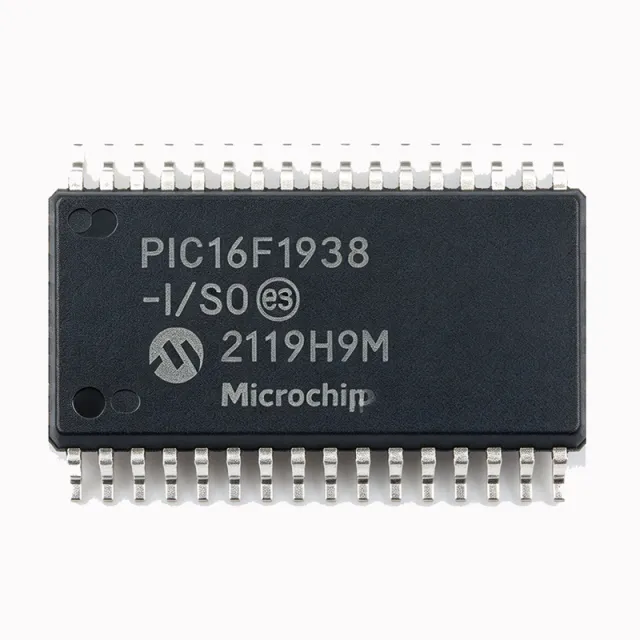
PIC16F1938-I/SO - 28KB Flash 8-bit MCU LCD Driver | Microchip
PIC16F1938-I/SO

PIC16F1938-I/SO - 28KB Flash 8-bit MCU LCD Driver | Microchip

The Microchip PIC16F1938-I/SO is an 8-bit PIC XLP flash microcontroller featuring 28KB of program memory, 1KB of RAM, 256 bytes of EEPROM, and an integrated LCD driver, housed in a 28-pin SOIC wide-body package. It operates from 1.8V to 5.5V, executes instructions at up to 32MHz, and integrates nanoWatt XLP technology for ultra-low-power sleep currents as low as 50 nA typical. An 8-bit microcontroller (MCU) is a small, self-contained computer-on-a-chip that combines a CPU, non-volatile program memory (flash), volatile data memory (RAM), and a rich set of peripherals on a single silicon die. Within the broader semiconductor taxonomy, an MCU belongs to the microcontrollers family, which itself is a sub-category of microprocessors and digital logic ICs. The PIC16F1938 sits in the PIC16 mid-range family from Microchip, optimized for low-power general-purpose embedded control with on-chip LCD drive capability and segment display driving. Key features include a 10-bit ADC with up to 17 channels, a 5-bit DAC, enhanced PWM with multiple complementary outputs, multiple communication interfaces (UART, SPI, I2C), and an integrated LCD driver supporting up to 96 segments. The 32MHz internal oscillator and four 8-bit timers plus one 16-bit timer deliver deterministic real-time control, while the 14-bit instruction width enables compact code density. The PIC16F1938 uses a Harvard RISC architecture with a 15-bit, 16-word hardware call stack and 49 instruction opcode set. The internal voltage reference, mTouch capacitive sensing module, and zero-cross detect simplify mixed-signal designs. The device is fabricated on a low-power CMOS process, achieving industry-leading sleep current that allows battery-powered and energy-harvesting designs to operate for years on a single cell. Typical applications include consumer appliances, battery-powered instruments with LCD readouts, industrial control panels, white goods and metering equipment, automotive body electronics, and IoT edge sensor nodes. Designers choose this part when segment-LCD UI, ultra-low standby current, and a small 28-pin SOIC footprint matter most. When designing with this MCU, allocate a 0.1uF decoupling capacitor within 5 mm of VDD, and connect the ICSPCLK/ICSPDAT pins to a header for in-circuit serial programming. The brown-out reset (BOR) and watchdog timer should remain enabled in safety-critical applications. This page synthesizes current distributor pricing, drop-in alternatives from the same PIC16F193x family and competing 8-bit MCUs, and practical design notes not found in the manufacturer datasheet.

USD $2,18 Контакты
PIC16F1938-I/SS - 28KB Flash 8-bit MCU LCD XLP | Microchip
PIC16F1938-I/SS

PIC16F1938-I/SS - 28KB Flash 8-bit MCU LCD XLP | Microchip

The Microchip Technology PIC16F1938-I/SS is an 8-bit CMOS flash microcontroller in the PIC16F family, featuring 28 KB of Flash program memory, 1 KB of RAM, and 256 B of EEPROM, housed in a 28-pin SSOP (5.30 mm) package. It operates from 1.8 V to 5.5 V with a 32 MHz internal oscillator, integrates an integrated LCD driver capable of up to 192 segments, and includes 25 I/O pins plus nanoWatt XLP extreme-low-power technology for battery-driven designs. A PIC microcontroller is a compact, self-contained computer-on-a-chip that combines an 8-bit RISC CPU core with program memory, RAM, EEPROM data storage, and a rich set of peripherals. PIC microcontrollers sit within the broader taxonomy of microcontrollers -> embedded processors -> semiconductor devices. The PIC16F family is Microchip's mid-range 8-bit line, optimized for low-power, general-purpose, and human-interface applications that do not require the performance of a 16-bit dsPIC or 32-bit ARM Cortex-M device. Key features of the PIC16F1938-I/SS include up to 32 MHz CPU speed (8 MHz with 4x PLL), 14-bit instruction word, 16-level hardware stack, 25 digital I/O pins, 11-channel 10-bit ADC, two comparators, PWM modules, MSSP (SPI/I2C), AUSART (RS-232/RS-485), and an integrated charge-pump LCD driver supporting up to 192 segments. The XLP nanoWatt technology provides sleep currents down to approximately 20 nA, watchdog timer, and multiple low-power operating modes (Run, Idle, Sleep). The architecture uses a Harvard RISC design with separate program and data buses, enabling single-cycle instruction execution except for branches. The integrated LCD driver with charge pump reduces external component count for segment displays. Device programming is supported through In-Circuit Serial Programming (ICSP) using only two pins, simplifying field updates. Typical applications include battery-powered consumer products with LCD user interfaces, home appliances, metering, industrial control panels, medical instrumentation, and low-power sensor nodes. The integrated LCD makes it especially suitable for thermostats, blood pressure monitors, and remote controls. When designing with this device, ensure the SSOP-28 land pattern matches the Microchip recommended footprint. Decoupling: place a 100 nF ceramic capacitor as close as possible to VDD, plus a bulk capacitor (10 uF) on the main supply rail. For LCD applications, follow the bias and segment contrast configuration in the device datasheet. This page synthesizes distributor pricing, drop-in alternatives, application notes, and design considerations not always surfaced by individual distributor listings - useful for both procurement and engineering teams evaluating the PIC16F1938-I/SS for new designs or as a replacement part.

Запрос цены Контакты