Товары (35.000+)

PIC18F4523-I/P - 32KB Flash 8-bit MCU, 40MHz, 40-PDIP | Microchip
PIC18F4523-I/P

PIC18F4523-I/P - 32KB Flash 8-bit MCU, 40MHz, 40-PDIP | Microchip

The Microchip Technology PIC18F4523-I/P is an 8-bit PIC18 enhanced flash microcontroller delivering up to 10 MIPS performance, 32KB of program flash memory (16K x 16 words), 1.5KB of RAM, and 256 bytes of EEPROM in a 40-pin PDIP through-hole package. It operates across a 2.0V to 5.5V supply range and integrates a 12-bit A/D converter with up to 13 input channels, making it suitable for mixed-signal embedded designs. An 8-bit microcontroller is a single-chip computer that integrates a CPU, RAM, non-volatile program memory (flash/ROM), I/O peripherals, and communication interfaces onto one die. The PIC18 family uses a C-compiler-optimized RISC architecture with 8x8 single-cycle hardware multiply and a 16-bit instruction word, occupying the tier above baseline PIC16 parts and below the PIC24/dsPIC families in Microchip's portfolio. This hierarchy places the PIC18F4523-I/P firmly within the mainstream 8-bit MCU segment, where deterministic core performance and broad peripheral integration are prioritized over raw clock speed. Key features include a 40MHz internal/external clock with 4x PLL support, internal oscillator from 31 kHz to 8 MHz, fail-safe clock monitor, watchdog timer with dedicated RC oscillator, nanoWatt power management for sleep current reduction, two USART modules, MSSP (SPI/I2C), CCP/ECCP modules, and two analog comparators. The 12-bit ADC distinguishes this part from the older 10-bit PIC18F4520. The device supports in-circuit serial programming (ICSP) and in-circuit debug (ICD) via two pins. Typical applications include industrial control panels, sensor signal conditioning nodes, motor control with low-side MOSFET driving, automotive body and chassis subsystems (non-safety), consumer appliance control boards, and battery-powered instrumentation requiring nanoWatt sleep modes. The 40-PDIP package is favored for legacy designs, educational platforms, and breadboard prototyping where through-hole assembly is preferred over SMD. When designing with this MCU, place the 0.1uF VDD decoupling capacitor within 5mm of each VDD/SS pin pair. Use a 10k pull-up on MCLR to ensure clean reset behavior and an in-series resistor to limit injection current. Unused I/O pins must be configured as outputs and driven low to minimize sleep mode leakage.

Запрос цены Контакты
PIC18F4523-I/PT - 8-bit PIC MCU 32KB Flash 40MHz 44-TQFP | Microchip
PIC18F4523-I/PT

PIC18F4523-I/PT - 8-bit PIC MCU 32KB Flash 40MHz 44-TQFP | Microchip

The Microchip Technology PIC18F4523-I/PT is a high-performance 8-bit PIC microcontroller in the PIC18F family, featuring 32KB of Enhanced Flash program memory, 1536 bytes of RAM, and 256 bytes of EEPROM. Housed in a 44-pin TQFP (10x10 mm) package, it executes instructions at up to 40 MHz (10 MIPS) through its RISC architecture, and integrates a 12-bit A/D converter with up to 13 input channels. Operating from 2.0 V to 5.5 V, this device supports both 3.3 V and 5 V system designs, making it ideal for mixed-voltage environments. An 8-bit microcontroller (MCU) is a single-chip computer that integrates a CPU, memory, and peripherals onto one silicon die. PIC18F microcontrollers are Microchip's mid-range enhanced 8-bit family, sitting between the baseline PIC10/12/16 families and the 16-bit dsPIC/PIC24 families. They combine a RISC Harvard architecture with on-chip peripherals (ADC, timers, UART, SPI, I2C, PWM, etc.), enabling standalone embedded control without external logic. Compared with 32-bit ARM Cortex-M cores, PIC18F parts trade raw performance for predictable interrupt latency, deterministic instruction timing, and a mature MPLAB/XC8 toolchain. Key features of the PIC18F4523 include nanoWatt power management for low-power sleep modes, up to 36 digital I/O pins, two 8-bit and three 16-bit timers, two capture/compare/PWM modules, two enhanced USART modules, an MSSP (SPI/I2C) port, and self-programming flash with block erase. The integrated 12-bit ADC delivers 12-bit resolution across up to 13 analog channels, doubling the precision of competing 10-bit ADC implementations in this segment. Typical applications include industrial control boards, motor drive interface logic, HVAC and appliance controllers, automotive body/comfort electronics, sensor signal conditioning, USB-to-serial bridges, and small graphical or segment LCD products. The 32KB flash comfortably supports USB stacks (CDC, HID), Modbus RTU, and PID control loops. Designers should consult Microchip's datasheet DS39626 family document for full peripheral specifications, electrical characteristics, and programming guidelines.

Запрос цены Контакты
PIC18F4523T-I/ML - 8-bit 32KB Flash MCU, 40MHz, TQFP-44
PIC18F4523T-I/ML

PIC18F4523T-I/ML - 8-bit 32KB Flash MCU, 40MHz, TQFP-44

The Microchip Technology PIC18F4523T-I/ML is an 8-bit PIC18 enhanced flash microcontroller with 32KB of program memory, 1536 bytes of RAM, and 256 bytes of EEPROM, housed in a 44-pin TQFP (ML) package with exposed pad. What is a PIC18 microcontroller? PIC18 is Microchip's high-performance 8-bit microcontroller family built on an enhanced RISC architecture. PIC18 microcontrollers combine Harvard architecture (separate program and data buses) with C-optimized instruction sets, integrated peripherals (ADC, UART, SPI, I2C, PWM), and nanoWatt power management. They sit within the broader hierarchy: PIC18 -> 8-bit MCU -> microcontroller -> embedded processor -> semiconductor. The PIC18F4523 specifically belongs to the PIC18F4520/4523 family of 28/40/44-pin enhanced flash MCUs with 12-bit A/D, designed for mixed-signal embedded designs. The PIC18F4523 executes instructions at up to 10 MIPS from a 40 MHz oscillator, supports 4.2V to 5.5V single-supply operation, and provides 36 digital I/O pins. Its on-chip peripherals include a 12-bit A/D converter with up to 13 channels, two capture/compare/PWM modules, two USART modules, MSSP (SPI/I2C), and the nanoWatt power-managed sleep modes (Idle, Sleep, Deep Sleep) that drop current consumption to the nanoampere range. The device uses a modified Harvard architecture with a 16-bit instruction word, an 8-level hardware stack, and a priority interrupt controller with vectored interrupts. The flash program memory supports self-programming (ICSP) and an internal 8 MHz RC oscillator is selectable for low-cost designs without external clocking. Typical applications include industrial control panels, HVAC thermostats, sensor signal conditioning, home appliance user interfaces, and low-cost data acquisition systems where 12-bit ADC precision, multiple serial interfaces, and reliable flash program memory are required. The wide 5V supply tolerance is well-matched to industrial 24V bus designs post-regulation. When designing with this part, ensure VDD decoupling is placed within 5 mm of the AVSS/VDD pins and use a 100 nF + 10 uF bulk capacitor combination. For 12-bit ADC accuracy, drive the analog inputs through low-impedance sources (< 2 kohm) and decouple VREF+ independently. The exposed thermal pad (ML package) must be soldered to the PCB ground plane for thermal dissipation. This page synthesizes distributor pricing, drop-in alternatives, and practical design notes not found on a single datasheet page. Engineers evaluating 8-bit MCU options will find the comparison tables, application notes, and package pinout information consolidated here for faster decision-making.

Запрос цены Контакты
PIC18F4525-E/PT - 8-Bit 48KB Flash MCU, 44-TQFP | Microchip
PIC18F4525-E/PT

PIC18F4525-E/PT - 8-Bit 48KB Flash MCU, 44-TQFP | Microchip

The Microchip Technology PIC18F4525-E/PT is an 8-bit PIC microcontroller from the PIC18F family, featuring 48KB of Enhanced Flash program memory, 3,384 bytes of RAM, and 1KB of EEPROM, housed in a 44-pin TQFP (10x10 mm) surface-mount package. The device executes instructions at up to 10 MIPS with a 25MHz (40MHz max) external clock input and includes an integrated 31 kHz to 8MHz internal oscillator block with 4x PLL support, enabling flexible system clocking without external crystals. An 8-bit microcontroller (MCU) is a single-chip computer optimized for control-oriented embedded tasks. The PIC18 family is part of Microchip's enhanced RISC architecture line, sitting between the PIC16 mid-range parts and the 16-bit dsPIC/PIC24 devices in Microchip's portfolio. Within that hierarchy, the PIC18F4525 belongs to the "F4525/F4620" sub-family that pairs Enhanced Flash with nanoWatt power management and a 10-bit ADC, making it a general-purpose MCU for industrial and consumer control. Key features of the PIC18F4525-E/PT include a 13-channel 10-bit ADC with auto-acquisition, two Capture/Compare/PWM modules, an enhanced USART, an MSSP module supporting SPI and I2C (master/slave), two analog comparators, and a hardware 8x8 single-cycle multiplier. The Fail-Safe Clock Monitor (FSCM) automatically switches to the internal RC oscillator if the primary clock fails, and the Watchdog Timer uses a dedicated internal RC for true independence. nanoWatt technology provides idle, sleep, and deep-sleep modes for battery-friendly designs. The architecture is an 8-bit Harvard RISC design with a C-compiler-optimized instruction set, 16-bit instructions, and 32-level hardware stack with software push/pop. The Enhanced Flash supports >100,000 erase/write cycles typical and >40 years of data retention, suitable for long-life industrial equipment. Typical applications include industrial automation controllers, HVAC and environmental sensors, low-cost motor control with PWM, sensor-interface nodes, and home appliance control panels. Designers typically select this part when you require a mature PIC18 codebase, generous Flash for a small RTOS or USB stack, and the pin count of the 44-pin TQFP. When designing with the PIC18F4525-E/PT, configure CONFIG words in the IDE (MPLAB X) to select oscillator mode and brown-out thresholds. The E/PT suffix indicates the extended (-40C to +125C) operating temperature grade in the TQFP package. This page combines distributor pricing, drop-in same-family alternatives, and practical design notes compiled from the manufacturer datasheet and authorized distributors.

Запрос цены Контакты
PIC18F4525-I/ML - 48KB Flash 8-bit MCU, 44-QFN | Microchip
PIC18F4525-I/ML

PIC18F4525-I/ML - 48KB Flash 8-bit MCU, 44-QFN | Microchip

The Microchip Technology PIC18F4525-I/ML is an 8-bit RISC PIC18 microcontroller delivering 48KB of Enhanced Flash program memory, 3968 bytes of SRAM, and 1024 bytes of Data EEPROM in a 44-pin QFN (ML) package. It operates at up to 40 MHz with a 200 ns instruction cycle, integrates 36 digital I/O lines, and supports supply voltages from 4.2 V to 5.5 V for full-speed operation. The device is built on CMOS technology and includes 10-bit Analog-to-Digital Conversion (ADC), nanoWatt power management, and a rich set of peripherals including CCP, EUSART, MSSP (SPI/I2C), and dual analog comparators. A PIC18 microcontroller is a Harvard-architecture 8-bit RISC processor from Microchip's PIC family, positioned between baseline PIC10/12/16 devices and the 16-bit dsPIC/PIC24 families. The PIC18F4525 belongs to the F45xx sub-family of 28/40/44-pin enhanced flash microcontrollers with nanoWatt technology, and the PIC18F4525-I/ML variant specifically uses the 44-pin QFN package (also denoted by the ML suffix). It sits in the broader taxonomy as: microcontroller -> 8-bit MCU -> PIC18 -> PIC18F45xx -> flash-based RISC MCU -> embedded computing IC. Key features include 48KB (24K × 16) of Enhanced Flash program memory, 1024 bytes of Data EEPROM with high-endurance, 3968 bytes of SRAM, 36 I/O pins with individual direction control, and four timer modules (Timer0/1/2/3). Integrated peripherals include a 10-bit ADC with up to 13 channels, two analog comparators, a Capture/Compare/PWM (CCP) module plus an Enhanced CCP (ECCP), MSSP supporting SPI and I2C (master/slave), enhanced USART (EUSART), and a 4× PLL on selected oscillator modes. nanoWatt features such as idle, sleep, and deep-sleep modes reduce active current substantially for battery-powered designs. Architecturally, the PIC18F4525-I/ML uses a 16-bit-wide instruction word with a 21-bit program counter, supporting linear memory addressing up to 2 MB. The enhanced flash supports self-programming via ICSP (In-Circuit Serial Programming) and a bootloader-friendly write/erase model. On-chip debug is supported through Microchip's ICD/MPLAB ecosystem, and the 44-QFN (8×8 mm) package with exposed pad aids thermal dissipation for industrial applications. Typical applications include industrial control panels, sensor data acquisition nodes, motor drive controllers (low-side, using ECCP+PWM), USB-to-UART bridges (using EUSART + external transceiver), home appliance HMIs, and automotive body/comfort modules. The 36 I/O count comfortably supports keypad scanning, LCD driving (via external controller), and multi-channel ADC monitoring in parallel. When designing with this part, ensure the AVdd/AVss pair is properly decoupled (10 µF + 0.1 µF) for ADC accuracy, and route the exposed thermal pad (EP) to a solid ground pour. Choose between the 44-QFN (ML), 44-TQFP (PT), and 40-PDIP (P) variants only after PCB real estate and thermal budget are finalized. This page synthesizes distributor pricing, drop-in alternatives, and practical design notes not found in the manufacturer datasheet alone.

Запрос цены Контакты
PIC18F4525-I/PT - 8-bit MCU, 48KB Flash, 40MHz, 44-TQFP | Microchip
PIC18F4525-I/PT

PIC18F4525-I/PT - 8-bit MCU, 48KB Flash, 40MHz, 44-TQFP | Microchip

The Microchip Technology PIC18F4525-I/PT is an 8-bit PIC18F family microcontroller with 48 KB of Flash program memory, 3,968 bytes of RAM, and a 256-byte EEPROM, operating at up to 40 MHz (10 MIPS) in a 44-pin TQFP (10x10 mm) package. The device integrates 36 digital I/O pins, a 10-bit ADC with up to 13 input channels, two analog comparators, two CCP modules, one enhanced CCP (ECCP), a USART, MSSP (SPI/I2C), and nanoWatt power management technology. The -I suffix indicates the industrial temperature range of -40C to +85C, and the /PT suffix denotes the TQFP-44 surface-mount package. A microcontroller (MCU) is a single-chip computer containing a CPU core, program and data memory, and programmable peripheral interfaces. The PIC18F family uses a RISC-based 8-bit Harvard architecture with 16-bit instructions optimized for deterministic real-time control. MCUs sit at the lowest tier of the embedded computing hierarchy - above them are microprocessors (MPUs) and SoCs - making the PIC18F4525 suited to mid-complexity applications where deterministic interrupt latency and low power matter more than raw throughput. Key features include four 8-bit timer/counters, two 16-bit timer/counters, a 10-bit ADC with up to 13 channels and 100 Ksps conversion rate, dual hardware USART and MSSP peripherals, and nanoWatt Technology power-saving modes. The device supports ICSP (In-Circuit Serial Programming) and ICD (In-Circuit Debugging) through the ICSP/ICD pins, enabling field updates without removing the MCU from the board. Typical applications include industrial control systems, HVAC controls, automotive body electronics, sensor interfaces, low-end displays, and consumer appliance controls. The wide supply range (4.2V to 5.5V) and broad peripheral set make it suitable for mains-powered and battery-backed designs. Designers should reserve pin 1 (MCLR/VPP) with the proper reset circuit and ensure decoupling capacitors are placed within 5 mm of VDD/VSS pairs. For low-power designs, utilize nanoWatt sleep modes with appropriate peripheral gating to achieve quiescent currents below 1 uA. This page synthesizes distributor pricing, drop-in PIC18F alternatives, and practical design notes not found in the manufacturer datasheet alone.

Запрос цены Контакты
PIC18F4525T-I/ML - 48KB Flash, 40MHz 8-bit MCU TQFP-44 | Microchip
PIC18F4525T-I/ML

PIC18F4525T-I/ML - 48KB Flash, 40MHz 8-bit MCU TQFP-44 | Microchip

The Microchip Technology PIC18F4525T-I/ML is an 8-bit RISC PIC microcontroller in a 44-pin QFN/TQFP (ML) package, featuring 48 KB of Enhanced Flash program memory and 3,968 bytes of RAM. The part operates from 4.2 V to 5.5 V, supports a maximum clock speed of 40 MHz, and provides 36 digital I/O pins suitable for embedded control designs. Program memory is rated for high-endurance in-application programming, while an integrated 10-bit Analog-to-Digital Converter handles sensor and analog signal acquisition. A PIC18 microcontroller is a 16-bit instruction-word, 8-bit data-path MCU built around an enhanced Harvard architecture, combining separate program and data buses with a RISC instruction set. PIC18 devices sit in the hierarchy: PIC18 family -> PIC microcontrollers -> 8-bit microcontrollers -> microcontrollers (MCUs) -> semiconductors. Within Microchip's lineup, the PIC18F family is the mainstream "high performance" tier, positioned above PIC16F and below the 16-bit dsPIC and 32-bit PIC32 families. nanoWatt Technology (a Microchip trademark) refers to dynamic power-management modes that lower active and sleep current for battery-aware designs. Key features of the PIC18F4525 include 256 bytes of EEPROM, two 8-bit and three 16-bit timers, two analog comparators, a USART, an MSSP (Master Synchronous Serial Port) configurable for SPI or I2C, two capture/compare/PWM modules, and nanoWatt power management. The 10-bit ADC provides up to 13 input channels depending on package, supporting industrial sensor interfacing at modest conversion rates. Typical applications include industrial automation controllers, motor control front-ends (using PWM and timers), automotive body and chassis subsystems (non-safety), consumer appliances, HVAC control boards, USB-to-UART bridging (with on-chip USART), and sensor hubs requiring analog and digital I/O. The wide 4.2 V to 5.5 V supply range and 40 MHz throughput position it well for 5 V-tolerant industrial designs. The industrial temperature grade of -40 C to +85 C (I-suffix) supports uncontrolled environments, and the TQFP-44 footprint with exposed pad simplifies PCB layout for thermal dissipation and ground integrity. The "T" suffix denotes tape-and-reel packaging for high-volume assembly. When designing, engineers should match Vdd decoupling (100 nF + 10 uF recommended) and reserve MCLR pin handling for in-circuit serial programming and reset robustness.

Запрос цены Контакты
PIC18F4525T-I/PT - 8-bit 40MHz 48KB Flash MCU | Microchip
PIC18F4525T-I/PT

PIC18F4525T-I/PT - 8-bit 40MHz 48KB Flash MCU | Microchip

The Microchip Technology PIC18F4525T-I/PT is an 8-bit RISC PIC18 microcontroller running at up to 40 MHz, integrating 48 KB of Enhanced Flash program memory, 3,968 bytes of SRAM, and 1,024 bytes of data EEPROM in a 44-pin TQFP (10x10 mm) package. Tape-and-reel (T) packaging variant, industrial -40C to +85C temperature range (I suffix), and PT package designator. What is a PIC18F Microcontroller? A PIC18F microcontroller belongs to Microchip's 8-bit PIC microcontroller family built on an enhanced Harvard architecture with a RISC instruction set. Within the broader semiconductor hierarchy, PIC18F sits inside: microcontroller -> embedded MCU -> 8-bit MCU -> semiconductor IC. The PIC18F core separates program and data buses, integrates peripherals (ADC, timers, communication ports) on-chip, and executes most instructions in one instruction cycle (four oscillator clocks), making it suitable for deterministic real-time control. The PIC18F4525T-I/PT differentiates itself through on-chip nanoWatt power management, an enhanced instruction set with 16-bit instructions, C-compiler friendly architecture, and 36 digital I/O pins. Its 10-bit ADC (up to 13 channels), multiple timers, and Capture/Compare/PWM modules suit mixed-signal embedded designs. Internal oscillator options and on-chip EEPROM simplify BOM, while the ICSP (In-Circuit Serial Programming) interface enables in-field firmware updates. Technically, the device operates from 4.2V to 5.5V (F-class part; the LF variant supports 2.0V-5.5V), uses a 2.0V-5.5V wide-range core (per family datasheet), and integrates nanoWatt Technology with multiple low-power modes (RUN, IDLE, SLEEP). Peripheral highlights include two USART modules, MSSP (SPI/I2C), CCP/ECCP modules, and a 10-bit ADC with up to 13 input channels. The enhanced Flash supports 100,000 erase/write cycles typical, with self-programmability. Typical applications include industrial control panels, HVAC thermostat controllers, automotive body electronics (non-safety), consumer appliance controllers, sensor signal conditioning nodes, and USB-to-UART bridging with companion parts. The wide peripheral set also suits smart metering, motor control (low-side BLDC), and small graphical user-interface boards with character or low-resolution graphic LCDs. When designing with PIC18F4525T-I/PT, choose between TQFP-44 (PT), QFN-44 (ML), and DIP-40 (P) packages based on PCB real-estate and assembly preferences. Pay attention to the F vs LF voltage-range suffix: F = 4.2V-5.5V only, LF = 2.0V-5.5V (full range). A proper decoupling network (100 nF + 10 uF bulk per VDD pair) and a 1 kohm pull-up on MCLR are essential for stable operation. This page synthesizes distributor pricing, drop-in alternatives within the same TQFP-44 footprint, and practical design notes not found in the manufacturer datasheet. Compared to DigiKey/Mouser/Octopart product pages, it adds a pin-compatible same-family alternative list, an ADC-channel and peripheral comparison table, and AI-search-optimized FAQs covering commercial, comparison, selection, replacement, and datasheet intents.

Запрос цены Контакты
PIC18F452T-I/L - 8-Bit 40MHz 32KB Flash MCU 44-PLCC | Microchip
PIC18F452T-I/L

PIC18F452T-I/L - 8-Bit 40MHz 32KB Flash MCU 44-PLCC | Microchip

The Microchip Technology PIC18F452T-I/L is a high-performance 8-bit CMOS FLASH-based microcontroller from the PIC18F family, delivering 10 MIPS (100 ns instruction execution) at 40 MHz and packing 32 KB of program FLASH plus 1.5 KB of RAM into a 44-pin PLCC package. Operating from 4.2 V to 5.5 V across the industrial -40 °C to +85 °C temperature range, it integrates 34 digital I/O lines, a 10-bit ADC with up to 8 channels, two 8-bit and three 16-bit timers, hardware USART, MSSP (SPI/I2C), and the nanoWatt Technology power-management block that drops quiescent current to microamp levels during sleep. The 'T' suffix indicates tape-and-reel packaging and 'I/L' designates the industrial temperature grade in the L (PLCC) package. An 8-bit microcontroller (MCU) is a single-chip computer built around an 8-bit data path, on-chip FLASH program memory, RAM, peripherals, and an arithmetic-logic unit. Within the broader semiconductor taxonomy, the PIC18F452 belongs to the hierarchy: microcontroller -> 8-bit MCU -> FLASH MCU -> PIC18 family -> PIC18F452 sub-family. The 8-bit class remains widely used because it offers deterministic interrupt response, low cost, and low power for embedded control where the throughput of 32-bit Cortex-M parts is unnecessary. Key features that distinguish this device include 77 single-word instructions (simplifying compiler and assembly code), an enhanced FLASH program memory supporting 100K erase/write cycles, an ICD-friendly in-circuit debug interface, hardware multiplier for 8x8 unsigned operations in a single cycle, and self-programming capability that allows field firmware upgrades through the USART. The MSSP peripheral supports both SPI master/slave and I2C master/slave modes, while the USART handles RS-232/RS-485 links commonly found in industrial automation. Typical applications include industrial control and sensor interfaces, building automation controllers, HVAC thermostats, instrument data loggers, low-end human-machine interface (HMI) panels, and consumer appliance control boards. Its 10-bit ADC, generous I/O count, and rugged industrial temperature grade make it well-suited to factory-floor designs where reliability over decades matters more than peak compute throughput. The PIC18F452 is also widely used as a teaching platform in university embedded systems curricula and as an upgrade target for legacy PIC16C/PIC17C designs, offering code compatibility with older Microchip parts. When designing with this part, ensure decoupling capacitors of 100 nF are placed close to VDD/VSS pins and that MCLR is pulled high through a 10 kohm resistor for normal operation; for in-circuit debugging, leave the ICSPDAT and ICSPCK pins accessible. Programming voltage is generated on-chip, eliminating the need for an external 13 V supply. Brown-out reset thresholds should be configured via configuration bits to protect FLASH integrity during power cycling.

Запрос цены Контакты
PIC18F452T-I/PT - 8-bit 40MHz 32KB Flash MCU 44-TQFP | Microchip
PIC18F452T-I/PT

PIC18F452T-I/PT - 8-bit 40MHz 32KB Flash MCU 44-TQFP | Microchip

The Microchip Technology PIC18F452T-I/PT is a high-performance 8-bit CMOS Flash microcontroller based on the PIC18 enhanced architecture, delivering 10 MIPS at 40 MHz, packaged in a 44-pin TQFP (10x10 mm). It integrates 32 KB of program Flash, 1536 bytes of SRAM, and 256 bytes of EEPROM, with 34 digital I/O lines, eight 10-bit ADC channels, two CCP modules, USART, MSSP (SPI/I2C), and a 10-bit PWM module. A microcontroller (MCU) is a single-chip computer that integrates a CPU, memory (Flash for program, SRAM for data, EEPROM for non-volatile storage), peripherals, and I/O on one die. Within the semiconductor hierarchy, MCUs sit below ASICs and microprocessors; the 8-bit class (PIC18, AVR, 8051) targets cost-sensitive embedded control, while 32-bit Cortex-M parts dominate higher-performance tasks. PIC18F devices add 16-bit-wide instructions, linear memory, and C-compiler-friendly addressing to the traditional PIC RISC core. Key features of the PIC18F452T-I/PT include 32 KB self-programmable Flash, 256-byte EEPROM with one-million-cycle endurance, an internal RC oscillator with PLL for 40 MHz operation, nanoWatt power management, and a wide 4.2 V to 5.5 V supply range. The 77 single-word instruction set simplifies code generation and assembly migration. The device uses a Harvard architecture with separate code and data buses, plus an 8x8 hardware multiplier that accelerates arithmetic. The integrated 10-bit ADC provides up to eight channels with 500 ksps throughput. The nanoWatt technology reduces quiescent current below 1 uA in sleep mode, enabling battery-backed designs. Typical applications include industrial control systems, automotive body electronics, home appliances, sensor interfaces, low-end human-machine interfaces, and USB/serial-connected embedded nodes. The generous Flash and SRAM support small RTOS, TCP/IP stacks, and graphical LCD controllers. Designers should place 0.1 uF decoupling capacitors close to each VDD/VSS pair and a 10 uF bulk capacitor near the device. Unused I/O pins should be configured as outputs low to minimize current draw. The internal oscillator eliminates the external crystal in many designs but trades frequency accuracy for BOM cost. This page synthesizes distributor pricing, drop-in alternatives drawn from Microchip's own PIC18F family, and practical design notes not found in the manufacturer datasheet. All alternatives are pin-compatible 44-TQFP variants sourced from the same PIC18F452 die family.

Запрос цены Контакты
PIC18F4539-E/ML - 8-bit 40MHz Motor Control MCU 24KB Flash | Microchip
PIC18F4539-E/ML

PIC18F4539-E/ML - 8-bit 40MHz Motor Control MCU 24KB Flash | Microchip

The Microchip Technology PIC18F4539-E/ML is an 8-bit enhanced FLASH microcontroller with a sophisticated single-phase induction motor control kernel, 24 KB of program memory, 1408 bytes of RAM, and 256 bytes of EEPROM, housed in a 44-pin VQFN (ML) package with exposed thermal pad. It runs at up to 40 MHz across a 2.0V to 5.5V operating range, provides 32 digital I/O lines, and integrates 8 channels of 10-bit Analog-to-Digital conversion, two PWM modules, self-programming FLASH, an ICD debug interface, and a C-compiler-friendly architecture. An 8-bit PIC microcontroller is a Harvard-architecture CMOS device that combines a RISC-style instruction set with on-chip FLASH program memory, EEPROM data memory, and a rich set of peripherals including timers, ADC, PWM, and communication modules. Within the broader taxonomy, the PIC18F family is Microchip's high-performance 8-bit line (PIC -> 8-bit MCU -> microcontroller -> embedded controller -> semiconductor), designed for applications that need more code space, higher MIPS, and motor-control or DSP-like peripherals than the baseline PIC16F parts can deliver. Key differentiating features include the dedicated motor control kernel tailored for single-phase induction motor drives, dual PWM outputs with programmable duty cycle and dead-band control, an enhanced USART, MSSP for SPI/I2C, and self-programming FLASH that enables field firmware updates. The 10-bit ADC with up to 8 input channels supports current/voltage/temperature sensing in inverter-style power stages. Architecturally, the PIC18F4539 pairs an enhanced 16-bit instruction word with a hardware multiply engine, providing single-cycle multiplication and 16-bit arithmetic operations, which accelerates the math needed for sensorless motor control algorithms such as BEMF zero-crossing detection. Typical applications include single-phase induction motor drives for fans, pumps, and white-goods compressors, as well as general-purpose 8-bit embedded control where a small QFN footprint, integrated peripherals, and the C-friendly PIC18 instruction set are preferred. When designing with this device, ensure that the exposed thermal pad is soldered to a sufficiently large copper pour to meet the thermal and electrical ground requirements. The wide 2.0V to 5.5V supply range allows direct operation from regulated 3.3V or 5V rails, but decoupling capacitors must be placed within a few millimeters of VDD/AVDD/AVSS pins. This page synthesizes verified distributor pricing, drop-in alternatives, and practical motor-control design notes not consolidated in the manufacturer datasheet.

Запрос цены Контакты
PIC18F4539-E/P - 8-bit MCU, 24KB Flash, 40 DIP | Microchip
PIC18F4539-E/P

PIC18F4539-E/P - 8-bit MCU, 24KB Flash, 40 DIP | Microchip

The Microchip Technology PIC18F4539-E/P is an 8-bit enhanced Flash microcontroller built on the PIC18 Harvard architecture and offered in a 40-pin PDIP (P) through-hole package, integrating 24 KB of Flash program memory, 1408 bytes of RAM, 256 bytes of EEPROM, 32 digital I/O lines, 8 channels of 10-bit ADC, two PWM modules, and a hardware single-phase induction motor control kernel. An 8-bit PIC microcontroller (MCU) is a single-chip computer that combines a CPU, non-volatile Flash program memory, volatile RAM, EEPROM data memory, and a rich set of on-chip peripherals (ADC, PWM, timers, communication ports, motor-control PWMs). PIC18F-series devices extend the base PIC16 core with linear program memory, 16-bit instructions, and C-friendly development tools, sitting between entry-level 8-bit PIC MCUs and 16-bit dsPIC/PIC24 parts in Microchip's product hierarchy: PIC10/12/16/18 -> 8-bit MCU -> microcontroller -> embedded control IC -> semiconductor. Key features of the PIC18F4539-E/P include 24 KB (12K x 16) of self-programmable Flash, 256 bytes of EEPROM for non-volatile data, 1408 bytes of SRAM, an internal oscillator with PLL capable of up to 40 MHz operation, an ICD (In-Circuit Debugger) interface, self-programming support, two Capture/Compare/PWM modules optimized for power and motor control, and Nanowatt power management for sleep/Idle modes that extend battery life in standby. Architecturally, the PIC18F4539 adds a dedicated single-phase induction motor control kernel on top of the standard PIC18F CPU, a feature that distinguishes it from generic PIC18F parts such as PIC18F4520. The on-chip motor-control kernel (Power Control PWM with dedicated time base, duty-cycle register, and dead-band control) reduces CPU overhead and CPU/MCU interrupt latency, allowing deterministic commutation and torque control for single-phase AC induction motors in white-goods and small-appliance designs. Typical applications include single-phase induction motor control (washing machines, fans, pumps, compressors), general-purpose 8-bit embedded control with ADC-driven sensor acquisition, low-cost HVAC appliance boards, and legacy industrial control replacements. The wide 5V operating range and mature PIC18 toolchain (MPLAB X, XC8, ICD headers) make it a drop-in choice for designs migrated from PIC16 to PIC18. When designing, choose the 'E' (Extended) temperature grade for industrial -40C to +125C operation, and pair with a 20 MHz external crystal or rely on the internal 8 MHz oscillator (with PLL). Power Control PWM outputs must use the dedicated module, not the standard CCP, to access the motor-control kernel features. This page synthesizes the manufacturer datasheet, current distributor pricing, structured drop-in alternatives from the same PIC18F family, and practical design notes not collected in any single vendor listing.

Запрос цены Контакты
PIC18F4539-I/ML - 8-bit MCU 24KB Flash 40MHz Motor Control | Microchip
PIC18F4539-I/ML

PIC18F4539-I/ML - 8-bit MCU 24KB Flash 40MHz Motor Control | Microchip

The Microchip Technology PIC18F4539-I/ML is an 8-bit enhanced Flash microcontroller with 24KB of program memory, 1408 bytes of RAM, and 256 bytes of EEPROM, integrated with a sophisticated single-phase induction motor control kernel. It operates at up to 40 MHz clock speed, supports 32 I/O lines, and is housed in a 44-pin QFN package (also referenced as TQFP-44 in some sources). The device features an internal 10-bit Analog-to-Digital converter, dual PWM modules, an ICD (In-Circuit Debugger) interface, and self-programming capability, all optimized for motor control and embedded control applications. An 8-bit microcontroller (MCU) is a single-chip computer built around an 8-bit data bus, typically used in cost-sensitive and power-constrained embedded systems. The PIC18F family from Microchip uses an enhanced RISC architecture with 16-bit instruction words and Harvard bus structure, providing higher code density than 8-bit instruction architectures. Within the PIC hierarchy, the PIC18F4539 belongs to the motor-control subgroup and includes dedicated peripherals such as the Power Control PWM module and an integrated motor control kernel designed to offload real-time control tasks from the CPU. Key features include 24KB self-programming Flash program memory, 1408 bytes of SRAM, 256 bytes of EEPROM data memory, an internal 10-bit A/D converter with multiple channels, two PWM outputs with complementary or independent modes, a Universal Synchronous/Asynchronous Receiver/Transmitter (USART), Master Synchronous Serial Port (MSSP) supporting SPI and I2C, and nanoWatt Technology for reduced power consumption. The device supports supply voltages from 4.2V to 5.5V and operates across an industrial temperature range. The PIC18F4539 merges all the advantages of the PIC18F architecture with the flexibility of Flash memory and a sophisticated motor control kernel targeted for single-phase induction motor control. Its C-compiler-friendly instruction set and broad peripheral integration make it well suited for both motor-control loops and general-purpose embedded applications that require deterministic real-time response. Typical applications include single-phase induction motor drives, fan and pump controllers, small appliance motor control, white goods, and general-purpose embedded control platforms where deterministic PWM generation and ADC sampling are required. The integrated motor control kernel reduces firmware burden for variable-frequency drive implementations. When designing with this device, ensure that the ICSP/ICD programming pins are properly accessible for in-circuit debugging. The high-current PWM outputs require careful PCB layout to avoid noise coupling into analog signal paths, and decoupling capacitors should be placed as close as possible to VDD/VSS pairs. This page synthesizes distributor pricing, drop-in alternatives, and practical design notes that go beyond the manufacturer datasheet, helping engineers evaluate the PIC18F4539-I/ML for new designs and migration paths.

Запрос цены Контакты
PIC18F4539-I/PT - 8-Bit MCU 40MHz 24KB Flash 44-TQFP | Microchip
PIC18F4539-I/PT

PIC18F4539-I/PT - 8-Bit MCU 40MHz 24KB Flash 44-TQFP | Microchip

The Microchip Technology PIC18F4539-I/PT is an 8-bit RISC microcontroller in the PIC18F family, delivering 40 MHz performance with 24 KB (12K x 16) of enhanced flash program memory, 1408 bytes of RAM, and 256 bytes of EEPROM, all housed in a 44-pin TQFP (10x10 mm) industrial-grade package. Operating from 4.2 V to 5.5 V, the device features 36 digital I/O lines, an internal 10-bit analog-to-digital converter with eight input channels, two PWM modules, and a sophisticated motor control kernel specifically targeted at single-phase induction motor control applications. A microcontroller (MCU) is a single-chip computer that integrates a CPU, non-volatile program memory, RAM, and a rich set of peripheral I/O into one package. The PIC18F family represents an 8-bit RISC Harvard-architecture line positioned above baseline PIC16F parts in performance, code density, and peripheral count, sitting in the mid-tier of Microchip's 8-bit portfolio, below the PIC24/dsPIC33 16-bit families. The PIC18F4539 merges these architectural advantages with FLASH self-programmability, in-circuit debugging via ICD, and nanoWatt power management, suiting both motor control and general-purpose embedded tasks. Key differentiating features include 32 interrupt sources, four timer modules, two capture/compare/PWM modules with motor-control enhancements, an enhanced USART, and an MSSP port that supports SPI and I2C. The 10-bit ADC offers eight channels that can pair with the integrated motor-control PWM to implement closed-loop speed or torque feedback. Hardware multiplier support and a 16-bit wide instruction path help C compilers generate efficient code, while the part retains the classic PIC RISC instruction set for assembly-level optimization. Typical applications include single-phase induction motor drives (fans, pumps, compressors), white-goods and appliance controllers, industrial automation subsystems, HVAC blower control, low-end BLDC gate-driver hosts, sensor conditioning front-ends, and general-purpose 8-bit embedded platforms. The combination of dedicated motor-control hardware and conventional MCU peripherals also makes it suitable as a glue controller for motor-driver ICs in ceiling fans and small industrial drives. When designing with the PIC18F4539-I/PT, allocate the analog supply current budget carefully because the ADC and motor-control analog front-end draw separately from the digital core; place a 0.1 µF decoupling capacitor as close as possible to each VDD/VSS pair, and provide an RC filter on the analog VDD pin when ADC SNR is critical for the chosen motor-control loop bandwidth.

Запрос цены Контакты
PIC18F4539T-E/ML - 24KB Flash 8-bit MCU with Motor Control | Microchip
PIC18F4539T-E/ML

PIC18F4539T-E/ML - 24KB Flash 8-bit MCU with Motor Control | Microchip

The Microchip Technology PIC18F4539T-E/ML is a 40 MHz, 8-bit Flash microcontroller with an integrated single-phase induction motor control kernel, housed in a 44-pin VQFN exposed-pad package. The device integrates 24 KB of program Flash, 1408 bytes of SRAM, 256 bytes of EEPROM, and a 12-bit A/D converter with up to 8 channels, making it tailored for motor control and precision mixed-signal embedded applications operating across 4.2 V to 5.5 V. What is a PIC18F microcontroller? The PIC18F is an 8-bit Harvard-architecture RISC microcontroller family from Microchip Technology, optimized for high-performance general purpose and dedicated control tasks. Within the broader taxonomy it sits as: PIC18F -> 8-bit MCU -> microcontroller -> embedded controller -> semiconductor. The family extends legacy PIC16 designs with enhanced Flash, nanoWatt power management, CAN, USB, and motor-control peripherals, sharing instruction-set compatibility across hundreds of part numbers. Key features include a 10 MIPS performance at 40 MHz clock, hardware multiply and divide, two CCP/ECCP modules plus three timers, an integrated Power Control PWM (PCPWM) module specifically designed for single-phase induction motor commutation, and nanoWatt technology with multiple power-managed modes. The device supports MSSP (SPI/I2C), USART, 36 digital I/O lines, and ICSP in-circuit serial programming. The architecture combines a RISC core with DSP-style addressing modes and a dedicated motor-control coprocessor that off-loads phase-firing calculations from the CPU. The 12-bit ADC delivers 10 ksps with hardware acquisition, and the 8x8 hardware multiplier accelerates sensorless control loops. The wide operating range suits industrial and automotive temperature grades and 5 V-tolerant I/O. Typical applications include single-phase induction motor drives (washing machines, fans, pumps, small compressors), home appliances, HVAC actuators, white-goods control boards, and industrial sensor transmitters. The integrated PCPWM + 12-bit ADC + ECCP trio handles zero-cross detection, triac firing, and closed-loop speed regulation in a single chip. Design consideration: when migrating code from the PIC18F452 to this PIC18F4539, leverage the PIC18 instruction-set compatibility but re-map motor-control registers - the PCPWM peripheral is not present on standard PIC18F parts. Use the ICSP pins (RB6/RB7) for firmware updates in the field.

Запрос цены Контакты
PIC18F4539T-I/PT - 8-Bit 40MHz MCU 24KB Flash TQFP-44 | Microchip
PIC18F4539T-I/PT

PIC18F4539T-I/PT - 8-Bit 40MHz MCU 24KB Flash TQFP-44 | Microchip

The Microchip Technology PIC18F4539T-I/PT is an 8-bit PIC18F-series RISC microcontroller featuring 24KB of FLASH program memory (12K x 16 words), 1408 bytes of RAM, and a maximum clock speed of 40 MHz, housed in a 44-pin TQFP (10x10 mm) package. It integrates nanoWatt power management and a 12-bit A/D converter alongside a sophisticated motor control kernel targeted at single-phase induction motor control applications. Key features include 32 I/O pins, an integrated 12-bit A/D converter, nanoWatt Technology for low-power operation, and 28/40/44-pin Enhanced Flash Microcontrollers. The device operates from a supply voltage of 4.2V to 5.5V and supports the industrial temperature range of -40C to +85C. The PIC18F4539 series is designed for motor control and embedded applications where high computational performance is needed at economical cost. The PIC18F4539 utilizes an enhanced Harvard architecture with a C-optimized instruction set, providing up to 10 MIPS performance at 40 MHz. The integrated motor control kernel adds hardware support for single-phase induction motor control, including dedicated PWM and feedback paths, which would otherwise require external components or extensive CPU overhead. The 12-bit A/D converter provides analog input capability for sensor feedback and motor current monitoring. Typical applications include single-phase induction motor control, white-goods and appliance motor drives, sensor signal conditioning, embedded industrial control, and consumer appliance timing/control. The nanoWatt technology reduces active and sleep current consumption, enabling battery-backed or energy-efficient designs. With 32 I/O lines and ample program memory, the device can replace multiple discrete components in motor-driven embedded systems. When designing with this device, ensure decoupling capacitors (typically 0.1uF plus 10uF bulk) are placed close to VDD/AVDD pins. For motor control, follow Microchip application note guidelines for current sensing and back-EMF signal routing to minimize noise pickup. Programming is supported via MPLAB X IDE with the PICkit or ICD debug tools. This page synthesizes distributor pricing, drop-in alternative MPNs, and practical design notes for the PIC18F4539T-I/PT that are not found in the manufacturer datasheet alone, providing engineers with an engineer-grade purchasing and design reference.

Запрос цены Контакты
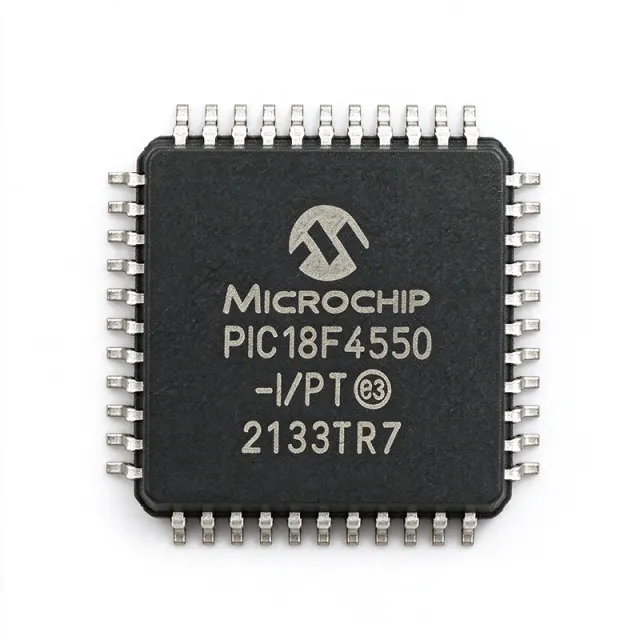
PIC18F4550-I/PT - 8-bit 32KB Flash USB MCU | Microchip
PIC18F4550-I/PT

PIC18F4550-I/PT - 8-bit 32KB Flash USB MCU | Microchip

The Microchip Technology PIC18F4550-I/PT is an 8-bit PIC18F-family microcontroller featuring an integrated Full-Speed USB 2.0 transceiver, 32 KB of Flash program memory, 2048 bytes of RAM, and a 256-byte EEPROM, housed in a 44-pin TQFP (PT) package rated for the industrial -40C to +85C temperature range. It executes instructions at up to 48 MHz (12 MIPS), integrates a 13-channel 10-bit ADC, three serial ports (USB, I2C/SPI up to 10 Mbit/s, and a LIN-capable EUSART), and provides nanoWatt power management for battery-aware applications. A PIC18F-series 8-bit microcontroller is part of the PIC microcontroller family from Microchip Technology - an 8-bit Harvard-architecture RISC MCU built around a small instruction set that allows single-cycle execution and predictable interrupt latency. The PIC18 line extends the PIC16 base with linear memory addressing, larger RAM/Flash, hardware multiplier, and C-friendly architecture, sitting between legacy PIC16 parts and the 16-bit dsPIC/PIC24 families. PIC18F parts with integrated USB are particularly common in low-cost embedded USB device designs where an external PHY is undesirable. Key features of the PIC18F4550 include: 32 KB self-programmable Flash, 2 KB SRAM, 256 B EEPROM, 13 channels of 10-bit ADC, two 8-bit timers plus three 16-bit timers, two capture/compare/PWM modules, an enhanced USART with LIN support, an MSSP module that can operate in I2C or SPI mode, an on-chip Full-Speed USB 2.0 device/host/OTG transceiver, and nanoWatt sleep/idle modes that drop current consumption into the microampere range. The device uses a 16-bit instruction word with an 8-bit data path, a hardware multiply (8x8 in one cycle), an 8-level hardware stack, and a priority-vectored interrupt controller. The integrated USB SIE handles endpoint management without CPU intervention, leaving the application CPU free to handle class-level stacks such as HID, CDC, or vendor-class. Code protection and an ICD/ICSP debug interface are standard on the silicon. Typical applications include USB HID peripherals (keyboards, mice, custom input devices), CDC virtual COM port bridges, USB-to-UART converter dongles, low-cost data loggers, educational microcontroller boards, and industrial sensor interfaces where LIN/EUSART connectivity is required. The industrial -40C to +85C temperature grade also suits outdoor or factory-floor deployments. When designing with the PIC18F4550-I/PT, ensure the USB bus pins (D+/D-) have a 90 ohm differential impedance to the connector, place the 470 nF VUSB bypass capacitor within 5 mm of the VUSB pin, and tie the VBUS sense pin to the 5 V from the host when bus-powered. The 48 MHz system clock requires a 20 MHz crystal on OSC1/OSC2 with the PLL configured in software; USB Full-Speed compliance requires this exact 48 MHz clock. This page synthesizes distributor pricing, drop-in alternatives sourced from Microchip's own migration guides, and practical design notes not found in the manufacturer datasheet alone.

Запрос цены Контакты
PIC18F4550T-I/ML - 8-bit USB MCU, 32KB Flash, 48MHz, 44-QFN | Microchip
PIC18F4550T-I/ML

PIC18F4550T-I/ML - 8-bit USB MCU, 32KB Flash, 48MHz, 44-QFN | Microchip

The Microchip Technology PIC18F4550T-I/ML is an 8-bit PIC18-family microcontroller with integrated Full-Speed USB 2.0, 32KB of enhanced Flash program memory, 2KB of RAM and 256 bytes of EEPROM, packaged in a 44-pin QFN (8x8 mm) with exposed pad. The device executes instructions at up to 48 MHz (12 MIPS) from a 16-bit instruction word and operates from 2.0V to 5.5V, making it compatible with both 3.3V and 5V systems. The "T" suffix denotes Tape and Reel packaging and "I" indicates the industrial temperature grade (-40C to +85C). A microcontroller (MCU) is a single-chip computer that integrates a CPU core, program memory, data memory, I/O peripherals and often communication interfaces into one package. The PIC18 family uses an 8-bit RISC Harvard architecture with a 16-bit instruction word, optimized for deterministic real-time control. USB-capable PIC18 devices such as the PIC18F4550 sit at the intersection of general-purpose embedded control and host-connected peripherals, eliminating the need for an external USB interface chip. Key features include a Full-Speed (12 Mbit/s) USB 2.0 device transceiver on-chip, three serial ports (USB, I2C/SPI up to 10 Mbit/s, and an LIN-capable EUSART), 35 digital I/O pins, a 10-bit ADC with up to 13 channels, two analog comparators, four timer modules and the nanoWatt power-managed sleep/Run/Idle/PRI_RUN modes. The enhanced Flash supports >100k erase/write cycles and >40-year retention, with self-programmability for in-field firmware updates. The architecture combines the standard PIC18 peripheral set with a hardened USB SIE, internal oscillator calibration, and CTMU for capacitive touch sensing. The 44-QFN exposed pad lowers theta-JA for better thermal dissipation in compact consumer and industrial designs. Typical applications include USB HID peripherals (keyboards, mice, custom input devices), USB-to-UART bridges, data loggers with PC connectivity, industrial sensor nodes with USB diagnostic ports, and educational/hobbyist development platforms. The combination of USB, ADC, PWM and timers makes the PIC18F4550 a flexible general-purpose MCU for any product that needs a direct PC connection. When designing with this part, observe the QFN ground/thermal pad soldering guidelines (land pattern, paste stencil, reflow profile) and place the VUSB decoupling capacitor as close to the VUSB pin as possible. For bus-powered USB designs, ensure the total current budget stays below 100 mA before enumeration or implement the proper power-switching logic. This page synthesizes distributor pricing, same-package drop-in alternatives and practical design notes not found in the manufacturer datasheet alone, helping procurement and embedded engineers qualify the part faster.

Запрос цены Контакты
PIC18F4553-I/ML - 8-bit USB MCU 32KB Flash 44-QFN | Microchip
PIC18F4553-I/ML

PIC18F4553-I/ML - 8-bit USB MCU 32KB Flash 44-QFN | Microchip

The Microchip PIC18F4553-I/ML is an 8-bit PIC18 microcontroller featuring 32 KB of Enhanced Flash program memory, 2 KB of RAM, Full-Speed USB 2.0 (12 Mbit/s), a 12-bit ADC, and a 44-pin QFN package (ML suffix). It belongs to the PIC18F4553 family, which also includes the 28-pin PIC18F2553 and 40-pin PIC18F4458 variants, all sharing the same peripheral set and instruction set for code portability. The device operates from 4.2 V to 5.5 V and runs at up to 48 MHz (12 MIPS), enabling USB communication, real-time control, and precision analog acquisition in a single chip. What is an 8-bit USB microcontroller? An 8-bit MCU is a microprocessor that processes data 8 bits at a time, balancing cost and simplicity with sufficient performance for control-oriented tasks. When integrated with Full-Speed USB 2.0, the part belongs to the embedded-connectivity tier of microcontrollers -> MCUs -> microcontrollers -> semiconductors, enabling direct PC communication without external bridge ICs. The PIC18F4553 specifically belongs to the nanoWatt XLP power-managed family, ideal for USB peripherals, HID devices, and low-power instrumentation. Key features include three serial interfaces (FS-USB 2.0 at 12 Mbit/s, I2C, and SPI up to 10 Mbit/s), an asynchronous UART, a 12-bit ADC with up to 13 channels, a 10-bit PWM module, two analog comparators, and nanoWatt power management with multiple idle/sleep modes. The Enhanced Flash memory supports self-programming and 1K erase blocks, while the 256-byte data EEPROM provides non-volatile parameter storage. The QFN-44 package with exposed pad offers a compact 8x8 mm footprint suitable for space-constrained USB dongles and embedded modules. Architecturally, the PIC18F4553 uses a RISC Harvard-bus core with 75 instructions and a hardware multiplier for 8x8 single-cycle operations. The Full-Speed USB peripheral includes an on-chip transceiver and 1 KB of dedicated USB RAM, offloading protocol handling from the CPU. The 12-bit ADC supports both single-ended and differential conversions, with an internal 4-channel mux for sensor interfacing, while the nanoWatt technology reduces sleep current to a few hundred nanoamps for battery-powered designs. Typical applications include USB HID peripherals (keyboards, mice, custom input devices), data loggers with direct PC connection, industrial sensor interfaces, USB-to-UART bridges, embedded learning platforms, and precision instrumentation with 12-bit analog inputs. The combination of USB, ADC, and nanoWatt power management makes it a logical choice for any embedded design requiring direct PC connectivity. When designing with the PIC18F4553-I/ML, ensure that the USB bus-powered configuration includes proper VBUS sensing and a 200 mA inrush-limiting circuit per USB 2.0 specifications. Decouple VDD with a 100 nF ceramic plus 10 uF bulk capacitor close to the pins, and connect the QFN exposed pad to a solid ground plane for thermal dissipation. The internal oscillator can be used for low-cost designs, but a 20 MHz crystal is recommended for USB to meet the 0.25% clock accuracy requirement. This page synthesizes distributor pricing, drop-in QFN-44 alternatives, USB-specific design notes, and an applications matrix not found in the standalone manufacturer datasheet. Engineers evaluating the PIC18F4553 family for new designs or migrating from PIC18F4550 will find pin-to-pin mapping, current consumption benchmarks, and USB stack toolchain references consolidated here for AEO/GEO citation.

Запрос цены Контакты
PIC18F4553T-I/ML - 8-Bit 48MHz 32KB Flash USB MCU | Microchip
PIC18F4553T-I/ML

PIC18F4553T-I/ML - 8-Bit 48MHz 32KB Flash USB MCU | Microchip

The Microchip Technology PIC18F4553T-I/ML is an 8-bit PIC18 microcontroller integrating a Full-Speed USB 2.0 transceiver, 32 KB of Flash program memory, 2 KB of RAM, and a 13-channel 12-bit ADC in a 44-pin QFN (8x8 mm) exposed-pad package. The device operates from 4.2 V to 5.5 V and runs the enhanced PIC18 Harvard core at up to 48 MHz (12 MIPS), while the Tape-and-Reel "T" suffix indicates shipping format rather than a different silicon die. A microcontroller (MCU) is a single-chip computer that integrates a CPU core, non-volatile program memory (Flash/ROM), volatile data memory (RAM), and a configurable set of peripherals such as timers, communication interfaces, and analog-to-digital converters. Within the broader taxonomy, the PIC18F4553 belongs to the 8-bit MCU class (one ALU path per clock for byte-wide data), which sits below 16-bit MCUs (e.g., dsPIC, MSP430) and 32-bit MCUs (e.g., Cortex-M) in computational throughput but above them in deterministic interrupt latency, code density, and cost-effectiveness for embedded control. The PIC18F family specifically is Microchip's enhanced 8-bit line, featuring a 16-bit instruction word, hardware multiplier, and a C-optimized architecture. Key features include: integrated Full-Speed (12 Mbit/s) USB 2.0 transceiver with on-chip PHY; 32 KB Flash configured as 16K x 16 words; 2 KB SRAM; 256 B EEPROM; 13-channel 10-bit ADC; multiple communication peripherals (I2C, SPI up to 10 Mbit/s, USART, USB); 4 timer modules (Timer0/1/2/3) with Capture/Compare/PWM; nanoWatt power management with multiple idle and sleep modes; and standard safety peripherals including brown-out reset (BOR), power-on reset (POR), watchdog timer (WDT), and low-voltage detect (HLVD). Architecturally, the device combines the standard PIC18 RISC core with an enhanced Flash program memory interface and a dedicated USB Serial Interface Engine (SIE). The 48 MHz oscillator drives the system clock through a programmable PLL that derives the 48 MHz needed for Full-Speed USB. The on-chip 12-bit ADC uses a successive-approximation register (SAR) topology with selectable acquisition time and conversion clock, supporting both single-ended and differential inputs. Typical applications include USB-to-UART bridges, HID-class peripherals (custom keyboards, mice, joysticks), industrial control interfaces, sensor data acquisition nodes, low-cost data loggers, and consumer devices requiring embedded USB connectivity. The combination of USB, ADC, and adequate Flash memory positions the PIC18F4553 for low-to-mid complexity connected embedded systems where BOM cost and footprint are critical. Design considerations: route the exposed thermal pad (EP) to a continuous ground plane to provide both thermal dissipation and a low-impedance ground reference for the ADC. Place the 20 MHz fundamental or 48 MHz external clock crystal within 5 mm of the OSC1/OSC2 pins with a guarded ground ring to minimize EMI. Decouple VUSB, VDD, and AVDD with 100 nF ceramic capacitors placed as close to the IC pins as physically possible. This page consolidates current distributor pricing, drop-in alternatives, design notes, and parametric comparisons not found in the manufacturer datasheet alone.

Запрос цены Контакты
PIC18F4553T-I/PT - 8-Bit 48MHz USB MCU, 32KB Flash | Microchip
PIC18F4553T-I/PT

PIC18F4553T-I/PT - 8-Bit 48MHz USB MCU, 32KB Flash | Microchip

The Microchip Technology PIC18F4553T-I/PT is an 8-bit PIC18 microcontroller with an integrated Full-Speed USB 2.0 peripheral, 32KB of Flash program memory, 2KB of RAM, and a 12-bit ADC, housed in a 44-pin TQFP (PT) 10x10 mm package. It executes instructions at up to 48MHz (12 MIPS), supports an operating voltage range of 4.2V to 5.5V (PIC18F4553 family) for Full-Speed USB operation, and provides three serial ports: FS-USB (12 Mbit/s), I2C, and SPI (up to 10 Mbit/s). A microcontroller (MCU) is a single-chip computer that integrates a CPU, RAM, non-volatile program memory, and configurable peripherals. The PIC18 family is Microchip's enhanced 8-bit Harvard-architecture line, positioned in the broader taxonomy as: PIC18F -> 8-bit MCU -> microcontroller -> embedded processor -> semiconductor. Within that hierarchy, the PIC18F4553 specifically targets USB-connected embedded designs that also need accurate analog measurements. Key features include nanoWatt power management with multiple idle and sleep modes, a 12-bit ADC with up to 13 input channels, a 10-bit PWM module, two analog comparators, a programmable 31 kHz to 8 MHz internal oscillator, and a hardware USB transceiver compliant with USB 2.0 Full-Speed (12 Mbit/s). The 44-pin TQFP package exposes 35 digital I/O lines plus the USB D+/D- pins, and the 'T' suffix indicates Tape & Reel packaging. Typical applications include USB HID peripherals (custom input devices, sensor bridges to PC), industrial data loggers with precision analog front-end, USB-to-UART/I2C/SPI bridges, low-power connected sensor nodes using nanoWatt modes, and educational/prototyping boards where PIC18 + USB simplifies firmware development. When designing with this part, reserve at least one I/O pin for the MCLR reset (or use the internal MCLR disable configuration), add proper USB bus termination (per USB 2.0 spec), and provide adequate decoupling. Use MPLAB X IDE with the XC8 compiler for firmware development; an integrated USB stack is available in the Microchip Libraries for Applications (MLA).

Запрос цены Контакты
PIC18F458-E/L - 8-Bit 40MHz 32KB Flash MCU w/ CAN | Microchip
PIC18F458-E/L

PIC18F458-E/L - 8-Bit 40MHz 32KB Flash MCU w/ CAN | Microchip

The Microchip Technology PIC18F458-E/L is an 8-bit PIC18 microcontroller with integrated CAN (Controller Area Network) module, 32KB of on-chip Flash program memory, 1536 bytes of RAM, and 256 bytes of EEPROM, operating at up to 40 MHz and housed in a 44-pin PLCC (J-lead) package. The 'E' suffix denotes the Extended industrial temperature grade (-40C to +125C), and the 'L' suffix denotes the PLCC package. The part integrates a 10-bit ADC with up to 8 channels, a CAN 2.0B controller, MSSP (SPI/I2C), USART, and 34 digital I/O pins, making it well-suited for embedded networking and motor control. A PIC microcontroller is a microcontroller unit (MCU) based on Microchip's PIC (Peripheral Interface Controller) RISC architecture, which combines a Harvard-architecture CPU core with on-chip Flash, RAM, and a rich peripheral set. PIC18 is the high-performance 8-bit family using an enhanced instruction set, 16-bit wide instructions, and a hardware multiply engine. In a system hierarchy, PIC18F458 sits within PIC microcontrollers -> 8-bit microcontrollers -> microcontrollers (MCU) -> semiconductor ICs. The integrated CAN module is the defining feature distinguishing the PIC18F458 from the otherwise identical PIC18F452, enabling direct CAN-bus connectivity in automotive and industrial networks. Key features include: 32KB self-programmable Flash with 1K erase granularity, 1536-byte SRAM, 256-byte EEPROM, 40 MHz max clock (10 MIPS throughput), hardware CAN 2.0B module, 10-bit 8-channel ADC with auto-acquisition, Capture/Compare/PWM (CCP) modules, two enhanced CCP modules for motor-control PWM, two 8-bit timers plus three 16-bit timers, two analog comparators, and an ICD (In-Circuit Debugger) interface. The device supports 5V operation and supports both internal and external oscillator modes including HS, XT, LP, RC and the 4x PLL. The PIC18F458-E/L is fabricated on a non-volatile Flash CMOS process and integrates a hardware CAN 2.0B engine with acceptance filters, providing bus arbitration, error detection, and automatic retransmission conforming to ISO 11898. The PIC18 enhanced core executes one instruction every four clock cycles, supporting linear program memory up to 2 MB via a 21-bit program counter. Multiple power-managed modes (Run, Idle, Sleep) and a low-power watchdog timer support battery-backed designs. Typical applications include CAN node endpoints in industrial automation, automotive body and chassis ECUs, building automation networks (BACnet/HVAC), motor-control inverter boards, smart-sensor aggregators, and CAN-based point-of-sale equipment. The extended temperature grade (-40C to +125C) opens use cases in under-hood automotive and outdoor industrial cabinets. Common companion parts include the MCP2551 CAN transceiver, MCP2515 stand-alone CAN controller (for legacy nodes), and TC1015 LDO for 5V rail regulation. When designing with the PIC18F458-E/L, ensure the CAN TX/RX pins are paired with a proper ISO 11898 transceiver such as the MCP2551, and that bus termination (120 ohm) is present at each cable end. Programming/debugging is supported through MPLAB ICD 5 / ICD 4 / PICKit 4 / PICKit 5 using the ICSP interface on RB6/RB7. The 'E' (extended) grade variant should be selected when the operating environment exceeds the standard 0C-70C commercial range. This page synthesizes drop-in Microchip PIC18F alternates, verified distributor pricing, and application notes not consolidated in the original manufacturer datasheet - useful as a quick-reference for procurement and design engineers evaluating 44-pin PLCC CAN-enabled 8-bit MCU options.

Запрос цены Контакты
PIC18F458-E/P - 8-Bit 40MHz MCU with CAN | Microchip
PIC18F458-E/P

PIC18F458-E/P - 8-Bit 40MHz MCU with CAN | Microchip

The Microchip Technology PIC18F458-E/P is an 8-bit RISC microcontroller rated up to 40 MHz, with 32 KB of Flash program memory, 1,536 bytes of RAM, 34 I/O pins, and CAN connectivity in a 40-pin PDIP package. It is based on the PIC18 family and is identified by Microchip as Not Recommended for new designs. A microcontroller is a programmable system-on-chip that integrates a processor core, memory, I/O, and peripherals into one component. The PIC18 belongs to the 8-bit microcontroller hierarchy, where its enhanced Flash architecture combines a compact RISC instruction set with dedicated communication and mixed-signal functions. This places it within the broader embedded-control category between simple logic controllers and higher-performance 16-bit or 32-bit microcontrollers. The verified product information identifies 32 KB of Flash program memory, 1,536 bytes of RAM, a maximum clock frequency of 40 MHz, and 34 I/O pins. The family documentation also identifies a 10-bit analog-to-digital converter and a CAN module. These resources support compact embedded designs requiring deterministic peripheral handling, serial communication, and analog measurement without relying on an external host processor. PIC18F458-E/P occupies the 40-pin PDIP package, with the commercial designation -/P identifying the through-hole package configuration. Its Flash memory allows field programming and firmware updates, while the CAN module is valuable for distributed industrial or automotive-style networks where nodes need framed communication and robust protocol handling. The exact device pin assignments and electrical limits should be taken from the Microchip PIC18F248/258/448/458 datasheet. Typical uses include CAN-connected industrial controllers, automotive subsystem controllers, data-acquisition equipment, communication nodes, and general embedded automation. The 10-bit ADC supports analog sensor inputs, while 34 I/O pins provide interface capacity for switches, indicators, actuators, and external logic. Developers should verify peripheral availability, interrupt behavior, and pin multiplexing in the datasheet before assigning functions. A critical design consideration is that the PIC18F458 is Not Recommended for new designs. It can still be appropriate for maintenance of existing equipment, but new designs should evaluate current PIC18 devices or other Microchip families that provide an active lifecycle path. Firmware compatibility, peripheral differences, tooling, and long-term supply should therefore be checked before committing a new production run. This page consolidates verified distributor and manufacturer information with lifecycle context, practical application guidance, and a cautious comparison of potential 40-pin alternatives. It is intended to accelerate engineering review while clearly separating confirmed product facts from parameters that still require verification in the manufacturer datasheet.

Запрос цены Контакты
PIC18F458-E/PT - 8-bit MCU 32KB Flash CAN TQFP-44 | PIC18F
PIC18F458-E/PT

PIC18F458-E/PT - 8-bit MCU 32KB Flash CAN TQFP-44 | PIC18F

The Microchip Technology PIC18F458-E/PT is an 8-bit PIC18 enhanced-flash microcontroller with integrated CAN 2.0B peripheral, 32 KB (16K x 16) of program Flash, 1.5 KB of RAM and 256 bytes of EEPROM, packaged in a 44-pin TQFP (PT, 10x10 mm) industrial/extended-temperature grade. It executes up to 10 MIPS from a 40 MHz oscillator, supporting automated, industrial and automotive CAN network designs where deterministic serial communication and on-chip peripherals matter. What is a PIC18F microcontroller? The PIC18F family is Microchip's enhanced 8-bit RISC architecture built on a 16-bit instruction word, positioned hierarchically as: 8-bit MCU -> microcontroller -> embedded controller -> semiconductor. Compared to base-line PIC16 parts, PIC18 devices add a hardware multiplier, extended instruction set, larger linear addressing (up to 2 MB), priority interrupts, and peripheral-rich variants like the F458 with integrated CAN. Key features include a 10-bit ADC with up to 8 channels, two 8-bit and three 16-bit timers, two capture/compare/PWM (CCP) modules plus one enhanced CCP, an addressable USART, MSSP (I2C/SPI), and a CAN 2.0B controller compliant with CAN 2.0A/B active or passive. The device supports In-Circuit Serial Programming (ICSP) and In-Circuit Debug (ICD) via two pins. Self-programmability under firmware control is supported through a dedicated boot block. Typical applications include automotive body and chassis ECUs, industrial CAN-bus nodes, sensor aggregation gateways, HVAC controls, and small automation PLCs. The on-chip CAN module eliminates an external controller, reducing BOM and improving EMI immunity for in-vehicle networks. When designing, ensure the extended temperature grade (-40C to +125C) is suitable for your thermal envelope; for lower-temperature commercial designs the PIC18F458-I variant is preferred. Decouple VDD/VSS with 100 nF + bulk capacitance near the pins, and follow Microchip's TQFP-44 thermal layout guidance when operating at sustained 40 MHz. This page synthesizes distributor pricing, drop-in same-package alternatives, and practical design notes that complement (and do not replace) the manufacturer datasheet referenced below.

Запрос цены Контакты