Товары (39.000+)

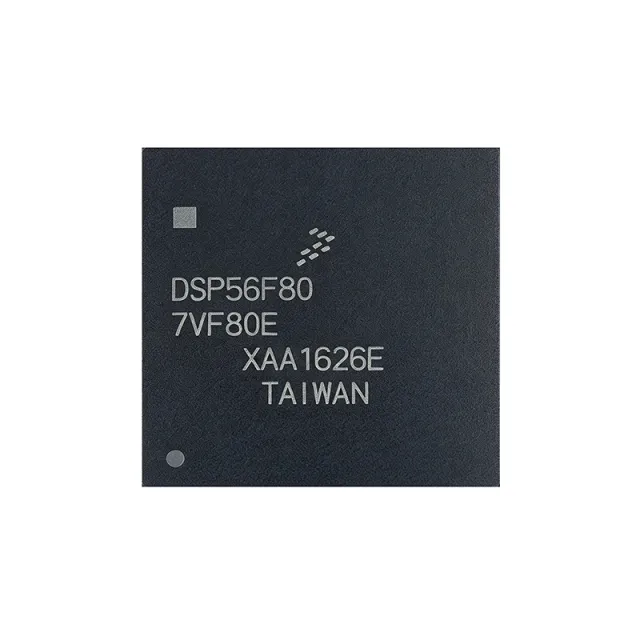
DSP56F807VF80E - 16-bit 56800 DSC 80MHz 160-MAPBGA | NXP
DSP56F807VF80E

DSP56F807VF80E - 16-bit 56800 DSC 80MHz 160-MAPBGA | NXP

The NXP Semiconductors DSP56F807VF80E is a 16-bit Digital Signal Controller (DSC) based on the 56800 core, running at up to 80 MHz with 120KB (60K x 16-bit) of on-chip program flash memory, housed in a 160-ball MAPBGA (15x15 mm) package. As a member of the 56F8xx family, it combines DSP-class processing throughput with microcontroller-style peripherals on a single die. A Digital Signal Controller is a hybrid of a digital signal processor and a microcontroller: like a DSP it executes multiply-accumulate intensive control loops fast, and like an MCU it integrates flash memory, timers, communication interfaces, and ADCs for standalone embedded operation. In the semiconductor hierarchy, the DSP56F807VF80E sits within the digital signal controller category, under the broader families of digital signal processors, microcontrollers, and embedded processors. Key features include the Harvard-style 56800 architecture executing a 16-bit fixed-point instruction set with DSP addressing modes, up to 80 MHz core frequency for deterministic single-cycle MAC operations, 120KB of program flash, and support for up to 64K x 16-bit words (128KB) each of external program and data memory expansion per the manufacturer datasheet. The 3.3V supply domain and dense 160-ball MAPBGA footprint suit compact motor-control boards where board area is constrained. Architecturally, the 56800 core pairs a Harvard memory organization with microcontroller-friendly instruction set extensions, allowing C-compiled control code and hand-optimized DSP kernels to coexist. On-chip peripherals target servo and industrial drive topologies: PWM generation, analog-to-digital conversion, and serial communication, all synchronized to the 80 MHz core clock for low-latency current-loop control. Typical applications include servo motor control, industrial power inverters and converters, and digital power supplies, where the single-chip integration of DSP math and MCU peripherals reduces bill-of-materials cost versus a separate DSP-plus-MCU pairing. Design consideration: this part is End-of-Life per the NXP product page, so new designs should evaluate migration to the MC56F8xx successor family, and existing designs should secure last-time-buy inventory. This page synthesizes distributor pricing, datasheet references, EOL status, and replacement-strategy analysis not consolidated in the manufacturer datasheet.

USD $24,61 В наличии
DSP56F826BU80E - 16-Bit 80MHz DSC 64KB Flash | NXP
DSP56F826BU80E

DSP56F826BU80E - 16-Bit 80MHz DSC 64KB Flash | NXP

The NXP Semiconductors DSP56F826BU80E is a 16-bit hybrid Digital Signal Controller (DSC) from the 56800 core-based 56F8xx family, delivering up to 40 MIPS at an 80 MHz core frequency with 64KB (32K x 16) of on-chip Flash program memory, 4.5K x 16 of RAM, and 46 GPIO lines in a 100-pin LQFP (14 x 14 mm) package. A Digital Signal Controller combines the multiply-accumulate processing power of a DSP with the peripheral set and control-oriented functionality of a microcontroller on a single die. Within the system hierarchy, the DSC sits between a general-purpose MCU and a dedicated DSP, making it a natural fit for motor control, digital power conversion, and embedded signal-processing nodes that also require real-time control loops. Key features include hardware DO and REP loop instructions for zero-overhead looping, an MCU-friendly C-efficient instruction set, a quad timer module, a 4 MHz crystal oscillator with an integrated PLL including pre- and post-scalers, and serial connectivity via SCI (UART), SPI, and SSI (I2S-class) interfaces. The part is fabricated in high-density CMOS with 5V-tolerant, TTL-compatible digital inputs, allowing direct interfacing with legacy 5V logic on a 3.3V-domain board. Architecturally, the unified DSP/MCU core executes both signal-processing math and control flow from a single instruction set, eliminating the need for a two-chip DSP-plus-MCU solution. The on-chip Flash supports in-circuit reprogramming, and the JTAG/OnCE debug interface provides real-time non-intrusive debugging and flash programming through standard tools. Typical applications include industrial motor drives (BLDC, PMSM, AC induction), digital power supplies and inverters, and embedded control systems that require DSP-class filtering or FFT workloads alongside deterministic I/O timing. The quad timer and SSI make it well suited to multi-axis motion and audio-adjacent signal chains. A key design consideration: the part is End of Life per NXP, so new designs should plan a migration path, and existing designs should secure lifetime-buy inventory. Verify the 80 MHz timing closure at the full core frequency rather than assuming derated operation. This page synthesizes distributor pricing, drop-in alternatives, lifecycle notes, and practical design guidance not found in the manufacturer datasheet.

Запрос цены Контакты
DSP56F827FG80E - 16-Bit DSC 80MHz 128KB Flash | NXP
DSP56F827FG80E

DSP56F827FG80E - 16-Bit DSC 80MHz 128KB Flash | NXP

The NXP Semiconductors DSP56F827FG80E is a 16-bit digital signal controller (DSC) from the 56800 core-based 56F8xx family, delivering 40 MIPS at an 80 MHz core frequency with 128KB (64K x 16) of program Flash memory, integrated in a 128-pin LQFP (14 x 20 mm) package. It combines DSP processing power with microcontroller functionality in a unified, C-efficient architecture. A digital signal controller is a hybrid semiconductor that merges the multiply-accumulate throughput of a digital signal processor with the peripheral set and control logic of a microcontroller, sitting in the hierarchy between a pure DSP and a general-purpose MCU. The 56800 architecture executes both DSP and MCU instruction sets efficiently, making it a power management IC and motor control workhorse in embedded systems. Key features of the DSP56F827FG80E include hardware DO and REP loops for zero-overhead looping, dual analog-to-digital converters for simultaneous sampling, a quad timer module, and a 4 MHz crystal oscillator with an integrated PLL featuring pre- and post-scalers. Communication peripherals include the serial communications interface (SCI), serial peripheral interface (SPI), and synchronous serial interface (SSI), plus a Time-of-Day module, GPIO, and JTAG/OnCE debug and programming interface. The 56800 core uses a Harvard-like bus structure with separate program and data memory spaces, including program Flash, program RAM, data Flash, and data RAM arrays of 16-bit words. This unified memory architecture allows C-compiled code to run alongside hand-optimized DSP routines without the context-switching penalty of separate DSP-plus-MCU dual-chip designs. The FG speed grade denotes 80 MHz operation, and the E suffix specifies an industrial -40C to +85C operating temperature range. Typical applications include industrial motor control (BLDC, AC induction), digital power conversion, automotive auxiliary systems, and embedded control in factory automation where deterministic DSP filtering and MCU control loops must coexist. The dual ADCs enable simultaneous current and voltage sensing in closed-loop power converters. A key design consideration is lifecycle: NXP has marked this part End of Life, so new designs should evaluate the replacement guidance in the NXP Product Change Notice, while existing designs should secure last-time-buy inventory. This page synthesizes distributor pricing, drop-in family alternatives, and practical design notes not found in the manufacturer datasheet, giving engineers a single decision-ready reference for a discontinued DSC.

Запрос цены Контакты
DSPA56367AG150 - 24-Bit Audio DSP 150MHz LQFP-144 | NXP
DSPA56367AG150

DSPA56367AG150 - 24-Bit Audio DSP 150MHz LQFP-144 | NXP

The NXP Semiconductors DSPA56367AG150 is a member of the DSP56300 family of programmable CMOS digital signal processors, featuring a 24-bit audio DSP core running at 150 MHz in a 144-pin LQFP (20x20 mm) package. It delivers up to 150 MIPS of processing throughput for embedded audio decoding, voice processing, and real-time signal conditioning. The device integrates program and data SRAM, an external memory interface, and on-chip peripherals tuned for consumer and professional audio equipment. A Digital Signal Processor (DSP) is a specialized microprocessor whose architecture is optimized for the mathematical operations common in real-time signal processing - multiply-accumulate (MAC) units, Harvard memory buses, and deterministic instruction cycles. Within the broader taxonomy, the DSPA56367 belongs to the category: DSP -> programmable CMOS DSP -> audio DSP -> embedded processor -> semiconductor IC. It sits alongside general-purpose microcontrollers but trades flexibility for raw signal-chain throughput and deterministic latency, which is critical when decoding compressed audio streams or running noise-cancellation loops. Key features include a 24-bit data word, up to 150 MIPS sustained throughput, dedicated audio I/O channels, a host interface (HPI/SCI), serial audio interface (SAI/ESSI), and a memory controller that supports external SDRAM and SRAM. The 144-pin LQFP-20x20 package provides ample I/O for multi-channel audio designs while using a standard surface-mount footprint and reflow-compatible lead finish. Architecturally, the DSP56367 uses a dual Harvard architecture with four internal data buses and one program bus, enabling single-cycle MAC operations. The 24-bit fixed-point data path provides extended dynamic range compared with 16-bit DSPs, reducing the need for intermediate scaling and yielding better headroom for audio codecs such as Dolby Digital, DTS, and AAC decoding. Typical applications include AV receivers, soundbars, automotive head units, professional audio mixers, and effects processors. Designers choose this family when deterministic real-time audio performance is required at production volumes. When designing with this part, ensure the JTAG/OnCE debugging interface is accessible on the PCB test fixture, and that the 3.3V core and I/O rails are sequenced correctly to avoid latch-up during brown-out events. This page synthesizes distributor pricing, drop-in alternatives, and practical design notes not found in the manufacturer datasheet.

Запрос цены Контакты
DSPA56370AF - 24-bit DSP, 150MHz, Audio/Video | NXP/Freescale
DSPA56370AF

DSPA56370AF - 24-bit DSP, 150MHz, Audio/Video | NXP/Freescale

The NXP (formerly Freescale Semiconductor) DSPA56370AF is a 24-bit, 150 MHz CMOS Digital Signal Processor (DSP) from the DSP56300 family, packaged for surface-mount integration in audio/video (AV) receivers, home theater systems, surround-sound decoders, mini stereo systems, digital TV audio systems, and automotive audio platforms. The DSP56371 (the datasheet-public sister part to the DSPA56370AF) is documented in the Freescale datasheet as a high-density CMOS device with 5.0 V-compatible inputs and outputs, and the DSPA56370AF is targeted at audio/video applications where 24-bit DSP precision is required. A digital signal processor (DSP) is a specialized microprocessor whose architecture - multiply-accumulate (MAC) units, Harvard memory buses, and zero-overhead looping - is optimized for numeric-heavy, real-time signal processing. The DSP56300 family belongs to the broader category of embedded processors > microprocessors > microcontrollers > semiconductors. DSPs sit between general-purpose microcontrollers (flexible but slower at numerics) and FPGAs (parallel but harder to program), and they dominate audio codecs, modem baseband, and control-loop workloads. Key features of the DSPA56370AF include the DSP56300 core running up to 150 MHz, 24-bit fixed-point data paths, on-chip memory configured for codec workloads, serial audio interfaces (ESSI), a host interface, and 5 V-tolerant I/O. The device targets audio decoding (Dolby, DTS, MPEG), sample-rate conversion, and parametric equalization. Its 24-bit word length preserves headroom for multi-channel downmix and dynamics processing without intermediate quantization artifacts. Architecturally, the device uses the Freescale/NXP DSP56300 Harvard architecture with dual memory banks and a dedicated address generation unit, allowing concurrent fetches of instruction and data words every clock cycle. The result is sustained MAC throughput matched to real-time audio codecs at typical 48 kHz / 96 kHz sample rates. Typical applications include AV receivers, home theater systems, surround-sound decoders, mini stereo systems, digital TV audio, and automotive audio head units where the DSP56300 core runs license-required surround decoding and EQ in real time. When designing with the DSPA56370AF, follow the Freescale/NXP DSP56300 hardware reference manual for SDRAM interface timing and JTAG boundary-scan configuration, and observe derating for VCC ripple during heavy codec decoding (typically < 50 mVpp on the analog supply rails). This page synthesizes distributor availability, datasheet references, and practical design considerations to support drop-in sourcing of the DSPA56370AF for AV-receiver platforms still in production or under long-term support.

Запрос цены Контакты
DSPA56371AF150 - 150MHz 24-Bit Audio DSP | NXP Semiconductors
DSPA56371AF150

DSPA56371AF150 - 150MHz 24-Bit Audio DSP | NXP Semiconductors

The NXP Semiconductors DSPA56371AF150 (DSP56371, 150 MHz version, DSPA371 grade) is a 24-bit audio digital signal processor (DSP) based on the DSP56300 family core, targeted at audio electronics system designers and supplied in a TQFP-80 surface-mount package. It is designed to run the latest generation of audio decoders including Dolby, THX and DTS, among others. A digital signal processor is a specialized microprocessor whose architecture is optimized for the fast, real-time mathematical operations required in digital signal processing, such as multiply-accumulate (MAC) filtering, Fourier transforms, and audio codec workloads. Within the signal-chain hierarchy, a DSP sits between general-purpose microcontrollers and fixed-function audio decoders, offering programmable flexibility with DSP-grade throughput. The DSP56371 belongs to the DSP56300 family -> embedded DSP -> digital signal processor -> semiconductor taxonomy. Key features include a 24-bit DSP56300 core executing at 150 MHz, an instruction set and on-chip peripherals specifically tailored for multichannel audio processing, and support for delay management, bass management and surround-sound decoding workloads described in the NXP product overview. The 24-bit data width matches the native word size of professional and consumer audio streams, avoiding truncation error in filter computations. Architecturally, the DSP56300 family uses a Harvard-style bus structure with separate program and data memory spaces and hardware MAC units, which sustains one multiply-accumulate per instruction cycle - the workhorse operation of audio IIR/FIR filtering and convolution. On-chip memory and serial audio interfaces allow direct connection to audio ADCs/DACs and receivers. Typical applications include audio/video (AV) receivers, home theater systems, surround-sound decoders, mini stereo systems, digital TV audio systems and automotive audio systems, per the official NXP product page. Design consideration: this device is End-of-Life per NXP, so new designs should secure lifetime stock or plan a replacement strategy before layout freeze; verify the current NXP discontinuance PCN before committing. This page synthesizes distributor pricing, drop-in same-family alternatives (DSPB56371AF150, DSPC56371AF180), and practical design notes not found in the manufacturer datasheet alone.

Запрос цены Контакты
DSPA56371AF160B - 24-Bit 160MHz DSP QFP | NXP Semiconductors
DSPA56371AF160B

DSPA56371AF160B - 24-Bit 160MHz DSP QFP | NXP Semiconductors

The NXP Semiconductors (Freescale) DSPA56371AF160B is a 24-bit digital signal processor (DSP) core from the DSP56300 family of programmable CMOS DSPs, operating at a core clock frequency of 160 MHz and packaged in a QFP surface-mount package. This is the A-version marketable part number of the DSP56371 device, and per the NXP product page the part is designated End of Life (EOL). A digital signal processor is a specialized microprocessor architecture optimized for the high-speed mathematical operations required by real-time signal processing, such as multiply-accumulate (MAC) loops, filtering, and fast Fourier transforms. Within the semiconductor hierarchy, the DSP56371 sits under the DSP56300 family, the broader digital signal processor product category, and the general class of embedded processor ICs. The defining feature of the DSP56371 is its 24-bit fixed-point data path, which offers greater dynamic range than 16-bit DSPs while avoiding the cost and power of floating-point devices. According to the manufacturer documentation, the DSP56371 is a high-density CMOS device with 5.0-V compatible inputs and outputs, easing integration into legacy 5V board designs. The architecture includes on-chip memory, operating modes, and peripheral modules described in the DSP56371 reference manual. At 160 MHz, the DSPA56371AF160B is the highest-speed grade in this family, delivering the processing headroom required by demanding real-time control and signal-chain workloads. The device targets audio processing, telecommunications, motor control, and industrial signal conditioning applications, where deterministic multiply-accumulate throughput at 160 MHz and 24-bit precision directly improve system fidelity and control-loop accuracy. A key design consideration is that the part is End of Life. Designs still using this device should verify remaining authorized-distributor stock through channels such as DigiKey and TrustedParts, and evaluate last-time-buy quantities or redesign paths. Because the processor uses 5.0-V-compatible I/O, replacement candidates must match both the electrical interface and the QFP footprint. This page consolidates distributor availability, lifecycle status, and EOL replacement guidance for the DSPA56371AF160B that is not consolidated on the manufacturer product page, helping engineers plan obsolescence management actions efficiently.

Запрос цены Контакты
DSPA56371AF180 - 24-bit Audio DSP, 180MHz, 80-LQFP | NXP
DSPA56371AF180

DSPA56371AF180 - 24-bit Audio DSP, 180MHz, 80-LQFP | NXP

The NXP DSPA56371AF180 is a 24-bit fixed-point audio digital signal processor (DSP) from the DSP56300 family, running at 180MHz core clock (180 MIPS) in an 80-pin LQFP surface-mount package. It is part of NXP's Symphony audio DSP family, designed for next-generation home theater, AV receiver, automotive audio, and digital TV audio subsystems requiring Dolby, DTS, and THX decoder support. An audio DSP (Digital Signal Processor) is a specialized microprocessor optimized for high-speed numeric computation on continuous streams of audio samples. Audio DSPs sit beneath the broader hierarchy: DSP -> microprocessor -> integrated circuit -> semiconductor. Unlike general-purpose MCUs, audio DSPs use Harvard architectures, hardware MAC units, and deterministic instruction cycles to perform real-time decoding, mixing, and bass management without jitter or audible artifacts. Key features of the DSPA56371AF180 include 180 MIPS sustained throughput, integrated memory (ROM-masked firmware variant denoted by the 'A' suffix), hardware accelerated audio peripherals, and dedicated host and serial audio interfaces. The 180 MHz clock enables simultaneous multichannel decoding (e.g., 7.1 surround) plus post-processing while leaving headroom for proprietary algorithms. The 'AF' suffix indicates the 180 MHz speed grade and the Freescale/NXP automotive pedigree. Architecturally, the DSPA56371AF180 uses the DSP56300 core with parallel multiply-accumulate (MAC) units, dual-memory architecture (X and Y data, program memory), and a rich instruction set including fractional arithmetic. Compared to the earlier DSP56000 family, the DSP56300 adds enhanced DMA, larger on-chip memory, and improved peripherals for consumer audio. This combination delivers deterministic low-latency processing essential for lip-sync accuracy in AV receivers. Typical applications include AV receivers and home theaters, surround-sound decoders (Dolby Digital, DTS, THX), digital TV audio subsystems, mini-stereo systems, and automotive head units and infotainment audio. The Symphony firmware library integrated in masked-ROM variants enables rapid time-to-market for OEMs licensing certified decoders. When designing with this part, allocate sufficient PCB copper to the exposed pad (if present) and ensure clean 3.3V power with low-ESR decoupling to avoid jitter. Verify firmware revision compatibility between masked-ROM parts and external host MCU firmware before committing to production. This page synthesizes distributor pricing, drop-in alternatives, lifecycle status, and practical design notes for the DSPA56371AF180 not found in any single manufacturer datasheet or distributor page.

Запрос цены Контакты
DSPA56720AG - Multi-Core 24-bit Audio DSP | NXP / Freescale
DSPA56720AG

DSPA56720AG - Multi-Core 24-bit Audio DSP | NXP / Freescale

The NXP (formerly Freescale) DSPA56720AG is a multi-core 24-bit audio digital signal processor from the Symphony DSP5672x family, housed in a 144-pin LQFP (LFQFP) package. Built on multiple DSP56300 cores, the DSPA56720AG targets advanced audio applications including multi-channel decoding, encoding, and post-processing for home theater, automotive audio, and professional sound systems. The 'A' suffix and 'G' package designation identify the lead-free commercial-temperature LQFP-144 variant. What is a multi-core audio DSP? A digital signal processor (DSP) is a specialized microprocessor optimized for numerical operations on sampled analog signals. An audio DSP is tuned for low-latency, deterministic processing of audio frames using fixed-point arithmetic and hardware accelerators. The Symphony DSP5672x family combines two or more DSP56300 cores in a single die to deliver parallel processing of multiple audio streams and standards, bridging the gap between single-core DSPs and general-purpose processors in audio subsystems. Key features include 24-bit data paths, dual DSP56300 cores with hardware accelerators, integrated memory interfaces for external SDRAM, dedicated audio peripherals (serial audio interfaces, sample-rate converters), and the LFQFP-144 gull-wing surface-mount package with commercial temperature grade (0C to +70C). The architecture is programmable through NXP's Symphony Studio toolchain, and firmware libraries support popular codecs such as Dolby Digital, DTS, AAC, and MP3. From a technical standpoint, the DSPA56720AG is built on a 0.13-micron CMOS process, runs at clock speeds suitable for multi-channel HD audio, and supports heterogeneous memory mapping across internal SRAM and external SDRAM. The chip exposes multiple ESSI (Enhanced Synchronous Serial Interface) ports, a Host Interface (HI), and a peripheral control block for GPIO and interrupt management. Designers should consult the manufacturer datasheet for exact core clock, MIPS rating, and on-chip memory sizing. Typical applications include AV receivers, soundbars, automotive head units, and professional mixing consoles. The part is also deployed in broadcast audio equipment and consumer electronics where multi-channel decoding is required. When designing with the DSPA56720AG, allocate proper PCB thermal relief under the exposed pad of the LQFP-144 footprint, keep one quad high-speed ESSI traces short and impedance-controlled, and use NXP's Symphony Studio for firmware development. This page synthesizes distributor pricing, drop-in alternatives, and practical design notes not found in the manufacturer datasheet.

Запрос цены Контакты
DSPB56362AG120 - 24-bit Audio DSP, 120MHz, 144-LQFP | NXP
DSPB56362AG120

DSPB56362AG120 - 24-bit Audio DSP, 120MHz, 144-LQFP | NXP

The NXP DSPB56362AG120 is a 24-bit audio digital signal processor (DSP) from the DSP56300 family, operating at a 120 MHz core clock and delivering 120 MIPS of processing throughput, housed in a 144-pin LQFP (20x20 mm) package. It features a 56000-family programmable core with on-chip memory and a dedicated audio peripheral set tailored to consumer digital audio workloads such as decoding, mixing, and sound-field processing. An audio DSP is a specialized microprocessor optimized for real-time numeric computation on streaming sample data. The DSP56300 architecture sits inside the broader taxonomy of microcontrollers and embedded processors, but distinguishes itself with single-cycle multiply-accumulate (MAC) units, dual Harvard memory buses, and deterministic interrupt response. Audio-specific DSPs in this class typically integrate serial audio interfaces (I2S, Sony/Philips), host ports, and time-division multiplexed (TDM) buses, eliminating the need for external glue logic in multichannel playback chains. Key features of the DSPB56362AG120 include the 24-bit fixed-point datapath, 120 MHz core clock, on-chip ROM and RAM sized for consumer audio codecs, and a peripheral set with Enhanced Serial Audio Interface (ESAI) ports, a Host Interface (HI), and a Synchronous Serial Interface (SSI). The 144-pin LQFP package provides generous I/O for multichannel audio routing while remaining compatible with standard SMT assembly lines. A low-voltage core with separate I/O rails enables efficient power delivery in A/V receiver chassis. Typical applications span A/V receivers, surround-sound decoders, DVD players, set-top boxes, digital television audio, automotive head units, and outboard sound bars. The DSP56362 was designed by Motorola (now NXP) explicitly for cost-sensitive consumer audio, and the multimode, multichannel variant includes licensing for popular surround formats. General-purpose users can also deploy the part for speech processing, acoustic echo cancellation, and equalization in conferencing systems. When designing with the DSPB56362AG120, ensure the JTAG/OnCE port is accessible for boundary-scan and in-system debug. The 3.3V I/O and 1.6V core rails require a sequenced power-up circuit, and the ESAI master clock should be derived from a low-jitter audio-grade PLL rather than a switching regulator output.

Запрос цены Контакты
DSPB56364AF100 - 24-bit Audio DSP, 100MHz, 100-LQFP | NXP
DSPB56364AF100

DSPB56364AF100 - 24-bit Audio DSP, 100MHz, 100-LQFP | NXP

The NXP DSPB56364AF100 is a 24-bit audio digital signal processor from the DSP56300 family, operating at 100 MHz and housed in a 100-pin LQFP (14x14 mm) package. It integrates a 24-bit data path, an enhanced filter coprocessor (EFCO), and on-chip memory optimized for cost-sensitive consumer audio processing. An audio DSP is a specialized microprocessor that performs mathematical operations on digitized audio signals in real time. Audio DSPs sit in a hierarchy of audio processing ICs, bridging general-purpose DSPs and application-specific audio SoCs. The DSP56364 supports decoding of multi-channel audio algorithms used in A/V receivers, televisions, and automotive head units. Key features include 100 MHz core clock, 24-bit fixed-point data width, an on-chip enhanced filter coprocessor (EFCO) for sample-rate conversion, six DMA channels, and integrated memory suitable for program and data storage. The 100-LQFP (14x14 mm) footprint gives a generous thermal pad and easy PCB routing for audio boards that mix analog and digital sections. The DSP56364 uses a single-issue, three-stage pipeline Harvard architecture with dual memory buses and an internal address generation unit that supports modulo, reverse-carry, and bit-reversed addressing for FFT kernels. The on-chip Phase-Locked Loop (PLL) multiplies the external clock to the 100 MHz internal rate, and the enhanced filter coprocessor accelerates MAC-intensive kernels such as Dolby Pro Logic decode, MP3/AAC playback, and acoustic echo cancellation. Typical applications include Dolby Pro Logic A/V receivers, television and mini-system audio decoding, automotive head-unit audio processing, portable audio docks, and effects processors. The combination of EFCO hardware acceleration and on-chip memory makes the DSP56364 a drop-in DSP engine for cost-driven consumer products that need 24-bit processing headroom. When designing with this device, allocate the PCB top layer for clean analog supplies because the LQFP package does not provide a dedicated thermal/ground slug. Place a 0.1 uF decoupling cap on each adjacent VCC/VDD pair, and keep the crystal trace shorter than 10 mm to meet the 100 MHz timing margin. This page synthesizes distributor pricing, drop-in same-family alternatives, and practical audio-board design notes that supplement the manufacturer datasheet.

Запрос цены Контакты
DSPB56366AG120 - 24-bit Audio DSP, 120 MHz, 144-LQFP | NXP
DSPB56366AG120

DSPB56366AG120 - 24-bit Audio DSP, 120 MHz, 144-LQFP | NXP

The NXP (formerly Freescale) DSPB56366AG120 is a 24-bit audio Digital Signal Processor operating at 120 MHz core clock with 120 MIPS throughput, housed in a 144-pin LQFP (20x20 mm) package. It belongs to the DSP56366 family, an extension of the DSP56300 core architecture tuned specifically for high-fidelity digital audio workloads, and integrates 240 kB of on-chip ROM plus 69 kB of on-chip RAM to host sound-field, equalizer, and surround algorithms without external memory. A DSP (Digital Signal Processor) is a specialized microprocessor optimized for real-time numerical computation on streaming sample data. In the hierarchy of components, a DSP sits between a microcontroller (general-purpose control) and an ASIC (fixed-function hardware); it is faster than a microcontroller for arithmetic-heavy loops but more flexible than an ASIC. Audio DSPs add native peripherals such as I2S/TDM serial interfaces, sample-rate timers, and host-command ports, making them a sub-category of embedded processors used in home theater, automotive head units, and professional audio equipment. Key features include single-cycle MAC operations on 24-bit x 24-bit data with a 56-bit accumulator, hardware DO loops with zero-overhead looping, integrated audio peripherals (ESSI/SCI ports for I2S, S/PDIF receiver support), a dedicated GPIO bank, and a JTAG/OnCE debug port for emulator-based development. The 144-LQFP package has a generous thermal pad through the lead frame, supporting industrial-grade operation from -40C to +85C ambient with proper airflow. Technically, the DSP56366 core combines an instruction cache, a program controller, and an address generation unit with eight independent register files, allowing up to 8 instructions per cycle under optimized assembly. The architecture includes a memory expansion bus for external SRAM/ROM, enabling algorithm designers to bring in large look-up tables for reverb or acoustic-correction coefficients without disturbing the on-chip working memory. Typical applications include AV receivers with Dolby/DTS decoding, automotive amplifier head units, soundbars with virtual surround, digital mixing consoles, and professional audio effects pedals. The combination of deterministic audio latency and on-chip codec interfaces makes it a strong fit for multi-channel mixing and sample-rate conversion. When designing with this part, provide a stable 3.3V core supply and a separate I/O voltage, plus a low-jitter MCLK for I2S synchronization. Place decoupling capacitors within 5 mm of each power pin and use a four-layer PCB with a continuous ground pour for EMI control around the external memory bus. This page synthesizes distributor pricing for DSPB56366AG120, drop-in alternatives in the same 144-LQFP footprint, and practical design notes that go beyond the manufacturer datasheet to support AV-receiver and amplifier designers.

Запрос цены Контакты
DSPB56367AG150 - 150MHz 24-Bit Audio DSP | NXP Semiconductors
DSPB56367AG150

DSPB56367AG150 - 150MHz 24-Bit Audio DSP | NXP Semiconductors

The NXP Semiconductors DSPB56367AG150 is a 24-bit audio digital signal processor (DSP) operating at 150 MHz, with 240 kB of on-chip ROM and 69 kB of on-chip RAM, housed in a 144-pin LQFP (20x20 mm) package. Formerly manufactured by Freescale Semiconductor, this member of the DSP56300 family targets high-performance audio processing. A digital signal processor is a specialized microprocessor whose architecture is optimized for the fast, repetitive mathematics of real-time signal processing, such as filtering, convolution and transforms. Within the semiconductor hierarchy, the DSPB56367AG150 sits under the DSP56300 family, under digital signal processors, under embedded processors and controllers. Key features include a 24-bit fixed-point data path with 56-bit accumulator, a 150 MHz core clock delivering roughly 150 MIPS of sustained DSP throughput, and an on-chip peripheral set covering Host Interface, I2C, SAI and SPI for audio and control connectivity. The 240 kB ROM enables mask-programmed firmware for cost-optimized production, while 69 kB of on-chip RAM supports zero-wait-state execution from internal memory. Technically, the DSP56367 uses the DSP56300 core: a symmetric dual-Harvard architecture with separate program and X/Y data buses, a hardware MAC (multiply-accumulate) unit, and dedicated addressing modes for circular buffering and bit-reversed FFT addressing. This makes it particularly efficient for multi-channel audio algorithms such as filters, sample-rate conversion and codecs. Typical applications include professional audio effects processors, automotive amplifiers, teleconferencing systems and digital loudspeaker management, where deterministic 24-bit audio processing at 150 MHz is required. Its SAI and I2C ports connect directly to audio codecs and ADC/DAC front ends. Design consideration: this part is flagged End of Life by NXP, so new designs should plan for last-time-buy quantities or evaluate the DSP56367 datasheet replacement guidance before committing to production. This page synthesizes distributor pricing, family drop-in alternatives, and EOL lifecycle guidance not found in a single manufacturer datasheet.

Запрос цены Контакты
DSPB56371AF150 - 24-Bit 150MHz Audio DSP | NXP
DSPB56371AF150

DSPB56371AF150 - 24-Bit 150MHz Audio DSP | NXP

The NXP (Freescale) DSPB56371AF150 is a 24-bit fixed-point digital signal processor (DSP) from the DSP56371 family, operating at 150 MHz with 150 MIPS performance, housed in an 80-pin LQFP (14x14 mm) package. It is purpose-built for multi-channel audio processing in AV receivers, home theater systems, and automotive audio platforms. A digital signal processor is a specialized microprocessor whose architecture is optimized for the fast, repetitive mathematical operations used in real-time signal processing, such as filtering, decoding, and matrixing of digital audio streams. Within the system hierarchy, the DSP56371 sits between general-purpose MCUs and dedicated audio codecs: it is an embedded processor within the DSP56300 (56000 core) family of audio and communications signal processors. Key features include the 24-bit fixed-point 56000 core, integrated audio peripherals, and decoder support for the latest generation surround formats including Dolby, THX, and DTS. The device can run delay management, bass management, tone control, and multi-channel surround decode workloads concurrently on a single chip, reducing bill-of-materials cost in consumer and automotive audio designs. Architecturally, the DSP56371 builds on the proven DSP56300 core with a Harvard memory architecture and on-chip memories sized for decoder application firmware. Its instruction set supports 24-bit data words, which natively match audio sample widths and avoid truncation error in filter banks and mixer paths. Typical applications include audio/video (AV) receivers, home theater and surround sound decoders, mini stereo systems, digital TV audio subsystems, and automotive audio amplifiers. In each case the chip decodes, post-processes, and outputs multi-channel PCM streams. Design consideration: NXP has marked this part End of Life, so new designs should secure stock via last-time-buy channels such as Rochester Electronics or plan a firmware migration path to current NXP audio DSP families. This page synthesizes distributor availability, drop-in alternatives, lifecycle status, and practical design notes not found in the manufacturer datasheet.

Запрос цены Контакты
DSPB56371AF180 - 24-bit 180MHz Audio DSP | NXP | 80-LQFP
DSPB56371AF180

DSPB56371AF180 - 24-bit 180MHz Audio DSP | NXP | 80-LQFP

The NXP DSPB56371AF180 is a 24-bit digital signal processor (DSP) from the DSP56371 audio family, running at up to 180 MHz in an 80-pin LQFP (14x14 mm) gull-wing package. It integrates the DSP56300 core with on-chip audio peripherals and is a ROM-based (blank ROM) version targeted at embedded audio processing. A digital signal processor (DSP) is a specialized microprocessor optimized for high-speed, multiply-accumulate-intensive mathematical operations such as filtering, convolution, and transform calculations. Within the signal-processing hierarchy, the DSP56371 sits in the audio DSP class beneath general application processors, descended from the DSP56300 core family that NXP (formerly Freescale Semiconductor) engineered for low power dissipation and a rich DSP instruction set for wireless, telecommunications, and multimedia products. Key features include a 24-bit fixed-point data path, 180 MHz maximum core operation, and integrated audio-oriented peripherals designed for surround decoding. According to NXP product information, the DSP56371 supports the latest generation of audio decoders such as Dolby, THX, and DTS, and is capable of running delay management, bass management, and multi-channel audio post-processing algorithms on a single device. The DSP56300 core architecture provides dedicated address generation units, hardware loops, and parallel move capability, which sustains high MAC throughput per clock cycle while keeping power dissipation low. This is important in multi-channel AV products where several DSP stages (decoder, post-processing, output mixing) must execute concurrently within a fixed latency budget. Typical applications include AV receivers, home theater systems, surround sound decoders, mini stereo systems, digital TV audio systems, and automotive audio amplifiers. The 180 MHz speed grade provides headroom for newer decoder suites compared with the 150 MHz DSPB56371AF150 variant. Design consideration: DSPB56371, DSPA56371, and DSPD56371 devices are pin-to-pin compatible, differing only in ROM code and data, so ROM selection and firmware availability must be confirmed before layout reuse. Note also that the DSPB56371AF180 is officially End of Life per NXP, so last-time-buy planning is essential. This page synthesizes distributor pricing, drop-in alternatives, lifecycle status, and practical design notes not found in the manufacturer datasheet.

Запрос цены Контакты
DSPB56374AE - 24-bit 150MHz Audio DSP, 52-LQFP | NXP
DSPB56374AE

DSPB56374AE - 24-bit 150MHz Audio DSP, 52-LQFP | NXP

The NXP DSPB56374AE is a 24-bit, 150 MHz (150 MIPS) audio-oriented Digital Signal Processor from the DSP56300 family, housed in a 52-pin LQFP (10x10 mm) package. It integrates the 56000-core DSP engine, dedicated audio peripherals, and large on-chip memory targets, providing high-density signal processing horsepower in a small footprint. A Digital Signal Processor (DSP) is a specialized microprocessor whose architecture is optimized for the numeric-intensive workloads of real-time signal processing - multiply-accumulate (MAC) operations, sample-rate conversion, and audio codec interfacing - rather than the control-flow tasks handled by general-purpose MCUs. Within the broader taxonomy, the DSP56374 sits under: digital signal processor -> programmable DSP -> embedded audio processor -> NXP/Freescale 56300 family. The 56000 family is one of NXP's flagship high-performance programmable audio DSP lineages, descended from the Motorola DSP56000 series. The DSP56374AE features a 24-bit data path, an internal 150 MHz core clock producing up to 150 MIPS, 3.3 V I/O, and a hardware-rich audio peripheral set including serial audio interfaces and timers. It is built on high-density CMOS, targets audio decode/encode, sample-rate conversion, and effects processing, and is commonly deployed in professional and consumer audio equipment. Typical applications include AV receivers, soundbars, automotive head units, mixing consoles, and multi-channel audio decoders. The 52-LQFP footprint allows integration on standard audio-class PCBs without BGA reflow complexity, which simplifies manufacturing. When designing with this DSP, ensure the JTAG/OnCE debug port is accessible for in-system debug, and observe the 3.3 V I/O supply decoupling guidelines from the manufacturer datasheet. Note that some reorders from independent distributors should be vetted for authenticity, as this part has been on the market for multiple product cycles. This page synthesizes distributor pricing, parametric alternatives, and practical design guidance drawn from the NXP/Freescale datasheet and major distributors - a level of cross-reference context not found in the standalone datasheet PDF.

Запрос цены Контакты
DSPB56374AF - 24-bit 150MHz Audio DSP, 80-LQFP | NXP
DSPB56374AF

DSPB56374AF - 24-bit 150MHz Audio DSP, 80-LQFP | NXP

The NXP DSPB56374AF is a 24-bit, 150 MHz audio digital signal processor from the DSP56300 family, packaged in an 80-pin LQFP (14x14 mm). It integrates 84 kB of on-chip ROM, 54 kB of on-chip RAM, and a Symphony DSP56K core tailored for high-performance audio decoding, post-processing, and mixing tasks in consumer and professional audio systems. An audio DSP (Digital Signal Processor) is a specialized microprocessor optimized for high-throughput mathematical operations on continuous streams of sampled audio. Unlike general-purpose MCUs, audio DSPs feature single-cycle MAC units, hardware circular buffers, and tightly coupled memory that sustain the real-time workloads of sample-rate conversion, equalization, and surround decoding. The DSP56374 sits within the broader hierarchy: audio DSP -> DSP -> microcontroller -> integrated circuit -> semiconductor. Key features include a 150 MHz core clock, dual-precision arithmetic, host interface, I2C, SAI (Serial Audio Interface), and SPI peripherals, plus dedicated audio DMA. The part operates from a 1.25 V core supply and 3.30 V I/O supply, drawing low power while sustaining the computational density required for multi-channel decoding. According to the NXP DSP56374 datasheet, the device supports popular algorithms including Dolby Digital, DTS, MPEG, and AAC decode. Architecturally, the DSP56374 uses a modified Harvard architecture with parallel X/Y data memory buses feeding a 24-bit ALU. This dual-bus arrangement lets the core fetch two operands and execute a multiply-accumulate every instruction cycle, which is why 150 MHz delivers roughly 300 MIPS of audio throughput. Integrated peripherals such as the ESSI/SAI ports, ESAI, and timers reduce external glue logic. Typical applications include AV receivers, soundbars, automotive head units, professional audio effects processors, and hearing aids. The wide host-interface and I2C/SPI control options simplify connection to mainstream SoCs and microcontrollers. When designing with this device, allocate the 1.25 V core rail through a low-noise LDO and keep the 80-LQFP thermal pad soldered to a continuous ground pour; the core can dissipate 1 W under full codec load and the plastic package has limited headroom without copper. This page synthesizes distributor stock, drop-in NXP family alternatives, and practical design notes not found in the standalone datasheet, giving procurement and engineering teams a single reference for the DSPB56374AF.

Запрос цены Контакты
DSPB56374AFC - 150 MIPS 24-bit Audio DSP, 80-LQFP | NXP
DSPB56374AFC

DSPB56374AFC - 150 MIPS 24-bit Audio DSP, 80-LQFP | NXP

The NXP DSPB56374AFC is a 24-bit fixed-point Digital Signal Processor (DSP) from the DSP56300 family, delivering 150 MIPS at 150 MHz clock in an 80-pin LQFP package (14x14 mm). It combines the high-performance single-clock-per-cycle DSP56300 core with Freescale's Symphony audio signal processing peripherals, targeting professional and automotive digital audio applications. An audio DSP is a specialized microprocessor optimized for real-time processing of digital audio streams, performing filtering, mixing, equalization, sample-rate conversion, and effects with deterministic latency. Within the broader IC hierarchy, the DSPB56374AFC sits at: DSP -> Digital Signal Processor -> Programmable DSP -> Microprocessor -> Integrated Circuit -> Semiconductor. It complements general-purpose MCUs by offloading compute-intensive audio tasks at lower power per MIPS than an MCU of equivalent clock speed. Key features include 84 kB of on-chip ROM, 54 kB of on-chip RAM, host interface plus I2C, SAI (Synchronous Audio Interface), and SPI peripherals, 24-bit addressing, a hardware barrel shifter, patch module, and direct memory access (DMA). The core uses a 1.25 V internal supply while the I/O ring supports standard 3.3 V logic interfaces for easy connection to audio codecs and host processors. Architecturally, the DSP56300 family uses a single-cycle 24x24-bit MAC, dual Harvard memory architecture, and dedicated audio DMA engines. The Symphony block integrates sample-rate converters and digital mixing, eliminating the need for an external audio hub. The 1.25 V core at 150 MHz gives 150 MIPS while keeping dynamic power lower than 5 V predecessors. Typical applications include automotive head-unit audio processing, AV receivers, sound bars, professional audio mixers, and instrument/effects processors. The part is qualified to automotive-grade requirements per NXP product page classification. Design tip: Place the 80-LQFP on a 4-layer stack-up with a continuous ground plane under the device. The internal 1.25 V core is generated by an on-chip regulator; only external decoupling on the VCCP pins is needed, not an external switching converter. This page synthesizes distributor stock/pricing across six sources, automotive lifecycle status (EOL overview on NXP site), and same-package alternatives within the DSP56300 family - synthesis not present in any single distributor listing.

Запрос цены Контакты
DSPB56720AG - Dual-Core 200MHz Audio DSP | NXP | Audio Processor
DSPB56720AG

DSPB56720AG - Dual-Core 200MHz Audio DSP | NXP | Audio Processor

The NXP DSPB56720AG is a Symphony DSP56720/DSP56721 series multi-core audio processor delivering 200 MHz of processing power in a 144-pin LQFP (20x20 mm) package. It is a 24-bit digital signal processor purpose-built for high-performance audio applications. An audio DSP (digital signal processor) is a specialized microprocessor optimized for real-time mathematical processing of audio streams - filtering, mixing, sample-rate conversion, and codec management. Within the signal-chain hierarchy, it sits between audio converters (ADC/DAC) and system controllers, forming part of the broader embedded processor family alongside MCUs and application processors. Key features include 200 MHz core clock for high-throughput audio algorithms, 24-bit fixed-point data path native to professional audio resolution, dual multi-core architecture for parallel audio processing, and I2C and SPI interfaces for control and data transfer. The device operates over a commercial temperature range of 0C to +70C and comes in a halogen-free, lead-free LQFP-144 package supporting surface-mount assembly. Architecturally, the DSP56720 family continues Freescale/NXP Symphony DSP lineage, combining DSP core computation with on-chip audio peripherals to minimize external component count in audio pipelines. This integration reduces board space and simplifies firmware development for multi-channel audio products. Typical applications include AV receivers and soundbars, professional audio mixers and effects processors, and automotive or industrial audio amplification systems where real-time multi-channel processing is required. Its 24-bit path preserves signal fidelity for high-end audio products. Design consideration: verify supply sequencing and clock configuration against the NXP DSP56720 datasheet, and plan PCB layout with solid ground planes and short trace runs to the audio converters to preserve the 24-bit noise floor.

Запрос цены Контакты
DSPB56720CAG - 200MHz Multi-Core Audio DSP | NXP | 144-LQFP
DSPB56720CAG

DSPB56720CAG - 200MHz Multi-Core Audio DSP | NXP | 144-LQFP

The NXP DSPB56720CAG is a Symphony DSP56720 series multi-core audio processor delivering 200MHz core performance in a 20x20mm 144-LQFP surface-mount package. It integrates 744kB of on-chip RAM, relies on external non-volatile memory for program storage, and provides Host Interface, I2C, SAI (Serial Audio Interface), and SPI communication interfaces for flexible system integration. A digital signal processor (DSP) is a specialized microprocessor architecture optimized for real-time mathematical operations such as FIR/IIR filtering, FFTs, and sample-accurate audio processing. The DSPB56720CAG belongs to the NXP Symphony DSP5672x family of programmable CMOS DSPs, positioned within the broader hierarchy of embedded processors -> digital signal processors -> audio DSPs, designed specifically to support multiple high-definition (HD) audio decoding standards in consumer and professional audio products. Key features include dual-core processing at 200MHz for demanding HD audio codec stacks, 744kB of on-chip RAM minimizing external memory traffic, multiple SAI ports enabling multi-channel I2S/TDM audio streams, and a gull-wing 144-lead LQFP package that simplifies inspection and rework compared to BGA alternatives. The industrial temperature grade supports a broad range of deployment environments. Architecturally, the DSP56720 combines Scipro-based DSP cores with a rich peripheral set, allowing simultaneous decode of multiple HD audio channels while performing post-processing such as bass management, room equalization, and Dolby/DTS-class algorithms. On-chip RAM partitions code and data across cores to reduce bus contention, and the host interface permits external application processors to load firmware and stream control commands. Typical applications include AV receivers, soundbars, digital audio preamplifiers, professional mixing consoles, and automotive infotainment amplifiers where multi-channel HD audio decode is required. Important design consideration: NXP has marked the DSPB56720CAG as End of Life (EOL) on its official product page. New designs should evaluate family variants such as DSPB56721 or secure last-time-buy stock, and firmware toolchain availability should be confirmed before committing to new production.

Запрос цены Контакты
DSPB56725CAF - 200MHz Dual-Core 24-bit Audio DSP | NXP
DSPB56725CAF

DSPB56725CAF - 200MHz Dual-Core 24-bit Audio DSP | NXP

The NXP DSPB56725CAF is a 200 MHz dual-core 24-bit audio digital signal processor from the Symphony DSP5672x family, housed in an 80-pin LQFP (14x14 mm) package. It integrates two DSP56300 cores with 112 kB on-chip RAM and is qualified for industrial temperature operation, targeting multi-channel professional and consumer audio equipment. The part is supplied in tray packaging and is being managed under an NXP End-of-Life product change notice per the official NXP product page. An audio DSP (Digital Signal Processor) is a specialized microprocessor architecture optimized for high-throughput numeric operations on streaming sample data. Unlike a general-purpose MCU, a DSP exposes single-cycle MAC units, hardware barrel shifters, and zero-overhead loops that make finite-impulse-response and infinite-impulse-response filtering, FFTs, and sample-rate conversion execute in deterministic cycles. In the system hierarchy, the audio DSP sits between analog front ends (ADCs, DACs, codecs) and the host application processor, offloading real-time mixing, equalization, dynamics, decoding, and effects so that the host CPU can focus on control-plane and connectivity tasks. Key features of the DSPB56725CAF include 200 MHz core clock from an external crystal or oscillator, dual 24-bit DSP56300 cores, 112 kB on-chip RAM, and external non-volatile memory for program storage. The device exposes Host, I2C, SAI (Serial Audio Interface), and SPI peripherals, plus a dedicated I/O voltage domain that simplifies interfacing to 3.3 V logic. Hardware accelerators and a rich interrupt controller further reduce software overhead in real-time audio pipelines. Architecturally, the DSPB56725CAF pairs two DSP56300 cores with shared memory and a high-bandwidth internal bus, allowing symmetric processing of left/right channels or asymmetric master/accelerator partitioning. Code compatibility with the legacy DSP56000 and DSP56300 families allows reuse of mature audio libraries and development toolchains, while pin compatibility with the DSP56721 simplifies migration between Symphony family members. Typical applications include AV receivers, sound bars, multi-zone audio matrix systems, automotive head units and amplifiers, professional digital mixers, and networked audio interfaces. The dual-core configuration also makes the part suitable for hands-free and echo-cancellation front ends as well as effects processors in musical instrument amplification. When designing with this part, verify the NXP End-of-Life status and last-time-buy window before committing to new production. Plan firmware and qualification effort assuming single-source supply, and confirm I/O voltage compatibility with codec and host processors early in the schematic phase. This page synthesizes distributor pricing, drop-in Symphony alternatives, and practical design notes not found in the standalone datasheet.

Запрос цены Контакты
DSPC56371AF150 - 150 MHz Audio DSP, 80-LQFP | NXP Semiconductors
DSPC56371AF150

DSPC56371AF150 - 150 MHz Audio DSP, 80-LQFP | NXP Semiconductors

The NXP Semiconductors DSPC56371AF150 is a 150 MHz, 24-bit audio-optimized Digital Signal Processor from the DSP563xx family, housed in an 80-pin LQFP (14x14 mm) package. It is the 'C revision' (AF150 suffix) of the DSP56371 silicon, targeted at audio/video receiver, home theater, surround-sound decoder, mini-stereo, digital-TV audio and automotive audio applications. The processor executes 150 million instructions per second (MIPS) and integrates interfaces, memory and a hardware audio accelerator block specifically tuned for next-generation surround decoders. A digital signal processor (DSP) is a specialized microprocessor whose architecture (Harvard-style, with separate program and data buses, and a dedicated multiply-accumulate unit) is optimized for the numeric-intensive, real-time computations required by audio, video, communications and control algorithms. Unlike a general-purpose microcontroller, a DSP performs multiply-accumulate (MAC) operations in a single cycle and supports zero-overhead looping, making it well suited to FIR/IIR filtering, FFTs, and codec post-processing. The DSPC56371AF150 belongs to the DSP56300 family tree (DSP -> DSP563xx -> audio DSP -> 24-bit fixed-point DSP), a hierarchy that frames it relative to both microcontrollers and modern ARM-based audio SoCs. Key specifications include a 150 MHz core clock, 24-bit data word size, 264 kB on-chip RAM, 384 kB on-chip ROM, integrated Host Interface, I2C, SAI and SPI peripheral set, 3.30 V I/O supply, and the 80-LQFP (14x14) gull-wing surface-mount package. The audio-targeted feature set includes hardware-accelerated Dolby Digital, Dolby Pro Logic IIx, Dolby Digital Surround EX, DTS, MPEG-2 AAC and other surround codecs, allowing a single chip to handle decoding and post-processing for a multi-channel A/V receiver. From a system-level perspective, the part is typically paired with a digital audio receiver (DIR), an audio DAC (such as a multi-channel PCM17xx), and a host microcontroller. Power is derived from a low-noise LDO supplying the 1.6 V core and 3.3 V I/O rails, and crystal selection should match the internal PLL to lock the 150 MHz core cleanly. Engineers designing AV receivers and automotive head-units use the DSPC56371AF150 to off-load all real-time audio decoding and bass-management from the application processor. Typical applications include A/V receivers, home theater in a box (HTiB), surround-sound soundbars, digital-TV audio sub-boards, mini/micro stereo systems, automotive head-unit amplifiers, and aftermarket automotive audio processors. A practical design tip is to keep the PLL reference, host interface and SAI traces length-matched and impedance-controlled to avoid jitter on the SAI clocks feeding downstream DACs. This page synthesizes distributor pricing, drop-in alternatives, and design notes not found in the manufacturer datasheet alone, helping engineers select, source, and qualify a replacement for the DSPC56371AF150 in active designs.

Запрос цены Контакты
DSPC56371AF180 - 180MHz 24-bit Audio DSP, 264KB RAM | NXP
DSPC56371AF180

DSPC56371AF180 - 180MHz 24-bit Audio DSP, 264KB RAM | NXP

The NXP DSPC56371AF180 is a 24-bit 180 MHz audio digital signal processor from the DSP56300 family, integrating 264 KB on-chip RAM, 384 KB ROM, and a 3.3 V I/O interface, housed in an 80-pin LQFP (14x14 mm) package. As an audio-specialized member of the DSP563xx family, it combines a Harvard architecture core running at 81 MIPS/180 MHz with dedicated audio peripherals including a Synchronous Audio Interface (SAI), Host interface (HDI08), I2C, and SPI, targeting high-fidelity consumer and professional audio products. A digital signal processor (DSP) is a specialized microprocessor whose architecture (Harvard-style separate program/data buses, single-cycle MAC, hardware loops) is optimized for numeric-heavy, real-time workloads such as FIR/IIR filtering, FFTs, decoding, and sample-rate conversion. Within the power management and signal-chain taxonomy, the DSPC56371AF180 sits as an audio DSP -> DSP -> microcontroller/MCU class device -> semiconductor IC, complementing general-purpose MCUs by offloading deterministic audio DSP tasks. Key features include a 180 MHz core clock delivering 81 MIPS, 264 KB of on-chip RAM (split between program and data), 384 KB of ROM containing audio processing kernels and codecs, and a dedicated Synchronous Audio Interface supporting I2S, left-justified, and TDM audio formats. The device also exposes a Host interface (HDI08) for connection to an external host controller, an ESAI port, and two GPIO-rich timer modules. Operating from a 1.25 V core supply (typical) with 3.3 V tolerant I/O, the device is built on a 0.13 um CMOS process and is JTAG/OnCE debug-capable. Architecturally, the DSPC56371AF180 extends the DSP56300 core with audio-targeted peripherals (ESSI/SAI, HDI08) and a 24-bit fixed-point data path that yields a 144 dB theoretical dynamic range - ideal for professional audio sample resolution. The 16-bit address space and 24-bit ALU preserve legacy software compatibility across the DSP563xx family. Typical applications include AV receivers and soundbars, automotive head units and active noise cancellation, mixing consoles, digital effects units, audio/video amplifiers, and instrument tuners/effects processors. Its 180 MHz headroom also makes it suitable for multi-channel decoding (Dolby, DTS) at sample rates up to 96 kHz. When designing with the DSPC56371AF180, allocate PCB real estate for proper decoupling (a 1.25 V LDO with 10 uF+0.1 uF capacitors is recommended near the core supply pin) and consider thermal management since the 80-pin LQFP has moderate thermal resistance. JTAG header access is required for code development and boundary-scan testing. This page synthesizes distributor pricing, drop-in alternatives from the same DSP563xx family, and practical design notes that complement - and extend - the manufacturer datasheet for engineers evaluating audio DSP options.

Запрос цены Контакты
DSPD56366PV120 - 24-Bit Audio DSP, 120MHz, 144-LFQFP | Freescale
DSPD56366PV120

DSPD56366PV120 - 24-Bit Audio DSP, 120MHz, 144-LFQFP | Freescale

The Freescale Semiconductor (NXP) DSPD56366PV120 is a member of the DSP56366 family of 24-bit audio digital signal processors, operating at 120 MHz and housed in a 144-pin LFQFP surface-mount package. Designed for high-fidelity digital audio, the device integrates an enhanced audio peripheral set including an S/PDIF transceiver and a Sony/Philips Digital Interface-compatible port for stereo digital audio I/O. A Digital Signal Processor (DSP) is a specialized microprocessor optimized for high-speed numeric operations on sampled-data signals such as audio, voice, and video. The DSP56366 family belongs to the broader category of embedded processors and microcontrollers, falling under the signal-processing branch of that taxonomy (DSP -> microcontroller -> embedded processor -> semiconductor). Its 24-bit fixed-point data word length and 120 MHz core frequency are well matched to professional audio algorithms such as sound field processing, acoustic equalization, and 3D surround synthesis. Key features include on-chip memory, low-power operating modes for consumer audio equipment, and integrated peripherals that minimize external component count. The processor's Harvard architecture with separate program and data memories allows simultaneous fetches each instruction cycle, sustaining high throughput for block-based audio processing. The 120 MHz core delivers 120 MIPS, which is sufficient for multi-channel decoding and effects processing in real time. Typical applications include AV receivers, sound bars, automotive head units, digital mixing consoles, and professional audio effects processors. Designers value the DSP56366 for its combination of deterministic real-time performance and an ecosystem of codecs supported by Freescale's Symphony Studio development environment. When selecting a DSP for audio, evaluate memory footprint, peripheral set, and tool-chain support; the DSP56366 remains a strong choice for legacy and cost-sensitive designs. This page synthesizes distributor pricing, drop-in alternative candidates, and design notes not found in the manufacturer datasheet, giving engineers a one-stop reference for sourcing and substitution decisions as of 2026-10-14.

Запрос цены Контакты