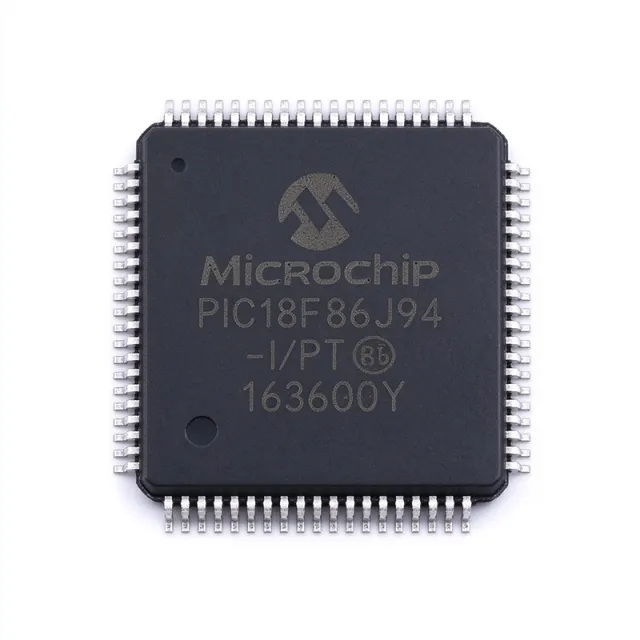
PIC18F86J10-I/PT
PIC18F86J10-I/PT - 8-Bit 40MHz MCU 64KB Flash 80-TQFP | Microchip
The Microchip Technology PIC18F86J10-I/PT is an 8-bit RISC PIC18 microcontroller with 64KB of Flash program memory and 2KB of RAM, operating at up to 40MHz and housed in an 80-pin TQFP (12x12 mm) package. The part provides 70 general-purpose I/O pins and integrates dual synchronous serial ports (I2C and SPI) plus dual asynchronous serial ports with LIN capability, making it a strong fit for cost-sensitive embedded designs.
A microcontroller (MCU) is a single-chip computer that integrates a CPU core, program memory (Flash/ROM), data memory (RAM), and configurable peripherals such as timers, communication interfaces, and analog blocks. Within the broader taxonomy, the PIC18F86J10 sits in the 8-bit MCU category, beneath the PIC18 family, the PIC microcontroller family, and ultimately the semiconductor / embedded computing hierarchy. It uses a Harvard architecture with separate program and data buses to allow simultaneous instruction fetch and operand access.
Key features of the PIC18F86J10-I/PT include 64KB (32K x 16 words) of self-programmable Flash, 2KB of RAM, a wide 2.0V-3.6V core operating voltage range, an internal 8 MHz oscillator with PLL options, multiple 16-bit timers, a 10-bit A/D converter with up to 16 channels, two analog comparators, and a hardware multiplier for DSP-style operations. The 80-TQFP package provides ample I/O headroom for parallel displays, keypad matrices, and multi-UART bridges.
Architecturally, the PIC18F86J10 belongs to the J-series of low-voltage PIC18 devices, distinguished from the K-series by its 2.0V-3.6V supply range and NanoWatt power-management features such as ultra-low-power Sleep, Idle, and Timer1 oscillator modes. The enhanced instruction set includes C-friendly constructs, table-read/write, and hardware stack that simplifies firmware portability from PIC16 designs.
Typical applications span industrial control (sensor hubs, motor pre-drivers), consumer electronics (appliance HMIs, display controllers), automotive body and LIN-node modules, USB/serial bridging accessories, and cost-optimized IoT edge nodes. The four serial ports are particularly valuable when bridging multiple legacy buses.
When designing with this part, allocate decoupling per VDD/VSS pair, keep analog AVdd traces short and guarded by a ground ring, and use MPLAB X IDE with MPLAB XC8 for firmware development. Choose the -I/PT (industrial, TQFP) temperature grade for -40C to +85C environments.
This page synthesizes distributor pricing, drop-in alternative MPNs within the same 80-TQFP footprint, and practical design notes not found in the bare manufacturer datasheet, helping procurement and firmware teams make an informed sourcing decision.
Запрос цены
Контакты