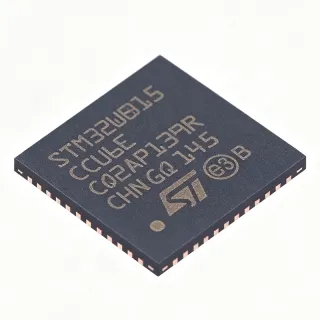
K32W061Z - Multiprotocol Wireless MCU 802.15.4/BLE 5.0 | NXP
Артикул: K32W061Z ✓ Активен| Кол-во | Цена за ед. | Итого |
|---|---|---|
| 1 | $8.36 | $8,36 |
| 10 | $7.69 | $76,90 |
| 100 | $6.45 | $645,00 |
| 500 | $5.72 | $2.860,00 |
| 1.000 | $5.18 | $5.180,00 |
K32W061Z Обзор
A wireless MCU (system-on-chip) is a category of integrated circuit that combines an application-class microcontroller with one or more radio transceivers on a single die. The K32W061Z sits within the hypernym hierarchy wireless MCU -> RF SoC -> short-range radio IC -> semiconductor -> integrated circuit. In system-level power architecture, it typically draws from a DC-DC converter or low-Iq regulator, occupies the application-layer role of a Thread Border Router node, a Zigbee Coordinator/End Device, a BLE 5.0 peripheral/central, or a Matter-over-Ready controller, and is commonly selected when designers need a single-chip solution that supports Matter, Zigbee, Thread, or BLE 5.0 protocols with NFC commissioning on coin-cell budgets.
Key differentiating specifications include simultaneous dual-protocol operation (IEEE 802.15.4 + BLE 5.0 on the same die), eight concurrent BLE connections, integrated NFC Type 2 Tag, hardware-accelerated AES-128/SHA-2, and an exposed thermal pad HVQFN-40 footprint. The device is qualified for coin-cell operation and supports OTA firmware upgrades, making it a strong fit for sealed, maintenance-free wireless sensor nodes.
Architecturally, the K32W061Z uses a Cortex-M4 core with Cortex-M0+ for radio housekeeping, a dedicated 2.4 GHz front-end, and on-chip DC-DC supporting 1.8-3.6 V supply. The integrated Arm CryptoCell primitives offload TLS / DTLS / OOB pairing for Matter commissioning flows, eliminating the need for an external secure element in most designs.
Typical applications include Matter-over-Ready smart-home bridges, Zigbee Coordinator light switches, Thread mesh sensors, BLE 5.0 beacons, NFC-commissioned locks, and battery-powered HVAC thermostats. The wide supply range and ultra-low sleep currents also suit industrial wireless sensor networks.
When designing with the K32W061Z, follow the manufacturer reference design for the RF matching network and decoupling. The exposed pad must be soldered to a continuous ground plane for thermal dissipation and RF performance.
This page synthesizes distributor stock levels, drop-in alternatives, and practical RF layout notes not found in the manufacturer datasheet summary, helping engineers shortlist the right multiprotocol wireless MCU for their connected product.
Аналоги без доработки для K32W061Z — тот же корпус, pin-to-pin совместимость. Компоненты в других корпусах, требующие переработки PCB, исключены.
Инструмент быстрого сравнения — выберите альтернативные компоненты для сравнения бок о бок:
K32W061
✅ Прямая замена📋 Справочный аналог (нет в каталоге)
K32W041
✅ Прямая замена📋 Справочный аналог (нет в каталоге)
K32W061YK
✅ Прямая замена ⚠️ Характеристики не проверены📋 Справочный аналог (нет в каталоге)
K32W061Z Максимальные параметры и электрические характеристики
| Core Architecture | Arm Cortex-M4 (application) + Cortex-M0+ (radio) |
| Operating Frequency | 2.4 GHz ISM band |
| Wireless Protocols | IEEE 802.15.4 (Zigbee/Thread), Bluetooth LE 5.0, Matter, NFC Type 2 Tag |
| BLE Concurrent Connections | 8 simultaneous |
| Напряжение питания | 1.8 V to 3.6 V |
| Корпус | HVQFN-40 (6x6 mm) Exposed Pad |
| Тип монтажа | Surface Mount |
| Рабочая температура | -40C to +85C (industrial) |
| Hardware Crypto | AES-128, SHA-2 (CryptoCell) |
| Peripherals | I2C, SPI, PWM, UART |
| Статус RoHS | Compliant |
Конфигурация выводов K32W061Z
| Контакт 1 | GND — Ground |
| Контакт 2 | ANT — RF antenna connection (2.4 GHz) |
| Контакт 3 | VDD_RF — RF supply |
| Контакт 4 | NFC1 — NFC antenna connection 1 |
| Контакт 5 | NFC2 — NFC antenna connection 2 |
| Контакт 6 | VDD — Main supply (1.8-3.6 V) |
| Контакт 7 | VDD_IO — I/O supply |
| Контакт 8 | RESET — Reset input (active low) |
| Контакт 9 | P0 — GPIO port 0 bit 0 |
| Контакт 10 | P1 — GPIO port 0 bit 1 |
| Контакт 11 | P2 — GPIO port 0 bit 2 |
| Контакт 12 | P3 — GPIO port 0 bit 3 |
| Контакт 13 | P4 — GPIO port 0 bit 4 |
| Контакт 14 | P5 — GPIO port 0 bit 5 |
| Контакт 15 | P6 — GPIO port 0 bit 6 |
| Контакт 16 | P7 — GPIO port 0 bit 7 |
| Контакт 17 | P8 — GPIO port 0 bit 8 |
| Контакт 18 | P9 — GPIO port 0 bit 9 |
| Контакт 19 | P10 — GPIO port 0 bit 10 |
| Контакт 20 | P11 — GPIO port 0 bit 11 |
| Контакт 21 | P12 — GPIO port 0 bit 12 |
| Контакт 22 | P13 — GPIO port 0 bit 13 |
| Контакт 23 | P14 — GPIO port 0 bit 14 |
| Контакт 24 | P15 — GPIO port 0 bit 15 |
| Контакт 25 | P16 — GPIO port 1 bit 0 |
| Контакт 26 | P17 — GPIO port 1 bit 1 |
| Контакт 27 | P18 — GPIO port 1 bit 2 |
| Контакт 28 | P19 — GPIO port 1 bit 3 |
| Контакт 29 | SWDIO — SWD data (debug) |
| Контакт 30 | SWCLK — SWD clock (debug) |
| Контакт 31 | UART_TX — UART transmit |
| Контакт 32 | UART_RX — UART receive |
| Контакт 33 | I2C_SDA — I2C data |
| Контакт 34 | I2C_SCL — I2C clock |
| Контакт 35 | SPI_MOSI — SPI master out slave in |
| Контакт 36 | SPI_MISO — SPI master in slave out |
| Контакт 37 | SPI_CLK — SPI clock |
| Контакт 38 | SPI_CS — SPI chip select |
| Контакт 39 | TEST — Test mode (tie to GND in production) |
| Контакт 40 | NC — Not connected (per datasheet) |
| Контакт EP | GND_PAD — Exposed thermal pad - solder to ground plane |
Типичное применение
K32W061Z подходит для 6 применениеs: Matter-over-Thread Smart Home Devices, Zigbee Coordinator / End Devices, BLE 5.0 Beacons and Asset Trackers, NFC-Commissioned Wireless Locks, Industrial Wireless Sensor Networks, Battery-Powered HVAC Thermostats.
Matter-over-Thread Smart Home Devices
The K32W061Z is purpose-designed for Matter-over-Thread smart-home products such as lighting, door locks, and occupancy sensors. The integrated 2.4 GHz IEEE 802.15.4 transceiver runs OpenThread with the Matter SDK on the Cortex-M4 core, while the Cortex-M0+ manages the radio housekeeping. Eight concurrent BLE 5.0 connections enable simultaneous commissioning and OTA firmware upgrades. According to the NXP datasheet, ultra-low sleep currents enable sealed coin-cell nodes with multi-year battery life, and hardware AES-128/SHA-2 acceleration offloads Matter security handshakes. The HVQFN-40 (6x6 mm) footprint suits compact in-fixture designs.
Рекомендуется
Zigbee Coordinator / End Devices
For Zigbee 3.0 mesh networks, the K32W061Z delivers a fully integrated 802.15.4 radio with hardware-accelerated AES-128/SHA-2 cryptography and on-chip DC-DC support across 1.8-3.6 V supply rails. The Cortex-M4 application core runs the Zigbee stack and application logic, while the Cortex-M0+ offloads radio housekeeping for deterministic packet timing. NFC tap-to-pair commissioning via the built-in Type 2 Tag differentiates this variant from the lower-cost K32W041. Per the NXP K32W061 datasheet, ultra-low TX/RX and power-down currents support sealed battery-powered Zigbee end devices.
Рекомендуется
BLE 5.0 Beacons and Asset Trackers
The K32W061Z's Bluetooth Low Energy 5.0 transceiver supports eight concurrent connections, ideal for multi-peripheral asset trackers and BLE beacons that must pair with several phones simultaneously. The Cortex-M4 application core runs the host beacon/asset-tracking application logic, and the integrated radio coexists with the IEEE 802.15.4 block for concurrent Thread/Zigbee+BLE operation. Ultra-low sleep currents documented in the NXP datasheet extend coin-cell life, and the HVQFN-40 (6x6 mm) exposed-pad footprint simplifies ground-plane stitching for the 2.4 GHz antenna.
Рекомендуется
NFC-Commissioned Wireless Locks
For wireless smart locks, the K32W061Z uniquely combines Zigbee or BLE 5.0 connectivity with NFC Type 2 Tag tap-to-unlock commissioning - the 'Z' suffix denotes the NFC-enabled variant. The hardware CryptoCell accelerates AES-128/SHA-2 for DTLS and secure pairing, and the 1.8-3.6 V supply range lets the lock draw directly from 2xAA cells. The Cortex-M4 application core runs lock firmware while the integrated radio handles secure wireless commissioning. Per the NXP K32W061 datasheet, the part is qualified for sealed industrial applications at -40C to +85C.
Рекомендуется
Industrial Wireless Sensor Networks
For industrial wireless sensor networks, the K32W061Z delivers multiprotocol 802.15.4 mesh plus BLE 5.0 in a single IC, eliminating the need for a discrete radio plus MCU. The 1.8-3.6 V supply range tolerates industrial 24V-to-3.3V regulator outputs, and the -40C to +85C operating range covers factory-floor environments. Ultra-low sleep currents documented in the NXP datasheet extend battery life for remote sensors, and the HVQFN-40 (6x6 mm) package provides a compact footprint for dense sensor PCBs. Hardware AES-128/SHA-2 acceleration secures OTA firmware upgrades.
Рекомендуется
Battery-Powered HVAC Thermostats
The K32W061Z suits battery-powered HVAC thermostats that must run Matter over Thread for HVAC zoning plus NFC commissioning at install time. The 1.8-3.6 V supply range accepts 2xAA cells directly, and ultra-low sleep currents documented in the NXP K32W061 datasheet enable multi-year battery life. The Cortex-M4 application core runs the thermostat UI and Matter stack, while the dedicated Cortex-M0+ radio core handles 802.15.4 packet timing deterministically. Integrated crypto offloads secure commissioning, and the HVQFN-40 (6x6 mm) package simplifies mechanical design.
Рекомендуется
Сводка рекомендуемых товаров
Справочные инженерные данные для K32W061Z — сравнение, рекомендации по проектированию и информация о соответствии.
Руководство по выбору
Сравнение с аналогами
| Параметр | Этот товар | K32W061 | K32W041 | K32W061YK |
|---|---|---|---|---|
| Brand | NXP Semiconductors | NXP Semiconductors | NXP Semiconductors | NXP Semiconductors |
| Package | HVQFN-40 (6x6 mm) Exposed Pad | HVQFN-40 (6x6 mm) Exposed Pad - same | HVQFN-40 (6x6 mm) Exposed Pad - same | HVQFN-40 (6x6 mm) Exposed Pad - same |
| NFC Tag | Yes (Type 2 Tag) | Disabled in firmware | Not present | Yes (Type 2 Tag) |
| 802.15.4 Radio | Yes (Zigbee/Thread) | Yes (Zigbee/Thread) | Yes (Zigbee/Thread) | Yes (Zigbee/Thread) |
| Bluetooth LE | 5.0 (8 concurrent connections) | 5.0 (8 concurrent) | 5.0 (8 concurrent) | 5.0 (8 concurrent) |
| Supply Voltage | 1.8 V to 3.6 V | 1.8 V to 3.6 V | 1.8 V to 3.6 V | 1.8 V to 3.6 V |
| Operating Temperature | -40C to +85C | -40C to +85C | -40C to +85C | -40C to +85C |
Ключевые отличия
- Integrated NFC Type 2 Tag for tap-to-pair commissioning (против K32W041)
- Concurrent dual-radio IEEE 802.15.4 + BLE 5.0 (против K32W061YK)
- Coin-cell-qualified ultra-low sleep current (против K32W041)
Заметки по проектированию
The K32W061Z integrates a 2.4 GHz radio, so the HVQFN-40 exposed pad must be soldered to a continuous, uninterrupted ground plane with stitching vias on a 0.5 mm pitch around the pad perimeter. Per the NXP datasheet reference design, keep the ANT pin trace as a 50-ohm controlled-impedance microstrip (typically 0.8-1.0 mm wide on 0.2 mm FR4), minimize its length, and place the RF matching network (L-C pi or T) within 2 mm of the ANT pin. Do not route digital signals under the antenna or the RF trace - this degrades radiated performance and harmonic emissions.
Place 100 nF X7R decoupling capacitors as close as possible to every VDD and VDD_IO pin, plus a single 10 uF X5R bulk capacitor on the main supply rail. The K32W061Z integrates an on-chip DC-DC converter, but its efficiency depends on the input decoupling network - follow the NXP reference design's LC filter values exactly. Estimated: at peak TX current the part draws ~25-30 mA from VDD_RF per the datasheet's typical characteristics; the bulk capacitor must support the peak without excessive droop.
Common pitfalls when designing with the K32W061Z include: (1) failing to solder the exposed pad, which destroys RF performance and thermal dissipation; (2) routing NFC antenna traces near metal that detunes the NFC Type 2 Tag interface; (3) forgetting the TEST pin tie-off (must be tied to GND per the datasheet); (4) omitting the SWD pull-ups on SWDIO/SWCLK, which prevents debug access; and (5) neglecting the BLE 5.0 stack-up time vs. Thread coexistence schedule. Always validate the RF matching network with a vector network analyzer before regulatory pre-compliance testing.
Информация о соответствии
RoHS compliant per NXP product page. AEC-Q100 not applicable (industrial/consumer wireless MCU); for automotive wireless designs consult NXP's KW45xx family. Halogen-free status not explicitly stated in the verified data - set to 'unknown' per Data Authenticity Rules.