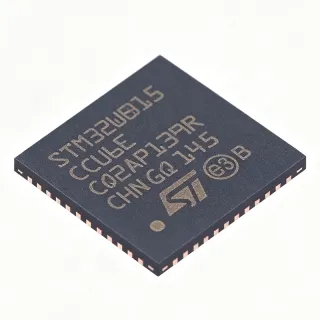
NRF51822QFAC - Bluetooth LE/2.4GHz SoC, 256kB Flash | Nordic
Артикул: NRF51822QFAC ✗ Снят с производства| Кол-во | Цена за ед. | Итого |
|---|---|---|
| 1 | $6.4 | $6,40 |
| 10 | $5.92 | $59,20 |
| 100 | $5.2 | $520,00 |
| 500 | $4.55 | $2.275,00 |
| 1.000 | $3.95 | $3.950,00 |
NRF51822QFAC Обзор
An RF System-on-Chip (SoC) is a single silicon die that combines a microcontroller core, on-chip program and data memory, analog/RF peripherals, and a radio transceiver. The nRF51822 belongs to the Bluetooth SoC family (Bluetooth low energy SoC -> wireless MCU -> connected microcontroller -> general-purpose MCU), which is itself a branch of the broader category of short-range wireless ICs. By collapsing the MCU and radio into one die, an RF SoC dramatically shrinks PCB area, simplifies BOM, and lowers sleep current compared with two-chip MCU+transceiver designs - enabling coin-cell-powered products that can run for years on a single CR2032.
Key features include a Cortex-M0 core running up to 16 MHz (31.25 MHz when using the on-chip HFCL), 256 kB on-chip flash for application + softdevice storage, 32 kB on-chip SRAM, a flexible 2.4 GHz radio supporting Bluetooth low energy (v4.0) and Nordic Gazell proprietary modes, integrated balun, and a rich set of peripherals including 10-bit ADC, RTC, GPIO, I2C, SPI, UART, and PWM. The QFN-48 (6x6 mm) package exposes an EP that must be soldered to the board ground for thermal and RF performance.
Typical applications include BLE beacons, fitness bands, smart watches, medical sensor patches, remote controls, smart-home bridges, and industrial telemetry nodes. The combination of sub-uA sleep current and on-chip Cortex-M0 processing makes it well suited to products where battery life is measured in months rather than hours.
When laying out a board, observe Nordic's reference layout: route the differential RF port (RFIO P0.18 / RFIO1 P0.21 on QFACA) with controlled 50 ohm impedance, place the chip's exposed pad on a continuous ground pour, and keep decoupling capacitors within 2 mm of the supply pins. The radio's TX output power, RX sensitivity, and blocking performance all depend on this layout.
This page synthesizes distributor pricing, drop-in QFN-48 alternatives from the Nordic nRF51/nRF52 family, and PCB-level design notes that are not collected in any single manufacturer document.
Аналоги без доработки для NRF51822QFAC — тот же корпус, pin-to-pin совместимость. Компоненты в других корпусах, требующие переработки PCB, исключены.
Инструмент быстрого сравнения — выберите альтернативные компоненты для сравнения бок о бок:
NRF51822QFAC-R
✅ Прямая замена📋 Справочный аналог (нет в каталоге)
NRF51822QFAC-T
✅ Прямая замена📋 Справочный аналог (нет в каталоге)
NRF51822QFAA-R
✅ Прямая замена📋 Справочный аналог (нет в каталоге)
NRF51422QFAC
✅ Прямая замена📋 Справочный аналог (нет в каталоге)
NRF52832QFAA
✅ Прямая замена📋 Справочный аналог (нет в каталоге)
NRF51822QFAC Максимальные параметры и электрические характеристики
| Product Type | Bluetooth Low Energy / 2.4 GHz SoC |
| Core | ARM Cortex-M0 |
| Core Clock | 16 MHz (HFCL 31.25 MHz available) |
| Flash | 256 kB |
| RAM | 32 kB |
| Radio | 2.4 GHz Bluetooth v4.0 + proprietary (Gazell) |
| Корпус | 48-pin QFN (6 x 6 mm) with exposed pad (QFN-48 / 48-VFQFN-EP) |
| Тип монтажа | Surface Mount |
| Peripherals | 10-bit ADC, RTC, I2C, SPI, UART, PWM, AES |
| Protocol Stack | Bluetooth low energy (v4.0), 2.4 GHz Gazell |
| Статус RoHS | Compliant |
| Lead-Free | Yes |
Конфигурация выводов NRF51822QFAC
| Контакт 1 | VDD — Power supply input |
| Контакт 2 | GND — Ground |
| Контакт 3 | DEC1 — Decoupling pin |
| Контакт 4 | DEC2 — Decoupling pin |
| Контакт 5 | DEC3 — Decoupling pin |
| Контакт 6 | DEC4 — Decoupling pin |
| Контакт 7 | VDDH — High-voltage supply (radio) |
| Контакт 8 | VDD_PA — Power amplifier supply |
| Контакт 9 | ANT — Differential antenna port (P0.18 / ANT1) |
| Контакт 10 | ANT2 — Differential antenna port (P0.21 / ANT2) |
| Контакт 11 | GND — Ground |
| Контакт 12 | RESET — Reset pin (active low) |
| Контакт 13 | SWDIO — Serial Wire Debug I/O |
| Контакт 14 | SWDCLK — Serial Wire Debug clock |
| Контакт 15 | GPIO — General purpose I/O |
| Контакт 16 | GPIO — General purpose I/O |
| Контакт 17 | GPIO — General purpose I/O |
| Контакт 18 | GPIO — General purpose I/O |
| Контакт 19 | GPIO — General purpose I/O |
| Контакт 20 | GPIO — General purpose I/O |
| Контакт 21 | GPIO — General purpose I/O |
| Контакт 22 | GPIO — General purpose I/O |
| Контакт 23 | GPIO — General purpose I/O |
| Контакт 24 | GPIO — General purpose I/O |
| Контакт 25 | GPIO — General purpose I/O |
| Контакт 26 | GPIO — General purpose I/O |
| Контакт 27 | GPIO — General purpose I/O |
| Контакт 28 | GPIO — General purpose I/O |
| Контакт 29 | GPIO — General purpose I/O |
| Контакт 30 | GPIO — General purpose I/O |
| Контакт 31 | GPIO — General purpose I/O |
| Контакт 32 | GPIO — General purpose I/O |
| Контакт 33 | GPIO — General purpose I/O |
| Контакт 34 | GPIO — General purpose I/O |
| Контакт 35 | GPIO — General purpose I/O |
| Контакт 36 | GPIO — General purpose I/O |
| Контакт 37 | GPIO — General purpose I/O |
| Контакт 38 | GPIO — General purpose I/O |
| Контакт 39 | GPIO — General purpose I/O |
| Контакт 40 | GPIO — General purpose I/O |
| Контакт 41 | GPIO — General purpose I/O |
| Контакт 42 | GPIO — General purpose I/O |
| Контакт 43 | DEC5 — Decoupling pin |
| Контакт 44 | DEC6 — Decoupling pin |
| Контакт 45 | VDD — Power supply input |
| Контакт 46 | GND — Ground |
| Контакт 47 | GND — Ground |
| Контакт 48 | GND — Ground |
Типичное применение
NRF51822QFAC подходит для 7 применениеs: Bluetooth Low Energy Beacons, Fitness Bands and Wearables, Medical Sensor Patches, Smart Home Hubs and Bridges, Industrial Wireless Sensor Nodes, BLE-Enabled Remote Controls, Wireless PC Peripherals (Mice/Keyboards).
Bluetooth Low Energy Beacons
The NRF51822QFAC's 256 kB flash comfortably fits Eddystone or iBeacon firmware alongside the BLE softdevice, while its sub-microamp sleep current lets coin-cell-powered beacons advertise for 1-3 years on a single CR2032. Place the chip with its exposed pad soldered to a continuous ground pour to preserve the radio link budget - the QFN-48 footprint is small enough to fit inside a 25 mm diameter puck-style beacon enclosure.
Рекомендуется
Fitness Bands and Wearables
With Cortex-M0 DSP plus BLE v4.0, the NRF51822QFAC can drive a fitness band's accelerometer, heart-rate sensor, and OLED display while streaming data to a smartphone over BLE. The 256 kB flash and 32 kB RAM are sufficient for typical wearable application code. The QFN-48 6x6 mm footprint fits inside a 15 mm x 40 mm band module, and the BLE link enables real-time heart-rate broadcast and firmware updates over the air (DFU).
Рекомендуется
Medical Sensor Patches
Medical patch designs leverage the NRF51822QFAC's ultra-low sleep current and Cortex-M0 processing to drive continuous glucose, temperature, or ECG monitoring from a 3V coin cell. The integrated AES hardware accelerator enables secure BLE communication required for HIPAA-conscious medical data transfer. Use an external LDO like the LP5900TLX-1.8 to clean the supply for low-noise analog front-end measurements.
Рекомендуется
Smart Home Hubs and Bridges
In a smart-home bridge, the NRF51822QFAC's BLE radio and Cortex-M0 can act as a gateway between BLE sensors and a Wi-Fi/Ethernet host. The 256 kB flash supports the BLE softdevice plus a Gazell proprietary bridge protocol for legacy 2.4 GHz sensors. The QFN-48 footprint is small enough to embed inside a wall-switch module, and Nordic's Gazell star network lets the hub pair with up to 8000 sensor nodes.
Рекомендуется
Industrial Wireless Sensor Nodes
Industrial sensor nodes benefit from the NRF51822QFAC's industrial temperature range and robust 2.4 GHz radio. Combined with Modbus-over-BLE firmware, the chip can wirelessly expose factory sensor data to a tablet or gateway. The exposed-pad QFN-48 package is suitable for conformal-coated industrial boards, and Nordic's OTA DFU capability allows remote firmware updates across thousands of deployed nodes.
Рекомендуется
BLE-Enabled Remote Controls
TV set-top boxes, smart speakers, and BLE remote controls use the NRF51822QFAC for voice command relay, BLE pairing, and IR-over-BLE bridges. Its 256 kB flash supports rich HID profiles plus voice codec buffering. Pair it with a low-power audio ADC and a haptic driver to create a full-featured BLE remote that runs for over a year on two AAA batteries thanks to the chip's low sleep current.
Рекомендуется
Wireless PC Peripherals (Mice/Keyboards)
The NRF51822QFAC's BLE v4.0 radio and 2.4 GHz proprietary mode are widely used in low-latency wireless mice, keyboards, and game controllers. Nordic's Gazell mode offers sub-5 ms latency suitable for gaming mice, while BLE enables universal smartphone pairing. The chip's high GPIO count drives a 16-bit RGB LED matrix and a high-resolution scroll-wheel sensor simultaneously.
Рекомендуется
Сводка рекомендуемых товаров
Справочные инженерные данные для NRF51822QFAC — сравнение, рекомендации по проектированию и информация о соответствии.
Руководство по выбору
Сравнение с аналогами
| Параметр | Этот товар | NRF51822QFAC-R | NRF51822QFAC-T | NRF51822QFAA-R | NRF51422QFAC | NRF52832QFAA |
|---|---|---|---|---|---|---|
| Brand | Nordic Semiconductor | Nordic Semiconductor | Nordic Semiconductor | Nordic Semiconductor | Nordic Semiconductor | Nordic Semiconductor |
| Package | QFN-48 (6x6 mm) | QFN-48 (6x6 mm) - same | QFN-48 (6x6 mm) - same | QFN-48 (6x6 mm) - same | QFN-48 (6x6 mm) - same | QFN-48 (6x6 mm) - same |
| Core | ARM Cortex-M0 | ARM Cortex-M0 | ARM Cortex-M0 | ARM Cortex-M0 | ARM Cortex-M0 | ARM Cortex-M3A |
| Flash | 256 kB | 256 kB | 256 kB | 128 kB | 256 kB | 512 kB |
| RAM | 32 kB | 32 kB | 32 kB | 16 kB | 32 kB | 64 kB |
| Bluetooth Version | v4.0 BLE | v4.0 BLE | v4.0 BLE | v4.0 BLE | v4.0 BLE + ANT+ | Bluetooth 5 |
| ANT+ Support | No | No | No | No | Yes | No |
| Lifecycle Status | NRND | NRND | NRND | NRND | NRND | Active |
Ключевые отличия
- Highest on-chip memory in nRF51822 family (против NRF51822QFAA-R)
- Lower-power Cortex-M0 vs newer Cortex-M3A core (против NRF52832QFAA)
- Pin-compatible upgrade path to active-production nRF52832 (против NRF52832QFAA)
Заметки по проектированию
Route the differential RF port (ANT/ANT2 on the QFN-48 QFAC build) with a controlled 50 ohm differential impedance. Nordic's reference layout shows a 0.5 mm trace width on 0.2 mm spacing over a 4-layer FR4 stackup. The exposed pad (EP) must be soldered to a continuous ground plane with at least 8 thermal vias - omitting the EP ground connection degrades radio range and causes RF instability.
Decouple each VDD/VDDH pin with a 100 nF ceramic capacitor placed within 2 mm of the pin. Add a 10 uF bulk capacitor near the radio section to absorb TX load transients (peak current ~12 mA at 0 dBm). A separate LP5029 ferrite bead between the digital and RF supplies reduces conducted noise coupling into the ADC readings.
Do not assume the QFAC variant has the same pinout as QFAA builds across all GPIO assignments - several pin functions (e.g. RESET, SWDIO) move between QFAC/QFAA revisions. Always cross-reference the exact pin name table in the nRF51822 datasheet before PCB layout. Failing to do so results in non-functional boards that pass initial power-up but fail firmware download.
At maximum continuous TX output (0 dBm), the QFN-48 die dissipates roughly 30 mW. With the EP soldered to a 1 square inch copper pour on a 4-layer board, theta_JA is around 35 C/W, yielding a 1 C temperature rise above ambient - acceptable. Without the EP ground, junction temperature can rise 10-15 C, risking CW transmission failures above 25 C ambient.
Информация о соответствии
RoHS and REACH compliant per Nordic product page. Not AEC-Q100 qualified - this part is intended for consumer/commercial/industrial wireless products, not automotive. Conflict-minerals declaration available from Nordic.