Mga Produkto (46,000+)

LM358BPX - Dual 36V 1.2MHz Op Amp | Texas Instruments
LM358BPX

LM358BPX - Dual 36V 1.2MHz Op Amp | Texas Instruments

The Texas Instruments LM358BPX is a dual, general-purpose operational amplifier with two independent channels, a 36 V maximum supply rating, a 1.2 MHz gain-bandwidth product, and an 8-ball VFBGA package. The device combines a 3 mV input-offset-voltage rating with a 0.5 V/us slew rate, making it suitable for low-to-moderate-speed analog signal conditioning, feedback-control loops, and general-purpose amplification. An operational amplifier is an analog integrated circuit that uses high-gain differential feedback to amplify the difference between two input voltages. The LM358 belongs to the operational-amplifier hierarchy, which includes voltage-feedback amplifiers, signal-conditioning ICs, and analog front-end components. Its two independent channels permit simultaneous processing of related signals without requiring two separate single-channel packages. The principal LM358B-family characteristics include operation from a single supply or from split positive and negative supplies, a 1.2 MHz unity-gain bandwidth, a 0.5 V/us slew rate, and a 3 mV maximum input-offset voltage. According to the TI LM358B product page, the commercial-temperature family operates from -40°C to 85°C. These characteristics place the amplifier between precision low-noise amplifiers and high-speed operational amplifiers: it offers useful DC accuracy and common-mode flexibility without the bandwidth of a high-speed comparator or precision amplifier. Each channel includes one input stage, an output stage, and compensation circuitry. The two amplifiers are independent rather than internally linked, allowing the same package to implement independent gain stages, comparators, buffers, or transducers. The 0.5 V/us slew rate limits how quickly a large output transition can occur, while the 1.2 MHz gain-bandwidth product limits closed-loop bandwidth as feedback gain increases. A practical gain-bandwidth relationship of 1.2 MHz divided by noise gain gives a useful first estimate of usable bandwidth. Typical uses include temperature-sensor signal conditioning, audio preamplification, DC motor-current monitoring, industrial sensor interfaces, low-frequency active filters, and power-supply feedback. For sensor applications, the 3 mV offset specification is important because input-referred offset appears directly at the amplifier output after multiplication by the closed-loop noise gain. In AC-coupled audio paths, the slew rate and bandwidth determine whether large low-frequency signals can be reproduced without excessive distortion. PCB design should prioritize short input and feedback paths, a stable output connection, and careful bypassing of the positive supply. Because the LM358BPX uses a compact ball-grid package, the manufacturer land pattern and pin-description table should govern assembly and inspection. Decoupling capacitors should be placed close to the supply and ground balls, while analog input traces should be kept away from switching nodes and high-current return paths. This page combines the LM358B family electrical characteristics, LM358BPX package information, pin assignments, verified source links, and practical guidance for analog-board design. It also identifies the limits of direct substitution: many LM358 equivalents use DIP or SOIC packages rather than the LM358BPX 8-ball VFBGA footprint, so a functional match does not necessarily qualify as a PCB drop-in replacement.

RFQ Kontak
LM358D - Dual 700kHz General Purpose Op Amp | Texas Instruments (Tape & Reel)
LM358D

LM358D - Dual 700kHz General Purpose Op Amp | Texas Instruments (Tape & Reel)

The LM358D is a dual operational amplifier from Texas Instruments in an 8-pin SOIC (D) surface-mount package. It operates from a single supply of 3V to 32V or dual supplies of ±1.5V to ±16V, with a gain bandwidth product of 700 kHz and a slew rate of 0.3 V/µs. This industry-standard, low-cost amplifier serves a vast range of general-purpose analog functions. An operational amplifier (op amp) is a high-gain differential-input, single-ended-output voltage amplifier and one of the most fundamental building blocks in analog electronics. General-purpose op amps like the LM358 prioritize versatility, low cost, and ease of use over precision or bandwidth. The LM358 is the dual version of the LM321 single amplifier and the two-amp counterpart of the quad LM324. Key features include a common-mode input voltage range that extends to ground, enabling direct sensing near ground in single-supply systems; low supply current of 0.7 mA typ, independent of supply voltage; internal frequency compensation for unity-gain stability; and short-circuit protected outputs. These characteristics suit battery-powered and cost-sensitive designs. Technically, the LM358 uses a bipolar process with a class-AB output stage that can drive loads as low as 2 kΩ with a large output swing. The commercial temperature grade is 0°C to +70°C. Input bias and offset currents are low, and the two internal amplifiers are well matched, sharing the same supply and bias circuitry. Typical applications include transducer amplifier front ends, DC gain blocks, active RC filters, voltage comparators and level shifters, power-supply feedback loops, and portable or industrial control electronics. The SOIC-8 package supports automated SMT assembly and reflow. Design considerations: decouple V+ to GND with a 0.1 µF ceramic capacitor close to pin 8, and respect output swing limits near the rails (output saturates roughly 1.5V below V+ at moderate loads). For higher bandwidth or lower noise, consider the pin-compatible TLV9152 or TL072. Pricing as of 2026-08-30 starts around $0.05 at volume from distributors such as LCSC.

RFQ Kontak
LM358D-JF - Dual Op-Amp, 2 Circuit, SOIC-8 | Texas Instruments
LM358D-JF

LM358D-JF - Dual Op-Amp, 2 Circuit, SOIC-8 | Texas Instruments

The Texas Instruments LM358D-JF is an industry-standard dual operational amplifier integrating two independent, internally compensated op-amp circuits in a single 8-pin SOIC package. According to the TI LM358 family datasheet, the device operates from a single supply as low as 3 V (B and BA versions) with a wide supply range up to 36 V, draws approximately 300 uA per channel of quiescent current (B and BA versions), and delivers a unity-gain bandwidth of about 1.2 MHz on the enhanced B/BA versions, with the standard LM358 characterized at 700 kHz on a 30-V class supply. The common-mode input voltage range includes ground, enabling direct sensing of signals near 0 V without a negative rail. An operational amplifier is an analog voltage amplifier with differential inputs and a single-ended output, forming the foundational building block of the linear signal chain: op-amp -> amplifier IC -> analog front end -> mixed-signal system. Dual op-amps such as the LM358D-JF combine two such stages behind one supply pin, halving board area and supply routing complexity compared with two single amplifiers. Key features include ground-sensing inputs for single-supply operation, a wide supply range supporting both 5 V logic-level and up to 36 V industrial rails (B/BA versions), low 300 uA-per-channel quiescent drain (B/BA versions) for battery-powered designs, and internally compensated unity-gain stability. The maximum input offset voltage of 2 mV at 25 C (BA version) keeps DC accuracy adequate for non-critical gain stages. The architecture uses a classic bipolar process with internal frequency compensation, giving well-behaved, phase-margin-safe behavior in inverting, non-inverting, and unity-gain buffer configurations. Output stages sink and source small currents and pull down close to ground on single supplies, which is why the LM358 remains the default comparator-adjacent amplifier for cost-driven designs. Typical applications include transducer signal conditioning near ground, low-speed active filters, current-sense front ends in power supplies and chargers, and level-shifting stages in industrial sensor nodes. The SOIC-8 surface-mount footprint suits compact commercial PCBs. Design consideration: keep closed-loop gains moderate and load capacitance low; the modest bandwidth means these parts are intended for slow, robust analog functions rather than wideband signal paths. This page adds value beyond the manufacturer datasheet by consolidating pin-compatible alternatives, pricing-channel availability, and practical design notes in one place.

RFQ Kontak
LM358DE4 - 700kHz Dual Op Amp, 16V | Texas Instruments
LM358DE4

LM358DE4 - 700kHz Dual Op Amp, 16V | Texas Instruments

Texas Instruments LM358DE4 is a dual general-purpose operational amplifier IC with two independent amplifier channels, a 700 kHz gain-bandwidth product, and operation from a 16 V maximum supply, packaged in an 8-pin SOIC. The device is intended for general-purpose analog signal conditioning, buffering, current sensing, filtering, analog measurement, and precision-control applications. An operational amplifier, or op amp, is a high-gain differential amplifier that uses negative feedback to amplify the difference between two input voltages. The LM358 belongs to the broader hierarchy of operational amplifier, analog amplifier IC, and semiconductor. Its dual-channel architecture provides two amplifiers in one package, reducing board area when two related analog functions are required. Unlike precision rail-to-rail amplifiers, the LM358 uses bipolar transistor circuitry and is therefore especially familiar in supply-voltage-oriented industrial, instrumentation, and control designs. Key characteristics include two amplifier circuits, a 700 kHz gain-bandwidth product, and a 16 V maximum supply identified by the manufacturer-oriented product information. The 8-SOIC package uses eight terminals in a rectangular surface-mount gull-wing format. Its dual-channel organization is useful for signal conditioning, buffering, current sensing, analog measurement, filtering, and precision-control circuits where two amplifiers share the same supply and ground references. The 700 kHz gain-bandwidth product makes the LM358 suitable for general-purpose closed-loop amplifier stages operating at low-to-moderate signal frequencies. In a non-inverting configuration, closed-loop bandwidth depends on the selected feedback network rather than the open-loop gain-bandwidth product alone. The bipolar implementation also supports operation from a single positive supply, allowing input and output signals to be referenced toward ground in many industrial and embedded analog circuits. Typical applications include sensor-signal conditioning, transducer buffering, active filtering, low-side current sensing, analog control loops, and general measurement boards. Two channels can implement differential signal conditioning, active filters, comparator-style threshold conditioning with suitable feedback arrangements, or independent amplifier stages sharing the same supply. The SOIC package is also convenient for prototype boards and production assemblies that use conventional surface-mount footprints. Design attention should focus on input common-mode range, output swing, load capability, and stability with the selected feedback network. Decoupling capacitors should be placed close to the supply pins, and sensitive analog traces should be kept away from switching nodes. Because the device is not rail-to-rail at its inputs and outputs, verify signal levels against the operating supply before using it in low-voltage battery systems. This page organizes the LM358DE4 specifications, pin and package information, application guidance, and pin-compatible alternatives into one engineering-focused reference. It also provides practical selection criteria for comparing the standard LM358 family with alternate dual-amplifier implementations before committing a PCB footprint to production.

USD $1.31 May Stock
LM358DG - Dual 1 MHz Operational Amplifier | onsemi
LM358DG

LM358DG - Dual 1 MHz Operational Amplifier | onsemi

The onsemi LM358DG is a dual general-purpose operational amplifier with two amplifier channels, 1 MHz gain-bandwidth product, 0.6 V/µs slew rate, and a 3 V to 32 V operating supply range. The device is supplied in an 8-SOIC package and supports both single-supply and split-supply operation. Its common-mode input range extends to ground and VEE, making it suitable for signal conditioning, current monitoring, and general industrial-control circuits. An operational amplifier is an analog integrated circuit that uses high-gain differential amplification and feedback to control gain accurately. The dual LM358 architecture provides two amplifiers in one package, reducing board area while offering independent input, output, and supply connections. The LM358 belongs to the operational-amplifier hierarchy, which also includes single and quad amplifier packages used in instrumentation, sensor interfaces, and power-management systems. Key characteristics include a 3 V to 32 V supply range, 1 MHz gain-bandwidth product, 0.6 V/µs slew rate, and a common-mode rejection ratio listed at a minimum of 65 dB. Input offset voltage is listed as 7 mV. The common-mode input voltage range extends to ground or VEE, allowing the amplifier to process signals near the lower supply rail. Low power drain and single- or split-supply flexibility suit both portable and industrial equipment. The dual amplifier can be used in noninverting and inverting gain stages, voltage followers, comparators, differential amplifiers, current-to-voltage converters, and sensor-signal conditioning. Independent channels allow one package to implement two related analog functions while sharing the same supply pins. However, users should verify input/output swing limits, output-current capability, stability conditions, and absolute maximum ratings in the manufacturer datasheet for the exact operating point. For PCB design, place the bypass capacitor close to the supply pin and route each amplifier's feedback and input traces away from switching nodes and high-current paths. Because the common-mode range extends toward ground but not necessarily beyond the positive rail, input signals must remain inside the specified common-mode limits. Stable feedback-network layout and adequate output-load compatibility are essential for reliable closed-loop behavior. This product page combines verified manufacturer and distributor information, same-footprint replacement candidates, parameter comparisons, and practical implementation guidance. It is intended to help engineers identify whether the LM358DG's dual-channel, wide-supply, near-ground-input capability fits a design before consulting the full manufacturer datasheet.

RFQ Kontak
LM358DG4 - Dual 700kHz Op Amp, 16V SOIC | Texas Instruments
LM358DG4

LM358DG4 - Dual 700kHz Op Amp, 16V SOIC | Texas Instruments

The Texas Instruments LM358DG4 is a dual general-purpose operational amplifier in an 8-pin SOIC package. It provides two amplifier circuits, a 700 kHz gain-bandwidth product, a 0.3 V/us slew rate, and operation from a maximum total supply voltage of 16 V. The device is packaged in a tube and is intended for general-purpose signal conditioning, buffering, and analog control applications. An operational amplifier is an analog integrated circuit that amplifies the difference between two input voltages. A dual operational amplifier combines two amplifier channels in one package, reducing board area when a design needs two independent gain stages or one amplifier can be reserved as a buffer. Within the broader hierarchy, the LM358 belongs to the operational amplifier, linear amplifier, and analog signal-conditioning IC categories. The LM358DG4's 700 kHz gain-bandwidth product supports signal paths that do not require high-frequency specialized amplifiers. Its 0.3 V/us slew rate defines how quickly the output can follow large voltage changes. The two amplifier circuits share the same 8-SOIC package and are identified as a general-purpose amplifier type in the product listing. The SOIC-8 format is a surface-mount package with gull-wing leads on the package sides. It is larger than modern compact packages but remains widely supported by standard PCB assembly equipment. Using one dual amplifier instead of two separate single-channel devices can reduce component count, simplify routing, and conserve board area where both channels perform similar signal-conditioning functions. Typical applications include low-frequency sensor conditioning, buffered analog inputs, active filtering, comparator-style threshold functions, and general instrumentation. The LM358DG4 is also suitable for educational and prototype circuits where a conventional dual operational amplifier is required without specialized low-noise, high-speed, or rail-to-rail performance. Designers should verify input common-mode range, output swing, input bias current, supply-current behavior, and stability requirements against the manufacturer datasheet for the intended operating conditions. Decoupling capacitors should be placed close to the supply pins, and unused amplifier inputs must be configured so they do not float. The SOIC-8 footprint and pin arrangement should be checked against the selected board layout before substitution. This product data consolidates the verified device identity, package, channel count, bandwidth, slew-rate, supply-voltage, and cross-reference information. It also adds application guidance, side-by-side parameter coverage, and practical design notes to help engineers evaluate the LM358DG4 for analog signal-conditioning designs.

RFQ Kontak
LM358DGKR - Dual 36V Operational Amplifier | Texas Instruments
LM358DGKR

LM358DGKR - Dual 36V Operational Amplifier | Texas Instruments

Texas Instruments LM358DGKR is a dual general-purpose operational amplifier with two amplifier channels, a 36 V maximum supply rating, a typical input offset voltage of 300 µV, and an 8-pin VSSOP package. It is designed for cost-sensitive analog signal conditioning across industrial, instrumentation, communications, and embedded-control systems. An operational amplifier, commonly called an op amp, is a high-gain differential amplifier whose open-loop behavior is shaped by external feedback networks. The LM358 belongs to the broader operational-amplifier hierarchy, within analog ICs and signal-chain conditioning. Its two independent channels allow one package to implement functions such as amplification, buffering, voltage comparison, difference amplification, and basic active filtering. Key features include two amplifier circuits in one package, a supply capability reaching 36 V, input offset voltage of 300 µV typical, a common-mode input range that extends to ground, and high differential-input-voltage capability. These characteristics suit systems whose signal levels vary widely and whose analog section operates from a single positive supply. The device also provides a practical choice for cost-sensitive designs because two channels reduce component count and board area. The LM358 architecture is intended for general-purpose rather than precision applications. Its typical 300 µV offset is useful for moderate-accuracy signal conditioning but requires careful bias-current compensation when the source impedance is high. Ground-referenced inputs are supported, which helps simplify single-supply interfaces. Designers should still evaluate output swing, input common-mode limits, supply headroom, capacitive-load stability, and channel-to-channel behavior at the selected voltage and temperature. Typical uses include sensor-amplifier interfaces, transducer signal conditioning, low-side current measurement, audio preamplification, comparator stages, industrial control loops, and general buffering. In instrumentation designs, the two channels can process complementary or sequential signals. The 8-pin VSSOP outline supports compact layouts, although careful input routing and stable feedback connections remain important in noisy systems. A key design consideration is to place input, feedback, and decoupling components close to their associated pins. Bypass the supply with a short, low-inductance connection, avoid long high-impedance input traces, and verify stability when driving capacitive loads. The common-mode input range and output swing must both be checked at the minimum and maximum operating supply. This page combines manufacturer specifications, package guidance, commercially sourced alternatives, and practical design guidance for engineers evaluating the LM358DGKR as a dual, general-purpose, high-voltage operational amplifier.

RFQ Kontak
LM358DGKRG4 - Dual 700kHz Op Amp, 8-VSSOP | Texas Instruments
LM358DGKRG4

LM358DGKRG4 - Dual 700kHz Op Amp, 8-VSSOP | Texas Instruments

Texas Instruments LM358DGKRG4 is a dual, general-purpose operational amplifier with two amplifier circuits, a 700 kHz gain-bandwidth product, and an 8-VSSOP package. The device is intended for commercial-grade instrumentation and signal-conditioning systems operating from a single supply or a split supply. Its package uses eight gull-wing terminals in a compact surface-mount TSSOP-compatible footprint. An operational amplifier is an analog integrated circuit that amplifies the voltage difference between its inverting and non-inverting inputs. The LM358 belongs to the broader operational-amplifier, linear-amplifier, and semiconductor hierarchy. Two amplifiers are integrated into one package, allowing one IC to support signal buffering, amplification, filtering, comparisons, and feedback-control functions while reducing board area and component count. The LM358 family provides differential inputs, high open-loop gain, frequency compensation, and the ability to operate from a single supply or split supply. Each amplifier in the LM358DGKRG4 is configured for general-purpose use rather than rail-to-rail input and output operation. The verified product description identifies the part as a 2-circuit amplifier in an 8-VSSOP package, while the manufacturer nomenclature identifies it as a 700 kHz device. The eight-terminal surface-mount package makes the device suitable for compact analog boards, but layout still requires care around feedback components and supply connections. Pin 8 is the positive supply, pin 4 is the negative supply or ground reference, and the remaining pins divide into two independent amplifier sections. Because the LM358 is a frequency-compensated operational-amplifier family, external stability networks are generally unnecessary for ordinary closed-loop uses. Typical applications include low-level sensor conditioning, current-loop receivers, audio preamplifier stages, active filters, comparators, feedback-control loops, and general-purpose analog signal processing. The two independent channels can be used simultaneously when channel requirements are similar, or one channel can remain unused when its input and output are properly configured. When designing around the LM358DGKRG4, verify the input common-mode range and output swing against the actual supply voltage. Place bypass capacitance close to the supply pins, keep feedback-loop routing compact, and avoid long parallel traces between the input and output networks. The commercial temperature grade should be checked against the intended ambient operating range. This product record consolidates the verified manufacturer and distributor identification, package information, drop-in candidate analysis, pin assignment, comparison parameters, and practical layout guidance. It is structured to support engineering selection for the LM358DGKRG4 and to distinguish confirmed drop-in options from candidates requiring additional qualification.

RFQ Kontak
LM358DMR2 - Dual 3-32V Low-Power Op Amp | onsemi
LM358DMR2

LM358DMR2 - Dual 3-32V Low-Power Op Amp | onsemi

onsemi LM358DMR2 is a dual general-purpose operational amplifier with two independent amplifier channels, a 3 V to 32 V operating supply range, and an 8-MSOP surface-mount package. It operates from a single supply or split supply, supports input common-mode voltages extending to ground and VEE, and is suited to low-voltage signal conditioning, sensing, and feedback-control circuits. An operational amplifier is an active analog component that amplifies the voltage difference between its inverting and non-inverting inputs. The LM358 belongs to the dual-operational-amplifier family within the broader linear-IC and signal-chain hierarchy. Its common-mode input range, low power consumption, and ability to operate close to the negative supply rail make it useful for battery-powered equipment, industrial controls, transducers, and general-purpose embedded systems. Key characteristics include typical input offset voltage of 3 mV, typical input offset current of 2 nA, typical input bias current of 20 nA, and typical supply-current drain of 0.7 mA per amplifier. The differential input range is equal to the maximum rated supply voltage. These specifications support precision-oriented applications where offset, bias current, power consumption, and usable input range must be balanced rather than optimized for only one parameter. The LM358DMR2 contains two independent, internally frequency-compensated amplifiers. Internal compensation simplifies closed-loop implementation because no external compensation network is required for ordinary voltage-feedback use. The dual configuration reduces component count in designs that need two gain stages, differential sensing, or multiple analog channels, while the common 8-MSOP footprint supports compact surface-mount assemblies. Typical uses include low-side current sensing, sensor amplification, buffer stages, threshold detection, and feedback loops in industrial and consumer equipment. Its ground-referenced common-mode capability is particularly useful for circuits powered from a single positive rail, where the signal may approach 0 V. For split-supply systems, operation can extend down toward VEE, subject to the applicable input and output limits. PCB design should keep feedback routing short, place input and output decoupling close to the device, and provide stable reference and return paths. Avoid placing long high-impedance traces beside switching nodes. The output must remain within its rated swing range, and applications must verify that the selected gain, load, supply voltage, and temperature remain within the device limits. This product page combines the exact LM358DMR2 ordering information with electrical characteristics, a complete 8-pin assignment, application guidance, PCB considerations, and a strict assessment of drop-in replacement evidence. The replacement section avoids presenting pin-compatible parts with different package outlines as direct substitutions.

RFQ Kontak
LM358DMR2G - Dual 1 MHz Op Amp, 3-32 V, 8-MSOP | onsemi
LM358DMR2G

LM358DMR2G - Dual 1 MHz Op Amp, 3-32 V, 8-MSOP | onsemi

onsemi LM358DMR2G is a dual general-purpose operational amplifier with two independent, internally compensated amplifiers, a 1 MHz gain-bandwidth product, a 0.6 V/µs slew rate, and operation from 3 V to 32 V in an 8-MSOP package. The LM358 family is designed for single-supply or split-supply operation and can tolerate input common-mode voltages extending to ground or VEE. An operational amplifier is a general-purpose analog building block that amplifies the voltage difference between its non-inverting and inverting inputs. The LM358 belongs to the dual-operational-amplifier hierarchy, combining two amplifier channels in one package for signal conditioning, buffering, filtering, feedback control, and low-frequency analog control applications. Each channel offers 1 MHz gain-bandwidth, 0.6 V/µs slew rate, and up to 40 mA output current. Its common-mode input range extends to ground or VEE, which makes it useful in single 3 V to 32 V supply systems where the signal can approach the lower supply rail. The device also supports dual-supply operation for circuits requiring bipolar signal ranges around ground. The internally frequency-compensated architecture reduces external compensation requirements and supports general-purpose closed-loop amplifier configurations. Because the LM358 is intended for moderate-bandwidth analog tasks rather than high-speed precision signal chains, bandwidth, slew rate, output-current capability, input-offset behavior, and noise should be checked against the actual signal amplitude and load requirements. Typical uses include sensor-signal conditioning, low-frequency active filters, transducers, audio and communication interfaces, motor-control feedback paths, and industrial control loops. Its 8-MSOP surface-mount package supports compact analog designs, while the two channels can implement independent amplifier functions or complementary push-pull output stages when circuit conditions permit. Layout should keep feedback components and sensitive input nodes compact, provide a stable local power bypass path, and avoid placing high-current return currents near the input reference. The 3 V minimum supply and 32 V maximum supply must remain within ratings at all times, including transients. Output loading should not exceed the device's stated 40 mA capability. This page combines the exact LM358DMR2G electrical and package characteristics with application guidance, a verified same-package comparison candidate, practical layout advice, and structured specifications that help engineers determine whether this general-purpose dual amplifier fits a specific analog design.

RFQ Kontak
LM358DR - Dual 700kHz General Purpose Op Amp | Texas Instruments
LM358DR

LM358DR - Dual 700kHz General Purpose Op Amp | Texas Instruments

The LM358DR is a dual operational amplifier from Texas Instruments in an 8-pin SOIC (D) surface-mount package. It operates from a single supply of 3V to 32V or dual supplies of ±1.5V to ±16V, with a gain bandwidth product of 700 kHz and a slew rate of 0.3 V/µs. This industry-standard, low-cost amplifier serves a vast range of general-purpose analog functions. An operational amplifier (op amp) is a high-gain differential-input, single-ended-output voltage amplifier and one of the most fundamental building blocks in analog electronics. General-purpose op amps like the LM358 prioritize versatility, low cost, and ease of use over precision or bandwidth. The LM358 is the dual version of the LM321 single amplifier and the two-amp counterpart of the quad LM324. Key features include a common-mode input voltage range that extends to ground, enabling direct sensing near ground in single-supply systems; low supply current of 0.7 mA typ, independent of supply voltage; internal frequency compensation for unity-gain stability; and short-circuit protected outputs. These characteristics suit battery-powered and cost-sensitive designs. Technically, the LM358 uses a bipolar process with a class-AB output stage that can drive loads as low as 2 kΩ with a large output swing. The commercial temperature grade is 0°C to +70°C. Input bias and offset currents are low, and the two internal amplifiers are well matched, sharing the same supply and bias circuitry. Typical applications include transducer amplifier front ends, DC gain blocks, active RC filters, voltage comparators and level shifters, power-supply feedback loops, and portable or industrial control electronics. The SOIC-8 package supports automated SMT assembly and reflow. Design considerations: decouple V+ to GND with a 0.1 µF ceramic capacitor close to pin 8, and respect output swing limits near the rails (output saturates roughly 1.5V below V+ at moderate loads). For higher bandwidth or lower noise, consider the pin-compatible TLV9152 or TL072. Pricing as of 2026-08-30 starts around $0.05 at volume from distributors such as LCSC.

RFQ Kontak
LM358DR2 - Dual 3-32V Op Amp | onsemi | Industrial
LM358DR2

LM358DR2 - Dual 3-32V Op Amp | onsemi | Industrial

The onsemi LM358DR2 is a single-supply dual operational amplifier designed for 3 V to 32 V operation and packaged in an 8-pin SOIC. It contains two amplifiers and supports single-supply or split-supply operation. Its common-mode input voltage range extends to ground and VEE, making it suitable for low-side sensing, signal conditioning, feedback control, and general-purpose analog circuits powered from industrial or automotive-style rails. The device is identified by the onsemi LM358DR2 ordering code and is associated with the LM358 family of low-power dual operational amplifiers. An operational amplifier is an analog integrated circuit that uses high-gain differential amplification to compare two input voltages. The LM358 family combines two amplifiers in one package, reducing board area compared with two separate single amplifier packages. A low-dropout single-supply architecture allows the amplifier to operate from a supply only slightly above the required output range, while the common-mode input range extending toward ground supports sensors whose signals begin near 0 V. The principal application advantages are the dual-channel configuration, 3 V to 32 V supply range, low power drain, and flexible single- or split-supply use. Two independent amplifier channels can implement non-inverting or inverting gain stages, differential sensing, comparators, active filters, transimpedance stages, and feedback loops. The 8-pin SOIC package supports compact PCB layouts and automated assembly, but the exposed package lead geometry and electrical limits must still be checked against the circuit requirements. The LM358 architecture is intended for general-purpose analog signal conditioning rather than high-speed, precision, or rail-to-rail applications. Designers should account for input bias current, input offset voltage, output-current capability, common-mode limits, and output-swing behavior in each operating condition. Because no complete timing, noise, accuracy, or output-drive table appears in the product results, those values should be taken directly from the manufacturer data sheet before sizing external resistors or capacitors. Typical uses include conditioning a 0 V to sensor-range signal, buffering a potentiometer, amplifying strain-gauge or thermocouple outputs, driving analog control loops, and forming active filters. In industrial systems, the 32 V maximum listed supply voltage provides compatibility with higher-voltage rails, but the design still requires correct input and output common-mode ranges for each channel. The main layout consideration is decoupling. Place the supply bypass capacitor close to the positive supply and ground pins, keep feedback-loop routing short, and return analog-ground currents directly to the device ground rather than through high-current switching paths. Check bias-current-induced offset and output-swing limits before using the amplifier with high-impedance sources, and verify that the selected SOIC footprint matches the exact ordering code. This product record combines the verified LM358DR2 identity, supply-range description, package information, sourcing links, drop-in comparison, and practical design guidance. It is intended to help engineers identify the correct dual amplifier and assess PCB, layout, and application compatibility before releasing a schematic or BOM.

RFQ Kontak
LM358DR2G - Dual 3-32V Op Amp, 1MHz, 8-SOIC | onsemi
LM358DR2G

LM358DR2G - Dual 3-32V Op Amp, 1MHz, 8-SOIC | onsemi

The onsemi LM358DR2G is a dual, general-purpose operational amplifier in an 8-pin SOIC package, specified for operation from 3 V to 32 V with a gain-bandwidth product of 1 MHz. Each of its two independent amplifier channels features internally compensated operation, high open-loop gain, and a common-mode input range that extends toward ground or the negative supply rail. The device supports both single-supply and split-supply configurations, making it suitable for industrial control, sensor conditioning, audio, and power-management circuits. A dual operational amplifier is a semiconductor containing two independent high-gain amplifier sections with internal frequency compensation. Within the broader IC hierarchy, it belongs to the operational amplifier family, which sits inside analog and amplifier ICs. The LM358 series is functionally similar to one half of a quad LM324, with the common-mode input range extending toward the VEE rail to simplify single-supply interfacing to sensors whose outputs remain close to 0 V. Principal electrical characteristics include a 3 V to 32 V operating supply range, a 1 MHz gain-bandwidth product, two amplifier circuits per package, and operation from a common ground or negative supply. The low power drain of the circuit designs from which the LM358 series was derived supports low-power industrial and instrumentation systems. The wide supply range allows the same amplifier topology to operate from regulated 5 V rails or directly from higher nominal industrial supply voltages, subject to the device ratings and local regulations. The LM358DR2G uses an internally compensated architecture with two independent channels. Internal compensation eliminates the need for an external dominant-pole capacitor in the basic non-inverting and inverting configurations, simplifying analog design and reducing component count. The common-mode input voltage range extending to ground makes the amplifier useful in battery monitoring, current-sense amplifiers, transducers, and interfaces whose signals do not swing far above the negative rail. Typical applications include 5 V and 24 V sensor-signal conditioning, low-side current sensing, audio preamplification, buffer stages, comparators with open-collector outputs, and general industrial control. Because both amplifiers share the same package and supply pins, the device can implement two independent stages or be configured as one differential amplifier using the second channel for feedback. The 8-SOIC package also supports automated assembly and is widely supported by standard analog design tools. When designing around the LM358DR2G, verify output-current capability for the selected load, especially when driving capacitive inputs, and check common-mode limits at the actual supply voltage. Place bypass capacitors close to the supply pins and route feedback and input traces away from switching nodes. This page combines manufacturer electrical characteristics, source traceability, drop-in alternatives, package details, and application-level engineering guidance for faster component selection.

RFQ Kontak
LM358DR2GH - Dual 8-SOIC Operational Amplifier | onsemi
LM358DR2GH

LM358DR2GH - Dual 8-SOIC Operational Amplifier | onsemi

The onsemi LM358DR2GH is a dual, general-purpose operational amplifier packaged in an 8-pin SOIC. It combines two amplifier channels in one package and is intended for standard low-frequency signal-conditioning applications. The verified part information identifies a 2-circuit amplifier configuration, an 8-SOIC package, and a low power-consumption figure of 45 nA per channel. These characteristics place the device in the operational-amplifier family within the broader linear and analog semiconductor hierarchy. An operational amplifier is a voltage-controlled, high-gain differential amplifier used to amplify, buffer, compare, filter, or control analog signals. Its positive and negative inputs form the signal input, while the output provides the amplified result. The dual-channel LM358 architecture allows two independent amplifier functions to share one package, reducing board area and simplifying designs that need more than one analog signal path. Unlike precision, rail-to-rail, or low-noise modern amplifier families, the LM358 is primarily selected for its general-purpose versatility and broad supply compatibility. The key verified features are the dual 2-circuit configuration, 8-SOIC surface-mount package, and 45 nA per-channel power-consumption figure. The SOIC package is suitable for conventional reflow assembly and automated manufacturing, while its exposed pin layout supports straightforward routing of power and feedback connections. Two amplifiers in one package can be used for instrumentation amplification, active filtering, comparator functions, sensor conditioning, or buffering where a single amplifier would otherwise require multiple packages. The LM358DR2GH belongs to the LM358 family associated with single-supply operation from an industrial-style positive rail toward ground. Its two channels support common single-supply analog circuits, including non-inverting and inverting stages referenced to ground. Because a general-purpose dual amplifier is often selected for availability and direct replacement rather than specialized signal-chain performance, designers should still verify supply limits, input common-mode range, output swing, input offset, noise, and stability requirements in the manufacturer datasheet for the exact ordering code. Typical uses include low-level sensor amplification, audio preamplification, active filters, current monitoring, comparators with open-collector outputs, and general instrumentation. In a two-channel design, one section might amplify a sensor output while the other provides an active filter or buffer. The 8-SOIC format also simplifies conversion from traditional through-hole prototyping methods when a suitable adapter or equivalent SOIC footprint is used. For a new PCB, follow the exact pin assignments and decoupling guidance in the onsemi LM358 family documentation. Place the supply bypass capacitor close to the positive supply and ground pins, keep feedback traces short, and avoid routing sensitive input traces beside switching nodes. Check the footprint dimensions and pin-one orientation before assembly because an SOIC-8 footprint does not eliminate lead-pitch or orientation errors. This page combines package identification, sourcing information, application guidance, and drop-in replacement analysis for engineers evaluating LM358DR2GH. It highlights where the dual 8-SOIC device is useful while directing critical electrical validation to the manufacturer datasheet.

RFQ Kontak
LM358DRE4 - Dual 8-SOIC General-Purpose Op Amp | Texas Instruments
LM358DRE4

LM358DRE4 - Dual 8-SOIC General-Purpose Op Amp | Texas Instruments

The Texas Instruments LM358DRE4 is a dual general-purpose operational amplifier containing two independent, high-gain, frequency-compensated amplifiers in an 8-pin SOIC package. Each amplifier can operate from a single supply or split supply over a wide voltage range, making the device useful for industrial control, sensor conditioning, audio, and low-voltage analog systems. The LM358DRE4 is supplied in tape-and-reel packaging for automated surface-mount assembly. An operational amplifier is an analog semiconductor that amplifies the voltage difference between its differential inputs. The LM358 belongs to the general-purpose operational-amplifier class, within the broader hierarchy of analog amplifiers, amplifiers, and semiconductor signal-conditioning devices. Its internally compensated architecture simplifies design because an external compensation network is not required for ordinary closed-loop applications. The principal feature of the LM358DRE4 is its combination of two amplifiers in one 8-pin SOIC. This allows a dual circuit, such as a two-stage filter or an instrumentation amplifier front end, to occupy one PCB footprint. The two amplifiers are independent, allowing them to process different signals or implement separate gain stages. The device is supplied in a compact surface-mount package and is arranged for tape-and-reel manufacturing. According to the Texas Instruments product description, the LM358 devices consist of two independent, high-gain, frequency-compensated operational amplifiers designed for single-supply or split-supply operation. Frequency compensation stabilizes closed-loop behavior in typical amplifier configurations, while the high gain supports useful amplification from small sensor and control signals. Its dual architecture can also reduce component count and simplify routing when two related analog channels must be processed. Typical applications include low-level sensor amplification, transducer signal conditioning, current-loop interfaces, audio preamplification, comparators, and general-purpose analog control. The same package and pin arrangement can simplify multi-channel designs when a board needs two amplifier functions but does not require high precision, rail-to-rail input/output operation, or unusually low offset voltage. Designers should verify the operating supply range, input common-mode range, output swing, offset voltage, bias current, slew rate, and channel behavior against the current Texas Instruments datasheet before fixing the power architecture. Decoupling capacitors should be placed close to the supply pins, and unused amplifier inputs should be tied to a defined potential near the active signal range to avoid unintended behavior. This product page consolidates package, application, replacement, and design information for engineers evaluating the LM358DRE4. It also identifies same-footprint alternatives, highlights differences that affect replacement decisions, and provides practical guidance for decoupling, signal routing, and analog layout.

RFQ Kontak
LM358DRG3 - Dual 36V Low-Power Op Amp | Texas Instruments
LM358DRG3

LM358DRG3 - Dual 36V Low-Power Op Amp | Texas Instruments

The Texas Instruments LM358DRG3 is a dual operational amplifier with two independent amplifier channels, a 3 V to 36 V supply range, approximately 300 uA quiescent current per channel, and a 1.2 MHz unity-gain bandwidth. The device is supplied in an 8-pin SOIC package, making it suitable for general-purpose signal conditioning, sensing, and control circuits. An operational amplifier is a high-gain analog building block used to amplify voltage differences, buffer inputs, implement filters, and drive control networks. The LM358 belongs to the broader hierarchy of dual operational amplifiers, analog amplifiers, signal-conditioning ICs, and power-management-support semiconductors. Its two channels can amplify separate signals or work together in differential, instrumentation, comparator, and feedback-control circuits. The LM358B family provides a wide 3 V to 36 V supply range, while the LM358 family covered by the manufacturer product page is commonly used in both single-supply and dual-supply systems. The common-mode input range includes ground, allowing signals close to the lower supply rail to be sensed directly. Low quiescent current of approximately 300 uA per channel also benefits battery-operated and distributed sensing systems where standby power matters. The 1.2 MHz unity-gain bandwidth provides adequate bandwidth for general-purpose closed-loop signal amplification, active filtering, and control applications. Each channel includes internal bias compensation, allowing operation without external nulling components. The dual-channel architecture reduces board area when two amplifier functions are required, while the SOIC-8 package supports conventional surface-mount assembly and automated inspection. Typical uses include transducer signal conditioning, temperature-sensor interfaces, low-side current measurement, audio preamplification, active filters, comparators with added hysteresis, and industrial control loops. Because the common-mode input range includes ground, the device is especially useful for signals generated by sensors whose output approaches the negative supply rail. Supply bypass capacitors should be placed close to the power pins to control noise and maintain stable operation. The principal design trade-off is bandwidth versus supply flexibility. The LM358 family supports higher supply voltages than many modern low-voltage rail-to-rail amplifiers, but its 1.2 MHz bandwidth is not intended for high-speed signal chains. Designers should also preserve input and output voltage limits and provide stable reference points for single-supply operation. This page combines manufacturer specifications, sourcing guidance, drop-in alternatives, package considerations, and application-oriented design notes to help engineers evaluate the LM358DRG3 before integrating it into a new analog circuit.

RFQ Kontak
LM358DRG4 - Dual 700 kHz Op Amp | Texas Instruments
LM358DRG4

LM358DRG4 - Dual 700 kHz Op Amp | Texas Instruments

The Texas Instruments LM358DRG4 is a dual general-purpose operational amplifier packaged in an 8-pin SOIC. It contains two independent, internally frequency-compensated amplifiers and is specified for a 700 kHz gain-bandwidth product, 0.3 V/µs slew rate, and supply operation from ±1.5 V to ±16 V. The LM358DRG4 is supplied in tape-and-reel packaging for automated surface-mount assembly. An operational amplifier is an analog integrated circuit that amplifies the voltage difference between its inverting and non-inverting inputs. The LM358 belongs to the dual operational-amplifier family, combining two amplifier channels in one IC. Its common-mode input range extends toward ground, making it useful in single-supply designs where signals remain close to the lower supply rail. It can also operate from split supplies for circuits that require positive and negative output swings. The two amplifiers are designed for general-purpose signal conditioning rather than precision-null or rail-to-rail performance. Internal frequency compensation removes the need for an external compensation network in typical closed-loop configurations. The 700 kHz gain-bandwidth product supports useful bandwidth at moderate closed-loop gains, while the 0.3 V/µs slew rate helps preserve large-signal response. Separate input, output, and supply pins give each channel independent signal-path routing. The LM358 architecture includes an input stage capable of operating with the output near the negative supply rail and output stages designed for capacitive-load drive. Because the output stage operates in a push-pull configuration, the device can source and sink output current, but ground currents associated with load current can affect source-to-source offset in some circuit configurations. Review the datasheet test conditions and application guidance before using the amplifier in precision measurement paths. Typical uses include audio preamplifiers, active filters, sensor-conditioning circuits, low-voltage control loops, and general instrumentation. The device is especially suitable for battery-powered and single-supply systems where input signals remain above ground, although input common-mode and output-swing limits still determine usable signal range. Two channels can implement independent gain stages, buffer a sensor and condition its output, or form the active elements in a multi-stage filter. For layout, keep input and feedback traces short, connect decoupling capacitors close to the supply pins, and avoid routing output traces near high-impedance input nodes. A common single-supply design uses ground as the reference at pin 4, decouples the positive rail at pin 8, and biases the non-inverting inputs above ground. Output saturation, input common-mode limits, load capacitance, and stability must all be checked during design review. This product overview combines the exact ordering, package, electrical, and packaging information for LM358DRG4 with practical guidance on single-supply operation, PCB implementation, application selection, and verified drop-in alternatives. It is intended to help engineers identify the correct amplifier, interpret its constraints, and plan a production-ready replacement strategy without relying on generic LM358 guidance.

RFQ Kontak
LM358DT - Dual Low Power Op Amp | STMicroelectronics | SOIC-8
LM358DT

LM358DT - Dual Low Power Op Amp | STMicroelectronics | SOIC-8

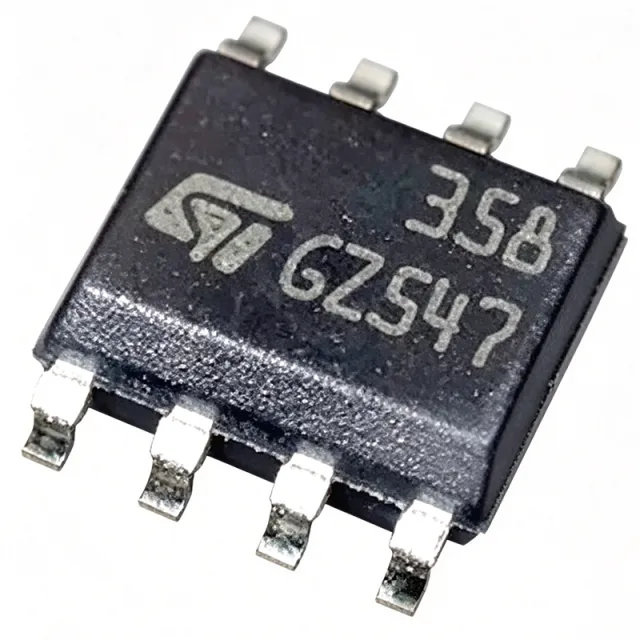
The LM358DT is a dual operational amplifier from STMicroelectronics, designed for low-power, general-purpose applications. It operates from a single or split power supply ranging from 3V to 32V (or ±1.5V to ±16V), with a typical quiescent current of 350 µA per amplifier. The device is housed in an 8-pin SOIC (SO-8) package, making it suitable for space-constrained PCB designs. Data verified as of 2026-08-05. An operational amplifier (op-amp) is a high-gain voltage amplifier with differential inputs and a single-ended output. It is a fundamental building block in analog electronics, used for signal conditioning, filtering, and mathematical operations. The LM358 is part of the general-purpose op-amp family, which includes the LM324 (quad version) and LM393 (comparator). These devices are widely used in industrial, automotive, and consumer electronics due to their low cost, ease of use, and wide supply voltage range. Key features of the LM358DT include a wide supply voltage range (3V to 32V), low quiescent current (350 µA per amplifier), and a common-mode input voltage range that includes ground, allowing single-supply operation. The output stage can sink and source current, and the device is short-circuit protected. The LM358DT also features a typical input offset voltage of 2 mV and a gain-bandwidth product of 1.1 MHz, making it suitable for low-frequency signal processing. The LM358DT uses a bipolar transistor architecture with a class-AB output stage, providing low crossover distortion. The input stage is a PNP differential pair, which allows the input common-mode range to extend to the negative supply rail (ground in single-supply operation). This design enables direct sensing of signals near ground, a key advantage in battery-powered and single-supply systems. Typical applications include transducer amplifiers, DC gain blocks, active filters, and signal conditioning in industrial control systems. The LM358DT is also used in portable instrumentation, power supply monitoring, and automotive sensor interfaces. Its low power consumption makes it ideal for battery-operated devices. When designing with the LM358DT, ensure that the input common-mode voltage does not exceed the specified range, and provide adequate decoupling capacitors on the power supply pins. The output can drive loads down to 2 kΩ, but for heavier loads, consider using a buffer stage. The device is stable with capacitive loads up to 500 pF, but for larger loads, an external compensation network may be required. This page synthesizes distributor pricing, drop-in alternatives, and practical design notes not found in the STMicroelectronics datasheet, providing engineers with a comprehensive resource for selecting and using the LM358DT.

USD $0.05 Kontak
LM358EDR2G - Dual General-Purpose Op Amp | onsemi
LM358EDR2G

LM358EDR2G - Dual General-Purpose Op Amp | onsemi

onsemi LM358EDR2G is a dual-channel, general-purpose operational amplifier designed for single or split-supply operation in an 8-pin SOIC package. The two amplifier channels support common-mode input ranges extending to ground and VEE, while the low-power-drain architecture is suited to compact analog systems requiring two amplifier functions on one board. An operational amplifier is an analog signal-processing IC that compares voltages applied to its high and low inputs and amplifies the difference. A dual operational amplifier combines two amplifier channels in one package. Within the broader semiconductor hierarchy, an operational amplifier belongs to the amplifier IC class, where it is used for buffering, signal conditioning, feedback control, instrumentation, and general analog circuit design. The LM358EDR2G is categorized as a standard, general-purpose amplifier rather than a precision or high-speed device. Its principal practical feature is its ability to operate from one supply or from split supplies. Its input common-mode range reaching ground and VEE is especially useful in single-supply circuits because it allows the amplifier to process signals near the lower supply rail. The SOIC-8 surface-mount package also supports automated assembly and compact general-purpose analog boards. The LM358 family uses a two-amplifier approach derived from the circuit architecture of the LM324 family. Each channel provides independent input and output connections while sharing common supply and ground pins. This arrangement lets a design implement two related analog functions, such as a buffer followed by a gain stage, without using two separate integrated circuits. Split-supply operation also supports bipolar signal paths centered around ground. Typical uses include low-side current measurement, sensor-signal conditioning, audio preamplification, active filtering, comparator-style threshold circuits, and industrial control interfaces. The grounded-input capability is useful when an upstream sensor produces voltages close to zero. Applications requiring rail-to-rail input or output behavior, very low offset voltage, high slew rate, or unrestricted output swing should verify the manufacturer specifications before assigning the amplifier to the function. For PCB design, place input and output components close to their associated pins, maintain a quiet ground-return path, and decouple the supply pins near the device. Check input and output common-mode limits across the complete temperature range, confirm the intended load and output-current conditions, and verify stability with the selected feedback network. Do not assume that the general-purpose LM358 specification is adequate for precision instrumentation. This product data combines the manufacturer description, lifecycle and compliance status, package information, source documents, and same-footprint replacement guidance into an engineering-focused overview. It also identifies the operating conditions and design checks that must be reviewed before using a substitute in an existing LM358EDR2G footprint.

RFQ Kontak
LM358F-E2 Dual Ground-Sense Op Amp | ROHM Semiconductor
LM358F-E2

LM358F-E2 Dual Ground-Sense Op Amp | ROHM Semiconductor

The ROHM Semiconductor LM358F-E2 is a dual general-purpose operational amplifier designed for ground-sense and low-power signal-processing circuits, supplied in an 8-pin SOP package. The device contains two amplifier channels, allowing one package to support filtering, amplification, buffering, level shifting, and instrumentation functions in compact analog systems. Its surface-mount construction supports automated assembly and high-density analog boards. An operational amplifier is an active analog integrated circuit that compares two input voltages and drives its output according to the difference between them. In a closed-loop circuit, negative feedback makes the amplifier behave predictably, while an open-loop application can use its high gain for comparator-style functions. The LM358F-E2 belongs to the dual operational-amplifier family, which combines two amplifier channels with a common package for space-efficient analog design. The principal feature of the LM358F-E2 is its dual-channel configuration. Two independent amplifier sections can process different signals in one package, reducing component count and simplifying board layout. Its ground-sense designation identifies its suitability for applications in which an input is referenced close to ground. The 8-pin SOP package also provides a practical footprint for compact, mixed-signal equipment where conventional through-hole dual amplifiers would be too large. Use of a dedicated ground-sense amplifier architecture can simplify circuits in which the measured or sensed voltage is small relative to the system ground. In practical designs, the exact input range, supply limits, offset, bandwidth, output capability, and common-mode behavior must be confirmed against the manufacturer datasheet for the selected operating conditions. Decoupling, input-referenced grounding, and output-load stability remain the principal implementation considerations. Typical uses include low-level sensor conditioning, current-sensing interfaces, general-purpose filtering, voltage buffering, audio preamplification, feedback networks, and small industrial control modules. The dual format is particularly useful when a board needs two related analog functions, such as a signal-conditioning channel followed by an active filter or buffer. Its low-power circuit positioning makes it relevant to compact analog and embedded-control products that require more than one amplifier function without allocating separate packages. For PCB implementation, place the device so that input and output traces remain short, maintain a quiet ground reference around both amplifier channels, and decouple the supply pins according to the manufacturer guidance. Confirm that the SOP land pattern matches the selected ordering code and supplier package drawing. When substituting the device, verify electrical ratings and operating-temperature limits rather than relying on the eight-pin footprint alone. This product record combines the confirmed LM358F-E2 identity, dual ground-sense function, and 8-pin SOP packaging with application guidance, comparison parameters, and practical replacement considerations. It helps engineers narrow the selection while preserving the need to validate detailed electrical limits against the current manufacturer documentation.

RFQ Kontak
LM358F-GE2 - Dual Ground-Sense Operational Amplifier | ROHM Semiconductor
LM358F-GE2

LM358F-GE2 - Dual Ground-Sense Operational Amplifier | ROHM Semiconductor

The ROHM Semiconductor LM358F-GE2 is a dual ground-sense operational amplifier with two amplifier channels, supplied in an 8-pin SOP package. It is identified as a standard general-purpose operational amplifier for precision and efficiency in circuit designs, with a listed supply-voltage range of 6 V to 32 V and a gain-bandwidth product of 800 kHz. The device is specifically described by the manufacturer as not recommended for new designs because it is not intended for design diversion. An operational amplifier is an analog amplifier IC that uses high open-loop gain to amplify the difference between two input voltages. In a feedback circuit, the LM358F-GE2 can provide voltage amplification, buffering, filtering, summing, or signal-conditioning functions. The dual-channel configuration lets one package implement two independent amplifier sections, reducing component count and board space in dual-signal or dual-rail applications. The principal electrical characteristics shown for the LM358F family include a 6 V to 32 V voltage range, 800 kHz gain-bandwidth product, and 300 V/us slew rate. The ground-sense designation indicates that the device is intended for applications where the signal is referenced close to ground. Its two-channel architecture is useful for sensor interfaces, buffer stages, low-level signal conditioning, and general-purpose analog circuits. The LM358F-GE2 is packaged in an 8-pin SOP format. The package provides eight external terminals for the two amplifier sections, power rails, and associated functions. Because the manufacturer marks the product as not recommended for new designs, engineers should confirm the application, supply conditions, temperature requirements, and qualification expectations with ROHM before starting a new production design. Existing designs can use the established device when its electrical characteristics and lifecycle expectations match the system requirements. Typical applications include ground-referenced sensor amplification, dual-channel signal conditioning, low-frequency filtering, and general-purpose analog buffering. The 800 kHz gain-bandwidth product supports moderate-bandwidth closed-loop configurations, while the 300 V/us slew rate limits how quickly the output can follow large voltage changes. For unity-gain stability and the best dynamic behavior, the recommended input and output network should follow the manufacturer’s application guidance. A key design consideration is the input common-mode range and output swing. Designers should keep signals within the device’s supported input and output limits, verify that the power supply meets the 6 V to 32 V range, and account for the ground-sense architecture when selecting feedback and decoupling components. Stable operation also depends on suitable bypass capacitors, short feedback paths, and careful routing of high-impedance input nodes. This page combines the manufacturer’s product identity, package information, operating characteristics, lifecycle indication, and practical selection guidance. It also identifies replacement candidates for engineers reviewing an existing LM358F-GE2 design, while making clear that a valid substitution must be checked for supply range, bandwidth, slew rate, input/output limits, and pin compatibility.

RFQ Kontak
LM358FJ-GE2 - Dual Ground-Sense Op Amp, 36V | ROHM
LM358FJ-GE2

LM358FJ-GE2 - Dual Ground-Sense Op Amp, 36V | ROHM

ROHM LM358FJ-GE2 is a dual ground-sense operational amplifier with two amplifier circuits in an 8-pin SOP-J package. It operates from a 3 V to 32 V single supply, accepts supply voltages up to 36 V, and is specified over a -40°C to +85°C temperature range. Its headline characteristics include a nominal 5 V supply, input offset voltage up to 5,000 uV, a slew rate of 0.3 V/us, and an 80 dB common-mode rejection ratio. An operational amplifier is an analog signal-conditioning semiconductor that uses high open-loop gain to amplify voltage differences while presenting high input impedance and low output impedance. The LM358FJ belongs to the dual operational-amplifier family, combining two amplifier channels in one package. Its ground-sense architecture is intended for measurements referenced to ground, including current-shunt monitoring and low-side sensing. The principal features are a wide single-supply operating range, low current consumption, ground-capable input and output operation, and two independent amplifiers. The 0.3 V/us slew rate favors general-purpose signal paths rather than demanding high-speed applications. A common-mode rejection ratio of 80 dB helps reject equal-magnitude noise appearing on both inputs, while the maximum input offset voltage of 5,000 uV defines a relatively coarse accuracy class compared with precision amplifier families. The LM358FJ uses a practical bipolar-style general-purpose amplifier architecture associated with the LM358 product family. Its broad supply tolerance allows operation from low-voltage single-supply systems through industrial rails approaching the 36 V maximum. Because the device is not rail-to-rail at all operating conditions, the usable input and output range must be checked against the selected supply voltage and common-mode requirements. Typical uses include low-side current monitoring, power-supply feedback, sensor interfaces, battery-current measurement, and general analog signal conditioning. The dual configuration can implement two related channels or provide a differential amplifier and voltage follower within one package. Each channel should be configured for stable operation with the feedback network and compensation values specified by the manufacturer. Designers should verify input common-mode range, output swing, input bias current, noise behavior, and channel matching against the actual supply. Input and output nodes must remain within their absolute maximum ratings, and unused inputs require an appropriate bias to prevent saturation. PCB placement should keep feedback paths short and provide a stable ground reference close to the amplifier. This page organizes the manufacturer specifications, lifecycle notice, package information, functional alternatives, application guidance, and engineering checks into a practical design reference. It also identifies where replacement qualification must be confirmed at the pin, electrical, and application level rather than relying only on the generic LM358 family name.

RFQ Kontak
LM358FV-GE2 - Dual Op Amp, 8-SSOP | ROHM Semiconductor
LM358FV-GE2

LM358FV-GE2 - Dual Op Amp, 8-SSOP | ROHM Semiconductor

The ROHM Semiconductor LM358FV-GE2 is a dual general-purpose operational amplifier in an 8-SSOPB package, with two amplifier circuits, a 3 V to 32 V total supply range, 0.7 MHz typical gain-bandwidth product, and 0.3 V/µs typical slew rate. It is designed for industrial, instrumentation, sensing, and control applications that require two amplifiers in one compact package. An operational amplifier, or op amp, is a high-gain, differential-input amplifier used to amplify and buffer signals within electronic control systems. The dual-amplifier configuration belongs to the broader hierarchy of amplifier ICs, interface ICs, and analog semiconductors. Combining two amplifiers in one package reduces board area and simplifies designs requiring matched gain stages, active filters, sensor amplification, or feedback-control loops. The LM358FV-GE2 combines a maximum offset voltage of 3 mV at 25°C with typical quiescent current of 0.35 mA per channel. Its 0.7 MHz gain-bandwidth product supports moderate-bandwidth signal conditioning, while its 0.3 V/µs slew rate determines large-signal response. The 3 V to 32 V operating supply range accommodates both conventional 5 V analog systems and higher industrial supply rails. The ROHM LM358 device uses an internal arrangement intended for general-purpose precision and control rather than high-speed signal processing. Operation from a single positive supply or a split-supply configuration supports both single-ended and ground-centered signal systems. Designers should account for input common-mode limits, output swing, stability, and power-supply headroom according to the manufacturer application guidance. Typical uses include industrial sensor interfaces, transducer conditioning, active filters, loop-control amplifiers, low-frequency data-acquisition channels, and general buffer stages. Its dual-channel arrangement is particularly useful when a board needs two similar amplifier functions without allocating two separate packages and their associated routing and decoupling requirements. Place input, output, and supply bypass capacitors close to the relevant pins, and route high-current return paths to minimize ground offsets. Verify that signal amplitudes remain within the input and output common-mode limits across the complete supply range and temperature range. Adequate supply decoupling and careful stability analysis are essential in feedback configurations. This product record combines the confirmed electrical and package characteristics with practical application guidance, comparison data, and design checks. Use the ROHM Semiconductor datasheet and pin-description table for final schematic, footprint, and operating-limit verification before placing a production order.

RFQ Kontak
LM358FVJ-E2 - Dual Ground-Sense Op Amp | ROHM Semiconductor
LM358FVJ-E2

LM358FVJ-E2 - Dual Ground-Sense Op Amp | ROHM Semiconductor

ROHM Semiconductor LM358FVJ-E2 is a dual-circuit, general-purpose operational amplifier designed for ground-sense signal conditioning, operating from 3 V to 32 V in an 8-TSSOP-BJ surface-mount package. It combines two amplifier channels in one compact package, making it suitable for signal conditioning, feedback, amplification, and general analog control functions. An operational amplifier is a voltage amplifier with high open-loop gain, negative feedback, and high input impedance. Used as a non-inverting or inverting amplifier, it can amplify a differential input voltage while presenting a high impedance to the source. The dual-channel configuration of the LM358FVJ-E2 provides two amplifiers in one package, reducing board area in circuits that need more than one gain stage. The ROHM product page identifies the device as a ground-sense operational amplifier, and distributor information describes it as a standard general-purpose amplifier with two circuits. Its stated 3 V to 32 V operating range supports both low-voltage systems and higher-voltage industrial signal chains when the complete circuit, including input and output limits, is designed accordingly. The -E2 ordering code identifies the specified supplier packaging configuration. Ground-sense operation is important when a measured signal is referenced close to ground or where the input source has low voltage headroom. The amplifier should be configured with suitable feedback, decoupling, and output-voltage headroom. Because this page does not reproduce the complete electrical characteristic table, designers should verify offset voltage, input bias current, output swing, slew rate, noise, and common-mode behavior against the current ROHM datasheet before production release. Typical uses include low-level signal conditioning, current-sense amplifier sections, sensor interfaces, feedback networks, analog control loops, and general dual-amplifier boards. The 8-TSSOP-BJ package is particularly useful for compact industrial, instrumentation, and embedded-control assemblies where two independent amplifier channels are required without allocating two separate packages. Start the design by confirming the pin mapping for the exact FVJ and -E2 ordering codes. Place the supply-decoupling capacitor close to the device, maintain a defined ground reference, and review output-swing limits against the expected signal range. The product page marks LM358FVJ-E2 as not recommended for new designs, so it is primarily appropriate for existing designs, controlled maintenance, and previously qualified production programs. This product summary combines the manufacturer product designation, distributor package and supply-range information, lifecycle status, application guidance, and a conservative review of what engineers must confirm before releasing a new PCB. It supports faster sourcing and design triage while directing critical decisions back to the official manufacturer documentation.

RFQ Kontak