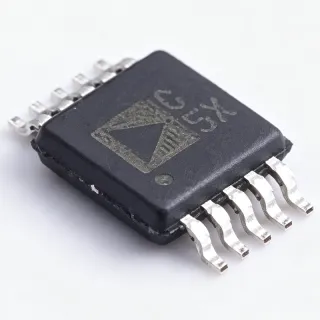
AD7450ARM - 12-Bit 1 MSPS Differential SAR ADC | Analog Devices
MPN: AD7450ARM ✗ Tapus ng BuhayAD7450ARM Ulas
A SAR analog-to-digital converter, commonly abbreviated as successive-approximation ADC, performs conversion by successively approximating the unknown input voltage with a controlled internal voltage. The AD7450 belongs to the ADC hierarchy and ultimately falls within the broader category of data-conversion and signal-processing semiconductors. Unlike flash converters, a SAR ADC generally combines lower power consumption with adequate resolution and conversion speed for industrial measurement, instrumentation, communications, and control applications.
The principal features of the AD7450ARM include 12-bit resolution, one fully differential analog input, operation from a 3 V or 5 V supply, and throughput rates of up to 833 kSPS at 3 V or 1 MSPS at 5 V. Its low-noise, wide-bandwidth differential track-and-hold amplifier supports acquisition of rapidly changing analog signals. The external reference input can be adjusted over a 100 mV to 3.5 V range, providing flexibility in matching the converter to the signal chain, excitation voltage, or system reference.
Because the architecture is fully differential, the input voltage is represented by the difference between two input nodes. This supports rejection of common-mode interference when the signal source and converter are properly interfaced. The differential track-and-hold stage acquires the input before conversion, while the SAR conversion process produces a 12-bit digital result. The 1 MSPS maximum rate is particularly useful for sampling waveforms, industrial transducer outputs, and multiplexed analog systems that require deterministic periodic sampling without the power and complexity associated with much faster high-resolution converters.
Typical applications include industrial process monitoring, sensor-interface and instrumentation systems, communications infrastructure, data-acquisition modules, and embedded measurement equipment. In a sensor interface, the differential input can accept the output of a bridge or instrumentation amplifier while rejecting common-mode voltage. In communications equipment, the converter can sample intermediate-frequency or envelope signals when the required bandwidth and resolution match the application.
A key design consideration is the relationship among input bandwidth, supply voltage, reference voltage, and conversion rate. The analog input must satisfy the signal-range and settling requirements described by the manufacturer datasheet, while the selected reference voltage determines the full-scale conversion range. Layout should keep analog input traces short, provide a quiet ground path, and place decoupling capacitors close to the supply pins to minimize conversion disturbance.
This product page combines the AD7450ARM electrical identity, package information, lifecycle status, practical application guidance, and verified drop-in alternatives. It also distinguishes the original AD7450 from the AD7450A family and clarifies the significance of the ARM ordering code, tube packaging, and obsolete-part replacement considerations for engineers maintaining or redesigning existing analog-to-digital converter boards.
Mga alternatibo na pwedeng ilagay na AD7450ARM — parehas na package, pin-to-pin na katugmang. Hindi kasama ang mga bahagi ng iba't-ibang package na nangangailangan ng pagpapaayos ng PCB.
Variante sa Seri na ito
Katulad na modelo sa serye na katugma sa pagpasok AD7450ARM (parehas na form factor at footprint) — pagkakaiba sa Packaging, Resolution.
AD7450ARMZ
✅ Drop-In📋 Alternatibo na Reference (hindi sa katalogo)
AD7450ARZ-REEL
✅ Drop-InMagkontak para sa presyo
Tingnan ang Datasheet →AD7450ARM Mga Pinakamataas na Rating at Electrical Characteristics
| Pangangasiwaan | 12 bit |
| Converter Architecture | Successive-approximation SAR |
| Input Type | Fully differential analog input |
| Number of Analog Inputs | 1 input |
| Maximum Throughput at 5 V | 1 MSPS |
| Maximum Throughput at 3 V | 833 kSPS |
| Supply Voltage Range | 3 V to 5 V |
| Supply Configuration | Single supply |
| External Reference Voltage Range | 100 mV to 3.5 V |
| Input Stage | Low-noise, wide-bandwidth differential track-and-hold amplifier |
| Hanay ng Temperature na Operasyon | -40°C to +85°C |
| Packhaging | 8-MSOP, 0.65 mm pitch, 3.00 mm width |
| Uri ng Pagpapasok | Surface mount |
| Packaging | Tube |
| Katayuan ng Lifecycle | Obsolete |
| Export Control Classification Number | EAR99 |
Gabay sa Pin Configuration ng AD7450ARM 8-msop, 0.65 mm pitch, 3.00 mm width
Pin configuration para sa AD7450ARM (8-msop, 0.65 mm pitch, 3.00 mm width package). Ang analog component na ito ay may input, output, at power supply pins. Sumangguni sa datasheet ng manufacturer para sa offset null, compensation, at enable pin configurations. Perpekto para sa signal conditioning at amplifier circuits.

Wala ng detalyadong pinout data na magagamit para sa AD7450ARM.
Sumangguni sa datasheet para sa buong pin configuration.
Tipikal na mga Gamit
AD7450ARM ay nararapat para sa 6 aplikasyons: Industrial Sensor Acquisition, Data Acquisition Modules, Communications Signal Sampling, Waveform Monitoring, Test and Measurement Instruments, Condition Monitoring Systems.
Industrial Sensor Acquisition
The AD7450ARM suits industrial sensor systems that need direct differential digitization with 12-bit resolution. Its fully differential input can receive the output of a bridge, instrumentation amplifier, or current-to-voltage stage while rejecting common-mode voltage present on both sensor lines. At a 5 V supply, conversion can proceed at up to 1 MSPS, allowing the controller to sample multiple channels sequentially or capture process variables at a useful control-loop rate. The 3 V option provides 833 kSPS throughput when lower supply power is more important. Designers must verify the input common-mode range, source settling time, and available signal span against the manufacturer datasheet. Proper grounding, analog filtering, and short input routing are essential because industrial sensor cables can introduce interference before the signal reaches the ADC.
Data Acquisition Modules
The AD7450ARM provides a compact conversion front end for compact data-acquisition equipment that accepts analog voltage measurements and outputs a 12-bit digital code. A 5 V implementation can sample at 1 MSPS, while a 3 V implementation can sample at 833 kSPS, making the part useful for portable and embedded measurement systems. The single differential input allows the module to use a balanced source without requiring a separate analog switch when only one channel must be converted. External reference voltage can be varied from 100 mV to 3.5 V, allowing the converter range to be matched to transducer excitation and signal-conditioning output. Practical designs should use a low-noise reference, local supply bypassing, and an input driver whose settling behavior supports the selected sample rate.
Communications Signal Sampling
The AD7450ARM can sample communication signals when 12-bit resolution and a maximum rate of 1 MSPS at 5 V are sufficient. Its differential track-and-hold amplifier is well matched to balanced IF, envelope, or demodulator outputs that are centered on a common-mode voltage. The architecture reduces sensitivity to shared noise on the two input lines, provided the source remains within the permitted common-mode range and develops the required differential voltage during the acquisition interval. Designers should insert an appropriate anti-alias or channel-selection filter and account for reference-voltage noise before converting. Interface timing to a microcontroller or DSP must follow the serial data specification from the manufacturer datasheet, including clock polarity, conversion timing, and the relationship between acquisition and conversion commands.
Waveform Monitoring
The AD7450ARM is useful for waveform monitoring, envelope detection, and periodic signal analysis in instrumentation that does not require sampling rates above 1 MSPS. A 5 V supply supports 1 MSPS throughput, allowing a control system to capture 12-bit samples of repetitive analog waveforms for amplitude, peak, RMS, or spectral analysis. The differential input can accept a balanced probe or instrumentation-amplifier output and reduce common-mode pickup. When the monitored signal is not centered within the permitted input range, the external reference can be adjusted from 100 mV to 3.5 V to match the measurement span. The acquisition chain should include anti-alias filtering, controlled source impedance, and careful grounding to avoid injecting noise that masks the 12-bit resolution.
Test and Measurement Instruments
The AD7450ARM can form the measurement stage of a compact test instrument or programmable signal measurement system. Its 12-bit resolution balances conversion accuracy against implementation complexity, while the 1 MSPS maximum rate at 5 V supports fast source characterization and repetitive sampling. The differential input provides flexibility when the measured quantity is produced by a balanced bridge or active probe. The external reference range of 100 mV to 3.5 V allows the instrument to select a suitable conversion scale, although reference noise and temperature drift directly affect measurement stability. Use a quiet reference source, local high-frequency decoupling, and careful separation between analog sampling traces and digital serial-interface routing to preserve usable measurement accuracy.
Condition Monitoring Systems
The AD7450ARM fits condition-monitoring and predictive-maintenance systems that digitize vibration, current, pressure, or temperature-derived analog signals. Differential sampling is advantageous when the sensor interface includes an instrumentation amplifier, because the converter responds to the signal difference rather than the full common-mode voltage. The 833 kSPS rate at 3 V or 1 MSPS rate at 5 V is suitable for periodic envelopes and moderate-bandwidth waveforms. In a field-installed system, filtering and protection should be placed ahead of the ADC to prevent transients from exceeding the input limits. The design must also account for the temperature-dependent behavior of the external reference and verify the available analog input span for the expected operating range of the monitored equipment.
Impormasyon ng Talumpati sa Engineering for AD7450ARM — ikabit, gabay sa disenyo, at impormasyon ng pagsunod sa kautusan.
Paunawang Hanapin
Ikabit sa Mga Alternatibo
| Parametro | Ito ang Producto | AD7450ARMZ | AD7450ARZ |
|---|---|---|---|
| Package | 8-MSOP | 8-MSOP | 8-MSOP |
| Brand | Analog Devices | Analog Devices | Analog Devices |
| Resolution | 12 bit | 12 bit | 12 bit |
| Converter Architecture | SAR | SAR | SAR |
| Analog Input Configuration | 1 fully differential input | 1 fully differential input | 1 fully differential input |
| Maximum Throughput at 5 V | 1 MSPS | 1 MSPS | 1 MSPS |
| Maximum Throughput at 3 V | 833 kSPS | 833 kSPS | 833 kSPS |
| Supply Voltage | 3 V to 5 V single supply | 3 V to 5 V single supply | 3 V to 5 V single supply |
| Reference Voltage Range | 100 mV to 3.5 V | 100 mV to 3.5 V | 100 mV to 3.5 V |
Pangunahing mga Pagkakaiba
- Differential 12-bit conversion at a compact 1 MSPS maximum rate (kumpara saAD7450ARMZ)
- Single-supply operation supports portable and compact instrumentation (kumpara saAD7450ARZ)
- External reference range allows conversion-scale optimization (kumpara saAD7450ARMZ)
Talaan ng Disenyo
Route the differential analog input as a short, symmetric pair from the source driver to the AD7450ARM input pins. Keep digital serial-interface traces away from the analog input and reference paths, and use a continuous ground reference beneath the relevant circuitry. Place input and reference bypass capacitors close to their associated pins with short return paths. The differential track-and-hold amplifier requires the source to settle within the acquisition interval, so routing resistance, capacitance, and source impedance must be included in the settling-time budget.
Choose either 3 V or 5 V operation according to the required throughput: the converter supports up to 833 kSPS at 3 V and 1 MSPS at 5 V. Decouple the supply locally and keep switching-regulator or digital-supply current out of the reference and analog-input return paths. The external reference may range from 100 mV to 3.5 V subject to supply constraints, but reference noise, drift, and dynamic resistance contribute directly to conversion error, so use a stable reference network rather than routing a sensitive analog node into the digital return.
Treat the analog input as a settling-time-sensitive node. The front-end amplifier or sensor interface must charge the ADC input capacitance and settle to the required accuracy before the next conversion. Include source resistance, cable or filter capacitance, and the ADC acquisition aperture in the timing analysis. An external anti-alias filter is recommended for waveform or communication inputs, but its capacitor values should be checked against the acquisition requirements so the filter does not prevent full settling at the selected sampling rate.
Do not assume that every AD7450 ordering suffix is production interchangeable solely because the devices use an 8-MSOP. Confirm the exact ordering table, package drawing, lead finish, temperature grade, tape-and-reel or tube handling, and lifecycle status. Because AD7450ARM is obsolete, also confirm whether a proposed replacement preserves the electrical limits, reference behavior, conversion timing, and all eight pin functions. PCB footprint compatibility alone is not sufficient evidence of drop-in equivalence.
Impormasyon ng Pagsunod sa Kautusan
The AD7450ARM listing identifies EAR99 export control classification and obsolete lifecycle status. Specific RoHS, REACH, AEC-Q100, lead-free, halogen-free, and conflict-minerals declarations require confirmation from the manufacturer documentation for the exact ordering code.