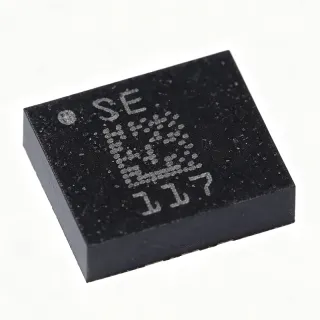
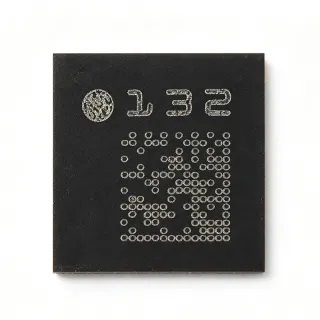
LSM6DSOTR - 6-Axis IMU, ±16g Accel, ±2000dPS Gyro LGA-14 | STMicroelectronics
MPN: LSM6DSOTR ✓ NakahandaLSM6DSOTR Ulas
An IMU (Inertial Measurement Unit) is a MEMS-based sensor package that combines multiple motion-sensing axes — typically 3-axis linear acceleration and 3-axis angular rate — into a single silicon die with a digital interface. The LSM6DSOTR belongs to the iNEMO inertial module family from STMicroelectronics, sitting inside the broader taxonomy of MEMS sensors → motion sensors → inertial sensors → IMU → 6-axis IMU. It integrates a capacitive MEMS accelerometer and a capacitive MEMS gyroscope on a single die, plus a digital SPI/I²C/MIPI I3C interface and an embedded finite-state machine plus machine-learning core for event recognition.
Key features include user-selectable full-scale ranges of ±2/±4/±8/±16 g on the accelerometer and ±125/±250/±500/±1000/±2000 dps on the gyroscope, 16-bit data output, embedded temperature sensor, and ST's machine-learning-core and FSM that offload classification from the host MCU. The integrated I3C bus support and a programmable interrupt generator simplify data-ready and threshold-triggered wakeups for always-on applications.
The LSM6DSO silicon uses a 130 nm CMOS ASIC paired with a high-aspect-ratio MEMS structure, achieving an accelerometer noise density of 60 µg/√Hz typical and a gyroscope rate noise density of 3.8 mdps/√Hz typical. The sensor operates from a 1.71 V to 3.6 V analog supply and a separate 1.71 V to 3.6 V digital I/O supply, allowing mixed-voltage host interfacing without level shifters.
Typical applications include wrist wearables for step counting and gesture recognition, tilt and orientation tracking in AR/VR controllers and remote controls, motion-activated user interfaces in smartphones and tablets, asset tracking and vibration monitoring in industrial IoT nodes, and head tracking in TWS earbuds. The 0.55 mA high-performance current and sub-µA power-down current make it well suited to coin-cell and Li-ion battery designs.
When designing with this device, ensure the LGA-14 land pattern matches the official ST reference layout and that the host processor issues the proper soft-reset and configuration sequence via I²C, SPI, or MIPI I3C. The device defaults to I²C address 0x6A and can be hardware-strapped to 0x6B; verify the strap with SDO/SA0 before issuing read commands.
This page synthesizes distributor pricing, drop-in LGA-10/LGA-14 alternatives, and practical design notes not found in the manufacturer datasheet alone.
Mga alternatibo na pwedeng ilagay na LSM6DSOTR — parehas na package, pin-to-pin na katugmang. Hindi kasama ang mga bahagi ng iba't-ibang package na nangangailangan ng pagpapaayos ng PCB.
Variante sa Seri na ito
Katulad na modelo sa serye na katugma sa pagpasok LSM6DSOTR (parehas na form factor at footprint) — pagkakaiba sa Embedded Features, Package, FIFO, Gyroscope Full-Scale Range, Accelerometer Full-Scale Range.
LSM6DSOXTR
✅ Drop-InMagkontak para sa presyo
Tingnan ang Datasheet →LSM6DSLTR
✅ Drop-InMagkontak para sa presyo
Tingnan ang Datasheet →LSM6DSRTR
✅ Drop-InMagkontak para sa presyo
Tingnan ang Datasheet →LSM6DSOTR
✅ Drop-InMagkontak para sa presyo
Tingnan ang Datasheet →BMI270
✅ Drop-In📋 Alternatibo na Reference (hindi sa katalogo)
LSM6DSOTR Mga Pinakamataas na Rating at Electrical Characteristics
| Product Type | 6-Axis IMU (Accelerometer + Gyroscope) |
| Sensor Function | 3D accelerometer + 3D gyroscope |
| Accelerometer Full-Scale Range | ±2 / ±4 / ±8 / ±16 g |
| Gyroscope Full-Scale Range | ±125 / ±250 / ±500 / ±1000 / ±2000 dps |
| Data Output Resolution | 16-bit |
| Supply Voltage (VDD) | 1.71 V to 3.6 V |
| Supply Voltage (VDDIO) | 1.71 V to 3.6 V |
| Current Consumption (High-Performance Mode) | 0.55 mA |
| Communication Interface | I²C / SPI / MIPI I3C |
| Default I²C Address | 0x6A (strap to 0x6B) |
| Package Type | LGA-14 |
| Temperature na Operasyon | -40 °C to +85 °C |
| Embedded Features | Finite-State Machine, Machine-Learning Core, Temperature Sensor |
| Tindminan RoHS | Compliant |
| Uri ng Pagpapasok | Surface Mount |
Pin Configuration ng LSM6DSOTR
| Pin 1 | CS — SPI chip-select (active low); tie high for I²C/I3C |
| Pin 2 | RESERVED — Reserved pin — leave floating or tie to GND per datasheet |
| Pin 3 | SCL/SPC — I²C clock / SPI serial clock |
| Pin 4 | SDA/SDI/SDO — I²C data / SPI serial data in (3-wire: serial data out) |
| Pin 5 | VDDIO — Digital interface supply voltage (1.71 V – 3.6 V) |
| Pin 6 | INT1 — Programmable interrupt 1 (data-ready, threshold, FSM) |
| Pin 7 | RESERVED — Reserved pin — leave floating or tie to GND per datasheet |
| Pin 8 | GND — Ground reference for digital and MEMS |
| Pin 9 | GND — Ground reference for digital and MEMS |
| Pin 10 | GND — Ground reference for digital and MEMS |
| Pin 11 | INT2 — Programmable interrupt 2 (data-ready, threshold, FSM) |
| Pin 12 | VDD — Analog and MEMS supply voltage (1.71 V – 3.6 V) |
| Pin 13 | SDO/SA0 — SPI data out / I²C least-significant address bit |
| Pin 14 | RESERVED — Reserved pin — leave floating or tie to GND per datasheet |
Tipikal na mga Gamit
LSM6DSOTR ay nararapat para sa 6 aplikasyons: Wrist Wearable Motion Tracking, AR/VR Controller Head Tracking, Smartphone and Tablet Motion UI, TWS Earbud Head Tracking, Industrial IoT Asset Vibration Monitor, Remote Control Motion UI.
Wrist Wearable Motion Tracking
The LSM6DSOTR's 0.55 mA high-performance current and sub-µA power-down mode make it ideal for wrist-worn fitness bands and smartwatches where battery life dominates the BOM trade-off. The integrated machine-learning core recognizes wrist gestures and step transitions on-sensor, freeing the host MCU to sleep — typical wearables see 30%+ system-power savings versus polling the IMU at 50 Hz. The accelerometer ±16 g range captures impact events for fall detection while the ±2000 dps gyroscope covers fast hand-swing dynamics during running. Placed adjacent to the coin-cell or Li-ion cell with the recommended LGA-14 land pattern, it replaces discrete accel + gyro combos with a single chip.
Inirekomenda
AR/VR Controller Head Tracking
The LSM6DSOTR's 16-bit output and ±2000 dps gyroscope range suit head and controller tracking in AR/VR HMDs and game controllers, where fast rotational updates prevent visible motion-to-photon latency. Its low gyroscope rate-noise density (3.8 mdps/√Hz typical) keeps drift low during sustained motion. The I3C interface minimizes bus traffic versus I²C at the same pin count, freeing CPU cycles on the host SoC. Placed on a flexible PCB between the controller grip and the IMU mount, it pairs well with magnetometer companion chips when 9-DoF fusion is required.
Inirekomenda
Smartphone and Tablet Motion UI
The LSM6DSOTR's small LGA-14 footprint (2.5 x 3.0 mm) and low-power always-on capability make it a drop-in fit for smartphone motion UI, screen-rotation, and step-counter pipelines. Its machine-learning core can run a gesture classifier for double-tap-to-wake without waking the application processor, drawing under 100 µA. The device supports both I²C and SPI for legacy application-processor compatibility, and the ±2 g low-g range preserves resolution for tilt sensing. Placed near the corner of the PCB opposite the main antenna, it minimizes vibration coupling from the speaker.
Inirekomenda
TWS Earbud Head Tracking
The LSM6DSOTR's small 2.5 x 3.0 mm LGA-14 package and sub-µA power-down mode are purpose-built for TWS earbuds, where PCB area and coin-cell runtime dominate. The accelerometer's ±2 g / ±4 g low-g modes preserve resolution for head-tilt and spatial-audio head tracking, while the gyroscope handles rapid yaw/pitch during walking. On-sensor gesture recognition via the FSM/MLC detects double-tap without waking the BT SoC, preserving battery. Placed inside the earbud stem with care to avoid acoustic port coupling, it is paired with a small MEMS microphone array.
Inirekomenda
Industrial IoT Asset Vibration Monitor
The LSM6DSOTR's ±16 g range and 6-axis simultaneous sampling make it suitable for industrial vibration monitoring on motors, pumps, and conveyor systems. The wide bandwidth and on-sensor FFT capability (via MLC/FSM feature extraction) offload anomaly classification from the gateway MCU, enabling edge decisions within milliseconds. Its -40 °C to +85 °C operating range covers most factory-floor environments, and the I3C interface connects directly to modern industrial MCUs. Placed on the asset chassis with a vibration-isolated mount, it captures bearing-fault signatures at fractional-amp draw.
Inirekomenda
Remote Control Motion UI
The LSM6DSOTR's on-sensor gesture recognition and low-power always-on features make it a strong fit for TV remotes and pointer-style controllers where click-and-drag motion replaces traditional IR keypads. The machine-learning core identifies circular, shake, and tap gestures with sub-mW draw, letting the remote run for months on AAA cells. The I²C interface connects directly to the BLE remote SoC without extra logic, and the ±8 g range covers flick-motions at the end of a wrist-swing. Placed near the remote's center of mass with a rigid mount, it delivers stable pointer tracking.
Inirekomenda
Buod ng mga Inirekomendang Produkto
Impormasyon ng Talumpati sa Engineering for LSM6DSOTR — ikabit, gabay sa disenyo, at impormasyon ng pagsunod sa kautusan.
Paunawang Hanapin
Ikabit sa Mga Alternatibo
| Parametro | Ito ang Producto | LSM6DSOXTR | LSM6DSLTR | LSM6DSRTR | BMI270 |
|---|---|---|---|---|---|
| Brand | STMicroelectronics | STMicroelectronics | STMicroelectronics | STMicroelectronics | Bosch Sensortec |
| Package | LGA-14 | LGA-14 - same | LGA-14 - same | LGA-14 - same | LGA-14 - same |
| Accelerometer Range | ±2/±4/±8/±16 g | ±2/±4/±8/±16 g | ±2/±4/±8/±16 g | ±2/±4/±8/±16 g | ±2/±4/±8/±16 g |
| Gyroscope Range | ±125/±250/±500/±1000/±2000 dps | ±125/±250/±500/±1000/±2000 dps | ±125/±250/±500/±1000/±2000 dps | ±125/±250/±500/±1000/±2000 dps | ±125/±250/±500/±1000/±2000 dps |
| Supply Voltage | 1.71 V to 3.6 V | 1.71 V to 3.6 V | 1.71 V to 3.6 V | 1.71 V to 3.6 V | 1.71 V to 3.6 V |
| High-Performance Current | 0.55 mA | 0.55 mA | 0.65 mA | 0.70 mA | 0.55 mA |
| Embedded ML / FSM | Yes (MLC + FSM) | Yes (MLC + FSM) | No | No | Yes (feature engine) |
| I3C Support | Yes | Yes | No | No | Yes |
| Startup Config File Required | No | No | No | No | Yes (host upload) |
Pangunahing mga Pagkakaiba
- Embedded machine-learning core at 0.55 mA (kumpara saLSM6DSLTR)
- Drop-in cross-brand migration path (kumpara saBMI270)
- MIPI I3C support on same LGA-14 footprint (kumpara saLSM6DSRTR)
Talaan ng Disenyo
Place the LGA-14 land pattern directly on the official ST reference footprint with a solid ground copper pour under the central die paddle. Keep high-speed digital traces (SPI/I3C, INT1/INT2) at least 2 mm away from the LGA-14 antenna-free zone to avoid stray capacitive coupling. The reserved pins (2, 7, 14) must be left floating or tied to GND per the datasheet — do not route signals to them, as this can interfere with the internal MEMS ASIC.
Decouple VDD and VDDIO each with a 100 nF X7R ceramic placed within 1-2 mm of the respective pin. Add a 1 µF bulk capacitor on VDD if the supply impedance is non-trivial above 1 MHz. Tie VDD and VDDIO together for single-rail 1.8 V designs; keep them separate when the host runs at 3.3 V logic and the IMU runs at 1.8 V. Power-rail sequencing is not required per the datasheet, but inrush is bounded by the soft-start circuit.
The I²C default address is 0x6A and can be strapped to 0x6B via the SA0 pin — verify with a logic probe before issuing the WHO_AM_I register read (0x6A register 0x0F returns 0x6C). Forgetting the soft-reset sequence (CTRL3_C 0x01 = 0x44) leaves the device in an undefined state after power-up on some lots. On I3C buses the device must be assigned a dynamic address during the ENTDAA hot-join window or the host will time out.
Impormasyon ng Pagsunod sa Kautusan
RoHS compliant per ST product page; not AEC-Q100 qualified — choose ST's automotive IMU family for automotive. Halogen-free per ST's environmental compliance datasheet section.