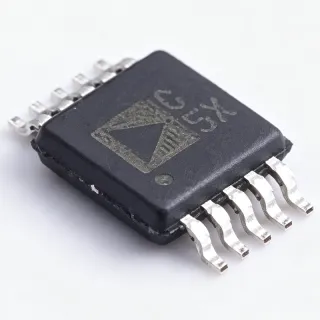
MCP3427T-E/MF - 16-Bit Dual-Channel Delta-Sigma ADC | Microchip
MPN: MCP3427T-E/MF ✓ NakahandaMCP3427T-E/MF Ulas
A delta-sigma ADC is a type of sigma-delta analog-to-digital converter that uses continuous-time oversampling and digital filtering to provide high-resolution conversion of slowly changing analog signals. Positioned within the ADC > data converter > semiconductor hierarchy, the MCP3427 is designed for precision measurement systems where low noise, simple connectivity, and compact implementation matter more than very high conversion speed.
The MCP3427 provides two differential input channels and up to 16-bit resolution. Differential measurement rejects common-mode voltage and often improves noise performance when the source is centered around the analog ground or midpoint of the selected input range. The integrated 2.048 V reference establishes a convenient full-scale range of ±2.048 V, while the I2C interface allows the converter to connect directly to a host microcontroller or embedded control system.
Internally, the converter uses a sigma-delta modulation and digital-decimation approach to average noise over the selected conversion cycle. The 15 SPS operating rate supports temperature, pressure, load-cell, potentiometer, and other slow-moving physical measurements. Its small DFN package reduces board area, but the exposed thermal pad requires a deliberate PCB thermal and layout implementation.
Typical applications include industrial process monitoring, precision temperature acquisition, pressure and force measurement, low-rate instrumentation, and embedded sensor interfaces. Differential inputs are particularly useful for sensor bridges and low-amplitude signals where common-mode rejection is valuable. The I2C interface also simplifies connection to distributed acquisition systems.
Route analog inputs away from switching nodes and digital clock traces, follow the manufacturer pin and layout guidance, and provide the specified input and reference capacitance close to their associated pins. Confirm the selected conversion rate, gain, and digital filter configuration before filtering the resulting measurements in firmware.
This page combines the manufacturer’s device characteristics, package information, application guidance, structured comparisons, and practical design considerations to support component selection, PCB implementation, and replacement planning.
Mga alternatibo na pwedeng ilagay na MCP3427T-E/MF — parehas na package, pin-to-pin na katugmang. Hindi kasama ang mga bahagi ng iba't-ibang package na nangangailangan ng pagpapaayos ng PCB.
Variante sa Seri na ito
Katulad na modelo sa serye na katugma sa pagpasok MCP3427T-E/MF (parehas na form factor at footprint) — pagkakaiba sa Conversion Rate, Differential Input Range, Digital Interface, Input Configuration, Package.
MCP3426T-E/MF
✅ Drop-In ⚠️ Mga Talaan Hindi Naiwerikmo📋 Alternatibo na Reference (hindi sa katalogo)
MCP3428T-E/MF
✅ Drop-In ⚠️ Mga Talaan Hindi Naiwerikmo📋 Alternatibo na Reference (hindi sa katalogo)
MCP3425T-E/MF
✅ Drop-In ⚠️ Mga Talaan Hindi Naiwerikmo📋 Alternatibo na Reference (hindi sa katalogo)
MCP3424T-E/MF
✅ Drop-In ⚠️ Mga Talaan Hindi Naiwerikmo📋 Alternatibo na Reference (hindi sa katalogo)
MCP3423T-E/MF
✅ Drop-In ⚠️ Mga Talaan Hindi NaiwerikmoMagkontak para sa presyo
Tingnan ang Datasheet →MCP3427T-E/MF Mga Pinakamataas na Rating at Electrical Characteristics
| Pangangasiwaan | 16 bit |
| Number of Input Channels | 2 channels |
| Input Configuration | 2 differential inputs |
| Converter Architecture | 1 sigma-delta ADC |
| Conversion Rate | 15 samples/s |
| On-Board Reference Voltage | 2.048 V |
| Differential Input Range | ±2.048 V |
| Digital Interface | I2C |
| Supply Voltage Range | 3.3 V to 5 V |
| Packhaging | 10-DFN with exposed pad, 3 x 3 mm |
| Uri ng Pagpapasok | Surface mount |
| Packaging | Tape & reel |
| Output Data Format | 16-bit ADC data |
| Input Type | Differential |
| Converter Type | Delta-sigma |
| Reference Type | On-board precision reference |
Gabay sa Pin Configuration ng MCP3427T-E/MF 10-dfn with exposed pad, 3 x 3 mm
Pin configuration para sa MCP3427T-E/MF (10-dfn with exposed pad, 3 x 3 mm package). Ang analog component na ito ay may input, output, at power supply pins. Sumangguni sa datasheet ng manufacturer para sa offset null, compensation, at enable pin configurations. Perpekto para sa signal conditioning at amplifier circuits.

Wala ng detalyadong pinout data na magagamit para sa MCP3427T-E/MF.
Sumangguni sa datasheet para sa buong pin configuration.
Tipikal na mga Gamit
MCP3427T-E/MF ay nararapat para sa 6 aplikasyons: Precision Temperature Sensing, Industrial Pressure and Force Measurement, Sensor Bridge Acquisition, Low-Rate Instrumentation, Process Monitoring, Precision Potentiometer Readout.
Precision Temperature Sensing
The MCP3427T-E/MF fits low-rate temperature acquisition from resistive sensors such as RTDs and thermistors. According to Microchip’s MCP3427 manufacturer product page, the converter provides two differential inputs, up to 16-bit resolution, a 15 SPS conversion rate, and an on-board 2.048 V reference. Place one channel across the bridge or divider and use the second channel for compensation or a reference sensor. Differential excitation and acquisition help reject common-mode voltage and supply variation. The 15 SPS rate is appropriate for thermal signals that change slowly, while the 10-DFN package permits compact multi-sensor acquisition. Use the manufacturer’s recommended input network and filter the converted values to remove residual noise without sacrificing useful thermal response.
Inirekomenda
Industrial Pressure and Force Measurement
The MCP3427T-E/MF is appropriate for bridge-based pressure, load, and force measurements where millivolt-level differential signals must be digitized accurately. According to Microchip’s manufacturer product page, the device offers two differential channels, up to 16-bit resolution, a 2.048 V reference, and a 15 SPS conversion rate. A bridge can be excited from a precision source while its differential output is measured, avoiding the large common-mode voltage present at the sensor terminals. The second channel can monitor excitation, temperature, or another low-frequency sensor. Because mechanical forces generally vary much more slowly than 15 samples per second, no high-speed sample-and-hold architecture is required. Validate excitation noise, sensor sensitivity, input filtering, and grounding against the manufacturer’s application guidance.
Inirekomenda
Sensor Bridge Acquisition
The MCP3427T-E/MF supports compact bridge-sensor interfaces in industrial monitors and embedded measurement equipment. According to Microchip’s MCP3427 manufacturer documentation, it converts two differential analog inputs at up to 16-bit resolution and 15 samples per second, with a 2.048 V on-board reference. Differential input arrangement reduces sensitivity to shared supply and ground disturbances, which is valuable when a sensor output is much smaller than its common-mode voltage. The device can digitize one bridge while the second channel handles a temperature or supply-tracking signal for compensation. The I2C interface simplifies connection to a controller, and the 10-DFN package leaves board space for signal conditioning. Keep the analog loop compact and route bridge excitation and digital control paths separately to avoid injecting converter noise into the measurement.
Inirekomenda
Low-Rate Instrumentation
The MCP3427T-E/MF is useful in portable and bench instrumentation that measures slow analog process variables with limited space. According to Microchip’s manufacturer product page, it combines a 16-bit conversion format, two differential channels, 15 SPS operation, I2C communication, and a 3 x 3 mm 10-DFN package. A process signal can be applied to one input while the other channel measures a reference or auxiliary sensor. The converter’s continuous delta-sigma operation and digital filtering suit stable readings from potentiometers, resistive dividers, and slow sensor outputs rather than waveforms above the audio band. Use the I2C bus for configuration and data retrieval, then perform calibration and linearization in the host controller. Verify filter settling behavior after each conversion so the firmware does not interpret transition data as a valid measurement.
Inirekomenda
Process Monitoring
The MCP3427T-E/MF can digitize slowly changing industrial process signals such as tank level, valve position, or pressure-setpoint feedback. According to Microchip’s MCP3427 manufacturer page, the ADC offers two differential channels with up to 16-bit resolution and a 15 SPS conversion rate, supported by an on-board 2.048 V reference. These characteristics suit normalized 4-20 mA or resistive sensor interfaces after appropriate conditioning. Differential inputs support rejection of shared noise on paired sensor wiring, while the I2C interface allows periodic reads from an embedded controller. A production design should include input protection, transient filtering, grounding, and calibration against the selected sensor. Use the 10-DFN exposed pad as the manufacturer specifies so the converter maintains reliable thermal performance in enclosed industrial equipment.
Inirekomenda
Precision Potentiometer Readout
The MCP3427T-E/MF can measure slow potentiometer movement or resistive divider output where resolution and repeatability are more important than sampling speed. According to Microchip’s manufacturer product page, the device provides two differential inputs, up to 16-bit resolution, a 15 SPS conversion rate, and an integrated 2.048 V reference. Connect one divider channel to an input and use the second channel for a redundant position sensor, diagnostic divider, or offset measurement. Differential acquisition can reduce errors associated with common supply and reference-node noise, although the input source impedance still needs to meet the converter’s acquisition requirements. Apply the manufacturer’s input-capacitance guidance, avoid long unshielded analog traces, and perform a zero-and-span calibration in firmware to compensate resistor tolerance and mechanical offset.
Inirekomenda
Buod ng mga Inirekomendang Produkto
Impormasyon ng Talumpati sa Engineering for MCP3427T-E/MF — ikabit, gabay sa disenyo, at impormasyon ng pagsunod sa kautusan.
Paunawang Hanapin
Ikabit sa Mga Alternatibo
| Parametro | Ito ang Producto | MCP3426T-E/MF | MCP3428T-E/MF | MCP3425T-E/MF | MCP3424T-E/MF | MCP3423T-E/MF |
|---|---|---|---|---|---|---|
| Brand | Microchip Technology | Microchip Technology | Microchip Technology | Microchip Technology | Microchip Technology | Microchip Technology |
| Package | 10-DFN (3x3) with exposed pad | 10-DFN (3x3) with exposed pad | 10-DFN (3x3) with exposed pad | 10-DFN (3x3) with exposed pad | 10-DFN (3x3) with exposed pad | 10-DFN (3x3) with exposed pad |
| Conversion Rate | 15 samples/s | 15 samples/s | 15 samples/s | 15 samples/s | 15 samples/s | 15 samples/s |
| Digital Interface | I2C | I2C | I2C | I2C | I2C | I2C |
| Converter Architecture | Sigma-delta | Sigma-delta | Sigma-delta | Sigma-delta | Sigma-delta | Sigma-delta |
Pangunahing mga Pagkakaiba
- Two differential inputs in a compact precision converter (kumpara saMCP3428T-E/MF)
- 16-bit resolution at a 15 SPS conversion rate (kumpara saMCP3424T-E/MF)
- Integrated 2.048 V reference with ±2.048 V differential range (kumpara saMCP3426T-E/MF)
Talaan ng Disenyo
Route the two differential input pairs as tightly coupled traces and place their input components directly beside the corresponding device pins. Keep the analog ground and digital return paths organized so I2C return current does not share the sensitive input return segment. According to Microchip’s MCP3427 layout guidance, the exposed pad is part of the package thermal and electrical implementation; use the manufacturer’s recommended pad and via pattern rather than relying on a generic 10-pin land pattern.
Differential signal lines should have matched impedances and should remain away from switching nodes, clock traces, and high-current return paths. The converter is optimized for slowly changing signals rather than wideband waveform capture, so excessive routing length and mismatched input impedance can create avoidable conversion errors. Use the manufacturer’s input-capacitance and acquisition-settling requirements, and verify filter settling time in firmware before using each conversion result.
Estimated: using a 3.3 V supply at the device’s documented maximum supply current would give a device-level dissipation ceiling of 3.3 V multiplied by that current; the exact numeric result cannot be calculated without the operating-current value for the selected conversion mode. Keep the exposed pad over an uninterrupted copper region with thermal vias, monitor junction temperature under worst-case conditions, and avoid enclosing the assembly without an airflow and thermal assessment.
Do not assume that the on-board 2.048 V reference makes every external source safe to connect directly. Check the differential input range, common-mode limits, absolute maximum ratings, and source impedance in the manufacturer datasheet before applying sensor excitation. Also avoid treating a conversion result as valid before the selected digital filter has settled, and account for offset, gain, and reference error during calibration.
Impormasyon ng Pagsunod sa Kautusan
Use the manufacturer’s current product documentation and material declaration for the exact ordering code. Automotive qualification and environmental compliance are not established by the product-page summary.