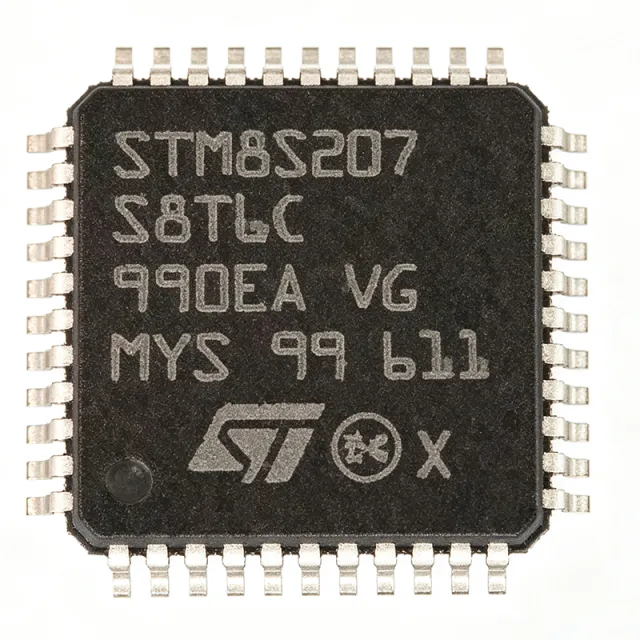
STM8S207MBT6B
STM8S207MBT6B - 24MHz 128KB 8-Bit MCU | STMicroelectronics
The STMicroelectronics STM8S207MBT6B is a 24 MHz performance-line 8-bit STM8 microcontroller with 128 KB of Flash program memory, integrated EEPROM, a 10-bit ADC, communication peripherals, and an 80-pin LQFP package measuring 14 x 14 mm. It is designed for embedded control systems requiring broad connectivity, moderate processing performance, and ample program storage.
An 8-bit microcontroller is a compact semiconductor containing a processor core, program memory, data memory, peripherals, and clock circuitry on one integrated circuit. The STM8S207MBT6B belongs to the STM8S performance line, where the STM8S family serves as the product family, the 8-bit MCU is the product type, and the microcontroller is the broader category within the semiconductor hierarchy. Its architecture is suitable for industrial controls, embedded equipment, communications equipment, and compact automation systems.
The device operates at up to 24 MHz and provides 128 KB of Flash memory. Integrated resources include EEPROM, a 10-bit analog-to-digital converter, timers, two UART interfaces, SPI, I²C, and CAN. These interfaces allow the MCU to connect sensors, actuator drivers, transceivers, displays, and industrial communication networks while retaining a relatively small 80-pin LQFP footprint.
The STM8S performance line combines an 8-bit CISC-oriented embedded architecture with performance reaching 20 MIPS at 24 MHz according to the manufacturer product listing. Integrated EEPROM supports nonvolatile parameter and calibration storage, while the 10-bit ADC supports analog measurement. The two UARTs provide asynchronous serial connectivity, and SPI and I²C support peripheral expansion and sensor integration; CAN makes the device especially relevant to industrial and embedded networking designs.
Typical applications include industrial control panels, motor and actuator control systems, CAN-connected equipment, data acquisition modules, communication controllers, instrumentation, and compact consumer or industrial controllers. Its 128 KB Flash capacity is useful for protocol stacks, control firmware, diagnostics, and field-updatable embedded functions. The 80-pin LQFP also provides more I/O and peripheral options than smaller packages, reducing the need for external interface expanders.
PCB design should preserve access to all 80 package pins and follow the manufacturer’s pin, decoupling, clock, and exposed-resource recommendations. Because the exact numbered pin assignment is not reproduced on this page, use the manufacturer datasheet pin-description table when assigning tracks and connectors. Validate the external clock configuration, reset circuit, supply bypassing, and programming interface before releasing the PCB.
This page combines the manufacturer’s 24 MHz and 128 KB headline specifications with interface-level application guidance, engineering design notes, and same-family drop-in comparisons. These details help engineers distinguish memory-capacity variants while confirming package, peripheral, and firmware-migration implications before selecting a replacement.
RFQ
İletişim