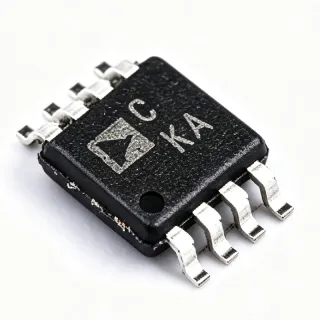
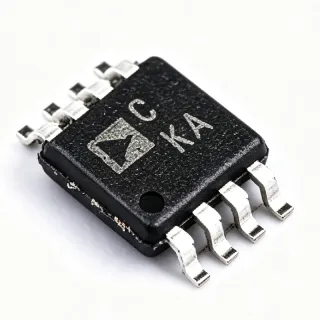
MAX31855KASA+ - K-Type Thermocouple-to-Digital Converter | Maxim Integrated
MPN: MAX31855KASA+ ✓ فعالMAX31855KASA+ جائزہ
An integrated thermocouple-to-digital converter such as the MAX31855KASA+ belongs to the broader sensor signal-chain IC family, which sits hierarchically under temperature sensor ICs -> sensors -> analog/mixed-signal ICs -> semiconductors. By performing linearization and cold-junction compensation in hardware, the part eliminates firmware lookup tables for Seebeck-coefficient polynomial correction and lets microcontrollers consume temperature data directly over SPI, freeing CPU bandwidth for system-level tasks.
Key features of the MAX31855KASA+ include 14-bit signed output resolution (plus sign bit), an SPI read-only interface with up to 4.3 MHz clock, on-chip open-thermocouple detection that flags a fault bit when the probe breaks, and a 2.7 V to 3.6 V supply range. The 8-pin NSOIC package provides low thermal mass for accurate cold-junction measurement and supports hand-solderable prototyping as well as high-volume reflow assembly. A dedicated fault register reports open thermocouple, short-to-GND, and short-to-VDD conditions in addition to the temperature data.
Typical applications for the MAX31855KASA+ include industrial furnace and oven temperature monitoring, 3D-printer hot-end and bed thermistor replacement, HVAC duct sensing, automotive exhaust and engine-temperature logging, food-service and laboratory equipment, and any embedded design that previously used a MAX6675 and now needs higher resolution plus thermocouple open-detection. The wide -270 degC to +1800 degC supported span also makes it suitable for cryogenic instrumentation and high-temperature process control.
When designing with the MAX31855KASA+, keep the thermocouple traces short, matched, and physically separated from switching nodes to preserve common-mode noise immunity. Place the device close to the thermocouple connector so the on-chip cold-junction sensor tracks the cold-junction temperature accurately, and add a 0.1 uF decoupling capacitor close to VDD. Unlike the MAX6675 it replaces, the MAX31855 changes SPI framing and clock polarity, so existing firmware must be updated; it is not code-compatible with the legacy part.
کے لیے ڈراپ اِن متبادل MAX31855KASA+ — یکساں پیکیج، پن سے پن مطابقت پذیر۔ مختلف پیکیج والے پرزے جن کے لیے PCB دوبارہ کام درکار ہو، شامل نہیں ہیں۔
اس سیریز میں مختلف ورژن
اسی سیریز کے ماڈلز جو ڈراپ اِن مطابقت رکھتے ہیں MAX31855KASA+ (یکساں فارم فیکٹر اور فٹ پرنٹ) — میں مختلف Cold-Junction Compensation, Function, Package, RoHS Status, Thermocouple Accuracy.
MAX31855JASA+
✅ ڈراپ-اِن📋 حوالہ جاتی متبادل (کیٹلاگ میں نہیں)
MAX31855NASA+
✅ ڈراپ-اِن📋 حوالہ جاتی متبادل (کیٹلاگ میں نہیں)
MAX31855TASA+
✅ ڈراپ-اِن📋 حوالہ جاتی متبادل (کیٹلاگ میں نہیں)
MAX31855EASA+
✅ ڈراپ-اِن📋 حوالہ جاتی متبادل (کیٹلاگ میں نہیں)
MAX31855KASA+T
✅ ڈراپ-اِن📋 حوالہ جاتی متبادل (کیٹلاگ میں نہیں)
MAX31855KASA+ زیادہ سے زیادہ ریٹنگز اور برقی خصوصیات
| فنکشن | Thermocouple-to-Digital Converter with Cold-Junction Compensation |
| Supported Thermocouple Type | K (K-type probe input) |
| Output Resolution | 14-bit signed (0.25 degC per LSB) |
| Output Interface | SPI-compatible, read-only |
| Thermocouple Temperature Range | -270 degC to +1800 degC |
| Thermocouple Accuracy | plus/minus 2 degC |
| Cold-Junction Compensation | On-chip, integrated |
| Open-Thermocouple Detection | Yes (fault register) |
| Supply Voltage (VDD) | 3.0 V to 3.6 V (2.7 V min per datasheet) |
| آپریٹنگ درجہ حرارت | -40 degC to +125 degC |
| پیکیج | 8-pin SOIC (NSOIC), 3.90 mm body |
| ماؤنٹنگ ٹائپ | Surface Mount |
| RoHS اسٹیٹس | Compliant (per distributor listing) |
MAX31855KASA+ پن کنفیگریشن
| پن 1 | GND — Ground reference for the IC and thermocouple inputs |
| پن 2 | T- — Thermocouple negative input (K-type chromel/alumel) |
| پن 3 | T+ — Thermocouple positive input (K-type chromel/alumel) |
| پن 4 | VDD — 3.0 V to 3.6 V supply input; decouple with 0.1 uF |
| پن 5 | SCK — SPI serial-clock input (active low, idles high) |
| پن 6 | CS — SPI chip-select input (active low) |
| پن 7 | SO — SPI serial-data output (tri-state when CS high) |
| پن 8 | NC — Not connected on K-variant datasheet pinout |
عام استعمالات
MAX31855KASA+ کے لیے موزوں ہے 6 ایپلیکیشنs: Industrial Furnace and Oven Monitoring, 3D Printer Hot-End and Heated Bed Sensing, HVAC Duct and Refrigeration Sensing, Automotive Exhaust and Engine Temperature Logging, Food Service and Laboratory Equipment, Cryogenic and High-Temperature Process Control.
Industrial Furnace and Oven Monitoring
The MAX31855KASA+ fits furnace and oven monitoring because its 14-bit signed output covers the -270 degC to +1800 degC K-type probe range that industrial Type-K mineral-insulated probes are spec'd for, and its plus/minus 2 degC accuracy is sufficient for kiln curve profiling, heat-treat recipes, and ceramic firing schedules. Placed within 2-3 cm of the Type-K screw terminal on the oven chassis so the on-chip cold-junction sensor tracks ambient accurately, the device drives a 3.3 V microcontroller over SPI at up to 4.3 MHz and reports open-thermocouple faults within one read cycle, which lets a PLC fail-safe rather than display a misleading mid-scale temperature. Unlike a discrete op-amp + ADC + software linearization chain, the MAX31855KASA+ integrates the Seebeck-coefficient polynomial in silicon and frees the MCU from per-sample floating-point math.
تجویز کردہ
3D Printer Hot-End and Heated Bed Sensing
The MAX31855KASA+ is widely used in 3D-printer hot-end and heated-bed designs because the K-type thermocouple survives the 250-300 degC extrusion environment that thermistors cannot, and the device's SPI interface plugs directly into Marlin/Klipper firmware running on 3.3 V microcontrollers. Per the MAX31855 datasheet, the open-thermocouple detector protects the heater from runaway by asserting a fault bit the firmware checks every loop iteration, preventing the hot-end from continuing to heat when the probe wire fractures. Designers mount the SOIC-8 within 1 cm of the thermocouple feed-through so cold-junction compensation stays accurate, and bias the T+/T- traces with the datasheet-recommended input protection network.
تجویز کردہ
HVAC Duct and Refrigeration Sensing
In HVAC duct and refrigeration systems, the MAX31855KASA+ provides digital temperature feedback for variable-air-volume boxes, chilled-water loops, and condenser coils where K-type probes are already standard. The 3.0-3.6 V supply aligns with the 3.3 V rails typical of modern building-automation controllers, and the SPI-only read protocol (one 32-bit frame per transaction) makes it easy to poll multiple ducts through a multiplexer. Open-thermocouple detection triggers a maintenance alert when the probe element fatigues, reducing unplanned service calls. The wide -270 degC to +1800 degC supported range also covers cryogenic lab and freezer applications using the same board design.
تجویز کردہ
Automotive Exhaust and Engine Temperature Logging
The MAX31855KASA+ suits aftermarket automotive exhaust gas temperature (EGT) and engine coolant logging because K-type probes are standard in this segment and the 1800 degC upper range covers the worst-case turbocharger-outlet temperatures. The IC operates across -40 degC to +125 degC ambient as specified in the datasheet, tolerating under-hood thermal cycling. Designers typically place a spark-gap or TVS protection on T+/T- to survive load-dump transients and route the SPI traces away from ignition coils. The on-chip fault register lets the data-acquisition firmware flag probe burn-out without requiring an external sense resistor.
تجویز کردہ
Food Service and Laboratory Equipment
Commercial ovens, sous-vide circulators, autoclaves, and laboratory temperature baths rely on the MAX31855KASA+ because the 14-bit signed output and 0.25 degC resolution meet food-code and ISO/IEC calibration requirements for process control. The SOIC-8 package handles the +125 degC ambient typical near heating elements when mounted on a thermally isolated section of the PCB, and the digital SPI output eliminates the analog noise pickup that plagues thermocouple instrumentation amplifiers in electrically noisy kitchen or lab environments. Open-thermocouple detection also satisfies HACCP documentation requirements by flagging the exact moment a probe fails during a cook cycle.
تجویز کردہ
Cryogenic and High-Temperature Process Control
Because the MAX31855KASA+ supports a -270 degC to +1800 degC K-type probe range, it is one of the few single-chip converters usable across both cryogenic laboratory instrumentation (liquid nitrogen research, superconducting test rigs) and high-temperature process control (vacuum furnaces, metal heat treatment). The on-die cold-junction sensor eliminates the need for an external thermistor or RTD, simplifying the BOM and reducing drift sources. Engineers cite the part's SPI fault register as a key benefit because it lets the host controller take immediate corrective action when probes fail mid-run, rather than waiting for a watchdog timeout.
تجویز کردہ
تجویز کردہ پروڈکٹس کا خلاصہ
کے لیے انجینئرنگ ریفرنس ڈیٹا MAX31855KASA+ — موازنہ، ڈیزائن رہنمائی، اور تعمیل کی معلومات۔
انتخاب کی گائیڈ
متبادلات کے ساتھ موازنہ
| پیرامیٹر | یہ پروڈکٹ | MAX31855JASA+ | MAX31855NASA+ | MAX31855TASA+ | MAX31855EASA+ | MAX31855KASA+T |
|---|---|---|---|---|---|---|
| Brand | Analog Devices (formerly Maxim Integrated) | Analog Devices | Analog Devices | Analog Devices | Analog Devices | Analog Devices |
| Package | 8-pin SOIC (NSOIC) | 8-pin SOIC (NSOIC) - same | 8-pin SOIC (NSOIC) - same | 8-pin SOIC (NSOIC) - same | 8-pin SOIC (NSOIC) - same | 8-pin SOIC (NSOIC) - same |
| Supported Thermocouple | K-type | J-type | N-type | T-type | E-type | K-type |
| Thermocouple Temperature Range | -270 degC to +1800 degC | -210 degC to +1200 degC | -200 degC to +1300 degC | -270 degC to +400 degC | -200 degC to +1000 degC | -270 degC to +1800 degC |
| Output Resolution | 14-bit signed (0.25 degC / LSB) | 14-bit signed (0.25 degC / LSB) | 14-bit signed (0.25 degC / LSB) | 14-bit signed (0.25 degC / LSB) | 14-bit signed (0.25 degC / LSB) | 14-bit signed (0.25 degC / LSB) |
| Output Interface | SPI (read-only, 32-bit frame) | SPI (read-only, 32-bit frame) | SPI (read-only, 32-bit frame) | SPI (read-only, 32-bit frame) | SPI (read-only, 32-bit frame) | SPI (read-only, 32-bit frame) |
| Cold-Junction Compensation | On-chip | On-chip | On-chip | On-chip | On-chip | On-chip |
| Open-Thermocouple Detection | Yes (fault register) | Yes (fault register) | Yes (fault register) | Yes (fault register) | Yes (fault register) | Yes (fault register) |
| Supply Voltage | 3.0 V to 3.6 V | 3.0 V to 3.6 V | 3.0 V to 3.6 V | 3.0 V to 3.6 V | 3.0 V to 3.6 V | 3.0 V to 3.6 V |
| Packaging Format | Tube (100-piece) | Tube (100-piece) | Tube (100-piece) | Tube (100-piece) | Tube (100-piece) | Tape & Reel (2500-piece) |
اہم امتیازی خصوصیات
- On-chip cold-junction compensation with NIST polynomial linearization (بمقابلہMAX6675ISA+)
- Higher resolution and wider temperature range (بمقابلہMAX6675ISA+)
- On-chip open-thermocouple and short-detection (بمقابلہMAX6675ISA+)
ڈیزائن نوٹس
Place the MAX31855KASA+ within 1-2 cm of the thermocouple screw terminals so the on-chip cold-junction sensor accurately tracks the cold-junction temperature; keep the device away from power resistors, LDO regulators, and other heat sources. Decouple VDD with a 0.1 uF ceramic capacitor placed within 5 mm of pin 4, and route the T+/T- traces as a matched-length differential pair physically separated from switching nodes or PWM signals. A small input protection network (TVS or spark gap) is recommended for automotive and industrial environments where load-dump or ESD transients can couple onto long thermocouple cable runs.
Do NOT assume the MAX31855KASA+ is code-compatible with the legacy MAX6675 - the SPI framing, clock polarity, and output data format are completely different. The MAX6675 used 12-bit unsigned output with a single falling edge on SCK; the MAX31855KASA+ uses 32-bit frames with active-low SCK, a fault register in bits[16:1], and a 14-bit signed thermocouple reading in bits[31:18]. Existing MAX6675 firmware must be rewritten. Additionally, do not power the MAX31855KASA+ from a 5 V rail - it is not 5 V tolerant and will be damaged. Use a 3.3 V regulator or level-shifters when interfacing with 5 V microcontrollers.
For SPI runs longer than ~50 mm, add 100 ohm source-series resistors on SCK, SO, and CS to dampen ringing and reduce EMI. Keep the SPI bus away from switching power converters and high-current traces; if the board has a switching regulator, route the SPI signals on the opposite layer with a continuous ground plane beneath. The MAX31855KASA+'s SCK input idles high and clocks data on the rising edge (per the datasheet timing diagram), so confirm the host MCU's SPI peripheral is configured for CPOL=1 / CPHA=1 to match the device timing.
تعمیل کی معلومات
RoHS and lead-free compliance per DigiKey distributor listing. Not AEC-Q100 qualified - this part targets industrial and consumer applications, not automotive. REACH compliance inferred from manufacturer policy (not explicitly stated in provided data).