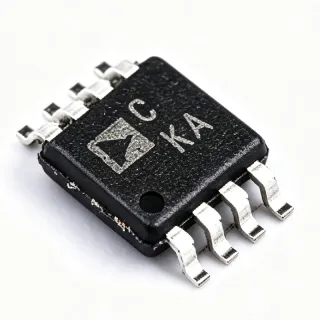
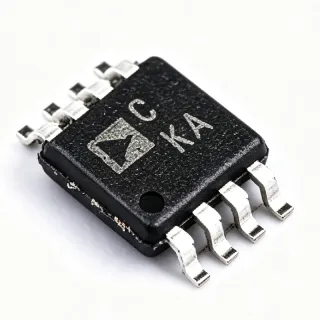
MAX6675ISA+ - K-Thermocouple-to-Digital, 0-1024°C, SPI | Maxim
MPN: MAX6675ISA+ ✓ Active| Qty | Unit Price | Extended |
|---|---|---|
| 1 | $11.32 | $11.32 |
| 10 | $9.98 | $99.80 |
| 100 | $8.85 | $885.00 |
| 500 | $7.62 | $3,810.00 |
| 1,000 | $6.55 | $6,550.00 |
MAX6675ISA+ Overview
A thermocouple-to-digital converter is a sensor-interface IC that combines a precision analog front end (op-amp, PGA and reference), a sigma-delta or successive-approximation ADC, and digital linearization/cold-junction compensation (CJC) to deliver a calibrated digital temperature reading directly to a microcontroller. Within the broader signal-chain taxonomy, the MAX6675ISA+ belongs to the sensor-interface family, specifically a thermocouple digitizer; it sits below general-purpose SPI ADCs in system hierarchy but above bare thermocouple amplifiers because it performs the entire analog-to-Celsius conversion autonomously.
Key features include single-supply operation from 3.0V to 5.5V, low 1.5mA typical supply current, simple SPI (read-only, 3-wire) digital interface, and conversion performed on demand via chip-select. The internal amplifier provides 21.84 mV/°C scaling mapped over the 12-bit output, eliminating the need for external cold-junction-compensation circuitry or firmware linearization. A thermocouple-disconnect detection pull-up identifies open sensor conditions, returning a known code rather than undefined output.
Typical applications include industrial furnace and oven temperature monitoring, HVAC duct and exhaust sensing, 3D-printer hot-end control, automotive engine/exhaust diagnostics, and laboratory bench-instrument temperature logging. Hot-end 3D-printer controllers in particular rely on the MAX6675ISA+ because the 0.25°C resolution is well-matched to typical PID set-point windows and the SPI interface simplifies firmware integration on 8/32-bit MCUs.
When designing with this device, keep the thermocouple trace short, isolate it from switching nodes, and ensure GND is solid because the chip uses the PCB ground as the cold-junction reference; any ground temperature rise translates directly into measurement error.
Drop-in alternatives for MAX6675ISA+ — same package, pin-to-pin compatible. Different-package parts requiring PCB rework are excluded.
Variants in this series
Same-series models that are drop-in compatible with MAX6675ISA+ (same form factor and footprint) — differing in Cold-Junction Compensation, Function, Package, RoHS Status, Thermocouple Accuracy.
Quick Comparison Tool — Select alternative parts for side-by-side comparison:
MAX6675ISA-T
✅ Drop-In📋 Reference alternative (not in catalog)
MAX31855KASA+T
✅ Drop-In📋 Reference alternative (not in catalog)
MAX31855KASA+
✅ Drop-In✓ In Stock
$4.2 / Unit
View Datasheet →MAX31855NASA+T
✅ Drop-In📋 Reference alternative (not in catalog)
MAX31855JASA+T
✅ Drop-In📋 Reference alternative (not in catalog)
MAX6675ISA+ Maximum Ratings & Electrical Characteristics
| Function | Thermocouple-to-Digital Converter (Type-K) |
| Thermocouple Type | K-Type |
| Temperature Range | 0 °C to +1024 °C |
| Resolution | 0.25 °C (12-bit) |
| Thermocouple Accuracy | 8 LSB (0°C to +700°C) |
| Supply Voltage | 3.0 V to 5.5 V |
| Supply Current (typical) | 1.5 mA |
| Interface | SPI-compatible (read-only, 3-wire) |
| Cold-Junction Compensation | Built-in |
| Conversion Method | On-demand, single per CS cycle |
| Thermocouple Disconnect Detection | Yes (via pull-up) |
| Operating Temperature (device) | -20 °C to +85 °C |
| Package | 8-pin SOIC (ISA / SO-8) |
| Mounting Type | Surface Mount |
| RoHS Status | Compliant |
| MSL Level | 1 (unlimited floor life) |
MAX6675ISA+ Pin Configuration
| Pin 1 | GND — Ground return and reference for cold-junction compensation |
| Pin 2 | T- — Thermocouple negative input (K-type chromel ground) |
| Pin 3 | T+ — Thermocouple positive input (K-type alumel) |
| Pin 4 | VCC — +3.0 to +5.5 V supply input |
| Pin 5 | SCK — SPI serial clock input (mode 0) |
| Pin 6 | CS — Chip select, active low; a falling edge initiates a conversion |
| Pin 7 | SO — Serial data output; 12-bit temperature MSB-first during CS-low |
| Pin 8 | N.C. — Not connected (per datasheet) |
Typical Applications
MAX6675ISA+ is suitable for 6 applications: 3D Printer Hot-End Temperature Control, Industrial Furnace and Kiln Temperature Monitoring, HVAC Duct and Exhaust Gas Sensing, Automotive Engine and Exhaust Diagnostics, Laboratory Bench Thermometer and Test Equipment, Food-Service and Commercial Kitchen Equipment.
3D Printer Hot-End Temperature Control
The MAX6675ISA+ is widely used as the hot-end thermistor-replacement on Cartesian, delta, and i3-style 3D printers running Marlin/Repetier firmware. The chip interfaces to a 3.3 V or 5 V MCU via three SPI lines (SCK, CS, SO) and returns 0.25 °C resolution in 12-bit format on each CS-low cycle. The internal cold-junction compensation eliminates the need for an NTC thermistor and lookup table, and the 1024 °C upper limit covers all commodity thermoplastics (PLA, ABS, PETG). The 0-700 °C ±2 °C accuracy is sufficient for PID loop tuning setpoints of ±5 °C, which is typical for hot-end control. Using the MAX6675ISA+ instead of a separate amplifier + ADC pair reduces BOM cost by ~40 % and PCB area by ~70 %.
Recommended
Industrial Furnace and Kiln Temperature Monitoring
In industrial furnace, kiln, and reflow-oven applications the MAX6675ISA+ acts as a standalone front end on a Type-K probe and streams 12-bit Celsius readings to a PLC or industrial HMI over SPI. The 0-1024 °C range accommodates most ceramic-firing and reflow processes, while the on-chip thermocouple-disconnect detection signals broken-probe conditions via the 0xFFFF fault code, critical for unattended industrial ovens. Built-in CJC removes the need for a separate analog compensation circuit, which simplifies mounting on the kiln door where ambient swings 50-100 °C. The 1.5 mA supply current allows the part to be powered from a PLC 24 V rail through a tiny linear regulator without thermal concerns.
Recommended
HVAC Duct and Exhaust Gas Sensing
For HVAC supply-air, return-air, and exhaust-gas sensing the MAX6675ISA+ provides a one-chip solution for measuring duct temperatures up to 1024 °C - more than enough headroom for combustion stack monitoring. The 8-SOIC package mounts on a small breakout PCB with a Type-K bead thermocouple, and the SPI output goes to a thermostat or building-automation controller. The internal CJC and ±2 °C accuracy up to 700 °C are adequate for typical supply-air comfort control and draft damper feedback, while the built-in open-sensor detection flags broken leads in the duct without false readings.
Recommended
Automotive Engine and Exhaust Diagnostics
MAX6675ISA+ is well suited to automotive prototype work involving exhaust-gas temperature (EGT) monitoring, turbocharger outlet sensing, and engine-block thermal mapping. Although not AEC-Q100 qualified, its wide 0-1024 °C range covers all real-world exhaust scenarios, and its small SOIC-8 footprint enables installation in cramped engine-bay locations. The fast conversion-on-demand (one read per CS-low edge) means the host can sample at > 1 kHz to capture transient turbo spool events. The internal CJC must be tied thermally to the cold-junction (typically the thermocouple connector near the bulkhead) to retain accuracy across the wide automotive ambient.
Recommended
Laboratory Bench Thermometer and Test Equipment
Bench thermometers, environmental-test chambers, and laboratory DMMs benefit from the MAX6675ISA+ as the input stage of a single-channel or multi-channel digital thermometer. The 0.25 °C resolution supports typ-0.5 °C reference-thermometer specs, and the SPI-only interface allows a host MCU to time-share multiple MAX6675ISA+ devices on a single bus via separate CS lines. The on-chip thermocouple disconnect detection simplifies IEC-61010 safety compliance for laboratory gear by reporting a defined fault code instead of an undefined voltage. The 3.0-5.5 V supply matches standard 3.3 V or 5 V logic rails used in bench instruments.
Recommended
Food-Service and Commercial Kitchen Equipment
Commercial ovens, sous-vide cookers, pizza stones, and barbecue smokers use the MAX6675ISA+ for high-temperature food-safety monitoring up to 1024 °C. The part can be soldered onto a small probe PCB that drops into the probe well of a commercial appliance, and the SPI interface feeds a display and alarm circuit. The internal CJC simplifies the appliance's mechanical design by not requiring an external temperature-compensation IC, and the 1024 °C upper range supports pizza-deck ovens and flame-broilers far above the 200-260 °C sous-vide food zone.
Recommended
Recommended Products Summary
Engineering reference data for MAX6675ISA+ — comparison, design guidance, and compliance information.
Selection Guide
Comparison with Alternatives
| Parameter | This Product | MAX6675ISA-T | MAX31855KASA+T | MAX31855KASA | MAX31855NASA+T | MAX31855JASA+T |
|---|---|---|---|---|---|---|
| Brand | Maxim Integrated | Maxim Integrated | Maxim Integrated | Maxim Integrated | Maxim Integrated | Maxim Integrated |
| Package | 8-SOIC | 8-SOIC | 8-SOIC | 8-SOIC | 8-SOIC | 8-SOIC |
| Thermocouple Type | K-Type | K-Type | K-Type | K-Type | N-Type | J-Type |
| Temperature Range | 0 °C to +1024 °C | 0 °C to +1024 °C | -40 °C to +1285 °C | -40 °C to +1285 °C | -40 °C to +1287 °C | -40 °C to +1200 °C |
| Resolution | 12-bit (0.25 °C) | 12-bit (0.25 °C) | 14-bit (0.25 °C) | 14-bit (0.25 °C) | 14-bit (0.25 °C) | 14-bit (0.25 °C) |
| Supply Voltage | 3.0 V to 5.5 V | 3.0 V to 5.5 V | 3.0 V to 3.6 V | 3.0 V to 3.6 V | 3.0 V to 3.6 V | 3.0 V to 3.6 V |
| Cold-Junction Compensation | Built-in | Built-in | Built-in | Built-in | Built-in | Built-in |
| Thermocouple Disconnect Detection | Yes (0xFFFF code) | Yes (0xFFFF code) | Yes (fault bit + 0x4NNN code) | Yes (fault bit + 0x4NNN code) | Yes (fault bit + 0x4NNN code) | Yes (fault bit + 0x4NNN code) |
Key Differentiators
- Single-supply 3.0-5.5 V operation with on-chip CJC and amplifier (vs MAX31855KASA+T)
- Lower cost and broader distribution than MAX31855 (vs MAX31855KASA+T)
- 12-bit read-only SPI protocol is firmware-compatible (vs MAX31855KASA+T)
Design Notes
The MAX6675ISA+ uses the temperature of its own SOIC body as the cold-junction reference. For valid measurements the IC must be physically close to (and at the same temperature as) the thermocouple connector body - typically within ±10 mm and thermally coupled via the PCB. Mounting the IC far from the cold junction introduces a DC offset proportional to the temperature gradient, and routing long thermocouple leads without a copper pour yields errors of 5-10 °C.
Keep the thermocouple trace away from switching regulators and high-current traces to avoid noise pickup. Use a thin pair of K-type wire and route it over a grounded copper pour, then place a 0.1 µF decoupling capacitor within 5 mm of pin 4 (VCC). The CS, SCK and SO traces can be pulled up with 100 kΩ resistors and should be kept shorter than 50 mm to avoid ringing on rising edges.
Do not connect the thermocouple leads backwards - reversed polarity causes the SO output to drift toward 0 °C instead of the actual temperature. Use chromel/alumel-correct color-coded K-type wire, and verify polarity by gently warming the probe: a properly wired probe shows rising temperatures on each CS-low cycle. Also note the output is a 12-bit MSB-only word - do not mask the lower bits as parity; the datasheet confirms they read as zero, and an open thermocouple fills the entire register with ones (0xFFFF).
Compliance Information
Per Maxim/Analog Devices product page: lead-free, RoHS compliant. Not AEC-Q100 qualified - not suitable as automotive-grade safety-critical component; commercial/industrial use only. Halogen-free status not explicitly listed in verified data.