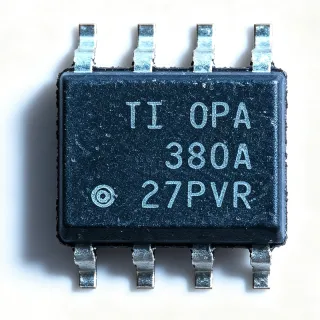
OPA211ID - 1.1nV/Hz Precision Op Amp 80MHz SOIC-8 | TI
MPN: OPA211ID ✓ فعالOPA211ID جائزہ
An operational amplifier (op amp) is a high-gain voltage amplifier with differential inputs and a single-ended output, a fundamental building block of analog signal chains. Precision op amps such as the OPA211 sit within the amplifier hierarchy: amplifier > operational amplifier > precision op amp, characterized by low offset, low noise, and high open-loop gain. They are essential in instrumentation, medical equipment, and test systems where signal accuracy is critical.
Key features include the 1.1 nV/√Hz input-referred noise density - among the lowest available for a precision op amp - plus a gain-bandwidth product of 80 MHz and 20 V/µs slew rate for high-speed signals. The rail-to-rail output maximizes dynamic range in low-supply designs. DC accuracy is strong with 50 µV typical offset voltage and 60 nA input bias current, and total harmonic distortion plus noise is a very low 0.000015%.
Technically, the OPA211 uses a bipolar input stage with laser trimming to minimize offset and drift. The class-AB output stage provides low distortion and solid capacitive-drive capability. Single (OPA211) and dual (OPA2211) versions exist, with shutdown options on single-channel family members, packaged in SON-8 (3x3 mm), VSSOP-8, and SOIC-8.
Typical applications include low-noise audio preamplifiers, precision instrumentation front ends, active filters, and data-acquisition stages driving high-resolution ADCs such as the ADS1262. The 80 MHz bandwidth also suits photodiode transimpedance amplifiers and RF/IF signal chains.
Design tip: place 0.1 µF ceramic decoupling capacitors close to the supply pins, and respect the input common-mode range to avoid phase reversal. For a second channel, the OPA2211 shares the same performance in one package. Prices as of 2026-08-30.
کے لیے ڈراپ اِن متبادل OPA211ID — یکساں پیکیج، پن سے پن مطابقت پذیر۔ مختلف پیکیج والے پرزے جن کے لیے PCB دوبارہ کام درکار ہو، شامل نہیں ہیں۔
اس سیریز میں مختلف ورژن
اسی سیریز کے ماڈلز جو ڈراپ اِن مطابقت رکھتے ہیں OPA211ID (یکساں فارم فیکٹر اور فٹ پرنٹ) — میں مختلف Input Bias Current, Output Type, Package, Slew Rate.
OPA1611ID
✅ ڈراپ-اِن📋 حوالہ جاتی متبادل (کیٹلاگ میں نہیں)
OPA211AID
✅ ڈراپ-اِن ⚠️ تفصیلات غیر تصدیق شدہ📋 حوالہ جاتی متبادل (کیٹلاگ میں نہیں)
OPA828IDR
✅ ڈراپ-اِن ⚠️ تفصیلات غیر تصدیق شدہقیمت کے لیے رابطہ کریں
ڈیٹا شیٹ دیکھیں →AD797ARZ
✅ ڈراپ-اِن ⚠️ تفصیلات غیر تصدیق شدہ📋 حوالہ جاتی متبادل (کیٹلاگ میں نہیں)
LT1028CS8
✅ ڈراپ-اِن ⚠️ تفصیلات غیر تصدیق شدہ📋 حوالہ جاتی متبادل (کیٹلاگ میں نہیں)
OPA211ID زیادہ سے زیادہ ریٹنگز اور برقی خصوصیات
| شور کی کثافت | 1.1 nV/rtHz |
| Gain-Bandwidth Product | 80 MHz |
| Slew Rate | 20 V/us |
| کوئیسینٹ کرنٹ | 3.6 mA per amplifier |
| Offset Voltage | 50 uV typical |
| Input Bias Current | 60 nA |
| THD+N | 0.000015% |
| آؤٹ پٹ کی قسم | Rail-to-Rail Output |
| Stability | Unity-Gain Stable |
| چینلز | 1 |
| آپریٹنگ درجہ حرارت | -40C to +125C |
| پیکیج | 8-SOIC (D) |
| ماؤنٹنگ ٹائپ | Surface Mount |
| RoHS اسٹیٹس | Compliant |
OPA211ID پن کنفیگریشن
| پن 1 | TRIM/NC — Offset trim / no connect per package option |
| پن 2 | -IN — Inverting input |
| پن 3 | +IN — Non-inverting input |
| پن 4 | V- — Negative supply |
| پن 5 | NC — No connect |
| پن 6 | OUT — Output (rail-to-rail) |
| پن 7 | V+ — Positive supply |
| پن 8 | NC/V+ — No connect or positive supply per package option |
عام استعمالات
OPA211ID کے لیے موزوں ہے 6 ایپلیکیشنs: Low-Noise Audio Preamplifier, Precision Data Acquisition Front End, Photodiode Transimpedance Amplifier, Active Filter and Signal Conditioning, Precision Instrumentation and Test Equipment, RF/IF and Wideband Signal Chains.
Low-Noise Audio Preamplifier
The OPA211's 1.1 nV/√Hz noise and 0.000015% THD+N make it excellent for microphone preamps and line stages where noise floor directly limits dynamic range. Placed as a gain stage between a balanced input and an audio ADC, its rail-to-rail output maximizes headroom on 5V single supplies. Unlike audio-optimized parts, it also provides 80 MHz bandwidth for ultrasonic extension, though the bipolar input's 60 nA bias current requires impedance matching on high-source-resistance inputs.
تجویز کردہ
Precision Data Acquisition Front End
In data acquisition, the OPA211 amplifies small sensor signals before digitization, using its 50 µV typical offset and 1.1 nV/√Hz noise to preserve low-level resolution. Configured as a gain-of-10 amplifier before a 24-bit ADC, its unity-gain stability and 80 MHz GBW settle quickly, reducing acquisition dead time. A low-pass R-C filter at the ADC input plus 0.1 µF decoupling capacitors at the supply pins keeps the rail clean, per the TI datasheet recommendation for noisy or high-impedance supplies.
تجویز کردہ
Photodiode Transimpedance Amplifier
The OPA211's 80 MHz gain-bandwidth product supports fast photodiode TIA designs for optical receivers and instrumentation. With feedback resistors in the 10 kOhm to 100 kOhm range, the closed-loop bandwidth remains in the MHz region, and the 1.1 nV/√Hz input noise limits TIA output noise. Because the bipolar input carries 60 nA bias current, designs with very high photodiode impedance should evaluate the FET-input OPA828, while standard optical links benefit from the OPA211's speed and low voltage noise.
تجویز کردہ
Active Filter and Signal Conditioning
The OPA211 works well in multi-feedback and Sallen-Key active filters up to several MHz, where its 80 MHz GBW ensures the filter's Q and corner frequency stay accurate. The 20 V/µs slew rate handles large-signal filter inputs without slewing distortion, and the rail-to-rail output allows the largest possible signal swing. Placing 0.1 µF plus 1 µF decoupling near each supply pin prevents the high bandwidth from coupling supply noise into the filter passband, a pitfall TI's datasheet explicitly warns about.
تجویز کردہ
Precision Instrumentation and Test Equipment
In bench instruments and industrial measurement equipment, the OPA211 serves as a low-noise buffer or gain stage for bridge sensors and signal conditioning chains. Its -40C to +125C industrial temperature specification supports harsh environments, while 1.1 nV/√Hz noise preserves measurement resolution at microvolt signal levels. Typical deployment: a gain-of-100 stage ahead of a precision ADC or scope front end; the 60 nA bias current must be balanced by matched source impedances to limit offset error in high-impedance probes.
تجویز کردہ
RF/IF and Wideband Signal Chains
The OPA211's 80 MHz bandwidth and 20 V/µs slew rate suit IF amplification and wideband buffering in communications receivers. Its 1.1 nV/√Hz voltage noise contributes minimally to system noise figure when driving 50-ohm-terminated IF stages. Placed after a mixer or ahead of a wideband ADC, the amplifier's class-AB output stage drives moderate loads with 0.000015% THD+N, preserving signal purity. Series resistors at the output help isolate capacitive loads and maintain stability at low closed-loop gains.
تجویز کردہ
تجویز کردہ پروڈکٹس کا خلاصہ
کے لیے انجینئرنگ ریفرنس ڈیٹا OPA211ID — موازنہ، ڈیزائن رہنمائی، اور تعمیل کی معلومات۔
انتخاب کی گائیڈ
متبادلات کے ساتھ موازنہ
| پیرامیٹر | یہ پروڈکٹ | OPA1611ID | OPA211AID | OPA828IDR | AD797ARZ | LT1028CS8 |
|---|---|---|---|---|---|---|
| Package | 8-SOIC | 8-SOIC - same | 8-SOIC - same | 8-SOIC - same | 8-SOIC - same | 8-SOIC - same |
| Brand | Texas Instruments | Texas Instruments | Texas Instruments | Texas Instruments | Analog Devices | Analog Devices |
| Noise Density | 1.1 nV/rtHz | 1.1 nV/rtHz class | 1.1 nV/rtHz | 3.3 nV/rtHz | ~0.9 nV/rtHz | ~0.85 nV/rtHz |
| Quiescent Current | 3.6 mA | ~3.6 mA | 3.6 mA | 4.8 mA | Higher (~8 mA class) | Higher (~10 mA class) |
| Gain-Bandwidth | 80 MHz | 40 MHz class | 80 MHz | 33 MHz class | 110 MHz class | 75 MHz class |
| Rail-to-Rail Output | Yes | Yes | Yes | Yes | No | No |
| Input Bias Current | 60 nA | 60 nA class (bipolar) | 60 nA | pA class (FET) | 250 nA class | 25 nA class |
| Offset Voltage (typ) | 50 uV | 50 uV class | Lower (precision grade) | 45 uV class | 25 uV class | 10 uV class |
اہم امتیازی خصوصیات
- Lowest noise per unit current in its class (بمقابلہAD797ARZ)
- Rail-to-rail output for maximum dynamic range (بمقابلہLT1028CS8)
- Higher bandwidth than audio-optimized sibling (بمقابلہOPA1611ID)
ڈیزائن نوٹس
Decouple both supply pins with 0.1 uF ceramic capacitors placed within 2 mm of the pins, plus a 2.2 uF bulk capacitor per supply rail. TI's OPAx211 datasheet explicitly warns that noisy or high-impedance supplies require decoupling close to the device pins; the 80 MHz bandwidth can otherwise couple supply noise directly into the output.
The bipolar input has 60 nA bias current; on high-impedance sources this creates offset error (60 nA x source resistance). Match source impedances seen by both inputs to cancel bias effects via bias-current cancellation. Also respect the input common-mode range to avoid phase reversal or degraded CMRR near the rails.
At closed-loop gains below 5, capacitive loads above roughly 20-50 pF can degrade phase margin; add a series isolation resistor (10-50 ohm) at the output when driving long cables or ADC input capacitance. For ADC driving, follow the datasheet typical application with an R-C charge kickback filter sized to the ADC sampling rate.
تعمیل کی معلومات
RoHS compliant per DigiKey/TI product listing. Other compliance attributes not stated in provided data.