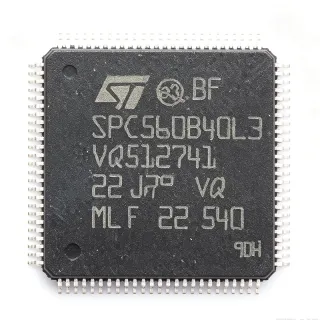
STM32F429VET6TR - 180MHz Cortex-M4 MCU, 512KB Flash, LQFP-100 | STMicroelectronics (Tape & Reel)
MPN: STM32F429VET6TR ✓ فعالSTM32F429VET6TR جائزہ
What is an MCU? A microcontroller (MCU) is a single-chip computer that integrates a CPU core, program and data memory, peripherals, and I/O. The Cortex-M4 family from Arm is optimized for deterministic real-time embedded workloads with a single-precision FPU and a subset of DSP instructions (MAC, SIMD), making it the mid-tier workhorse for motor control, audio, connectivity, and graphical HMIs. The STM32F4 series specifically targets high clock frequencies (180 MHz), large SRAM, and rich connectivity (USB OTG HS/FS, Ethernet, CAN, SDIO, FMC) at mainstream cost points.
Key features include an Adaptive Real-Time (ART) Accelerator allowing 0-wait-state execution from Flash, a Cryptographic hash / AES-128 / RNG suite on the F429 line, Chrom-ART Accelerator for 2D graphics, and a TFT-LCD controller with SVGA support. The device offers USB OTG Full-Speed and High-Speed (with on-chip PHY on HS), 10/100 Ethernet MAC, 17 timers, three 12-bit ADCs (2.4 MSPS), two 12-bit DACs, and up to 20 communication interfaces including USART, SPI, I2C, CAN, and SAI.
The Cortex-M4 core uses a 3-stage pipeline with branch speculation, and the on-chip ART accelerator uses a 64-bit-wide Flash interface and user-configurable prefetch buffers, allowing the F429 to execute code from Flash at full 180 MHz without stalls. The Chrom-ART accelerator offloads 2D block transfers and pixel-format conversions from the CPU, freeing MIPS for application logic; the integrated TFT-LCD controller can drive displays up to SVGA resolution (800x600) over an 8080/6800 or HDMI-CEC/parallel-DSI bridge path.
Typical applications include graphical HMI panels (appliance, HVAC, medical, industrial), USB-connected test instruments, motor-control inverter boards, Ethernet-connected PLCs, and small-form-factor camera devices. The 1.8V core with on-chip regulator + integrated SDIO simplifies SD-card data logging. Design considerations: route the USB DP/DM pair as 90 ohm differential, place decoupling within 5 mm of each VDD pin, and use the on-chip LDO (PWR_REG) with a 1uF + 100nF capacitor network. The 100-pin LQFP has a thermal resistance of approximately 50 C/W (typical, per package), so at 180 MHz the device is comfortably within thermal limits below 70 C ambient. This page synthesizes distributor pricing, drop-in pin-compatible alternatives, and practical design notes beyond what the manufacturer datasheet alone provides.
کے لیے ڈراپ اِن متبادل STM32F429VET6TR — یکساں پیکیج، پن سے پن مطابقت پذیر۔ مختلف پیکیج والے پرزے جن کے لیے PCB دوبارہ کام درکار ہو، شامل نہیں ہیں۔
اس سیریز میں مختلف ورژن
اسی سیریز کے ماڈلز جو ڈراپ اِن مطابقت رکھتے ہیں STM32F429VET6TR (یکساں فارم فیکٹر اور فٹ پرنٹ) — میں مختلف ADC, SRAM, Mounting Type, Package, Communication Interfaces.
STM32F429VGT6
✅ ڈراپ-اِنقیمت کے لیے رابطہ کریں
ڈیٹا شیٹ دیکھیں →STM32F427VGT6
✅ ڈراپ-اِنقیمت کے لیے رابطہ کریں
ڈیٹا شیٹ دیکھیں →STM32F407VET6
✅ ڈراپ-اِنقیمت کے لیے رابطہ کریں
ڈیٹا شیٹ دیکھیں →GD32F450VKT6
✅ ڈراپ-اِن📋 حوالہ جاتی متبادل (کیٹلاگ میں نہیں)
STM32F429VET6TR زیادہ سے زیادہ ریٹنگز اور برقی خصوصیات
| Core | Arm 32-bit Cortex-M4 with FPU |
| DSP Instructions | Yes |
| زیادہ سے زیادہ کلاک فریکوئنسی | 180 MHz |
| DMIPS | 225 DMIPS / 1.25 DMIPS per MHz (Dhrystone 2.1) |
| Program Flash | 512 KB |
| SRAM | 256 KB + 4 KB backup |
| پیکیج | LQFP-100 (14x14 mm) |
| سپلائی وولٹیج | 1.8 V to 3.6 V |
| آپریٹنگ درجہ حرارت | -40C to +85C (industrial grade) |
| USB | USB OTG Full-Speed + USB OTG High-Speed (on-chip PHY) |
| Ethernet | 10/100 MAC (external PHY required) |
| TFT-LCD Controller | Yes (up to SVGA 800x600) |
| Camera Interface | 8- to 14-bit parallel |
| ADC | 3x 12-bit, 2.4 MSPS |
| DAC | 2x 12-bit |
| Timers | 17 (incl. PWM, HRTIM on some SKUs) |
| Communication Interfaces | Up to 20 (USART/SPI/I2C/CAN/SAI/SDIO) |
| Crypto | AES-128, Hash, RNG |
| RoHS اسٹیٹس | Compliant |
| ماؤنٹنگ ٹائپ | Surface Mount (LQFP) |
STM32F429VET6TR پن کنفیگریشن
| پن 1 | PE2 — GPIO PE2, TRACECLK |
| پن 2 | PE3 — GPIO PE3, TRACED0 |
| پن 3 | PE4 — GPIO PE4, TRACED1 |
| پن 4 | PE5 — GPIO PE5, TRACED2 |
| پن 5 | PE6 — GPIO PE6, TRACED3 |
| پن 6 | VBAT — Backup battery / RTC domain |
| پن 7 | PC13 — GPIO PC13, RTC TAMPER |
| پن 8 | PC14 — GPIO PC14, OSC32_IN |
| پن 9 | PC15 — GPIO PC15, OSC32_OUT |
| پن 10 | VSS — Ground |
| پن 11 | VDD — Digital supply |
| پن 12 | PH0 — GPIO PH0, OSC_IN |
| پن 13 | PH1 — GPIO PH1, OSC_OUT |
| پن 14 | NRST — Reset, active low |
| پن 15 | PC0 — GPIO PC0, ADC123_IN10 |
| پن 16 | PC1 — GPIO PC1, ADC123_IN11 |
| پن 17 | PC2 — GPIO PC2, ADC123_IN12 |
| پن 18 | PC3 — GPIO PC3, ADC123_IN13 |
| پن 19 | VSSA — Analog ground |
| پن 20 | VREF+ — ADC reference voltage positive |
| پن 21 | VDDA — Analog supply |
| پن 22 | PA0 — GPIO PA0, WKUP, UART4_TX, TIM5_CH1 |
| پن 23 | PA1 — GPIO PA1, UART4_RX, TIM5_CH2, ETH_RMII_REF_CLK |
| پن 24 | PA2 — GPIO PA2, USART2_TX, TIM5_CH3, ETH_MDIO |
| پن 25 | PA3 — GPIO PA3, USART2_RX, TIM5_CH4, ETH_MII_COL |
| پن 26 | VSS — Ground |
| پن 27 | VDD — Digital supply |
| پن 28 | PA4 — GPIO PA4, SPI1_NSS, USART2_CK, ADC12_IN4, ETH_MII_RXD0 |
| پن 29 | PA5 — GPIO PA5, SPI1_SCK, ADC12_IN5, ETH_MII_RXER |
| پن 30 | PA6 — GPIO PA6, SPI1_MISO, ADC12_IN6, TIM8_BKIN, ETH_MII_RX_DV |
| پن 31 | PA7 — GPIO PA7, SPI1_MOSI, ADC12_IN7, ETH_MII_RX_CLK |
| پن 32 | PC4 — GPIO PC4, ETH_MII_RXD0/RMII_RXD0 |
| پن 33 | PC5 — GPIO PC5, ETH_MII_RXD1/RMII_RXD1 |
| پن 34 | PB0 — GPIO PB0, ADC12_IN8, ETH_MII_RXD2, TIM3_CH3 |
| پن 35 | PB1 — GPIO PB1, ADC12_IN9, ETH_MII_RXD3, TIM3_CH4 |
| پن 36 | PB2 — GPIO PB2, BOOT1 |
| پن 37 | PE7 — GPIO PE7, TIM1_ETR |
| پن 38 | PE8 — GPIO PE8, TIM1_CH1N |
| پن 39 | PE9 — GPIO PE9, TIM1_CH1 |
| پن 40 | PE10 — GPIO PE10, TIM1_CH2N |
| پن 41 | PE11 — GPIO PE11, TIM1_CH2 |
| پن 42 | PE12 — GPIO PE12, TIM1_CH3N |
| پن 43 | PE13 — GPIO PE13, TIM1_CH3 |
| پن 44 | PE14 — GPIO PE14, TIM1_CH4 |
| پن 45 | PE15 — GPIO PE15, TIM1_BKIN |
| پن 46 | PB10 — GPIO PB10, I2C2_SCL, USART3_TX, ETH_MII_RX_ER |
| پن 47 | PB11 — GPIO PB11, I2C2_SDA, USART3_RX, ETH_MII_TX_EN/RMII_TX_EN |
| پن 48 | VCAP_1 — Internal LDO bypass (1.8 V core) |
| پن 49 | VSS — Ground |
| پن 50 | VDD — Digital supply |
| پن 51 | PB12 — GPIO PB12, SPI2_NSS, I2S2_WS, TIM1_BKIN, ETH_MII_TXD0 |
| پن 52 | PB13 — GPIO PB13, SPI2_SCK, I2S2_CK, ETH_MII_TXD1 |
| پن 53 | PB14 — GPIO PB14, SPI2_MISO, I2S2ext_SD, TIM8_CH2N |
| پن 54 | PB15 — GPIO PB15, SPI2_MOSI, I2S2_SD, TIM8_CH3N |
| پن 55 | PD8 — GPIO PD8, USART3_TX, ETH_MII_RXD3 |
| پن 56 | PD9 — GPIO PD9, USART3_RX, ETH_MII_RXD2 |
| پن 57 | PD10 — GPIO PD10, FSMC_NOE/EVENTOUT |
| پن 58 | PD11 — GPIO PD11, FSMC_A16, USART3_CTS |
| پن 59 | PD12 — GPIO PD12, FSMC_A17, TIM4_CH1, USART3_RTS |
| پن 60 | PD13 — GPIO PD13, FSMC_A18, TIM4_CH2 |
| پن 61 | PD14 — GPIO PD14, FSMC_D0, TIM4_CH3 |
| پن 62 | PD15 — GPIO PD15, FSMC_D1, TIM4_CH4 |
| پن 63 | PC6 — GPIO PC6, I2S2_MCK, TIM8_CH1, USART6_TX, FSMC_NWAIT |
| پن 64 | PC7 — GPIO PC7, I2S3_MCK, TIM8_CH2, USART6_RX, FSMC_NE1 |
| پن 65 | PC8 — GPIO PC8, TIM8_CH3, USART6_CK, FSMC_NCE2 |
| پن 66 | PC9 — GPIO PC9, TIM8_CH4, I2C3_SDA, I2S_CKIN |
| پن 67 | PA8 — GPIO PA8, I2C3_SCL, USART1_CK, TIM1_CH1, OTG_FS_SOF, MCO1 |
| پن 68 | PA9 — GPIO PA9, I2C3_SMBA, USART1_TX, TIM1_CH2, OTG_FS_VBUS |
| پن 69 | PA10 — GPIO PA10, USART1_RX, TIM1_CH3, OTG_FS_ID |
| پن 70 | PA11 — GPIO PA11, CAN1_RX, USART1_CTS, TIM1_CH4, OTG_FS_DM |
| پن 71 | PA12 — GPIO PA12, CAN1_TX, USART1_RTS, TIM1_ETR, OTG_FS_DP |
| پن 72 | PA13 — GPIO PA13, JTMS-SWDIO |
| پن 73 | VCAP_2 — Internal LDO bypass |
| پن 74 | VSS — Ground |
| پن 75 | VDD — Digital supply |
| پن 76 | PA14 — GPIO PA14, JTCK-SWCLK |
| پن 77 | PA15 — GPIO PA15, JTDI, SPI3_NSS, I2S3_WS, TIM2_CH1 |
| پن 78 | PC10 — GPIO PC10, SPI3_SCK, I2S3_CK, UART4_TX, FSMC_NE3 |
| پن 79 | PC11 — GPIO PC11, SPI3_MISO, I2S3ext_SD, UART4_RX, FSMC_NCE4_1 |
| پن 80 | PC12 — GPIO PC12, SPI3_MOSI, I2S3_SD, UART5_TX, FSMC_NCE4_2 |
| پن 81 | PD0 — GPIO PD0, CAN1_RX, FSMC_D2 |
| پن 82 | PD1 — GPIO PD1, CAN1_TX, FSMC_D3 |
| پن 83 | PD2 — GPIO PD2, SDIO_CMD, TIM3_ETR, UART5_RX |
| پن 84 | PD3 — GPIO PD3, SDIO_CLK, FSMC_CLK |
| پن 85 | PD4 — GPIO PD4, USART2_RTS, FSMC_NOE |
| پن 86 | PD5 — GPIO PD5, USART2_TX, FSMC_NWE |
| پن 87 | PD6 — GPIO PD6, USART2_RX, FSMC_NWAIT |
| پن 88 | PD7 — GPIO PD7, USART2_CK, FSMC_NCE2 |
| پن 89 | PB3 — GPIO PB3, JTDO, SPI3_SCK, I2S3_CK, TIM2_CH2, SWO |
| پن 90 | PB4 — GPIO PB4, NJTRST, SPI3_MISO, I2S3ext_SD, TIM3_CH1 |
| پن 91 | PB5 — GPIO PB5, SPI3_MOSI, I2S3_SD, CAN2_RX, TIM3_CH2 |
| پن 92 | PB6 — GPIO PB6, I2C1_SCL, CAN2_TX, TIM4_CH1, USART1_TX |
| پن 93 | PB7 — GPIO PB7, I2C1_SDA, TIM4_CH2, USART1_RX |
| پن 94 | BOOT0 — Boot mode select (Flash / System ROM) |
| پن 95 | PB8 — GPIO PB8, I2C1_SCL, CAN1_RX, TIM4_CH3, SDIO_D4 |
| پن 96 | PB9 — GPIO PB9, I2C1_SDA, CAN1_TX, TIM4_CH4, SDIO_D5 |
| پن 97 | PE0 — GPIO PE0, TIM4_ETR, FSMC_NBL0 |
| پن 98 | PE1 — GPIO PE1, FSMC_NBL1 |
| پن 99 | VSS — Ground |
| پن 100 | VDD — Digital supply |
عام استعمالات
STM32F429VET6TR کے لیے موزوں ہے 7 ایپلیکیشنs: Graphical HMI Panel (TFT-LCD Touch UI), Industrial Motor Control / FOC Drive, Industrial Ethernet Gateway / PLC, USB Test & Measurement Instrument, Camera-Enabled Embedded Vision Device, Audio Playback / DSP Effects Processor, IoT Edge Node with Secure Boot.
Graphical HMI Panel (TFT-LCD Touch UI)
The STM32F429VET6TR's integrated TFT-LCD controller (up to SVGA 800x600) and the Chrom-ART 2D accelerator remove the need for an external graphics controller in HMI boards, reducing BOM cost and PCB area. Designers can drive displays like a 7-inch 800x480 RGB-TFT directly from the controller's parallel interface with on-chip frame-buffer in 256 KB SRAM, leaving the Cortex-M4 at 180 MHz for UI logic. The hardware crypto and RNG blocks also let the device run secure boot and TLS handshakes for network-connected appliances. Compared with the STM32F407 family the F429's on-chip TFT controller saves 1-2 USD and 200 mm² of board space per design.
تجویز کردہ
Industrial Motor Control / FOC Drive
The STM32F429VET6TR is well-suited for field-oriented control (FOC) of 3-phase PMSM and BLDC motors thanks to its 6-channel advanced-control PWM timers with programmable dead-time insertion. The 12-bit ADC reaches 2.4 MSPS, and in dual-interleaved mode 4.7 MSPS, so a single-shunt current-sense stage can resolve a 50 kHz PWM drive per ST application note AN3150. Designers typically pair the MCU with ST's STGIPN3H60 gate driver and a 5 kW SiC inverter, leveraging the F429's 256 KB SRAM for sensorless observer state-variables. The Cortex-M4 FPU accelerates Park/Clarke transforms by ~40% over the Cortex-M3 generation.
تجویز کردہ
Industrial Ethernet Gateway / PLC
The STM32F429VET6TR integrates a 10/100 Ethernet MAC that - combined with the on-chip USB-OTG and SDIO - lets designers build compact industrial gateways that bridge sensor networks (Modbus/TCP, EtherNet/IP) to backhaul uplinks. Real-time FreeRTOS + LwIP stacks run comfortably on 256 KB SRAM with the FPU accelerating JSON/XML parsing. The MCU's 1.8-3.6V range and -40 to +85C industrial operating temperature make it acceptable for PLC chassis. Designers typically add an external LAN8720A RMII PHY, plus eMMC/SD card through SDIO for local data buffering.
تجویز کردہ
USB Test & Measurement Instrument
Engineers building USB-connected oscilloscopes, logic analyzers, or data-acquisition modules benefit from the STM32F429VET6TR's dual USB OTG controllers: the high-speed 480 Mb/s channel gives ample bandwidth for streaming ADC data, while the full-speed OTG can act as a USB-C Power Delivery sink. The 12-bit ADC at 2.4 MSPS plus a single-precision FPU performs FFTs and digital-filtering in real time at sample rates under 100 kS/s. A complete 4-channel 1 MS/s scope is achievable inside the 512 KB Flash with ST's open-source oscilloscope firmware. The hardware crypto (AES-128) secures the USB control channel between the instrument and the host PC.
تجویز کردہ
Camera-Enabled Embedded Vision Device
The STM32F429VET6TR has an 8- to 14-bit parallel camera interface (DCMI) that accepts raw Bayer-RGB data from OV5640-class CMOS sensors at up to 14 MB/s in burst mode. With Chrom-ART accelerating JPEG-decompression and the FPU doing 3-channel demosaicing, the F429 performs simple machine-vision tasks (color blob detection, frame differencing) at VGA 30 fps. The integrated TFT-LCD controller can preview the image directly on a 800x480 RGB-TFT without an external bridge. For higher resolution, designers move to STM32N6 with a dedicated NPU; for this class the F429 offers an unbeatable cost-per-vision-pipeline ratio.
تجویز کردہ
Audio Playback / DSP Effects Processor
The SAI (Serial Audio Interface) plus the SAI PDM/SAI SPDIF interfaces make the STM32F429VET6TR an excellent host for audio effects, USB speakers, or in-car infotainment sub-modules. Sampling rates up to 96 kHz at 24-bit are easily handled by the FPU doing biquad filters, reverb tails, and dynamics. The integrated USB OTG-HS delivers a high-bandwidth audio class 2.0 stream to the host PC. Designers often pair the F429 with an external audio DAC like the PCM1794A via I2S, leaving the Cortex-M4 cores ~50% utilization for stream decoding. The 1.8-3.6V supply simplifies battery-powered portable audio gear.
تجویز کردہ
IoT Edge Node with Secure Boot
The STM32F429VET6TR's hardware AES-128, SHA-1/SHA-2 hash, and true RNG blocks accelerate TLS 1.2/1.3 handshakes on Cortex-M4, achieving TLS handshake in ~150 ms on real hardware per ST application note AN4235. Secure-boot firmware verifies signatures in < 50 ms because AES decryption runs as a single-cycle instruction. Designers integrate LwIP or MBED TLS over the on-chip Ethernet MAC, or Wi-Fi via SPI-controlled modules. The 4 KB backup SRAM offers RTC-grade key storage while the device is in standby at 1.8 uA typical. The 100-LQFP footprint eases reflow and rework in tightly stacked sensor boards.
تجویز کردہ
تجویز کردہ پروڈکٹس کا خلاصہ
کے لیے انجینئرنگ ریفرنس ڈیٹا STM32F429VET6TR — موازنہ، ڈیزائن رہنمائی، اور تعمیل کی معلومات۔
انتخاب کی گائیڈ
متبادلات کے ساتھ موازنہ
| پیرامیٹر | یہ پروڈکٹ | STM32F429VGT6 | STM32F427VGT6 | STM32F407VET6 | GD32F450VKT6 |
|---|---|---|---|---|---|
| Brand | STMicroelectronics | STMicroelectronics | STMicroelectronics | STMicroelectronics | GigaDevice |
| Package | LQFP-100 (14x14 mm) | LQFP-100 - same | LQFP-100 - same | LQFP-100 - same | LQFP-100 - same |
| Core / Max Clock | Cortex-M4 / 180 MHz | Cortex-M4 / 180 MHz (same) | Cortex-M4 / 180 MHz (same) | Cortex-M4 / 180 MHz (same) | Cortex-M4 / 200 MHz (+11%) |
| Flash | 512 KB | 1 MB (+100%) | 1 MB (+100%) | 512 KB (same) | 2 MB (+300%) |
| SRAM | 256 KB + 4 KB backup | 256 KB + 4 KB (same) | 256 KB + 4 KB (same) | 192 KB + 4 KB (-25%) | 256 KB (same, no backup) |
| TFT-LCD Controller | Yes (SVGA 800x600) | Yes (same) | No (F427L only) | No | Yes |
| USB OTG | FS + HS (on-chip PHY) | FS + HS (same) | FS + HS (same) | FS + HS (same) | FS + HS (same) |
| Ethernet MAC | 10/100 (MII/RMII) | 10/100 (same) | 10/100 (same) | 10/100 (same) | 10/100 (same) |
| Hardware Crypto (AES / RNG / Hash) | AES-128, RNG, SHA-1/2 | Same | RNG only | None | AES-256, RNG, SHA only |
| Approx. Unit Price (qty-1 USD) | ~14.50 | ~17.00 | ~17.50 | ~13.00 | ~6.50 |
اہم امتیازی خصوصیات
- On-chip TFT-LCD controller and Chrome-ART 2D accelerator (بمقابلہSTM32F407VET6)
- Hardware AES-128 and RNG included (بمقابلہGD32F450VKT6)
- Mature STM32CubeF4 ecosystem (بمقابلہGD32F450VKT6)
ڈیزائن نوٹس
Provide a 100 nF X7R ceramic on each VDD/VSS pair placed within 5 mm of the pins, plus a 4.7 uF bulk capacitor on the regulator output (e.g. AP2112-3.3 SOT-23-5) before VCAP pins. Estimated: at 180 MHz with all peripherals disabled the F429VET6 typically draws ~70 mA (per ST DS-table for typical TFBGA-grade silicon), but with USB HS, Ethernet, and TFT-LCD active draw climbs to 130 mA. The internal VCAP_1 and VCAP_2 rails each need a 1 uF + 100 nF parallel network with 2 nH ESR; do not share their capacitance. VDD must be in the 1.8-3.6 V window; monitor VDD with the brown-out-reset (BOR) to avoid Flash corruption.
The LQFP-100 with 4-layer 2-oz copper PCB has typical theta_JA around 50 C/W (per ST PM0075 package thermal note). Estimated: at 130 mA and 3.3 V dissipation is 0.43 W, giving a self-heating of ~21 C above ambient, well inside the 85 C industrial ceiling. For -40C to +105C industrial designs increase the copper pour to 1-oz area of 2 sq-cm to keep margin. The LQFP body is plastic so avoid mechanical mounting near parts that need to be cooler than the MCU.
Route the USB OTG-HS DP/DM pair as 90-ohm differential over an unbroken ground reference, max 8 mm trace length mismatch (per AN5457). Place the 1.5 kohm pull-up and 22-ohm series resistor near the connector, and series-common-mode choke (e.g. ACM2012) at the cable entry. The Ethernet RMII signals to an external LAN8720A need 50-ohm trace impedance and length-matched + within 50 mm of the PHY; keep the 50 MHz RMII_REF_CLK trace to one layer and surround with ground stitches. Pin-out the SDIO bus as parallel matched-length lines to avoid timing violations at 50 MHz SDHC. The LQFP-100 has 0.5 mm pitch and benefits from 6/6 mil trace/space rules on the inner PCB layers.
Common pitfalls include: (1) Over-driving the USB HS DP/DM without a 45-ohm RC network - causes FATAL USB compliance failure. (2) Forgetting to set ART Accelerator ACR[PRFTEN] before clocking above 84 MHz, which halves Flash throughput. (3) Using the FPU interrupt handlers without saving floating-point state on the stack (lazy stacking) leads to CRASHES - consult device errata ES0287 for the complete list. (4) Using the same SDIO pin mapping as the F407 and the F429 at the same time - the F429 TFT-LCD controller occupies those pins, causing conflicts. (5) Trying to use 5 V GPIOs into the F429 - the I/O is 5V-tolerant on TT pins only, never stretch 5V into a regular pin.
تعمیل کی معلومات
RoHS and REACH compliant per Mouser/DigiKey listings. Halogen-free per ST product environmental compliance docs. Not AEC-Q100 qualified; for automotive applications consider STM32F429VET6TR-ANT (industrial grade) or upgrade to STM32F429NIH6/H7 derivatives. Conflict-mineral reporting per ST's CMRT filings.