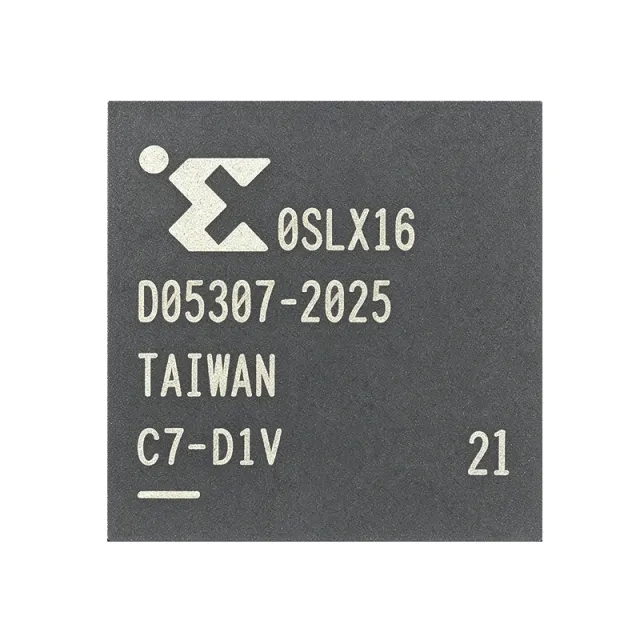
XC3S50-4VQG100I
XC3S50-4VQG100I - 50K Spartan-3 FPGA, 1.2V, 100-TQFP | AMD
The AMD XC3S50-4VQG100I is a Spartan-3 field-programmable gate array with 50,000 system gates, 1,728 logic cells, 192 logic blocks, and 63 I/O pins, operating from a 1.2 V core supply in a 100-pin TQFP package. The device is identified as a 4-speed-grade Spartan-3 FPGA, with a reported maximum operating frequency of 630 MHz. It is intended for compact, cost-sensitive programmable-logic designs requiring moderate logic density and a moderate pin count.
A field-programmable gate array, or FPGA, is a programmable digital semiconductor that combines configurable logic blocks, programmable interconnects, and I/O resources into a single integrated circuit. FPGAs sit within the broader semiconductor hierarchy: FPGA -> programmable logic device -> digital logic IC. Unlike a fixed-function application-specific integrated circuit, an FPGA can be reconfigured after manufacture, allowing designers to implement parallel logic, control, data acquisition, communication, and embedded system functions in one device.
The XC3S50-4VQG100I provides 1,728 logic cells and 63 user I/O pins according to the verified distributor and comparison data. The 1.2 V core supply and 90 nm process technology place the device in the Spartan-3 generation of AMD/Xilinx programmable logic. Its 100-pin surface-mount package provides a smaller footprint than higher-pin-count Spartan-3 devices while retaining enough I/O for control, interface, and low-to-moderate-speed parallel systems. The listed lead-free packaging designation is suitable for modern manufacturing processes, although individual procurement channels should be checked for current stock and traceability.
The -4 designation identifies the device performance grade within the Spartan-3 naming system, while the I suffix identifies the industrial-temperature configuration. Verified cross-reference information lists an industrial operating range of -40 °C to +100 °C for this part. The 630 MHz figure is a device-family or comparison value and should not be treated as a guarantee that every design or I/O interface will operate at that frequency. Actual timing performance depends on the selected Spartan-3 device, clocking, I/O standards, logic utilization, routing, and timing constraints.
Typical uses include industrial control logic, sensor and signal conditioning, communication interfaces, test equipment, embedded control, consumer electronics, and general-purpose prototyping. Because the FPGA is programmable, designers can implement parallel datapaths, state machines, protocol controllers, or custom interfaces without designing a fixed ASIC. The 63 I/O count is particularly useful for designs requiring multiple digital control or status signals while keeping the package reasonably compact.
The main design consideration is package and pin planning. This page synthesizes verified distributor specifications, source links, and practical selection guidance; it does not invent pin functions or timing details. Before layout, engineers should obtain the official Spartan-3 family documentation and confirm the exact VQG100 pin map, bank voltages, configuration requirements, decoupling recommendations, and supported I/O standards for the selected board design.
For replacements, the XC3S50-4VQG100C and related 100-pin Spartan-3 devices can be considered as same-footprint candidates where temperature grade, speed grade, device revision, and configuration details are acceptable. The XC3S50A-4VQG100I is a Spartan-3A-family option with related package information, but Spartan-3 and Spartan-3A devices should not be treated as automatically interchangeable without checking the complete pinout, configuration interface, electrical characteristics, and design-tool support.
RFQ
Liên hệ